First paediatric bone marrow transplant succeeds at Kasturba Hospital Manipal

Manipal :

The first ever paediatric bone marrow transplantation in coastal Karnataka has been done at Kasturba Medical College and Hospital, Manipal. The autologous bone marrow transplant (BMT) was performed on a four year old female child.

Parents of the girl child, a resident of Korangarapadi, Udupi, Initially she came with swelling in her skull and neck. Later she was diagnosed as stage 4 neuroblastoma in Kasturba Hospital, Manipal. Neuroblastoma is a most common solid cancer of childhood that frequently originates in one of the adrenal glands, but can also develop in nerve tissues in the neck, chest, abdomen, or pelvis. Soon after the diagnosis, the child received eight cycles of chemotherapy for which she responded well. This was consolidated with autologous bone marrow transplant which lasted for 36 days from January 7 to February 12.

This was done under the leadership of Medical Oncologist Dr Karthik S Udupa, Assistant Professor, Department of Medical Oncology, Shirdi Sai Cancer Hospital, Kasturba Hospital, Manipal.

Dr Udupa said that bone marrow transplant involves three major steps – Stem Cell Collection., High dose Chemotherapy and Stem Cell Transfusion. The child was admitted on January 5 and her normal stem cell were collected and stored. The patient was give high dose Chemotherapy on January 6 and the previously collected stem cell was transfused on the next day. Subsequently she had a period of Neutropenia i.e. low WBC count which was then complicated by high grade fever and persistent loose stools and electrolyte imbalance. The doctor said all complications were managed with appropriate medicine and strict aseptic measures for next 25 days. During the procedure the child was made to stay in an isolated sterile environment and strict barrier nursing was followed.

Presently the child has no fever and loose stools and electrolyte are within the normal range. He also said child is perfectly healthy and is fit to perform her normal daily activities like any other normal child.

Stem cell collection (Apheresis); which is required for BMT, was done under the leadership of Dr. Shamee Shastri , Head, Transfusion medicine and specialist Paediatric advice was obtained from Dr. Srikiran Hebbar, head, Paediatrics, Kasturba Hospital, Manipal.

Dr M Dayananda, Medical Superintendent and COO said that: Five successful transplants have been performed so far by Dr Udupa after introduction of BMT facility in 2015,. This was the first occasion where transplant was done in a paediatric patient, he added. This treatment is the first of its kind in Coastal Karnataka, earlier available only at Bengaluru.

source: http://www.timesofindia.indiatimes.com / The Times of India / News Home> City> Mangalore / by Stanley Pinto, TNN / February 11th, 2016

Call of the green thumb

Madhu Chandan: Founder, Organic Mandya

Madhu Chandan left his IT job in the U.S. to come back to India and farm. He decided to change age-old methods and introduce new ones.

Under the hot sun, a group of farmers huddle around a man. They are brimming with excitement as the man plants paddy saplings. He is one of them, yet different. While they are farmers who have almost lost hope of a decent livelihood, this man is a farmer by choice, one who is quite new to farming, yet is bringing back hope to the farmers of Mandya, Karnataka. A software developer from the U.S, Madhu Chandan S.C. plants the last sapling and stands up to cheers and applause from the bystanders.

Chandan, or “Madhu anna” as he is referred to by the farmers, came back from the U.S. after giving up his job as a software developer. He started Organic Mandya, in association with the Mandya Organic Farmers Cooperative Society, in November 2015.

The goal of the Society was to highlight the importance and need for organic farming. There were organic farmers in Mandya, but they found the returns were low. The Society aimed to uplift these farmers. It began with 270 members and now has 350.

The goal of the Society was to highlight the importance and need for organic farming. There were organic farmers in Mandya, but they found the returns were low. The Society aimed to uplift these farmers. It began with 270 members and now has 350.

Last week, Organic Mandya was in the news for having organised a Sweat Donation for agriculture. The idea was to sweat for a cause by working on the farm and learning about organic farming and the healthy benefits of eating organically grown food.

Reaping benefits

Chandan says he and his wife gave up the American Dream to come back and take up farming. In Mandya, he realised that farmers had been using pesticides and chemicals which led to the soil quality being compromised. Consequently, the Society was formed. “After starting the Society, we realised that we needed a good marketing channel. The Society did not have enough to take care of the marketing of the produce. This is how Organic Mandya was born,” says Chandan. Only marginal or small land-holding farmers — those with holdings that range from 0.5 to 2.5 acres — are part of the Society.

Organic Mandya bridges the gap between farmers and those who buy their products. Set up on the Mysuru-Bengaluru Highway, it has a supermarket, an organic food restaurant, and an oil extraction mill. However, the organic products are expensive. When asked about the higher prices, in an interview, Chandan said, “I never understand how people are willing to spend hundreds of rupees on medicines, but when it comes to shelling out a little extra money for organic products they think twice. In fact, I would recommend that everyone tries going completely organic for a year. And then see how much money you save on hospital bills and medicines.”

source: http://www.thehindu.com / The Hindu / Home> Features> Young World / by Madhuvanti S. Krishnan / February 11th, 2016

MobileOne app bags gold at summit

Bengaluru:

Karnataka on Wednesday took India’s ‘Digital India’ campaign one step ahead, bagging gold prize for its MobileOne service at the World Government Summit in Dubai.

MobileOne was adjudged the best m-government service in the world at the fourth edition of the summit attended by 125 countries. The other shortlisted nominees were ‘UK.Gov’ and ‘Kazakhstan.gov.’ MobileOne was selected through online voting and the jury comprised experts from the United Nations, World Economic Forum and World Bank.

“I still don’t know who nominated us. No government (state or country) can nominate its own services. We received a communication last week that our service has been nominated and shortlisted,” e-governance secretary Srivatsa Krishna told TOI.

The app, launched in December 2014, provides integrated services to the public. It got over 1.5 crore hits with two lakh downloads.

“There are over one lakh hits and downloads every day. It works via a unique nationally available, across all telecos, all circles number 161. The app, for the first time in India, facilitates citizens to pay all their utility bills, including income tax,” Krishna said.

MobileOne was presented to the United Nations leadership in New York during Prime Minister Narendra Modi’s visit there and was much appreciated. “We think the app got noticed at the presentation and got selected for this award,” sources said.

source: http://www.timesofindia.indiatimes.com / The Times of India / News Home> Chennai> Bangalore / TNN / February 11th, 2016

The Omen : Wadiyar’s Rajendra Vilas Palace

Mystery of a temple-tower and a Palace-dome!

WadiyarsBF11feb201y6

Nothing seems to go well for the much loved and regarded Wadiyar dynasty of erstwhile Kingdom of Mysore these days. Rather since independence of our country in 1947. The problem for the then last Maharaja Sri Jayachamarajendra Wadiyar [1940-1950] began when, under wrong advice by his much-hailed Dewan Sir Arcot Ramaswamy Mudaliyar [1946-1947], His Highness refused to sign the all-important Accession Treaty with the Union Government and lost its goodwill for ever. The dilly-dallying did not last long though.

Since then, the events in the Mysore Palace (Amba Vilas Palace), the Bengaluru Palace and the Palace in Ooty (Udhagamandalam) Fern Hill Palace and other minor Palaces in city and may be, elsewhere are under the shadow of ill-omen. Nothing seemed to go well for the Royalty — from domestic affairs to the ownership and management of its multi-crore rupees worth of properties spread all over the State and who knows abroad.

The Wadiyar dynasty, which never drew the battle-sword from its sheath or fired a shot from the gun or cannon eversince Hyder Ali usurped the throne in 1761 till this day, lived a leisurely, languid life under the suzerainty and protective wings of the British Raj. However, after the death of Krishnaraja Wadiyar IV, whom Mahatma Gandhi rightly called the Raja Rishi, the philosopher King of the kind described by the Greek philosophers, the dynasty seemed to lose its hallow of earlier glory.

The political events in the country moved so fast, the Wadiyars were unable to anticipate the consequences. The worse happened after the death of Sri Jayachamarajendra Wadiyar, the father of the scion of the royal family Sri Srikanta Datta Narasimharaja Wadiyar leaving behind the burden of many unsettled property issues among his children and the Government. His son Sri Srikanta Datta Narasimharaja Wadiyar himself died without issues on Dec. 10, 2013 and the Maharani Pramoda Devi Wadiyar had to resort to the Hindu tradition of adopting Yaduveer Gopal Raj Urs, a grand nephew of her husband and rechristen him as ‘Yaduveer Krishnadatta Chamaraja Wadiyar.’ But, the Maharani and her adopted son Yaduveer are now to carry on a different kind of battle — in the law courts. And to think that so many valuable properties are lying around like imaginary assets without generating any income or income commensurate with its value is indeed sad.

What could be the cause for this ashanthi, for these problems haunting the Royal family? Is it similar to the legendary curse of Alamelamma to the Wadiyars that is thought to be the cause for the dynasty not having a son to inherit the throne by a direct descendent of the ruling King? We do not know. But here is a probable cause for the present troubles of the dynasty after the death of Sri Krishnaraja Wadiyar IV as told to me by a reader of this paper.

The root cause is traced to the Palace atop Chamundi Hill, known as Rajendra Vilas Palace, now lying in a state of total neglect — euphemistically called under repair and renovation.

But before I come to that, a brief history of the Palace atop the hill itself. It all started when one englishman by name Sir Arthur Cole constructed his bungalow here in 1822. The kingdom was under the suzerainty of British East India Company following the fall of Tipu Sultan in 1799 and Sir Arthur Cole must have been in the service of the company. Lord William Bentinck, the Governor-General of India [1833-1835], had stayed here in 1834 for a few days, according to history.

Later when the British left, under the royal ownership, it was used as a Summer Palace, a hill station residence at an altitude of 1000 feet above mean sea level. It is said, Mahraja Krishnaraja Wadiyar IV was taught English and Philosophy here in this ‘Summer Palace.’

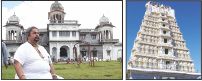
It was re-built as a Palace in the Indo-Saracenic architectural style found in Rajasthan by Krishnaraja Wadiyar IV and completed in 1938-39. The Palace was further developed with a high dome during the period of Sri Jayachamarajendra Wadiyar. However, the Maharaja was cautioned by the Chief Priest of the Palace and the Chamundeshwari temple not to raise the dome to a height which will be higher than that of the vimana gopura atop the tower of the Chamundeshwari temple closeby, hardly 1000 meters away. The warning was ignored.

The Palace was leased to a hotel for some years where ‘sinful’ activities were taking place. And later it was closed. Sri Srikanta Datta Narasimharaja Wadiyar ran it as a hotel for a while but failed and then the Palace fell into disuse and royal neglect. The Palace, located on 15 acres of land, was valued at Rs. 6 crore during the year 2000.

Srikanta Datta Narasimharaja Wadiyar wanted to remodel the Palace with special interiors and re-start the hotel after his vision: “The Rajendra Vilas Hotel will have the stamp of a five-star luxury and heritage Palace hotel. Ancient scenes of Khedda operation, Dasara processions and Jumboo Savari will be depicted on murals by artists,” Wadiyar used to say to journalists who talked to him on seeing the construction work being carried out. Sadly he did not live to see his dream-hotel operational. But, what about the prognosis of the Palace Priest?

Would the property problem of the Wadiyars find a final resolution if the dome of the Palace is reduced in size or removed to comply with the Chief Priest’s warning? Or would it help the Wadiyars if the Palace itself is given up as belonging to the presiding deity Chamundeshwari on the lines how properties of some temples are considered belong to the deity as owner?

God only knows. But I would be happy if Wadiyars are allowed to live in peace by the government and the law of the land under a democratic governance. After all, the Wadiyar Kings were good Kings, benevolent Kings, encouraged art, literature, sculpture and worked to make Mysore a great cultural capital of Karnataka.

e-mail: kbg@starofmysore.com

source: http://www.starofmysore.com / Star of Mysore / Home> Abracadabra….Abracadabra / by K.B. Ganapathy / February 11th, 2016

Maratha Regimental Day celebrated in city


Seen in the picture are (standing from left): Lt. Col. P.C. Guru (Retd.), 19 MARATHA LI; Lt. Col. K.N. Srikantaiah (Retd.), 17 MARATHA LI; Maj. K.P. Madappa (Retd.), 22 MARATHA LI; Col. T.M. Muthappa (Retd.), 20 MARATHA LI (10 Mech Inf); Col. P.B. Chengappa (Retd.), 6 MARATHA LI; Maj. Gen. C.K. Karumbaya, SM (Retd.), 5 MARATHA LI; Capt. P.M. Ganapathy (Retd.), 17 MARATHA LI; Col. C.P. Muthanna (Retd.), 18 MARATHA LI; Lt. Col. M.M. Aiyanna (Retd.), 17 MARATHA LI; Brig. P.T. Monappa, VSM (Retd.), 17/15 MARATHA LI; Lt. Col. Thamappa (Retd.), 20 MARATHA LI (10 Mech Inf); Col. N.A. Chinnappa (Retd.), 20 MARATHA LI (10 Mech Inf) and Chaitra, wife of Maj. N. Naveen, 22 MARATHA LI. Sitting from left: Arathi Muthanna, Varija Chinnappa, Mrs. P.B. Chengappa, Lalitha Ganapathy, Sudha Srikantaiah, Lilly Ganesh, Dechu Karumbaya and Taj Madappa.

Mysuru :

With an aim to foster the regimental spirit, the first ever Maratha Regimental Day was celebrated at a function held at The Roost in city on Feb.4 to commemorate the capture of Singhgarh Fort by Tanaji Malusare, the Maratha military leader in the army of Shivaji, the founder of the Maratha Empire, way back in 1670. The famous battle witnessed the tenants of ‘Duty, Honour, Courage.’

The event was attended by the veterans along with the families stationed in Mysuru and Kodagu. A similar kind of event was held at 40 places spread across India as a mark of respect to the Maratha warrior and to celebrate the spirit of ‘Duty, Honour, Courage,’ the motto of the Regiment.

Maratha Regiment has been in service of the nation for the last 247 years, actively involved in both the World Wars and all the wars fought by the Indian Army post-independence.

The Regiment was honoured with three battIe honours and two theatre honours for their exemplary performance during the testing times of 1965 conflict in Punjab and Rajasthan and in 1971 in both Western and Eastern sectors where the Marathas made their presence felt.

The first ever Maratha Regimental Day was very well organised by the veterans who showcased the Espirit-de-corps of the Marathas and will go long way in fostering the regimental spirit bringing everyone on a common platform to celebrate their everlasting association with the great Regiment.

Lt. Col. K.N. Srikantaiah welcomed. On the occasion, Maj. Gen. C.K. Karumbaya, SM, spoke about the brief history of the Maratha Empire and also about the prestigious Maratha Regiment. He fondly remembered the Maratha Reunion of 2015.

The Profile of Maj. Gen. PJS Pannu, AVSM, VSM, was stated formally to the gathering by Chaitra Naveen.

Maj.K.P.Madappa conveyed the Congratulatory Message of the Colonel of the Regiment to all the veterans and their families attending the event.

source: http://www.starofmysore.com / Star of Mysore / Home> General News / February 09th, 2016

2 billion meals for schoolkids, this IITian shows the way

Bengaluru :

Its 12 noon at the government school in DJ Halli, northeast Bengaluru. Hundreds of little faces are fixed on the van that has carried their lunch. For 15 years, every afternoon, the Bengaluru headquartered Akshaya Patra Foundation (APF) has been bringing smiles on faces of 1.4 million children.

And in a few weeks, it will serve its two billionth meal.

APF,founded by IITian Madhu Pandit Dasa, who was conferred the Padma Shri last month, is the world's largest school lunch programme
APF,founded by IITian Madhu Pandit Dasa, who was conferred the Padma Shri last month, is the world’s largest school lunch programme

APF, founded by IITian Madhu Pandit Dasa who was conferred the Padma Shri last month, is the world’s largest school lunch programme.

“I still remember the day when I took the first meal to a government school. The children loved it. I did not believe that we would go with the food the next day. But for 15 years now, we have been able to sustain,” Dasa said. From ensuring that no child in India shall be deprived of education because of hunger, the scheme has won many accolades for its transparency, hygiene and tech savvy delivery of cooked meals.

Says APF CEO Shridhar Venkat: “Growth has not been a challenge but sustainably growing is a challenge. Every time we start a kitchen, children come with a hope that they will get a good meal every day. Ensuring food safety especially at the school level which is the last mile and on a daily basis is a challenge. The road ahead is to implement innovative ideas in operations, fundraising and sourcing. We also would like to freely share our learnings with any organigation or an individual who wants to work on alleviating hunger amongst children.”

APF trustee T V Mohandas Pai told TOI: “I think the reason for our success has been how different competencies which are mutually inclusive and collectively exclusive have come together to fight hunger among children.”

PM Narendra Modi has congratulated the foundation for the milestone. “I am happy to learn that the foundation will complete 15 years of serving midday meal to schoolchildren and will serve its second billionth meal soon. These milestones and efforts inspire many to serve children,” he said.

source: http://www.timesofindia.indiatimes.com / The Times of India / News Home> India / by Seetha Lakshmi, TNN / February 10th, 2016

Prof. Vasu Malali award presented

Genuine writers facing the fate of Prof. M.M. Kalburgi: Activist

B. Anasuyamma, Vice-President of KRRS, who was conferred Prof. Vasu Malali award in city yesterday, is seen with activist K. Neela, senior writer Dr. C.P. Krishna Kumar, writer Dr. Malali Vasanthakumar and others.


Mysuru :

Speaking at Prof. Vasu Malali award presentation ceremony organised, jointly by Vasu Malali Kutumba Bhoomithayi Thota and Karnataka Vichara Vedike, at the Institution of Engineers-India (IEI) on JLB Road here yesterday, Neela said that creative writing is facing a threat in this era of globalisation.

Stating that the freedom of writers is under threat in the State, she lamented the untoward incidents that took place during Tipu Jayanti celebrations in November.

Regretting that attempts are being made to distort history, she bemoaned that original history is gradually disappearing from the society after losing its value.

Stressing on the need for looking at history in an unbiased manner, she called for more activities to propagate genuine history in the State, which is known for its harmonious existence of multi-culturism.

B. Anasuyamma, Vice-President of Karnataka Rajya Raitha Sangha (KRRS) was conferred Prof. Vasu Malali award.

Senior writer Dr. C.P. Krishna Kumar released two works titled ‘Prof. Vasu Malali,’ a collection of articles on Prof. Vasu Malali and ‘Molake Vodeyada Beeja,’ a collection poems by Prof. Vasu Malali, on the occasion.

Veteran litterateur Dr. Dejagow presided over the programme.

Writer Dr. Malali Vasanthakumar, Kannada Professor Belur Raghunandan, Karnataka Vichara Vedike President Hiremarali Dharmaraj and others were present.

source: http://www.starofmysore.com / Star of Mysore / Home> General News / February 08th, 2016

‘We wanted to create a warm film that was full of life’

Thithi will be in cinemas this summer, says Raam Reddy

“We tried to create a balance between realism and the creation of a particular cinematic world,” said director Raam Reddy about his experience of working on Thithi , which won the best film award in the Asian Films category at the recently concluded Bengaluru International Film Festival.

He was speaking to The Hindu ’s readers in a live web chat on Saturday. “Our initial intention was to create a warm, humorous film that was full of life,” he said.

To a question, Mr. Reddy replied that the decision to work with villagers who were not professional actors was taken to make the film more authentic. “Once you are able to get them to relax in front of the camera and to understand their roles, they can create magically honest performances,” he said.

On his inspiration for Thithi , he said, “My starting point for Thithi was with the location: I decided that I wanted to make a film in a particular place. I then explored the place with my writer Ere Gowda, and the story happened organically out of that exploration.”

Thithi has secured distribution rights in India and will be in cinemas this summer.

He advised aspiring filmmakers to make original short films and explore the medium of cinema thoroughly. He urged them to watch famous international films and deconstruct them carefully. “From personal experience, I learnt a lot more from watching well-regarded films from all over the world than from film school,” Mr. Reddy said.

On genre definitions in films, he said, “I am quite keen on attempting to break genre definitions in films. What I think is more important is the initial intention. My team and I decided to stay true to our creative impulses and did the best we could. Thithi came out of this simplicity.”

source: http://www.thehindu.com / The Hindu / Home> News>Cities> Bengaluru / by Staff Reporter / Bengaluru – February 07th, 2016

Down the memory lane : Late A. Ramanna of Vijaya Patrike , A Unique Personality ; My mentorship in his daily

RamannaBF07feb2016

by K. Vijaya Kumar, Former Jt. Director of Information & Publicity

He was indeed a unique personality in Mysore, known to people of all strata — be they vegetable vendors in Devaraja Market, traders in Santhepet, politicians, Chief Ministers, VIPs in all fields all over, Ramanna was fondly identified by them as their close friend. Nobody knows exactly why or how he migrated to Mysore from Mangalore at a very young age. He had little lame in one leg from child birth, but it never deterred him in his very active life.

I am told he started life here mingling with freedom fighters of thirties and showed his speaking talent in freedom movement by his early speeches in Subbarayanakere park. Thus he came in close contact with Gandhians H.C. Dasappa, Yashodharamma and other leaders of that time. Though he had no formal education, he ventured to start a small Kannada Daily ‘Vijaya’ on India’s Independence Aug.15, 1947.

He had contacts with our family as my grandfather was a freedom fighter. That is how I came under his influence in 1958-60 starting my career in his Daily as a graduate studying journalism for my degree. But it is a different story how he turned me to be more a Public Relations (PR) man than to be a journalist.

K.S. Bhagawan, known for his rational thinking and writing, who met me during his walk at Manasagangotri, accompanied by a security guard provided by Police, recalled his working in ‘Vijaya’ from 1963 to 1965 remembering A. Ramanna.

By then, Ramanna’s stature had grown so much he was sought by people for help, recommendation though he was not holding any office. But he was a member of Trade Union, member of Housing Board, Coffee Board etc. I had seen how even Ministers would visit him in his small ‘Vijaya’ office behind Dhanvantri Main Road. And they wanted the company of Ramanna during their visits to Mangalore. Chief Minister Kengal Hanumanthaiah was so close to him that he wanted Ramanna’s company during all his visits to Mysore.

It was Ramanna who made me to join the Information Department and I remember how he made my bachelor life comfortable in Mangalore when I was posted there in 1964 by visiting Mangalore and getting me accommodation in Bunts Hostel.

Though Ramanna was a bachelor, he had adopted a family from Mangalore and also established a house for them. He looked after their children growing — a son K.J. Kumar who became a film journalist and later edited ‘Vijaya’; daughter Pramila became a nominated member of Mysore City Corporation. I still remember how Ramanna celebrated her marriage at Nanjaraja Bahaddur Choultry inviting several thousands of people.

Ramanna had continuous contacts with Mangalore and Bunts community. So much so, he had even started a Bunts Hostel in Mysore in the name of A.B. Shetty, a stalwart figure of South Canara. He had also secured a site for the hostel building.

Pejawar Swamiji and Kengal at his 60th birthday: S. Krishna, a former Corporator (son of late A. Shivanna, Banana merchant, who was very close to Ramanna) informs me that his father had arranged Ramanna’s 60th birthday at Madhu Nivas in Gandhi Square, in co-operation with Ramadas Bhat of that Hotel which was attended by Sri Vishwesha Theertha Swamiji of Pejawar Mutt and Kengal Hanumanthaiah.

Close contact with Adichunchanagiri Mutt: Eighty-eight-year-old S. Bhyrappa, a very senior advocate, recalls his close association with Ramanna describing him as a fearless person, sincere, straightforward, loyal, helpful and never had enmity with others. He particularly remembered Ramanna’s interest in the growth of Adichunchanagiri Mutt since its beginning and his service to the Mutt till his death.

His contribution with T.S. Subbanna for Sarvajanika Hostel: R. Vasudeva Murthy (RV), 89, President of Mahajana Education Society, going back to his memory as a student of Central College, Bangalore, describes how he came in contact with Ramanna who knew some office-bearers of All India Student Congress and himself (RV) was the Treasurer of that Congress. From then on, his contacts with him continued when he came down to Mysore after his education. It was at that time, Ramanna introduced his close associate T.S. Subbanna to Vasudeva Murthy. Subbanna, a bachelor and a Gandhian to the core, was selfless, humble and dedicated his life for welfare of poor students.

Since then, the young Vasudeva Murthy supported them in their noble cause of providing food and shelter to poor students through Sarvajanika Hostel in Vidyaranyapuram which Subbanna had started in 1937 in a small structure.

G.H. Nayak, a known literary critique, who was a resident of the Hostel in later years, described, “it is difficult to believe that a person like Subbanna lived in their midst.” He also recalls that U.R. Anantha Murthy was also a boarder of the Hostel among many others who had come up in their life.

With the tireless efforts of Subbanna and Ramanna with Vasudeva Murthy and a host of others, the present building Sarvajanika Vidyarthi Nilaya was inaugurated on 18.4.1954 by no lesser person than Maharaja Jayachamaraja Wadiyar. The Foundation for the hostel building was laid by the then Mysore Government first Ministry Cabinet Minister H.C.Dasappa on 16.2.1951.

The photo above from Vasudeva Murthy’s album speaks of the dignitaries present on the occasion: To the left of Maharaja — H.M. Chennabasappa; young Vasudeva Murthy and A. Ramanna.

Behind Maharaja: Kengal Hanumanthaiah.

To the right of Maharaja: One Sakamma, who donated Rs. 25,000 for the hostel building.

Behind her: B.V. Banumaiah of Banumaiah Educational Institutions.

[G.H. Nayak recalls that T.S. Subbanna never wanted publicity nor his photo. Hence, there is no photo of his anywhere even with the Maharaja Jayachamaraja Wadiyar above.]

e-mail: kumarkv59@gmail.com

source: http://www.starofmysore.com / Star of Mysore / Home> Feature Articles / Sunday – February 07th, 2016

City’s Wrestlers on the cover page of ‘ Beyond The Body ’

Wrestlers Shankar Chakravarthy (left) and Vinod are seen with the copy of the book ‘Beyond the Body’ presented to them.

Mysuru:

Mysuru’s famous wrestler Shankar Charavarthy (Dasara Kesari, Darasara Kanteerava and Dasara Kumar a award winners and currently employed with CARP, Mysuru) and Vinod (a former University of Mysore wrestler and an M.PEd student at the Department of Physical Education and Sports Sciences, have appeared in the front cover of world famous photographer Tomasz Gudzowaty’s photo book ‘Beyond the Body’ which released in Europe last month. Both the wrestlers are the products of well known wrestling coach L. Manjappa.

Tomasz Gudzowaty shot the wrestling sequences at the Goapalaswamy Awara Garadi in Nala Beedi in city during 2006 and also in 2008. The project was co-ordinated by C.K. Muralidharan, city’s freelance sports journalists. A total sequence of 12 photos were shot in Mysuru for a story on “Nada Kusti” which won the third prize in the World Press Photo contest in Amsterdam held in 2006.

The book ‘Beyond the Body’ has been edited by Nan Goldin a famous American photojournalist and the book has black and white photographs of Tomasz Gudwowaty’s works in India (five projects- Nada Kusti-Mysuru, Kalaripayattu & Women’s Boxing- Kerala, Yoga (with Mysuru Yoga artists shot in Varnasi), Urban Golf in India (shot with caddies in Mumbai) and abroad in China, Mexico, Mongolia, USA & Japan).

source: http://www.starofmysore.com / Star of Mysore / Home> Sports News / Saturday – February 06th, 2016