Pradeep Kumar Saxena, General Manager, SWR, is seen flagging off the First Bio-diesel Powered Train at Hubballi on Dec.3 as S.S. Soin, Chief Electrical Engineer, SWR, Shyamadhar Ram, Chief Motive Power Engineer, SWR and others look on.
Mysuru :
The first Bio-Diesel Fuelling Loco, attached to Bio-Diesel Powered Train No.12080 Hubballi-Bengaluru City Jan Shatabdi Express, was flagged off on Dec.3 at Hubballi Railway Station by Pradeep Kumar Saxena, General Manager, South Western Railway (SWR).
Speaking on the occasion, Saxena said that bio-diesel blending powered loco consumes lesser diesel rate of 5% in the regular High Speed Diesel (HSD). The locos are filled bio-diesel blending oil at Railway Consumer Depot adjacent to Platform No.5 of Hubballi Railway Station situated adjacent to Hubballi Workshop.
He said about 50 Diesel Locomotives are fuelled daily with 100 Kilo litres of HSD at Hubballi Railway Station. These locomotives will hereafter be fuelled with the Biodiesel blended fuel.
He further stated that Biodiesel is an alternative to conventional diesel fuel made from renewable sources such as non-edible vegetable oil. Fuel extracted from plants are being mixed at the rate of 5% with normal High Seep Diesel. Hence, these organic fuel extracts biodiesel, have better lubricity when mixed with normal HSD, this B5 Diesel (5% biodiesel and 95% normal diesel) is reported to provide better engine life, Saxena said.
While briefing the advantages of biodiesel, he said that biodiesel produce less toxic pollutants than other petroleum products; it reduces foreign oil dependence; biofuels are produced locally and thousands of people are employed in biofuel production plants. Since biodiesel is produced from crops, an increase in demand for biodiesel leads to increase in demand for suitable biofuel crops. Besides, biodiesel is a renewable energy source unlike other petroleum products that will vanish in the years to come, he added.
P.A. Lamhare, Chief Mechanical Engineer, SWR, S.S. Soin, Chief Electrical Engineer, P. Ganeswara Rao, Chief Operations Manager, SWR, K. Harikrishnan, Chief Personnel Officer, Vishal Agarwal, Chief Commercial Manager, Shyamadhar Ram, Chief Motive Power Engineer, Swayambhu Arya, Deputy Chief Mechanical Engineer (Diesel), SWR and other Senior Railway Officials, staff of SWR and officials from Indian Oil Corporation (IOC) were present.
source: http://www.starofmysore.com / Star of Mysore / Home> General News / Saturday – December 05th, 2015
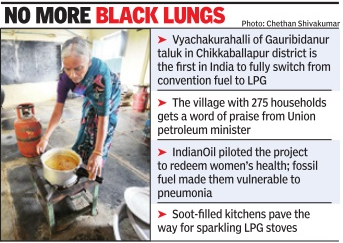
Lakshmidevamma in her clean kitchen in Vyachakurahalli village, Chikkaballapur district, Karnataka, on Thursday.
Gauribidanur (Chikkaballapur District) :
Until last month, Thimmakka had to blow her lungs out even to make a cup of coffee. And this has been her ritual for 40 years now . Not any more. Her kitchen is now fitted with an LPG stove. Like 274 other households in Vyachakurahalli of Gauribidanur taluk in Chikkaballapur district.
Cooking with firewood is passe in Vyachakurahalli since all households here have LPG. The Union petroleum ministry has officially declared it as India’s first smokeless village, owing to its conversion from conventional fuel to LPG. “My compliments to the residents of Vyachakurahalli which has been declared as the first smokeless village in India,” tweeted petroleum minister Dharmendra Pradhan.
Indian Oil Corporation (IOC) piloted the ‘Mission Smokeless village’ project here, about 77km from Bengaluru. “The idea was to redeem women’s health,” said Moti Sayi Vasudevan, general manager (smokeless villages) at IOC. “Due to the continuous inhalation of particles, women are more prone to pneumonia due to usage of firewood as a fuel.”
For over four decades, firewood had been the only fuel for the most of the village’s women. Wracked by bouts of cough caused by the soot-filled air in the blackened kitchens, cooking was an ordeal for them.
But that was until last week. Now, the kitchens have got swanky steel gas stoves and red cylinders. While a separate plank has been built to accommodate the new gas stove in Lakshmidevamma’s kitchen, Saraswathamma is looking forward to cooking these days. “I would frequently have bouts of cough due to the continuous use of firewood,” she said. “This is the best thing that has happened to women in the village.”
In drought-hit Gauribidanur, this recognition for clean fuel comes as a huge relief. As Ratnamma put it: “No more black roofs and black lungs.”
Learning safe handling of LPG
Gita Jayender sits with a group of women in a small thatched roof kitchen, telling them how to operate an LPG stove, how it is important to switch off the regulator at the end of the day, how not to leave utensils on the stove and go away, among other things. Shrenik Enterprises on Railway Station Road is buzzing with activity as entire families walk in to purchase new LPG stoves. “We had to first conduct an awareness campaign for villagers to tell them why it is important to go smokeless. Drought is staring at them. Why LPG, they asked,” said Shrenik R J, who is spearheading the smokeless movement in the village. The next project will be taken up at Gandhian Dr H Narasimhaiah’s birthplace, Hosur, in Chikkaballapur district, he said.
source: http://www.timesofindia.indiatimes.com / The Times of India / News Home> City> Bengaluru / by Seetha Lakshmi, TNN / December 04th, 2015
Stop by at Artisans Centre, Kala Ghoda, for a glorious glimpse of the past through an exhibition of saris. For over four decades, Chimy Nanjappa and Pavithra Muddaya from Bangalore have endeavoured to revive ancient crafts, preserve family heirlooms and revitalise tradition
It is one thing to spot a tag on a sari that explains the technique of its weave, it’s quite another to drape a family heirloom, a grandma’s memory or a forgotten generation’s story over your shoulder. Ironically, it was during overseas visits, over four decades ago, that 83-year-old Bangalore-resident Chimy Nanjappa first recognised the immeasurable value in every fold of an antique sari that was otherwise destined to be discarded.
Recalling the birth of the enterprise that she became a part of in the ’70s, Chimy’s daughter Pavithra Muddaya shares, “My mother used to work for the Cauvery Arts and Crafts Emporium. When she represented the Handloom and Handicrafts Export Corporation at fairs overseas, around 1965, it occurred to her that if foreigners could appreciate the beads of culture that are woven into these garments, shouldn’t one get Indians to recognise their immense value too?”
Chimmy’s grand daughter, Vipra now helps Pavithra Muddaya at Vimor. Pics/Satish Badiger
That’s when Nanjappa began experimenting with techniques that breathed new life into antique garments. “She’d find creative ways to restore and revive old saris and, eventually, she started selling them — just a small stock of painstakingly restored garments — literally out of a box at our home,” recalls Pavithra.
Incidentally, their traditional sari store, Vimor, gets its name from the Indonesian word for Pavithra (pure). “We started restoring temple saris — saris that people would donate to temples — which would be auctioned off eventually. We’d touch up these antiques by patching up a torn border or concealing damaged embroidery and metal stains, all the time ensuring that we stayed true to the traditional style.”
However, sourcing such garments became something of a challenge in due course, Pavithra tells us. She points out that the saris typically boasted of a very traditional aspect, a feature that was representative of a specific period, for instance, peacock and rudraksh-bead motifs. “Some saris even had the donor’s name embroidered on the pallus,” Pavithra says, as she explains why they decided to replicate and revive the old weaves. “We felt there was a need to encourage weavers to retain the old techniques and and they required a steady income.
We also felt it was important to instill a sense of cultural pride to show the weavers that what they’re creating is more than just a piece of apparel and that they’re contributing to safeguarding a valuable piece of our heritage.”
The collection to be exhibited in Mumbai includes only hand-woven saris with very intricate, traditional South Indian weaves. “We’ll be showcasing revival pieces that resemble garments one may find at museums today,” Pavithra smiles. “There will be reproductions of temple saris and Cubbonpet, Ganduberunda, Lakshadeepa, Surte, Adike and Ghine saris, in cotton and silk, with prices starting from Rs 1000 onwards. Heavier saris will be priced Rs 12,000 onwards.”
“Years of documenting and studying these garments have earned Pavithra a reputation as a textile expert,” says Radhi Parekh of Artisans Centre, whose family’s association with Vimor spans back two generations. “Since I was a child, we always made a stop at Vimor whenever we were in Bangalore,” Radhi recalls.
“The workshop is a small space inside their home,” Radhi shares, telling us how charmed she was by the framed images of motifs that adorned the walls of the modest space. “Each image bore a description explaining the root and significance of the motif,” Radhi describes, excited to be able to present the products of such passion to this city.
“People trust us with their great-grandmothers’ saris, so we really have to ensure that each garment, each weave, receives due respect,” she adds. “When we sell saris like those we usually include the ancestor’s story,” Pavithra points out.
The Revival collection displayed in Mumbai won’t include these naturally, but what you will get with each purchase is an analysis of the weave, a small account of the region the style hails from and a sense of satisfaction for having played your part in the preservation of our tremendous heritage. Vimor’s Heirloom Saris, From My Grandmother’s Cupboard, will be on display from December 1 to 3.
At: Artisans Centre, 52/56, Dr VB Gandhi Marg, behind Rhythm House, Kala Ghoda. Call: 22672290 / 22673040
source: http://www.mid-day.com / Mid-Day / Home> News> Life and Style News / by Anjana Vaswani / December 01st, 2015
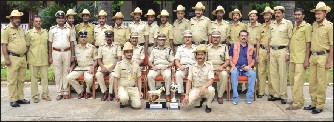
City Police Commissioner B. Dayananda (sitting fourth from left) is seen with the team of Mounted Police personnel who participated at the 34th All India Police Equestrian Meet held at Gwalior recently. Also seen are DCP N.D. Birje, K.S. Rudrappa (kneeling left) and Mahesh (kneeling right).
Mysuru :
Mysuru City Mounted Police personnel have excelled in the recently held 34th All India Police Equestrian Meet held at Gwalior in Madhya Pradesh.
K.S. Rudrappa riding ‘Lady Heaven’ won two gold medals in Show Jumping Preliminary Normal and Show Jumping Preliminary Fault and Out events. While, Mahesh riding ‘Candance’ won the silver medal in Show Jumping Novice Normal event.
A total of 24 Mounted Police personnel and 12 horses had participated in the event that concluded on Nov. 25
source: http://www.starofmysore.com / Star of Mysore / Home> Sports News / Wednesday – December 02nd, 2015
One of the iconic restaurants in Bengaluru, Ebony was the first to introduce Parsi food to the city. The 22-year-old culinary point, known for its pan Asian flavours, constantly keeps reinventing itself. The latest additions to their comprehensive and rather exhaustive menu are Chandraseniya Kayastha Prabhu (CKP) food and authentic Mudaliar signature dishes, which are unlikely to be found in other restaurants in the city.
If all goes well, a wide range of Hindu Goan dishes—found rarely in Bengaluru, as Mangalore and Kerala-styled sea food are more popular here—will soon be introduced here. ‘Chandraseniya’ literally means ‘people from the valley of river Chenab or Chandra in Kashmir’. People of this community are known for their love of food and drink. After they settled in the Konkan region, they used locally available ingredients like rice, fish, kokum, tamarind etc., in their cuisine. However, their food is distinctly different from other cuisines of Maharashtra; it has a Kashmiri influence that can be seen in the use of poppy seeds, khus khus and saffron.
Owner and managing director of Ebony Rajesh Rajaram and his associate Krishna Shantakumar have been working to introduce some à la carte dishes and cuisines in addition to their popular value for money lunch buffet. Rajaram’s mother-in-law Lata Palekar, who has Konkani roots, helped introduce a Konkan platter of sea food delicacies, including fish fry and prawn bhajjiyas that was well-received by the people here.
Palekar’s simple and wholesome CKP chicken has been a sell-out. Besides coconut milk, it has lot of fresh coriander leaves and green chillies that give it a nice green colour. Whole cashew nuts, poppy seeds and shahi jeera give it a distinctive flavour—an amalgamation of Konkani and Kashmiri influences. She plans to do in depth research on CKP food and gradually introduce many dishes into the menu.
Palekar, a Goan by birth, holds a diploma in cooking from Nirmala Niketan in Mumbai. She is assisted by Shantakumar to guide the chefs at Ebony and teach them to perfect dishes like Goan fish curry, roast chicken, masala eggs, shakoti or Goan wild pig (can be substituted with mutton or chicken) curry with lime juice, as opposed to the version made by Goan Christians who use vinegar and jeera. Stuffed pomfret with green chutney, Goan prawn pulav (which is vastly different from the Mudaliar one), roast chicken, fried mutton chops and stuffed prawns are some of the other interesting dishes that will be introduced.
A pineapple sabji is traditionally cooked with mangoes and jackfruit, but since all fruits may not be readily available, Palekar uses only pineapple to create a side dish using coconut, chana dal and uncooked cashew nuts. “Cashew nut is used very liberally in many Goan dishes as English vegetables were introduced later and cashew was grown in abundance,” says Palekar.
Meanwhile, Shantakumar has introduced authentic Mudaliar dishes—Arcot mutton chops and prawn pulav being the two most popular ones. The chops have just five ingredients—Kashmiri chilli powder, ginger garlic paste, sour curd and garam masala. “This was the staple dish of our family during long train journeys. The prawn pulav is an old family recipe of the Mudaliars, which I managed to pick from my mother, who in turn learnt it from a family cook,” says he. The pulav is prepared over dum by carefully layering half-cooked basmati rice with prawn masala.
Variety is the spice of life. Ebony, with its variety, adds the right spice to food that gastronomes in Bengaluru are looking for
source: http://www.newindianexpress.com / The New Indian Express / Home> LifeStyle> Food / by Sangeeta Cavale Radhakrishna / November 28th, 2015
Y.G. Vijayeendra, winner of the Open category title, seen with the trophy
Mysuru :
Top-seed Y.G. Vijayeendra, the former State champion from Mysuru, fourth seeded Kedar Umesh Vaze from Bengaluru, A. Augustin from Madikeri and L. Vivekananda from Mysuru tied with 7.5 points from 9 rounds, but based on a better tie-break score of 51.5 points, Vijayeendra clinched the Open Category title on the concluding day of the Smt. Sarojamma Memorial Karnataka State Open Rapid Chess Tournament-2015, conducted by the MDCA at the Chamundi Vihar Indoor Stadium here yesterday.
The winner received a cash prize of Rs. 7,000 along with the trophy. Kedar Umesh Vaze secured the second place and took home a cash prize of Rs. 5,500 along with a trophy. A. Augustin of Madikeri won the third place and secured a cash prize of Rs.4,000 and a trophy. Cash prizes were given to the winners from the fourth to the 25th place in the Open category. Trophies and certificates were given to the winners in the U-16, U-13, U-11, U-9,U-7, Unrated, Ladies, Veterans & Youngest Players section.
During the occasion, the MDCA honoured P.N. Somashekar, Vice-President, Sports Authority of Karnataka, M.P. Ajith (National Amateur champion), K.G.R. Anagha (National U-7 girls champion) and S.N. Jatin (National Ranked player).
The prizes to the winners were given away by P.N. Somashaker, Vice-President, Karnataka Sports Council, Yashasvi Shankar, Managing Director, M/s. Saanvi Technologies, Sarika Prasad, President, Inner-wheel Club of Mysuru Central, Sudharshan, Vice-President, MDCA, C.K. Muralidharan, Prof. S.K. Ananda Theertha, President, MDCA and K.S. Shivarame Gowda, Hon. Secretary, MDCA.
With farmers’ suicides in Karnataka touching 800, the highest ever in the state, the government is quickly pushing through an initiative to promote cash-rich horticulture farming by linking up the poor and marginal farmer directly to private companies that deal with agri-produce.
Using a programme devised by the Congress-led United Progressive Alliance ( UPA) in its second term for integrated agriculture development through private-public-partnerships (PPP-IAD), the state’s horticulture department is dovetailing state, central and corporate initiatives to turn the farmer into a horti-business entrepreneur.
Karnataka, with lakhs of small and marginal farmers, has the third largest area under horticulture crop in the country. It is the seventh in production. The state is the highest exporter of cashew, roses, gherkins, rose onion, spices and condiments, earning a whopping Rs 8,453 crore annually.
Tomatoes grown in Kolar travel all the way to Kolkata for sale, while lemons from Bijapur are sold in Bihar. Income generation from the sector is Rs 36,000 crore. Still, Chawla sees a vast, untapped market for horticulture crop and value-added products from the state. “Why can’t the extraspicy Byadgi chilli become as famous as Mexican chilli?” he asked.
The area that the state wants to fix is the 20 to 25% post-harvest losses in the sector. The idea is to find value additions to the horticulture produce that will use up the highly perishable items without causing any loss to the farmers.
They want to do this by facilitating private intervention, rather than set minimum support prices for all products. Chawla pointed out that the government-sponsored HOPCOMS (Horticultural Producers Cooperative Marketing and Processing Society Ltd), which purchases vegetables and fruits from the farmers and sells them to consumers through stalls, covers hardly 3% of the 12,000 tonnes consumed in Bengaluru city.
Government Intervention
The horticulture department has studied several models including the PPP-IAD implemented by Maharashtra, which began functioning in 2012. Karnataka is also looking to scale up through government intervention two private, successful models in horticulture.
The sale of vegetables from groups of farmers through linked-up groups of vendors under the Samriddhi brand by IIM-A alumnus Koushalendra Kumar in Patna is one model the state wants to replicate. The other is that of the Siddhivinayak group in Maharashtra, where everything from seeds to modern, efficient technology to turning of the grown potato crop into chips and their sale is handled by the company, through agreements with farmers.
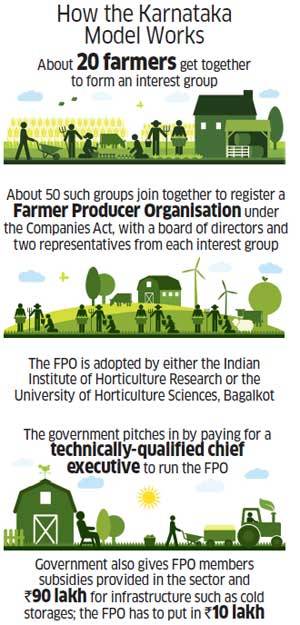
Here’s how the Karnataka model, inspired by those from the other states, works: about 20 farmers first get together and form an interest group. About 50 such groups join together and register a farmer producer organisation (FPO) under the Companies Act, complete with a board of directors with two representatives from each interest group.
The FPO is adopted by either the Indian Institute of Horticulture Research or the University of Horticulture Sciences, Bagalkote, which provides technical support. The government pitches in by paying for a technically qualified chief executive to run the FPO as management support for a period of three years. Besides this, the government gives the FPO members all the subsidies provided in the sector and Rs 90 lakh towards permanent infrastructure such as cold storages, on the condition that the FPO puts in Rs 10 lakh.
The state is expecting a range of companies, including the Big Four consulting firms like PricewaterhouseCoopers and Ernst & Young, to come forward to bid for tenders to provide manpower to support this project on the marketing, BPO and IT side. The government is likely to give each FPO seed money of Rs 25 lakh, while the centrallyfunded Small Farmers Agriculture-Business Consortium (SFAC) will give an equity linked grant of Rs 10 lakh that the state will facilitate. Besides this, NABARD is committed to give each FPO Rs 5 lakh.
Horticulture officials and farmers discussing how to store and market vegetables through the FPO
The FPO draws up a detailed project report with help from the horticulture department and focuses on a specific area. For example, Yogananda of the alreadyregistered FPO in Chikkamagaluru district, told ET Magazine that their FPO will focus on vegetables including tomato, potato, cabbage, beans and green chillies. And they are planning a cold storage to store them and sell them to FPOs in districts that don’t grow vegetables, or to other private outlets. “Farmers are not getting good prices, so these FPOs that we have formed among ourselves are a very good idea to ensure that we don’t suffer.
The FPO will get fertilisers and pesticides at cost and sell them to all of us shareholders, who have paid Rs 1,100 to join it, at cost. We will also get all benefits and no taxes. There will be no intermediaries and we will sell directly to the consumers or the company that links up with us,” Yogananda explained. The state is aiming to register 92 FPOs this financial year and get them off the ground.
The horticulture department insists that the FPO model will work better than the cooperatives that have been racked with politics and power play. Yogananda pointed out that he was a BJP supporter, but Congress and JD(S) farmers were also present in his FPO. Rudresh, a director of another registered FPO in Davanagere district, said: “Politics may come in at some point, but currently, we are all just farmers who are working together for the welfare of all. We can plan who will put what crop and work out benefits for everyone.
As an initiative, this FPO idea is very good and can work at the ground level.” The government is further incentivising FPOs by giving them trader licences in the agriculture produce market committee (APMC) markets that sell agriculture products in each district. The FPO can itself sell to consumers directly at these markets without going through any agents, as they are a group of farmers and not individuals. The FPOs also get priority storage space in all APMCs.
IT Support
All FPOs will be linked up through a database that can be accessed by any company which wants to work with them. The horticulture department will identify five local resource persons who will geo-map the land owned or leased or used by each FPO member. There will be constant updates in all the project area and at any point in time, the state of the land, the fertilisers that have been used, the state of the crop and how it is progressing towards harvest, can be accessed at fingertips.
“A package of practices, which is a set of prescribed practices like the seeds, pest and disease details, pesticides and fertilisers and so on, recommended by University of Horticulture Sciences, Bagalkote will be given to the farmers. These will be monitored at every step through an app, developed for the purpose,” Kshama Patil, deputy director of horticulture (project monitoring unit), told ET Magazine.
Chawla has written to several companies that linked up with the contract farmers in Maharashtra and other states, besides all food processing majors and super-markets including Hindustan Unilever and Metro Cash and Carry, inviting them to attend a workshop on the project and begin the linkage process. “The companies can directly link up with the FPOs and control the whole process of growing their raw material, like providing the seeds, the fertilisers, the know-how and finally purchase the product.
However, unlike contract farming, if the farmers want to sell the produce to someone else who will give them a better rate, they are free to do so. They are not bound to the company. So the company will have to pay them market rates,” Chawla explained. Prabhakar Rao, trustee of the Sri Sri Institute of Agricultural Sciences and Technology Trust, said he has expressed interest in attending the workshop. “I believe the PPP-IHD model has great potential as demonstrated by the Sri Sri Farmers Market we have going in Madhya Pradesh. It is fully run by The Art of Living as a direct linkage between farmers and consumers.
With government support, we believe that there is tremendous potential to take it further,” he told ET Magazine in an emailed response. Hemant Gaur, managing director of Siddhivinayak Agri Processing, pointed to the success of his model in Maharashtra, where everything from seeds to the final marketing of potatoes was done by his company, benefitting everyone along the line. “I don’t believe that the middleman or the dealer has managed to make a lot of money between the consumer and the producer as, if that was the case, the middleman should now be very rich. That has not happened. But what we are looking at is control of the quality of the product that we deliver to the consumer and, for that, this system is very effective,” he said.
source: http://www.economictimes.indiatimes.com / www.etsmallbiz.com / ET Home> Small Biz> Entrepreneurship / by Sowmya Aji, ET Bureau / November 29th, 2015
She had been engaged to pilot Rajiv Hoskote who perished in a Pawan Hans chopper crash in Arunachal Pradesh 3 months ago and cremated in city on Aug.14
Mysuru :
Nischitha Ramakrishna,who was engaged to marry city based pilot Rajiv Hoskote, who perished in a Pawan Hans Chopper crash in Arunachal Pradesh on Aug.4, 2015, passed away at a private hospital in city following brief illness.
It may be recalled that Rajiv Hoskote, a resident of Ramanuja Road was engaged to marry the Delhi-based techie Nischitha, daughter of Ramakrishna, a resident of Srirangapatna in Mandya district and the reception of their wedding had been slated for Oct.4 in Mysuru.
Pilot Manjunath, a friend of Rajiv told Star of Mysore that Nischitha, who could not bear the loss of Rajiv had slipped into depression for which she had been treated at several hospital but in vain.
Manjunath also said that Nischitha’s last rites were performed at Srirangapatna yesterday.
source: http://www.starofmysore.com / Star of Mysore / Home> General News / November 29th, 2015
The centuries old Kayani at Hinka village which is being renovated by the Yuva Brigade and the villagers.
Mysuru :
Villagers of Hinkal on Hunsur road in the city have pledged to save the centuries old Kalyani (water pond), a portion of which was about to become the property of someone else due to the negligence of MUDA authorities.
The historical Nanneshwara Temple of the village originally had an area of 42 acres, out of which only about 3 acres is now remaining with the temple. The MUDA after acquiring a portion of this land, sanctioned it to an educational institution. The land sanctioned by MUDA included centuries old Kalyani (water pond) measuring 100ft x 100ft.
The Kalyani had shrunk to a large extent as time went by, with mud and shrubs covering more than half of the pond, posing a threat to the very existence of the Kalyani. The villagers drew the attention of the people representatives about the status of the pond. But the people’s representatives including the MLA, MP and other local leaders did not pay much attention to saving the Kalyani then.
The Yuva Brigade along with Hinkal villagers taking keen interest in saving the pond, visited almost every household in the village seeking co-operation.
A few days later, the villagers led by Yuva Brigade leader Lohit Urs, started a voluntary Shramadan to save the pond.
MP Pratap Simha who came to know of the villagers resolve to save the pond, visited the spot and summoned MUDA officials, who later took up works on cleaning the pond of weeds, mud and filth by deploying excavating machines.
But the MUDA which began renovation works with great enthusiasm a few days ago, stopped the works all of a sudden yesterday, which angered Hinkal residents.
Strongly condemning the MUDA’s action of abruptly stopping the renovation works, thousands of Hinkal residents staged a demonstration at the site yesterday.
MUDA member Rakesh Papanna, who hails from Hinkal, held talks with MUDA officials and asked them to resume renovation works immediately, it is learnt.
MUDA Commissioner Dr. N. Mahesh reacting to the protest, admitted that the CA site allotted to the education institution included a portion of the Kalyani and added that the confusion arose as the Kalyani’ appeared to be a small water pond.
Meanwhile, MUDA Chairman K.R. Mohan Kumar speaking to SOM said that “As soon as we came to know of the existence of the Kalyani, we cancelled the allotment of sites around the pond and took possession of the Kalyani. The MUDA sent a JCB to excavate the pond for development and added that measures are taken to develop the Kalyani.
source: http://www.starofmysore.com / Star of Mysore / Home> General News / November 29th, 2015
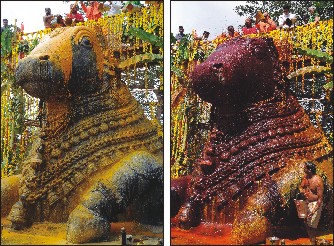
The more than 360-year-old monolith of Nandi, located mid-way on Mysuru-Chamundi Hill Road, was today, bathed in more than 30 items like milk, honey, curds, kumkum, ghee, dry fruits, tender coconut, sandal, turmeric, rice flour, etc., as devotees performed ‘Mahabhishekha’ to it.
It may be recalled that the event is being jointly organised annually by the members of ‘Bettada Balaga’ (a group of regular morning walkers to the hill) and ‘Srikshethra Chamundi Bettada Sri Nandiya Puja Mahotsava Samiti’ since 2006.
Legend has it that performing the ritual on third Sunday of Kartikamasa of the Hindu calendar enhances the life of the stone statue. It is also said that the practice of performing Mahasbhishekha to the monolith existed during the reigns of Wadiyars.
Prior to the Mahabhishekha, the statue was cleaned with water before a group of over a dozen priests conducted the abhishekha, which was witnessed by thousands of devotees and tourists.
The ritual, which began at around 10.30 am with Suttur Seer Sri Shivaratri Deshikendra Swamiji performing the ‘abhishekha’ in the presence of Pramoda Devi Wadiyar, Yaduveer Krishnadatta Chamaraja Wadiyar, Datta Vijayananda Swamiji, Junior Pontiff of Ganapathy Ashram, Chidananda Swamiji of Hosamutt, Jamanagiri Swamiji, Vyaghramukharudrapada Cave in Nandi premises and others, continued for more than four hours.
Interestingly, both Pramoda Devi and Yaduveer also performed abhishekhas.
It is said that this is the 10th Mahabhishekha being performed by the ‘Bettada Balaga’ which spends more than Rs. 2 lakh for the ‘Mahabhishekha’ annually.
Organisers had arranged lunch for more than 5,000 devotees and visitors while the employees of JSS Hospital have organised a Deepotsava at the Nandi premises on Nov.30 at 6.30 pm.
Samiti Convenor S. Shivakumar, Balaga President S. Prakashan, Working President N. Govinda, Secretary H.S. Jagannath, Treasurer V.N. Sundhar were among those present.
Scenes of foreign tourists and locals clicking pictures of the celebrations on their mobile phones and cameras were common at the venue which had been provided tight security with vehicular traffic being restricted.
source: http://www.starofmysore.com / Star of Mysore / Home> General News / November 29th, 2015