The U.S. Consulate in Chennai is funding the restoration of the Oriental Research Institute in Mysore.— Photo: M.A. Sriram / The Hindu
Conservation principles are being adhered to strictly
The restoration of the Oriental Research Institute (ORI), one of the heritage buildings in the city that adds to its antiquity and is a repository of ancient manuscripts, is under way with funding from the U.S. Consulate in Chennai.
M.R. Veerabhadraswamy, Director of ORI, who also heads the Department of Sanskrit, University of Mysore, told The Hindu that this was one of the biggest funding for restoration that the ORI has ever received and they are making the best use of it.
“The renovation is constantly supervised by the members of the U.S. Consulate, who come down once in a month to see the progress made. There has been a remarkable progress in the work, with one half of the building already fixed and painted to perfection, and work on restoration of the second half of the lime and mortar classical structure, has just about started”, he added.
It was in January 2012 that ORI — which has over 80,000 manuscripts in its collections — was recognised by the U.S. Consulate, Chennai, as one of the cultural heritage sites that needs restoration and preservation and granted $50,000 to the institution following which ORI signed an MoU with the Indian National Trust for Art & Cultural Heritage (INTACH), Bangalore, to undertake the renovation project, which started in September last year.
A significant feature of the restoration work is the adherence to the conservation principles that forbids use of cement and other modern materials that alters the structural profile of the heritage building.
Not the first
N.S. Rangaraju of the Department of Ancient History and Archaeology, University of Mysore, expressed happiness over the work in progress and said he had visited the site a couple of times and there was no violation of the conservation norms.
“The restoration of ORI is the third such exercise undertaken by the varisty– the others being Jayalakshmi Vilas Mansion which was restored with funding from Infosys, Prof. Radhakrishnan’s Bungalow which was funded from M.R. Doreswamy, MLC and founder of the PES Educational Institutions, and the ORI funded by US Consulate. The varsity has become a role model for others to emulate in conservation exercise”, said Prof. Rangaraju.
The intricate designs on the frontal section of the building are being delicately restored and embellished, and once the structure if fully restored, the manuscripts and palm leaves that constitute the country’s ancient cultural heritage, can be preserved better as it would be supported by a better environment, according to scholars at ORI.
A bit of history
Conceived by the then Maharaja Chamaraja Wadiyar, it was constructed in 1887 to commemorate the Golden Jubilee of Queen Victoria’s accession to the British throne, and was known as the Jubilee Hall. The Oriental Library was established here in 1891 and was handed over to the University of Mysore in 1916, and renamed as the ORI in 1943.
It shot into international fame when the only extant copy of Kautilya’s Arthashastra was found here by R. Shamashastry in 1902, and was published in 1909. And, it helped throw light on political and economic statecraft of ancient India.
source: http://www.thehindu.com / The Hindu / Home> National> Karnataka / by Nandita Bhakta / Mysore – May 01st, 2013
The heat is on! The excitement is peaking up with every single IPL match. And our very own Bengaluru models are doing an IPL trail and travelling across the country, for the after-party fashion shows.
We speak to a few on the fun times at these soirees.
Creating quite a flutter in the ongoing IPL Season 6 are city models Parto Gohari, Mitali Rannorey, Nina Mo, Jasleen Benipal, Vibhinta Verma, Viraja, Noyonita and others sashaying down the ramp in designer creations by designers like Riyaaz Gangji, Reshma Gangji, Rina Dhaka, Samant Chauhan, Nida Mahmood and others.
Model Parto Gohari, who is doing IPL shows for both Sheetal Sharma and Rahul Dev Shetty, has been on a roll ever since the season began. “The shows are so much fun, but it gets really late each time. We walk with the cricketers on the ramp and then dance with them after the shows. We also get a lot of compliments. Even though I’m not so much into cricket and cricketers, it’s fun to get to mingle with them. Gayle is a very sweet and funny guy. Only thing I wish for is more sleep. Most shows start only by midnight and the following day we start fittings and rehearsals by 2 in the afternoon. Some team owners and VIPs come really late and we have to wait for them for the shows to begin.”
But Bengaluru model Jasleen Benipal is all excited and happy with the buzz. She reveals, “I love my job and the IPL shows are so much fun. I’m used to staying up late nights. Yes, the long waiting hours for the shows to begin, when you’re all dressed with make-up and hair in place sometimes gets too much, but then I just grab a drink and have fun. One of the cricketers came up to me and said he finds Indian girls very pretty and said I was beautiful. Some of them even show attitude, but I love every bit of it.”
Another model who’s living life in the fast lane is Vibhinta Verma. She confesses, “Travelling out of town on shows is always great fun. The best one was when we were all in Goa and after a show all us models and others were chilling and we all got into the pool in our clothes and danced away to the latest Bollywood hits. Even though it’s tiring, as we need to take early morning flights coupled with late night shows, the high during the shows is something we all look forward to. The after-parties in Hyderabad are the most exciting. Most girls usually end up going from the parties straight to the airport to catch the early flights back to Bengaluru. Its funny to see all of us taking a power nap on the flights.”
Even the city choreographers are a busy lot with Sheetal Sharma doing the signature IPL shows and choreographer Rahul Dev Shetty doing the Videocon IPL shows in Pune and Mumbai. Touring with the models he admits to the shows being a fun riot all the way. “It’s been a blast. We are in a new city in a new bed and a new hotel every day and I keep forgetting which side the elevators are. Harbhajan Singh is the funniest of the lot and comes up with such wisecracks all the time.”
source: http://www.deccanchronicle.com / Deccan Chronicle / Home> Lifestyle> Fashion/Beauty / by Namita Gupta – DC / May 04th, 2013
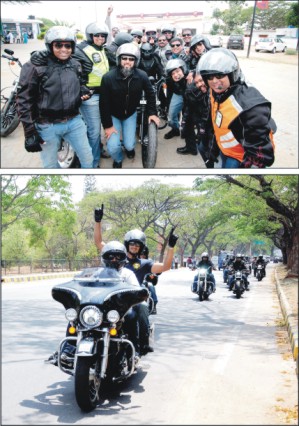
It was all Harley show on Mysore-Madikeri road in Mysore on Sunday. Members of Bangalore-based Riders’ Republic had organised a bike rally to Kadakani Resort near Ammathi in Kodagu. Around 50 bikers from Bangalore took part in the rally covering around 600 kms in two days.
Bikers, who left Bangalore at around 5 pm, arrived at Kadakani Resort at around 12.30 pm on Saturday. After an overnight’s stay at the resort, the team left for Bangalore at around 11 am on Sunday and reached Mysore at 1.45 pm. The team of bikers included IT&BT professionals, doctors, industrialists, students, air pilots, lawyers and others.
After arriving at Mysore, majority of them stopped by at Sri Kanteerva Narasimharaja Sports Club (Mysore Sports Club) for lunch before vrooming towards Bangalore.
Speaking to Star of Mysore, Shivakumar, member of Riders’ Republic, said that the tour was purely based on tourism and there was nothing like charity. He added that previously the team had done similar tours for charity purposes.
Another member Saxena said that the bikers had a 600 kms long hassle-free ride and added, “Speed is not important for us, but it is safety which is our priority. Moreover, there were doctors who had also accompanied us in the ride.”
Saxena also claimed that Riders’ Republic was the biggest such organisations in the country. The team organises rallies once in six months and believes that it is one of the many ways to bring down stress levels among participants.
The feature of this rally was that a city-based entrepreneur Daljith Ram also took part in the rally. Daljith owns a Harley Davidson Street Glide which has its own stereo system and other features making it unique among other Harleys.
When asked why they had chosen Harley Davidson bikes for the rally, the members said that Harleys were American styled bikes which are available from 750 CC to 900 CC.
This apart, the cost of these bikes ranges from Rs. 7 lakh to Rs. 45 lakh and these bikes cruises past any ditch on the Road making it a comfortable ride for the bikers.
Besides, the sound it makes attracts a lot of people’s attention when on road, they added.
source: http://www.starofmysore.com / Star of Mysore / Home> General News / April 29th, 2013
Biotechnology major Biocon plans to launch in July its novel biologic drug Itolizumab branded as ‘Alzumab’ to be used for the treatment of chronic plaque psoriasis in the country.
“We plan to launch Alzumab (Itolizumab) in July this year in the country. It is a novel, first-in-class biologic for the treatment of psoriasis,” Biocon Chairman and Managing Director Kiran Mazumdar- Shaw told agencies in an interview.
It will be manufactured at the company’s Biopharma manufacturing facility at Biocon Park in Bangalore, she added.
Psoriasis is an inflammatory auto-immune skin disease that follows a typical relapsing and remitting course with the disease affecting two to three per cent of the total population in the country.
“The market for such a drug is huge in India as the disease affects quite a number of people,” she added.
The global market for psoriasis treatments is estimated to cross USD 8 billion by 2016, Biocon said.
The company had received marketing authorisation for Itolizumab from the Drugs Controller General of India (DCGI) in January, 2013.
“We also plan to extend the clinical development of the drug for other auto-immune diseases like rheumatoid arthritis , multiple sclerosis and vitiligo in future,” Mazumdar-Shaw said.
The company has also completed a pre-IND (Investigational New Drug) meeting for Itolizumab with the US Food and Drug Administration as it plans for a global clinical development of the new medicine.
This is company’s second novel biologic developed in India. BioMab EGFR, an anti-cancer monoclonal antibody being the first.
source: http://www.articles.economictimes.indiatimes.com / The Economic Times / Home> News> News By Industry> Healthcare/Biotech / by PTI / April 28th, 2013
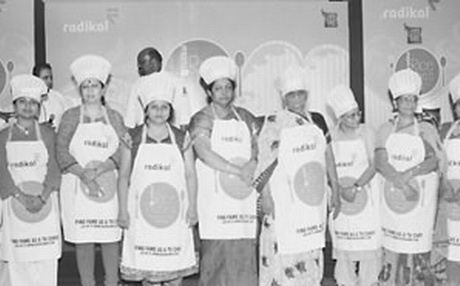
After a tough battle, resulting in many wonderful culinary creations, one winner was selected from each outlet for the state level cooking challenge | EPS
Rice to Riches, a state-level cookery challenge was organised last week for the home chefs of Bangalore. All participants demonstrated their rice cooking skills in the basket cooking round out of which 5 were qualified for the desert making round.
Dishes were selected based on various parameters, such as taste, innovation and presentation skills. The event was organised by Radikal Overseas Pvt. Ltd.
Jameela won the ‘Rice to Riches’ cookery challenge from Bangalore.
The winning meal consisted of a main course of vegetarian coriander rice and dessert of rice mousse.
On sharing her excitement on qualifying for the National Level of the cookery challenge which will be held in Delhi, Jameela said, “I am really excited about competing in Delhi. I never expected to reach this level. It feels like I am on top of the world.”
From across eight metros and mini metros an overwhelming response was received from approximately 2 lakh consumers.
After a tough battle, resulting in many wonderful culinary creations, one winner was selected from each outlet for the state level cooking challenge.
The winners will cook and present their culinary rice delight. Siddharth Chaudhary, Managing Director, Radikal Overseas, said, “We are glad to receive an overwhelming response from Bangalore. The enthusiastic participants created unique and delicious delicacies. Their passion and enthusiasm for the culinary arts is inspiring and we look forward to experience their talent in the national level. Despite stiff competition, the winners truly stood out. The grand finale will have one finalist from each city who will compete to become the celebrity chef.
source: http://www.newindianexpress.com / The New Indian Express / Home> Cities> Bangalore / by Express News Service – Bangalore / April 30th, 2013
People generally pray before a deity in most temples but in a 13th century temple that is situated on a hillock called Maradi Gudda (adjacent to Ranganathapura in Sira taluk of Tumkur district), there is a unique custom where people offer their prayers to an ancient huge Dhanush (bow) installed in the temple. Maradi Gudda is a green hill in the middle of the plains and has a beautiful temple that can be seen for miles around and you can drive all the way to the top. It is 135 km from Bangalore and in recent years, it has become popular because of the availability of rare medicinal plants and shrubs in and around the hills.
This temple dedicated to lord Vishnu in the form of Sri Ranganathaswamy, has its own share of myths and legends, and is called the Maradi Ranganathaswamy temple. The most important and perhaps the most sought out in the temple is the huge bow made of Panchaloha generally comprising alloys of gold , silver, copper, iron and lead.
Legend of the Dhanush: Legend has it that the huge bow and arrow was found at the base of the hill. Several villagers tried to lift it and failed. Their combined effort also did not yield any result. A small boy appeared mysteriously and effortlessly lifted the bow and the arrow. He walked all the way up to the temple on the top of the hill and deposited it near the sanctum sanctorum alongside the idols of Lord Ganesh and Lord Anjaneya.
The road to the hill is through rolling fields and greenery. You will get to the Kamadahalli Ranganathapura village first and then move towards the hillock Maradi Gudda, also called as Pancha Kalasha Gudda. It is easy to spot the hill as it is visible for miles around.
You will see the 40-feet Gopuram of the temple even before you approach it. At the base of the hill is a small lake called Purusharama Kere. You will find a small beautiful Kalyani nearby and the water is used for worshipping the deity.
According to Krishnappa, the priest, the temple is said to be built in the 13th century by Huildore village head Halegowda as per available historical records. “The paintings and the sculpture are recent additions,” he added.
Maradi Ranganathaswamy temple stands on a three-feet-high jagali (pedestal). Built in the Dravidian style, the temple has a spacious mukhamantapa with intricate carvings of gods and goddesses.
The deity of Ranganathaswamy in a reclining posture is made of black stone and holds the pride of place in the Garbha Gudi. Former Committee Member of the temple, Anantha Raju said, “There is also a saligrama stone kept in a silver bowl which is revered.” The big bow can be seen inside the Sukhanasi housing the idols of Ganesha and Anjaneya near the temple’s sanctum.
The outer walls of the temple have some fine sculpture and colourful mural paintings depicting stories from the Ramayana and Mahabharatha.
When I entered the temple, it was virtually empty and the atmosphere was delightfully serene. Anantha Raju explained, “We get visitors in huge numbers all throughout the day. Youngsters come for trekking and occasionally groups of trekkers camp here. Maradi Ranganathaswamy is the family deity for thousands of people and they come to pray here regularly from everywhere in the country and abroad.”
Dr Chandrappa, a visitor from Cambridge, United Kingdom said he comes here every year, 15 days after Ugadi, for the Kalyanotsava. “Thousands come to witness the marriage ceremony of Lord Ranganathaswamy and Goddess Lakshmi and take part in the annual fair,” he said.
The view from the top of the hill with the lush green landscape is simply amazing. The hill slopes were blanketed by brown and dried grass. Thippeswamy, a local, said, “In the rainy season, the river below fills up and the hills are covered by a layer of lush green grass. All kinds of birds, rabbits, and deer stroll around leisurely. Many youngsters camp here in the hills. Food and accommodation is provided by the temple authorities and our only request to tourists is to refrain from littering on the sacred hills”. By the evening, the sun set a golden glow on the hillock and made way for a spectacular visual. One thing became certain from this visit to this not so popular hill station; Maradi Gudda is the place for anyone looking for some peace and quiet.
source: http://www.newindianexpress.com / The New Indian Express / Home> Cities> Bangalore / by Dr. Mamatha B. R, / May 02nd, 2013
Rahul Gomes Pereira, a student of the Oberoi Centre of Learning and Development has been selected to represent India in the cooking skills category at the 42nd WorldSkills global competition which will be held in Leipzig, Germany in July 2013. Rahul is the sole Indian representative and he will be the torch-bearer for India’s cooking skills.
Rahul, a kitchen management associate will be accompanied by his trainer and mentor, Chef Parvinder Singh Bali. He will be competing to demonstrate the best of his culinary prowess against chefs from 52 other countries. The preliminary rounds of the competition were held across India. Rahul impressed the jury with his expertise and was selected to represent India at the cooking finals, held on March 30 and 31.
WorldSkills gives young talent between the ages of 17 to 22 the opportunity to demonstrate their excellence in skilled professions. Winners are awarded medals and certificates of achievement recognising their skills and abilities in their respective fields.
On Rahul’s achievement, Mohit Nirula, Dean, The Oberoi Centre of Learning and Development said, “We are proud that Rahul will be representing India in the cooking skills competition at the WorldSkillss competition. We wish him success and hope that he will demonstrate the best of his learning and skills.”
About the competition:
WorldSkills is a skills competition, jobs and careers event held in a member country every two years. It is a competition for youth from 17 to 22 years to demonstrate their excellence in skilled professions. The competition is promoted and managed by WorldSkills International, formerly known as the International Vocation Training Organization (IVTO). As of September 2008, WorldSkills International has 50 member countries. The 42nd Worldskills International competition will be held in Leipzig from July 2 to July 7.
source: http://www.newindianexpress.com / The New Indian Express / Home> Cities> Bangalore / by Express News Service – Bangalore / May 02nd, 2013
Tuluvas residing in Qatar witnessed the rich cultural heritage their native land come alive with Tulu Koota hosting ‘Tulu Parba-2013’ on Friday April 19 at Al Ghazal Club in Doha.
Guests of honour Tukaram Poojary, Bhaskar Rai Kukkuvalli, Ravi Shetty were honoured with ‘Panchavadyam’ which showcased the rich traditional culture of Tulu Nadu.
The event was compered by Prarthana Shetty who was introduced on stage by cultural secretary Padmashree Shetty. The green signal for the first part of Tulu Parbha-2013 was given with the traditional dance form of Yakshagana Sthreevesha followed by a welcome dance to escort the guests to light the lamp. A Tulu song to welcome the audience then followed. A beautiful diya dance by young talented team of children lit up the stage.
Later, the audience were entertained with one hour of flawless performance of different dance forms depicting different stages and shades of life, which culminated with ‘Janapada Dibbana’, a traditional Tulu procession which involved 30 different characters such as Shoola, Navilu, Bannada Kode, tribal folk, Yakshagana characters, Bhootha Kola, Bonte, Kambula, Kumbara, Moorthe, Korida Katta, Natti Ponjovu, fishermen, Anarkali and Pili Vesha which symbolised the unity in the diversified culture of Tulu Nadu.
During the stage programme, Tulu Koota president Seethram Shetty welcomed the gathering and emphasized that youth must be initiated to learn more about their culture. Tulu Parba-2013 brochure was released by chief guest Nilanshu Dey, chairman of ICBF Advisory Board along with chief editior Prakash Ajila and team. Mementos were presented to pouplar music director Charan Das and Sathish Venkataramana who came all the way from Dubai in support of Tulu Koota Qatar.
Ravi Shetty, past president and main sponosr of the event in his brief introduction of guest of honour Prof Tukaram Poojary (history head of the department, SVS College, Bantwal) highlighted the contribution of Poojary to Tulu culture, Tulu baduku and appreciated his single-handed effort of now famous Rani Abbakka Adyayana Kendra at Bantwal. Past president Divakar Poojary later introduced guest of honour Vidhya Rathna Prof Bhaskara Rai Kukkuvalli (scholar and multi-talented personality from Tulu Nadu) and highlighted his contribution to Kannada and Tulu literature, culture and art and also media service. President and dignitaries on the dias felicitated Prof Poojary, Prof Kukkuvalli and Ravi Shetty with traditional shawla and presented them with mementos.
Thukaram Poojary and Bhaskar Rai Kukkuvalli spoke about the heritage of Tulu culture and praised Tulu Koota Qatar for the hard work in preserving and promoting our rich Tulu culture in this part of the world and also for imparting these values to the younger generation. President and dignitaries also felicitated chief guest Nilanshu Dey and presented him with a memento. Dey in his address appreciated Tulu Koota Qatar’s consistent contribution to the community not only in culture front but also in meeting special needs.
The entire event was compered by energetic and enthusiastic Prarthana Shetty. Guest of honour Bhaskar Rai Kukkuvalli gave a timely and expert narration in original Tulu ridham. On the whole Tulu Parbha 2013.Cultural secretary Padmashree Shetty proposed vote of thanks
Prarthana handed over the dais to culutural secretary Padmashree Roshan Shetty, who has in turn invited Rajshekar Bappal to brief and introduce various artists of the drama. Bappal was the story writer and Director of “Tulu Drama Julie My Darling”, a 75 minute drama with two songs and a complete entertainment combining comedy, love, emotion and a strong message for the society based on the life in the Gulf, beliefs, and values imparted to children and to the society. Charan Das of the ‘Ashok Charan Nite Fame and Tulu films’ led the music of the play.The play was choreographed by Milan Arun who is also a singer and the creative director of the play. The lyrics of the songs were written and sung by Charan Kumar from the ‘Raagdev’ fame in Mangalore. Milaan Arun.The play was lit up and sounds were provided by Pramod. The play brings out the truth behind the myth and prejudices of caste, money and dowry. The main characters of the play were portrayed as: Kuwait Mary – Milan Arun, Dubai Ram -Ramchandra Shetty, Julie (Daughter of Mary) – Akila Rao, Vijay (son of Ram) – Vijay Rai, Broker Benji – Ajay Raj, Thomasa (brother Mary) – Mohan jeppinamogaru, Saudi Mammuni – Mamouni, Vincy (drama actor)-Vincy Lobo, Qatar Rego – Albert Rego, Rego – Della Rego, Hotel supplier – Alron Rego.
Tulu Koota committee members, volunteers worked hard in presenting this exclusive event which was witnessed by Tulu expatriate community members in large numbers. Choreographers and directors for the event were Veena Rao, Milan Arun, Archana Shetty, Rajshekar Bappal, Roopesh Kumar, Chaitali Shetty, Akshaya Shetty. Overall cordination of the cultural event was done by the cultural secretary Padmashree Shetty. Mementos were presented to all the participants. Tea, snacks and dinner were served to the audience.
source: http://www.daijiworld.com / Daiji World / Home> Top Stories / by Daijiworld Media Network – Doha / Doha, April 21st, 2013
Charitable donations of wealthy Indian firms is only 0.6-1% of GDP, compared with 2.2% for American companies
Pic: Business Standard
Many believe that Indian businessmen have cash registers for hearts. Their philanthropic contributions are believed to be insignificant in comparison to their wealth. According to the 2012 Forbes list, the wealth of the 100 wealthiest Indians is around $250 billion—13.89 per cent of India’s GDP. But, according to the estimates of a 2010 report of Bain Company, the charitable donations of Indians is only 0.6 per cent to 1 per cent of the GDP, when the charitable contribution of Americans is around 2.2 per cent of the GDP.
But, before one jumps to a conclusion, there is the other side of the story as well. On a program aired on the CNN recently, Ratan Tata, former chairman of Tata Sons, said that of 60-65 per cent of the Industrial proceedings of Tata Sons goes into programmes for education, medical, rural development or eradication of poverty. Only two per cent of the industrial proceedings go to the family.
Tata is the chairman of the Tata Trusts, which is among the largest private sector philanthropic trusts in India.
He is not alone. In February 2013, Azim Premji, the Chairman of Wipro became the first Indian to sign the giving pledge. Premji had also donated $ 2.3 billion to a trust to fund Azim Premji Foundation, an education-oriented non-profit. The giving pledge group was founded by Warren Buffett and Bill and Melinda Gates in 2010 to urge rich businessmen to donate a significant part of their wealth. With a net worth of $ 16 billion, Azim Premji is the 3rd richest Indian, and the 41st richest person in the world. Premji is also among the world’s top five givers. But, many think of them as an anomaly in a country where businessmen have billion dollar homes.
Gurcharan Das, author and former Procter and Gamble India CEO said philanthropy is a new idea in India when countries like the United States have a culture of philanthropy. “More and more people will donate to charitable causes in the future.” he said.
However, evidence suggests that philanthropy in India is often informal, and far more than suggested by data. Bibek Debroy, an economist, and a research professor at Centre for Policy Research said though Indians do a lot of philanthropy, much of it is to religious institutions, is informal and does not appear in the official records.
Veena Jha’s recently published work, “India Emerging: The Reality Checks” sheds light on the long philanthropic tradition in India. Charitable donations have increased radically in the post-reform period. Studies of ‘The Society for Participatory Research in Asia’ between 2000 and 2002 shows that 53 per cent of the charity in India operates in rural areas and nearly half of it is unregistered.
Some studies suggest that nearly half of Indian households give charity. In India, non-profit activity, especially private nonprofit activity, is much higher than the global average. According to Bain and India’s annual philanthropy report, the private donation to charity had gone up by 50% from 2006 to 2011.
“A part of the philanthropic donations in India is to institutions abroad, like the universities and think-tanks. This is partly for visibility. But, many of them have studied abroad, and feel indebted to their alma mater.” Bibek Debroy said.
In 2010, Anand Mahindra had donated $ 10 million to the Harvard University, and Ratan Tata’s $ 50 million donation to the Harvard Business School in 2010 was the largest international donation in its history. In December 2012, a Delhi-based entrepreneur Sharik Currimbhoy had pledged $12.12 million to Columbia University, and businessman Siddharth Yog had gifted $11 million to the Harvard Business School.
Some economists have proposed an estate tax and corporate social responsibility (CSR) practices to increase the philanthropic contribution in India. While the former was not to the liking of the Finance Ministry, at least in the budget for 2013-14, the latter is there in the Companies Bill, 2012 which is yet to be passed by the Rajya Sabha.
Ajay Shah, a professor at National Institute of Public Finance and Policy (NIPFP), said an estate tax will help inter-generational class mobility and to reduce the concentration of wealth.
“Incentives do matter. But, I do not see this as a black-and-white issue. It is perfectly possible for a man at the bottom to rise to the top, and I admire people who come from a humble background, but in our country, it is very difficult to do so,” he said.
However, he voiced views against CSR. ” But, CSR is a bad idea because it puts managers in control of the purported charitable objectives of shareholders.” Ajay Shah said.
But, doing charity is intrinsically difficult. Steve Jobs had once said that he is not deeply engaged in philanthropy because there is no measurement system—-It is very hard to measure whether you have succeeded or not.
According to the Bain and India philanthropy report, 80 per cent of the individuals and 90 per cent of the NGOs are satisfied with the efficacy of their philanthropic activities. Many economists think that this is because people often donate for the “feel-good” factor, and prefer to believe that their money goes into the right causes.
Many, like Bill Gates had proposed solutions to this problem which is magnified in India, where philanthropy is informal, and the feedback mechanism weaker. Some proposed solutions include measuring the funding for social causes, the teacher absentee rate, and the extent of corruption.
Gurcharan Das opined that this is not severe problem. “The Gates’ foundation is known for their accountability and their work to counter AIDS in many poor countries, including India. Though it is hard for individuals to do philanthropy, they can pick a good NGO to donate their money to. It only takes a Google search to find out the NGOs that are more accountable.” he said.
But, Nitin Pai, the founder of The Takshashila Institution said because it is difficult to measure the outcome in philanthropy, people often measure the outputs. “Across the world, they tend to focus on impressing the donors, which is not always a good thing. Feedback mechanisms, if not properly designed, can skew the outcome. It is important to realize that this is intrinsically difficult.” he said.
And, charity will never be sufficient. Economist Jagdish Bhagwati once said that an outright redistribution of wealth would only increase the food consumption of the poor by one chapatti a day. Some economists have estimated that sharing the total wealth in developing countries would leave its citizens with a few dollars a day. It is clear that charity will not solve the problem of world poverty.
“Poverty is too big a problem to be solved by charity alone, but that does not undermine the case for charity.”, Ajay Shah said.
source: http://www.business-standard.com / Business Standard / Home> Companies> Features / by Shanu Athiparambath / New Delhi – April 20th, 2013
Persons with haemophilia made their day under the sun as Manipal Haemophilia Society celebrated World Haemophilia Day at End Point here on Saturday.
SMH Kirmani, former Indian stumper and Malathi Holla, Paralympics silver medallist in discus/shot put and Arjuna award winner made their day as well as that of their families in the event sponsored by Novo Nordisk Haemophilia Foundation and supported by Manipal University.
The Society planned an afternoon of fun and frolic for persons with haemophilia. There was Team Mangalore with their colourful kites of various shapes and sizes adorning the skies and music to go with it. A mass tera-band musical exercise was performed by more than 300 students of various colleges of university for benefit of persons with haemophilia who need regular exercise to keep them fit to prevent episodes of bleeding.
Dr Annamma Kurien, president of Manipal Haemophilia Society, the person behind the show, welcomed the gathering and gave a brief of the work being done by the Society to encourage and give hope to persons with haemophilia. Kirmani acknowledged the importance of getting associated with such a noble cause. He was all praise for Malathi Holla who has conquered challenges from her wheelchair to bring laurels to the country.
Kirmani released a music CD titled ‘Sa Re Ga Ma Pa 1, 2, 3, 4’ which was distributed to all persons with haemophilia. Students of Melaka Manipal Medical College sang a song composed by Dr Kurien.
Malathi awarded scholarships to children with haemophilia in three categories. District surgeon Dr Anand Naik dwelt on efforts made by the government to provide factor VIII and IX to PwH which could remarkably help in fighting the disorder.
Dr H S Ballal, pro-chancellor, Manipal University, said the public-private partnership model can help fight this bleeding disorder.
The formal function was followed by a cricket match between Manipal XI led by Dr Ballal and Haemophilia XI led by Kirmani. Haemophilia XI included children and youngsters with haemophilia and Manipal XI included officials and others of Manipal University.
source: http://www.articles.timesofindia.indiatimes.com / The Times of India / Home> City> Mangalore / by TNN / April 21st, 2013