Striking the golden mean

ProfSastryBF21mar2016

Prof. T.V. Venkatachala Sastry is an authority on ancient Kannada and Sanskrit classical texts. Speaking about the waning interest in this area of study, he tells DEEPA GANESH that we must be open to multiple interpretations of the text

It would well be a high pedestal if the acclaimed grammarian, lexicographer, Sanskrit and Halegannada scholar T.V. Venkatachala Sastry (TVV) sat on his achievements. But, on that cloudy morning in Mysore, the 83-year-old scholar was waiting at his gate. “You had to come all the way here, excuse me, I could not make it more convenient for you,” he said, with genuine concern. With over hundred books to his authorship, TVV is an authority on prosody, pre-modern classical texts, aesthetics, languages, literary criticism and more. He served the University of Mysore for several decades, and was later the director of Kuvempu Kannada Adhyayana Samsthe — the outcome of his erudition and vision has been huge. He has been guru to several generations of Indian students, and also to foreign scholars like Prof. Laurie Honke (who famously said to TVV: ‘You are Panini to me’), Prof. Showman, Prof. Karl Johanssen, and Prof. Stefan Anacker. Also teacher to the renowned Indologist, Prof. Sheldon Pollock, who attributes the idea of his book, “The Language of the Gods in the World of Men” to “the greatest living scholar in the field of old Kannada, T.V. Venkatachala Sastry”.

SastryStudyBF21mar2016

We settle down in his modest study, packed with books from all sides. On his bed by the window, are books that people have sent him, manuscripts, reading material etc. Lean that he is, TVV tucks in comfortably. The phone rings. It is a student who needs help with historical data. Yet again the phone rings, and this time in Telugu he tells the caller: “Of what use are these controversies? Chaduvukopora… Go to your studies, and I will also continues with mine.” In his home library of over 15,000 books, TVV knows exactly the location of each book. With undiminished energy after a conversation that ran into several hours, he explains his collection. “You must come again, I will keep some books for you,” he says with a rare generosity. The doors of his house constantly kept open for students, scholars, researchers and friends, TVV is so eager to give and share that 21st century ideas like “creative commons” seem outdated. For him, it is a way of life. Issues like intellectual property rights are hardly a matter of concern. Hence, if you discuss the global publishing industry, its politics and economics, you find that it lies outside his worldview. All that matters to him is the pursuit of knowledge.

Excerpts from the interview.

One often hears that soon there will be no one studying the classical texts in India, and the western world will be custodians of Indian classical studies. How do you react to this?

It is hard to give a yes or no answer. I don’t think that is expected of me either. Steadily, as someone who has been associated with the University, one see the dearth of students for Indian classical studies. About five decades ago, almost every Indian University had a department of Indian classical studies. We are hardly left with any now. With the advent of modern technology, it has become difficult even for departments of philosophy, science and literature to survive. Sanskrit and Halegannada became unpopular with students rather early.

We have had a continued relationship with Western scholars. They came from Germany, France, Finland, America… and worked extensively in India. For instance, Sir Monier Williams who studied, documented and taught Asian languages, wrote “An Elementary Grammar of the Sanskrit Language” (1846), compiled a Sanskrit-English dictionary (1899), A.B. Kieth wrote “The Sanskrit Drama” (1923), Weber’s “The Religion of India” (1916), F. Edgerton’s “Studies in the Veda” (1915), E.V. Arnold’s “Vedic metre in its historical development” (1905), Max Mueler’s “Sacred Books of the East” (1879-1910) and several others are early works by Westerners in the field of classical studies. There was rich literature available here and scholars have always been interested in studying it. Even back then, a lot was said about how they came with religious interest. It may be true, but it is not entirely true. They were genuinely attracted to languages, history and culture and worked assiduously. Karnataka has 25,000 to 30,000 inscriptions. Epigraphica Indica, the first volume of which was edited by James Burgess (1888) is the most competent. The later versions are just photographs of these inscriptions with no analysis whatsoever.

Their rigour was similar to that of our good old Pandits, who lived and breathed the subjects of their interest. The old school western scholars were also similar; however, you still find that this is a tradition continuing in their part of the world. Look how the outlook of our universities has changed so completely! They want to give you what is easy and what brings in many. The bulk of our literary, cultural-historical practises, has gone on reducing. Even if there is one single student, it is the responsibility of the University to keep the department functioning. You should be able to convince people to take it. However, ironically, now Universities ask, “What is the use of such a study?” Once you start asking questions of “usefulness” linked to material benefits, pursuit of knowledge simply moves to the background.

Do you think the Nehruvian imagination of State is also responsible for this?

Well… perhaps. It was a language of development, of course different from how we speak of it today. Also, these factions of Right and Left, have done more harm than good to classical studies. We must remember that the path of the King is flanked by a right and a left, but neither is complete in itself. Everyone wants to read their ideologies into these texts. Society is not just what constitutes our imagination. In this tussle for upholding one view, we have lost pride in what belongs to us. An anti-Sanskrit campaign started when ideologies began to take over.

Having said this, I think classical studies will survive. It will be sad that it may soon disappear from our formal educational processes, but it will live on, like it has all these years. I from my end, have started conducting workshops all over Karnataka for various interest groups.

Do you think the study of Halegannada and Sanskrit would help contemporary thinking, including the study of literature?

The classical way of learning is of no use to the “productive” outlook, to get jobs in this world. Let me tell you a story. A friend of mine, a solid pandit, was trained in the traditional way. Because he had not gone through formal schooling, he ended up as a middle school teacher. He took it as a challenge and did SSLC to MA from the Banaras University and became a lecturer. Isn’t this sad? The government must nurture this kind of scholarship.

The best of students go to other streams, and what we are left with is a disinterested bunch. My friend, a professor of philosophy, told me that he lectured on the philosophy of death for two hours, and at the end of it, students went out of the classroom laughing and whistling!

In your own personal interactions with several western scholars, were there moments when you felt “this far and no further”? Did you feel the “insider” was essentially different from the “outsider”? The outsider had an omniscient view, but a tad reductionist?

Hangal Virupaksha Shastrigalu, in the course of a conversation, had apparently mentioned to DVG that Westerners had done a lot of work. And DVG had remarked in a loaded statement: “Houdappa, they have. But with their mind.” (TVV laughs)

That’s exactly what they are saying about Sheldon Pollock too…

Is this great tradition of knowledge any single man’s property? It is for all. You have a problem with Pollock’s views? Let’s have an academic debate. Truth doesn’t change with somebody’s reading of it. I don’t understand this anxiety of representation!

Sheldon Pollock maybe alien to Indian culture and society. But the fact that he has spent four or more decades of his life studying all this, his readings will certainly not be grossly off the mark. Think of this – he could have chosen to study American literature which is closer to his culture. Why did he make this choice? He has been studying Sanskrit since he was 18. The respect he has, his passion, the depth and engagement, it is special. If you have to read old Kannada texts, you have to Shabdamani Darpana, which is no easy nut to crack. Pollock reads it. He comes back with doubts, and then when you give him an answer, he will tell you: “But this is what D.L. Narashimhachar has said…” Always thorough in his research.

Now listen to this. Kuvempu used to tell us in class that for us goddess Lakshmi comes with a whole emotional world of meanings, and therefore she means to us more than what she signifies. But for a Westerner, at best, she will be goddess of wealth. We recognise that difference. By virtue of being insider what is possible for you may not be exactly possible for them. But their research is also first hand. I personally feel that it is a great service that they have brought global attention to our ancient texts.

Having said this, let’s not even take away the merit of a discussion or of differences. Once, G.S. Shivarudrappa and I had a difference in a seminar about interpreting a verse from the Bhagavadgita. Should that take away our respect for each other? B.M. Shrikantaiah had once remarked that Halegannada poetry is kagga, old-fashioned and of little significance. Does that mean he had no respect for it? There are several instances to prove that he valued it immensely. I don’t understand this raising cudgel for everything.

I’m sure there have been discussions and disagreements between scholars in the past. Also inter-cultural. Can you recall some of those exchanges?

There have been famous exchanges, ones that have been documented. V. Sitaramaiah and R.V. Jagirdar (Sriranga), K. Krishnamurthy and Raganantha Sharma, Masti and Kuvempu, There are several others, academic and honest. That was the spirit of those times. The kind of teachers we had, and the writers of those times…. remarkable people who nurtured youngsters.

At the Shivagange Sahitya Sammelana for which Ram. Shri. Mugali was president, Masti had come. I had written a couple of essays for his journal Jeevana, so I went and introduced myself. He drew me into an embrace and said: “Chinnadanta baravanige. Golden writing…” There was nothing great in my writing, but it was their way of encouraging. Such generosity. Masti was so great a man that he apologized to Tirumalamba saying his observations on her writing were faulty. There was an intellectual atmosphere. Today, politics is dangerously ruling our cultural world.

Sediyapu Krishna Bhatta was an outstanding chandassu (metre) expert and a vedic scholar. S.D. Velankar had read all the Prakrit and Sanskrit texts. He had read so much more than Sediyapu. When he presented his views, Sediyapu didn’t take offence. Isn’t that a growth in pursuit of knowledge?

Let me tell you of A. Venkatasubbiah. He was a wonderful scholar. He was a master of vedic studies and Panchatantra. He had a doctorate from a German University in 1910. He wrote a 650-page book on the Veda. During the period even Western scholars were majorly into research. Venkatasubbaiah who had read all their works went on record to say – “Their estimate of several things are wrong because of cultural gap. I will revise the work of these German and French scholars.” In reply, one of them wrote, “Venkatasubbaiah is a great scholar but is not aware of recent research.” Isn’t this an ongoing process in the pursuit of knowledge?

I remember once Pollock asked me a question related to the works of Rice and Kittel. He had disagreements with their findings. He could have easily said, “What does this Venkatachala Sastry know? Kittel is the greatest afterall!” But that is anti-academic culture.

We have lost the tradition of Pandits. It has been replaced by professors. What is your reading of this situation?

The Pandits were unshakeable scholars. They had complete hold over the texts. They could extempore quote hundreds of poems, they could tell you the source of the words, their meaning, grammar… etc. University trained professors are aware of the modern tools of criticism, but their scholarship is limited. Also, the passion and commitment of the pandits cannot match that of professors. It is indeed a loss. In fact, DVG and Ti.Nam. Shrikantaiah have discussed this issue.

What is the difference between Indian and Western students?

It is very different, yet what I say are not generalisations. I have had fine students in the past who have become reputed scholars. Now, our students are not interested in the foundation. They are always trying to see how they can fit their ideologies into it. I always tell them to enjoy reading poetry for the sheer experience of finer feelings. Once that is done, you can start analysing and exploring other things. They are not prepared to enter the gateway of classical literature. They have lost patience, interest, engagement and the tools.

The West is interested in research, and wants to find new dimensions. They don’t get satisfied easily and work with perseverance and patience. Also, there is an academic system that is interested in the work of these scholars. They ask them questions, and engage with their work. There is a world that is watching them with interest. Here, even if I put out a great work, I am not sure if another scholar working in the same area as I do, will even read it. That makes a huge difference to your outlook.

You must understand one more thing, you get huge honours easily now. Social justice is fore-grounded and talent takes a backseat. Neralige sanmana madovaaga, akruti beke (when they felicitate shadows do you really need the real persona?)? Nevertheless, passion and interest needs no justification.

U.V. Swaminath Iyer, the Tamil scholar, writing about Malur Ranaganathachar who taught Sanskrit at the Presidency College says, “his head was constantly buried in some book or the other”. M.S. Puttanna writes about Triyambak Shastri: “He was always reading or writing. In case he felt drowsy in the afternoon, he would sleep over his book, wake up and start reading.” Ralapalli, our teacher, was an outstanding scholar. He would say, “I am slightly doubtful of this. I have asked D.L. Narasimhachar to help me with this.” Chidananda Murthy, at his age, calls me frequently to discuss something or the other. Learning is not easy. It is upasane. I feel thrilled when I read of such things. It is hard to find such people now. They all believed in the power of the text. Tell me, will Bhagavadgite get burnt if you burn it…?

You are quintessentially a traditional scholar who is not anxious about other readings of our texts…

Let me clarify this. I am a traditional scholar who has immense faith in the kind of learning that was imparted to me. We have a tradition and I believe in its values and respect it. I am also aware of its weaknesses. In a sense, I am also a moderner and in many ways I subscribe to some aspects of modernity. For instance, the liberal outlook that came with it. I stand in this new world, and would like to envision the ever expanding meanings of the old world order. I will not impose my beliefs on it. I adhere to the text, and am interested in its interpretation. No political ideology or country stamp will take me away from my commitment to the text. I will stand by what I find correct. If Pollock or whoever makes a mistake I will tell them my views. Since I respect scholarship, I respect Pollock’s dedication and good work too.

I want to quote Kavirajamarga. In a verse, Nrupatunga raises this question: “What is kasavara (gold)?” If you can accept another’s thoughts, another’s religion with antahkarana (feeling), that is gold. Else, he says, kasa (dirt) and kasavara (gold) are the same.

Corrections & Clarifications:

This report has been edited for factual errors.

source: http://www.thehindu.com / The Hindu / Home> Features> Friday Review / by Deepa Ganesh / Bengaluru – March 17th, 2016
Now, information on all govt services just a call away


PatilBF20mar2016

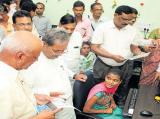
Minister for IT, BT and S&T S R Patil launched ‘Pratispandana Helpline 1800 208 1237’ to provide information and services to the public here on Wednesday’.

The department of IT, BT has set up the centre through its IT service wing KEONICS and it is the first-of-its-kind in Karnataka. It provides all information related to government schemes under one roof, (on toll free number). The centre will be functional from 10 am to 6 pm on all week days (government working days).

On the occasion, Minister Patil said that Chief Minister Siddaramaiah had announced the launch of a helpline in 2015-16 budget. If there is a good response to the people-friendly helpline, similar helplines would be launched in every district in the State. The helpline centre will also facilitate appointments with government officers of different departments in case of public demand. Public can also enquire about the APMC rates, he added.

Information about various hospitals, medical facilities, ration card, Aadhaar, RTI, permits and licences, students’ scholarships, soil cards, services related to education and RTE, will be a call away. The staffers for the service centre had been recruited from Vindhya E-Infomedia private limited, a Bengaluru-based BPO which recruits physically challenged candidates, who will run the helpline, the minister informed.

source: http://www.deccanherald.com / Deccan Herald / Home> State / Bagalkot – DHNS / March 17th, 2016

KIA logs 100 millionth passenger

Bengaluru :

The Bangalore International Airport Limited (BIAL) on Friday greeted its 100 millionth passenger at the Kempegowda International Airport. He was Vinay Kulkarni, 50, who arrived from Mumbai on a Jet Airways flight.

On an average, 52,000 passengers transit through KIA every day, officials said.

BIAL MD GV Sanjay Reddy said: “This is a special moment for us. The achievement comes within 8 years of operations and is a testimony of our ability to meet the rapid demand and growth of domestic and international air traffic.”

BIAL determined the 100 millionth passenger after it created an algorithm based on actual passenger numbers from the start of airport operations in May 2008 to March 2016.

KIA is India’s third busiest airport with the highest passenger traffic in southern India.

source: http://www.timesofindia.indiatimes.com / The Times of India / News Home> City> Bangalore / TNN / March 19th, 2016

Vedashastra Poshini Sabha to Honour Sanskrit Scholars

Mysuru :

Vedashastra Poshini Sabha, Khille Mohalla, Mysuru, has organised a function to felicitate Sanskrit scholars on Mar. 20 at 4.30 pm at Jaganmohan Palace in city.

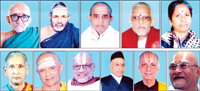
Well-known Scholar Dr. K.S. Narayanacharya of Bengaluru will do the honours. Vid. Prof. B.N. Nagaraj Bhat, President, Vedashastra Poshini Sabha, will preside. The Sabha will be felicitating the following 11 Vedic scholars tomorrow:

SanskritScholarsBF19mar2016

1. Vid. Dwijaraja Umashiva Upadhyaya: Aged 89, he is a native of the famous Gokarna in Kumta taluk of Uttara Kannada district. An expert in Rig Veda, he retired as chief teacher of Vidyadayini Vedashastra School in Gokarna.

2. Vid. Prabhakara Dixit: An expert in Rig Veda, he is a resident of Vidyaranyapura Agrahara in Sringeri Taluk of Chikkamagaluru district. He taught Veda to more than 150 students at Sadvidya Sanjeevini Pa-tashale in Sringeri. He is now 65-years-old.

3. Vid. P. Vishweswara Bhatta: The 74-year-old Krishna Yajur Veda scholar, who has taught more than 600 students, is a resident of Pallatadka village in Kasargod, Kerala.

4. Vid. Shivarama Bhatta Aleka: A Sama Veda expert from Hosakuli village in Uttara Kannada district, the 78-year-old scholar has served in Sri Raghavendra Bharathi Veda Samskrutha Mahavidyalaya for more than 40 years and taught over 200 students.

5. Vidu. Dr. K. L. Prasannakshi: A native of Kolar district, Vidu. Prasannakshi, 62, served as Professor in Maharani’s College and Government Women’s College in Mandya. A resident of Mysuru, she has mastered Alankara Shastra and has worked for popularising Sanskrit language. She has also authored ‘Nityamadhiyatam’ and ‘Yogavasistasara.’

6. Vid. S. Narayana Bhatta: A native of Golagodu village in Sagar taluk of Shivamogga district, the 74-year-old scholar has mastered the Vyakarana Shastra and has worked as a lecturer in Kasturba PU College of Rashtriya Shikshana Samsthe in Shivamogga.

7. Vid. Nagendra Anantha Bhatta: The 86-year-old scholar is the master of Aagama, Sasya, Vaastu, Jala and Murti Shatras along with astrology. A native of Hithnalli village in Uttara Kannada district, he has also involved himself in agriculture.

8. Vid. Dr. M. A. Lakshmithatacharya: Former Director of Sanskrit Research Institute in Melukote, he was born in the spiritual land of Melukote in Mandya district. A Vidwat degree holder in Navinanyaya and Alankara Shastra, the 79-year-old scholar worked as a Professor in Bangalore University and also authored books like Sabhaparva Sangraha, Ramanuja Life’s Philosophy among others.

9. Vid. Dr. Venimadhavashastry B. Joshi: The 67- year-old scholar is a resident of Sadanakeri in Dharwad district. An expert in Vedanta, Nyaya and Alankara Shastra, he served in Karnataka College at Dharwad and Karnataka University. He has to his credit around 150 research papers.

10. Vid. Dr. M.E. Rangachar: A native of Melukote in Mandya district, the 81-year-old scholar has expertise in Vishistadwaitha, Vedanta and Nyaya Shastra. Having served in D.V.S Mahavidyalaya in Shivamogga, he is the author of ‘Maharshi Vedavyasaru,’ ‘Ramanageeta,’ ‘Raghavayadaveeyam’ and other books. His books have been published in Kannada, English and Sanskrit languages.

11. Vid. Dr. K.S. Narayanacharya: This 83- year-old scholar is a resident of Kanakanahalli in Bengaluru. He served as an English lecturer and as professor in Karnataka Arts College, Dharwad. Having gained mastery over Sanskrit, he is known for his discourses on Ramayana, Mahabharata, Bhagavata and Bhagavad Gita.

source: http://www.starofmysore.com / Star of Mysore / Home> General News / March 19th, 2016

Book release on Sunday

Jeevasiri, the 50th book by Vasundhara Bhupati, a well-known writer and social activist, will be released at Dr. Joladarashi Doddanagouda Rangamandir here on Sunday at 5.30 p.m.

S.G. Siddaramaiah, former Chairman of Kannada Book Authority, will release the book, while Nadoja Belagal Veeranna, Chairman Karnataka Bylaata and Yakshagana Academy and president of Sri Ramanjaneya Togalu Bombe Mela Trust, Ballari, who has organised the programme, will preside over the function.

A lecture on mental health would be delivered by C.R. Chandrashekar, psychiatrist. Sumangala Mummigatti, writer, Siddaram Kalmath, president, district unit of Kannada Sahitya Parishat, Gangadhar Pattar, poet, B. Nagaraj, Assistant Director, Kannada and Culture, S. Nagesh, publisher, would be among the guests.

Folk songs would be rendered by Jeevansab Walikar and troupe and a documentary on Dr. Vasundhara Bhupati would be screened.

source: http://www.thehindu.com / The Hindu / Home> National> Karnataka / Ballari – March 18th, 2016

Mysuru to host National Congress of Spiritual Scientists on Mar. 26 & 27

BrahmarishiBF18mar2016

Mysuru :

Indian Federation of Spiritual Scientists, along with Vijay Foundation and Rotary Mysore, will be hosting the 23rd National Congress of Spiritual Scientists in city, under the leadership of Brahmarshi Patriji, Founder of Pyramid Spiritual Societies Movement.

The Spiritual Congress will be held on Mar. 26 and 27 at Rotary High School auditorium, next to Mandovi Motors, KRS Road, Mysuru.

Aravind Jatti, President, Basava Samithi, Bengaluru, will be the chief guest and also deliver the keynote address. As many as 13 renowned Spiritual Scientists from all over India will address the Congress.

The speakers include Maharshi Sri Surya Narayan Pande, one of the foremost experts on Yoga Sutras, Dr. T.M. Srinivasan, an Electron Physicist and a global pioneer in Energy Medicine, S.K. Rajan, the Vice-Chairman of Indian Federation of Spiritual Scientists, Girija Rajan, who has conducted 28 Spirituality episodes on National TV, Dr. Mohandas Hegde, Director of Centre for Research, Education, Sadhana & Training (CREST), Purneema, Past-Life Regression Therapist, Prem Kumar, Vice-President of Pyramid Dhyana Prachara Trust, Prof. Varahamurthy, renowned Anapanasati Meditationist, Dr. Jeevandhar Ketappanavar, an expert on Kabirdas and Basavanna and Dr. B.R. Pai, well-known engineer-industrialist and Wellness propagator from Mysuru.

Four books — ABC of Life (a compilation of Osho’s talks), Who Am I? (thoughts of Sri Ramana Maharshi), Energy Medicine (Ancient Wisdom and Wellness Trends) and Total Wellness Management (TWM) — are to be released as part of the Congress.

The book release function will be presided over by Srinivas Arka, Founder of Centre of Conscious Awareness and the Founder of Arka Meditation.

The highlight of the event will be a Flute Music Meditation by Brahmarshi Patriji.

All those with an inclination towards Spirituality and Science will benefit. Those interested may register their names before Mar. 20 for an early bird discount.

For registration, contact Vijay Foundation on Mob: 78295-55513 or 0821-2412284.

Profile of Spiritual Scientists

• Brahmarshi Patriji is a great realised Master of our times who is spreading the message of spiritual and vegetarian living to all of humanity. He realised the power of meditation through his profound experiences early in his life and attained enlightenment in 1979. His approach has been completely scientific and secular without invoking any religious symbolism. He founded the Pyramid Spiritual Societies Movement in the year 1990. He encourages the use of Pyramids for meditation as they have been considered as storehouses of energy. He has established pyramid centres throughout the country and abroad.

• Maharshi Sri Nagaraja Surya Narayana Pande studied the Vedas, Bhagavad Gita at various ashrams like Ramakrishna Mission – Mumbai, Nityananda Ashram – Mumbai, Sandipini Educational Institute for Vedas, Mahesh Yogi Institute etc. He has authored many books on Upanishads and Yoga Sutras. He is one of the very few speakers who can talk authoritatively on Yoga Sutras.

• Srinivas Arka from Mysuru is a widely travelled philosopher, author, inspirational speaker and developer of human positive potential programmes. He is known for his work and service to communities around the world. He is the author of best selling books ‘Petals of the Heart’ and ‘Adventures of Self Discovery.’ Srinivas Arka has founded centres in India, UK, Spain, Canada, New Zealand among other countries.

• Aravind Jatti, son of former President B.D. Jatti, is an engineer by profession and is proficient in the teachings of Basaveshwara, the great spiritual and revolutionary guru. He studied the Vachanas of Basavanna and took great interest in propagating his ideas and philosophy for the benefit of humanity. As the head of the Basava Samithi, he has contributed immensely towards enabling spiritual ideas to be imbibed by the members.

• Dr. B.R. Pai, a philanthropist and Wellness practitioner with many other professional degrees and a Doctor of Honours from Colombo, is the CMD of VWF Industries Limited, Mysuru. He has been conducting health & wellness, spiritual and social activities through his non-profit organisation Vijay Foundation. Dr. Pai has authored a book ‘Total Wellness Management.’ He has also developed many concepts like ‘Swasthya Yoga’ and ‘Corporate Wellness Programme.’

• Dr. T.M. Srinivasan, a Ph.D holder in Electron Physics from Goteborg, Sweden, returned to his native India to help set up a Biomedical Engineering Department at Chennai. During 1977-78, he was in charge of the Institute of Yoga, studying prevention and cure through yoga. He served as Chairman of the International Conference on Energy Medicine at Chennai during March 1987, the papers from which are reported in his book ‘Energy Medicine around the World.’

• S.K. Rajan is the Vice-Chairman of Indian Federation of Spiritual Scientists and a Global Ambassador of PSSM. He has established centres for teaching meditation and imparting spiritual knowledge in Karnataka, Tamil Nadu and Kerala. He has helped conduct over 9,000 sessions throughout India and abroad in the last eighteen years.

• Girija Rajan is the Chief Editor of the bi-monthly Tamil journal of the Pyramid Spiritual Societies Movement – Pyramid Dhyana Tamilazham. She was invited by National TV – Doordarshan to conduct 28 episodes on various Spiritual topics. She believes and follows Patriji’s concept “No Doctor – No Medicine” and has not taken any drugs in the past 16 years. She has been awarded ‘Dhyana Vidwan Mani’ for her contribution to spirituality by Brahmarshi Patriji.

• Dr. Mohandas Hegde is the Director of Centre for Research, Education Sadhana and Training – CREST (recognised by University of Mysore), Bengaluru. He worked as an Economics Science Professor for 16 years in Educational institutions affiliated to Cambridge University and Indian Educational Institution, Dubai. He did his Ph.D (HR & Spirituality) on “Spiritual Input in Effective Human Resource Development for Corporate Management.”

• Purneema, Past Life Regression Therapist, specialises in the therapy for children and is also a tarot card reader. She is the author of two books on spirituality. She conducts workshops in past-life regression at ‘Soul Trends,’ the spiritual store in HSR Layout in Bengaluru.

• Prem Kumar is the Vice-President of Pyramid Dhyana Prachara Trust (Karnataka). He is a voracious reader and regularly speaks at leading institutions. He is the author of highly acclaimed book ‘Zero to Hero’ and ‘Khali Cup’ in Kannada and ‘The Empty Cup.’

• Prof. Varahamurthy is presently serving as the President of Karnataka Pyramid Dhyana Prachara Trust, Bengaluru. He has been preaching Anapanasati meditation for the past nine years in different places at Karnataka.

• Dr. Jeevandhar Ketappanavar is a meditator who after his introduction to Patriji in 2000, started devoting his time for propagating spiritual wisdom in Hindi and Kannada. He has a doctorate in Hindi. He has immense knowledge of the spiritual contribution of many great masters like Kabirdas, Basavanna etc. He has translated many spiritual books from English to Kannada and Hindi.

source: http://www.starofmysore.com / Star of Mysore / Home> General News / March 18th, 2016

Bengaluru pals building India’s first driverless car

For Bengaluru techie Roshy John, it was a near-death experience brought about by a sleeply taxi driver that got him thinking.

Chennai:

A few years ago, Bengaluru-based techie Roshy John was one his way home from the airport in a taxi when the sleepy driver almost ran into another vehicle. John took the wheel and drove the driver and then himself home — but the near-death experience got him thinking. Five years later, he and his friends have developed India’s first driverless car — Tata Nano Autonomous.

John, who is practice head, robotics and cognitive systems at TCS, and his 29-member team worked on the software and algorithms in their free time and created a 3D model to test it. The car is yet to be tested on the road, and John is hoping to get permission from the traffic police soon.

In 2011, John purchased a Nano to test the software. “The Tata Nano is considered an engineering marvel. What better car to test Indian technology than on a car made in India?” says John. Across the world, Daimler, Nissan, General Motors, BMW, Google and Tesla are investing big bucks in developing driverless cars .

John used onboard diagnostics, a regular feature in most cars today, and a scanner to monitor the engine. “I had to get data from the car to make it accelerate or slow down based on the RPM,” explains John. Creating an algorithm using a custom cluster (multiple computers), John and his team were able to read all parameters of the engine.

Several other devices were used to extract vitals of the car and its surroundings — wheel encoders to measure the speed of the wheel, multiple lidars (a surveying technology that measures distance by illuminating a target with a laser light) to identify obstacles around the car, HDR cameras and GPS. The data was processed by the software to make the car ‘drive’ like a human.

He attached pedal robots to the accelerator, brake and clutch and connected them to the software. The ultimate test for the team was when the car halted by itself when John jumped in front of it. In May 2012, John’s autonomous car drove the roads of Bengaluru for the first time.

John’s journey wasn’t easy though. They were often interrogated by the police, who got suspicious about the cameras and many computers in the car. To import the scanners, John had to submit a three-page essay to the commissioner of customs before he was given his package. Amidst work responsibilities and project deadlines, John and his team have been at work on the autonomous Nano.

So what is the way ahead for John and his driverless car ? A demo event for people to experience the technology will be scheduled soon. Having invested more than Rs 1 crore on the research, he is testing the technology on other cars. While John has been approached by several auto companies, he has kept the offers at bay. “Right through my career, I have encouraged my team members to experiment with advanced technology. I built this car to satiate my hunger for innovation in robotics and inspire others,” he says.

(This story has not been edited by timesofindia.com and is auto–generated from a syndicated feed we subscribe to.)
source: http://www.timesofindia.indiatimes.com / The Times of India / News Home> Tech> Tech News / by Ranjani Ayyar / TNN / March 16th, 2016

Brothers’ Record-Breaking Biking Expeditons

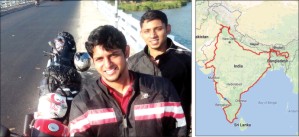
Suraj takes selfie with his brother Sagar enroute their biking expedition. Picture below shows the route map (red line) of their biking expedition.

SurajBF16mar2016

Mysuru :

There have been many instances where various biking groups across the country and State have taken up biking expeditions to North India especially to Leh-Ladakh. But there would be very few instances of two-brothers coming together to go on a biking expeditions alongside the borers of the country.

One such brother duo is Sagar S. Bharadwaj, 19-year-old engineering student at NIE, Mysuru and his elder brother Suraj S. Bharadwaj, a 21-year-old final year engineering student at BNMIT, Bengaluru, who completed the border biking expedition in just 29 days.

Though the expedition began for the sake of pleasure, the brothers also aimed to enter the Limca Book of Records for the fastest biking expedition along the borders of the country. Earlier record was created in 59 days. They have submitted their documents to the Limca Book of Records and in case of them creating a record they would be intimated only next year.

Both Sagar and Suraj started their journey from Bengaluru on Dec. 31, 2015 and completed their expedition on Jan. 28, 2016. However, the duo could not visit Leh-Ladakh as the roads were closed and Arunachal Pradesh since they were denied permission owing to tense environment.

Speaking to Star of Mysore, Sagar said that it was nice experience to ride the bike along the borders of the country and added that the journey got them introduced to different culture, tradition and also variety of cuisines.

“We also experienced different terrains across the country out of which few were very challenging. The visit to the Wagah Border to watch the Beating Retreat was mesmerising so also the ride in Manali where the temperature was running at minus 6 degrees,” he added.

Sagar went on the biking expedition on Honda CBR 250 R while Suraj went on Pulsar 220S. Sagar stays in Mysuru with his grandmother in Chamarajapuram while Suraj stays with his mother at Girinagar in Bengaluru. Duo is sons of S. Sanath Kumar, an Automobile Engineer with Volkswagen in Pune and Sabhitha, a home-maker.

source: http://www.starofmysore.com / Star of Mysore / Home> General News / March 16th, 2016

Maharaja Film Club inaugrated

Film columnist M.N.Swamy (second from left) is seen inaugurating the Maharaja Film Club at Maharaja’s College Centenary Hall here this morning as wildlife photographer Lokesh Mosale Maharaja’s College Principal Dr. B. Nagarajamurthy, Maharaja's College Administrator Dr. Vasantha and others look on.
Film columnist M.N.Swamy (second from left) is seen inaugurating the Maharaja Film Club at Maharaja’s College Centenary Hall here this morning as wildlife photographer Lokesh Mosale Maharaja’s College Principal Dr. B. Nagarajamurthy, Maharaja’s College Administrator Dr. Vasantha and others look on.

Mysuru :

Film columnist M.N.Swamy this morning inaugurated the Maharaja Film Club at Maharaja’s College Centenary Hall here.

The Club, earlier called Maharaja Film Society, which was defunct for some time, has been revived with assistance from wildlife photographer Lokesh Mosale with the aim of screening motivational and inspirational short films in English and Kannada apart from screening educational-oriented films.

Speaking after inaugurating the Club, Swamy urged society not to discriminate between Art and Commercial movies as the efforts involved in making these films are equal in terms of participation of technicians and artistes.

Film Director Prakash Babu, speaking on the occasion opined that these Clubs would ensure emergence of quality directors. Maharaja’s College Principal Dr. B. Nagarajamurthy was among those present.

source: http://www.starofmysore.com / Star of Mysore / Home> General News / March 10th, 2016

City’s Krishna Murthy is National Table Tennis Champion

KrishnMurthyBF15mar2016Mysuru :

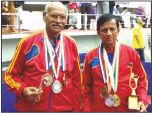
K.V. Krishna Murthy of Mysuru, representing Karnataka, annexed the men 75+ National Table Tennis Championship (Gold Medal) in the STAG 23rd Veteran National Table Tennis Championship-2015 organised by the Chandigarh Table Tennis Association under the auspices of the Table Tennis Federation of India and Indian Veteran Table Tennis Committee at Chandigarh from Feb. 27 to Mar. 2.

In the finals, Krishna Murthy defeated K. Satyanarayana, also of Karnataka, 3-1 [12-10, 9-11, 11-7, 11-7]; in the semi-finals he defeated Rajagopal of Tamil Nadu 3-1 [10-12, 11-8, 11-7, 11-2]; in the quarter-final B.U. Krishna Murthy of Karnataka – the reigning National Champion & Top seep, 3-1 [11-5, 11-6, 7-11, 11-4] and M.Chatterjee of West Bengal 3-0 [11-7, 11-6, 11-6] in the pre-quarter finals.

Krishna Murthy also won Silver Medal in the Team Championships and Bronze in the 70+ Doubles partnering N.S. Singh of Mysuru.

City’s women players J. Mamatha and Ansa won the women 40+Gold medal team event while Dr. T. Shantha won Bronze in 65+ Individual event.

K.V. Krishna Murthy and N.S. Singh duo also won Bronze Medal in 70+ Doubles event.

source: http://www.starofmysore.com / Star of Mysore / Home> Sports News / March 15th, 2016