The University of Mysore (UoM) Academic Council which met here yesterday, gave nod for direct admission of students who have completed ITI to degree courses.This decision follows after Davanagere University granted permission for ITI and JOC passed students to join Degree courses such as B.A, B.Com and BBM.
The other decision taken by the Council included allowing a Singapore-based University to start an International Centre of Physical Biology at UoM, making Computer knowledge and PU education mandatory for candidates seeking appointment to non-teaching posts, granting affiliation to degree colleges started by the Government at Bettadapura, Saragur, Talkad, Chamarajanagar, Terakanambi and Arehalli and bracing itself to implement ‘Connect to India’ scheme as suggested by the University Grants Commission (UGC).
VC Prof. K. S. Rangappa presided over the meeting, which also took the historic decision of providing admission to students from Hyderabad-Karnataka (HK) region. With the decision, the UoM becomes the first University outside HK region to allot 8 per cent seats to students from the backward region under the provisions of article 371(J) of the Constitution.
source: http://www.starofmysore.com / Star of Mysore / Home>General News / July 19th, 2014
by Prof. A.V. Narasimha Murthy, former Head, Department of Ancient History & Anchaeology, University of Mysore
Gulbarga, which is now a district of Karnataka, had a chequered history from ancient times. It was the habitat of stoneage man as evidenced by the stone tools found in various sites. Sannati in this district was a flourishing Satavahana site as evidenced by parts of Buddhist stupas and Buddha images as discovered in archaeological excavation. Asokan inscription also has been found in Sannati. It has also yielded a large number of ancient coins.
The Rashtrakutas, who ruled over Deccan and made incursions even to north India, had their capital at Malkhed which was located in Sedam taluk of this district. Subsequently, it came under the rule of the Chalukyas of Kalyana. When Mohammad Bin Tughlaq invaded this part of Deccan, Gulbarga came under his rule.
It came to prominence when Alauddin Hasan Gangu Bahman Shah founded the Bahmani kingdom in 1347 AD. It became his capital and continued to be so under various kings of this dynasty. When Bahmani kingdom was divided into five States, some parts went to Adil Shahis of Bijapur and Barid Shahis of Bidar. During the Deccan invasion of Mughal emperor Aurangazeb, Gulbarga was included in his empire. After the death of Aurangazeb, the Asaf Jahi dynasty became prominent and it was included in it. It was included in the province of Nizam of Hyderabad.
In the meantime, the parts of this district came under different chiefs known as Nayakas. The district was included in the kingdoms of Surapura Nayakas. This hunter community chiefs of Surapura were very brave and under the leadership of Venkatappa Nayaka rebelled against the British and he was put to death and the latter took away his kingdom and handed it over to Nizam of Hyderabad.
The famous Salar Jung introduced many reforms and Gulbarga became a part of Surapura district. In 1873, Gulbarga was made into a separate district. In 1956, some taluks of this district were transferred to Andhra Pradesh and the remaining taluks formed parts of Gulbarga district and it was included in Mysore State, now Karnataka.
Gulbarga district has a respectable place in literary and cultural history also. The author of Kaviraja Marga belonged to this place, poet Ponna and Devara Dasimayya belong to the district. It is also considered to have had connections with poet Lakshmisha, saint Akshobhya Tirtha of Dvaita philosophy, Pushpadanta, the author of Mahapurana etc. Thus it had a glorious history and it became more famous because it became the capital of the Bahmanis in the medieval period, and for its Islamic buildings. Two such buildings are examined here:
Jamia Masjid (mosque) at Gulbarga is a unique mosque with a special feature not seen in other buildings of this type. Hence, it is famous all over the Islamic world. According to a Persian inscription, this mosque was completed in 1367 AD during the reign of Mahmad Shah Bahmani. He was the second Sultan of the Bahmani dynasty and he was successful in consolidating the political power of the Bahmani dynasty. He also introduced many administrative reforms and his period saw peace and prosperity. Architecture received great patronage during the period. This mosque was designed by an engineer- cum-artist from Persia, namely Rafi. He was a hereditary architect from the town of Kazvin in north Persia. The uniqueness of this mosque is that it has no open courtyard and the entire structure is covered. It is believed that this is not according to the Islamic tradition and hence people did not favour it and consequently this type of building was not repeated and for this reason this mosque became unique. The architect has designed it in such a subtle way as to show the harmonious blending of Persian and Indian elements in an undistinguishable way.
The mosque is built on a rectangular base of 216 ft in length and 176 ft in width. It has cloisters on its three sides. The other western side has a nave under a high dome. The entire area is filled by rows of aisles forming sixty-eight bays each having a cupola for its roof. In effect, the entire area is made into a vast closed pillared hall. The main dome which is an elegant structure and huge dominates the vicinity. The interior of the central dome is artistically ornamented with foliage designs. These attest to the long experience and superior technical knowledge of the artists. The decoration over the arches adds a grace to the entire building. The exterior walls have tall and slender arches repeated at regular intervals. This provides a graceful façade to the building on all the four sides.
Inscriptions in Persian at different places add a charm because of the fine calligraphic characters. With all these characters, the Jamia mosque is a unique monument. It has a dargah or tomb of saint Haji Hafeez Jamaluddin Ul Harmain. He was the grandson of Ghouse Azam Dastagir. He lived in Iraq. He was a famous philosopher and a learned man and was highly respected in the Islamic world for his knowledge and saintly living. Devotees go to this mosque to pay homage to this saint. Even today Jamia mosque attracts visitors in huge numbers.
Gulbarga has a large number of tombs of the rulers of the Bahmani dynasty and they are found in two groups. The first group consists of simple tombs beginning from the first ruler Alauddin Bahman Shah. The second group is more famous because of the architectural embellishments and innovations. As a group they are referred to as Haft Gumbaz or seven domes in local parlance. Actually it consists of the tombs of the four sultans beginning from Mujahid Bahmani who died in 1378 and of his successors. Firoze Bahman Shah (1397-1422) was a peace-loving sultan and sent an embassy to Timur in 1401 and thereby became the head of the Deccan, Malwa and Gujarat. He invited a large number of Arabs and Persians to his kingdom and this is reflected in the architecture of the period. This King died in 1422 and a tomb was built in the same year for him.
This tomb has many unique characters. It expresses the architectural features of Tughlaqs in addition to local innovations. The most important character of this tomb is the introduction of double domes over the structure. Normally only one dome is found over the structure. There are also two chambers. The arrangement is such that one dome and corresponding chamber is for the Sultan and the other one is for his family.
The structure measures externally 150 ft in length and 78 ft in width and the height of the walls is 42 ft. Above the latter are two hemispherical domes of 30 ft. The two symmetrical domes at the top are very elegant and add a special charm to the building. But what is more imposing and charming are the outer walls which give the appearance of a double-storeyed building. This is achieved by introducing a series of arches at the ground level.
Over these rises the walls with similar arches with pierced window designs. Above is a moulding on which is a parapet with row of decorations. A slight projection after the two alternate arches at the central level is very elegant. The smooth stucco work for which the Deccanese artists were famous all over the Islamic world is easily seen in abundance at this tomb. From all these architectural members, decorative embellishments and double domes, this tomb of Firoz Shah Bahmani is considered unique and a beautiful edifice.
source: http://www.starofmysore.com / Star of Mysore / Home>Feature Articles / July 19th, 2014
Prestige Group head Irfan Razack buys a 4000-sq ft plot once owned by the late Ambaram Fakirbhai. The property is just a block away from a shop from where the rags-to-riches story of the construction group began
Irfan Razack says he bought the property since it is close to their first store, Prestige Men’sStore, on Commercial Street
Virgin land in the heart of the city is priceless. Those with ramshackle old buildings on them command a hefty price. But the benchmark was raised on Monday when a plot on upscale Commercial Street was sold for Rs 62,500 per square foot — the highest in the city so far.
Irfan Razack, head of the Prestige Group, the top realty firm, purchased the 4,000-sq ft plot from the heirs of late Ambaram Fakirbhai, the textile businessman who once owned large swathes of land in the area now known as Indiranagar. Razack was the lone bidder in the auction.
The plot, which bears municipal registration numbers 15 and 16 and includes a dilapidated building, was bought for a staggering Rs 25 crore at a public auction. This is the second largest realty deal in Bangalore in the last fortnight; the previous one was an eight-acre plot in Koramangala which sold for Rs 345 crore.
“The going rate around Commercial Street is in the Rs 40,000 – 45,000 per sq ft range,” a realtor who monitors transactions in the central business district said. “But the Ambaram deal is a real stunner.”
The Prestige Group are not saying what they plan to do with the plot just as yet, but a source said, “The area is close to the hearts of the Prestige Group founders as they started with a cloth shop on Commercial Street close to the Ambaram plot. By buying land a stone’s throw away from their old store, they have shown that they want to stay attached to their Commercial Street roots.”
Confirming the transaction, Razack told Bangalore Mirror, “The property is very close to my property – Prestige Men’s Store. I bought this because there is only one property between this and our property. The Prestige Men’s Store is a family business run by me and my brothers (two of them). It was a matter of pride to buy a property on this street.”
On the exorbitant price, Razack indicated that he had little choice. “The court had fixed a minimum price of Rs 25 crore for the property,” Razack said. “We were the only ones to participate in the bidding as two others who had registered their names, didn’t participate. Though the price is on the higher side, I don’t think I will regret my decision five years later. It is a family deal and my company has no role in this. This was a personal decision.”
The auction brought the curtains down on a 43-year-old feud by heirs of Ambaram over the land. “Since the heirs could not reach a consensus on sharing the prime property, the court decided to auction it,” sources said.
According to the copies accessed by Bangalore Mirror, the original propositus was Ambaram Fakir Bhai. He married Jeeva Bai and after her death, he married Girija Bai. They had six sons — Thakurdas, A Venilal, A Ramanlal, A Sukhlal, A Krishna, A Narayan — and five daughters — Umiya Ben, Vichkore Ben, Parvathi Ben, Narmada Ben and Tara Ben.
After the death of Ambaram, his eldest daughter, Vichkore Ben, filed a suit for partition of her 1/12 share in the estate left behind by her father. Though the suit was still pending, she sold her right, title and interest in favour of four of her brothers — Krishna, Venilal, Sukhlal and Narayan. Similarly the other four daughters received a certain sum of money from these four brothers in lieu of their share in full and final settlement. Thakurdas and Ramanlal were each allotted 1/7th share.
The above suit culminated in final decree proceedings initiated by Thakurdas in 1981. A commissioner was appointed to work out the modalities of actual partition. He reported to the High Court that the properties were not divisible and that it should be disposed in a public auction. Dispute arose in regard to the mode of partition of shop premises No 15/15, Commercial Street and premises No 27 F, E and D of Hospital Road. It resulted in a civil revision petition before the High Court (CRP No 2920/1973).
All the brothers, however, had reached an agreement that Thakurdas and Ramanlal were to be given first option to purchase 5/7 share of the parties to the suit by depositing Rs 10.71 lakh in the trial court on or before November 14, 1974. When they failed to deposit the amount, the other brothers – Venilal, Sukhlal, Narayan and Krishna — purchased the share of Thakurdas and Ramanlal by depositing a sum of Rs 1.75 lakh each.
Since the four brothers did not have funds, they had obtained a loan from Vijaya Bank to buy their bothers’ shares. It was also agreed that immediately after the purchase of share of Thakurdas and Ramanlal’s shares, premises bearing No 15 and No 16 of Commercial Street and premises No 27 F, E and D of Hospital Road will be substituted as security for the repayment of the loan in place of the individual properties of Venilal and Sukhlal.
Property was locked for 15 years
The three brothers entered into possession in April 1976, while another brother, Narayana, took actual possession of the entire premises in 1978. But he kept the premises under lock and key for 15 years, rendering it unfit for human habitation. Moreover the loan obtained from Vijaya Bank had not been repaid despite repeated reminders. A fresh suit was filed in 1991 for partition of the property. The suit was contested and during the pendency of the suit, two brothers, Venilal and Sukhlal, died.
During the pendency of appeal, parties decided to settle the matter amicably and they filed a compromise petition before the High Court on September 5, 2005. The court decided to auction the property.
Earlier bids unsuccessful
The court’s reserve price for the Commercial Street property was set at Rs 12 crore, while that of the Hospital Road properties was Rs 6 crore. All bids were to commence for a price higher than the reserve price indicated above.
Advocate K N Krishna Rao, representing the family members of Ambaram, told Bangalore Mirror, “During 2005, the Hospital Road property was sold for Rs 18 crore at an auction, but there was no buyer for the Commercial Street property. The Commercial Street property was again put up for auction in 2008 and again there were no bidders. Finally on Monday, the auction was conducted with the initial bid amount of Rs 25 crore and if was successful.”
source: http://www.bangaloremirror.com / Bangalore Mirror / Home> Bangalore> Cove Story / by Atul Chaturvedi, Bangalore Mirror Bureau / July 23rd, 2014
A normal office day for Arundhati Ghosh of the IFA includes meeting artists, watching performances, films, and sharing ideas for the future. And she finds it all awesome
Every morning, Arundhati Ghosh wakes up to an urgent excitement. Each day, over 13 years, since she joined India Foundation for the Arts (IFA), has been a blood rush about what the day holds for her. “I know I am fortunate,” beams Arundhati, who, as Executive Director of IFA, spends as much time outside Bangalore as in the city meeting artists and prospective donors. “Normal office days are full of arguments, debates and discussions on trying to see things from various perspectives. Many times artists drop into office and share their work with us – films, pieces of performance work, research ideas, imaginations for the future…it’s awesome,” she beams.
This sense of seamless creative perspectives lingers. “One has no clue when evening has descended outside and it’s time for Mathukathe, where we invite scholars and artists who are passing by Bangalore to share their work with us to an interested audience. So the office transforms one evening into a space for a chamber concert, on another to a movie hall and on yet another day, a workshop space for children,” says Arundhati, adding, “We put up fundraisers and showcases of the work of our grantees for public and donors to view. These are times of great excitement and I feel very proud to see the entire team at IFA put in their best to make these events meaningful and enriching.”
Such is Arundhati’s life, and if there are shows to engage herself in, she is home by 8 pm. “I have a large family of friends strewn around the world. My home belongs to many of my friends and most often, there is someone or the other staying the night. A lot of my own writing and reading happens after 11 pm. A few hours of intensive reading, writing, sharing and then it’s time for bed around 2 or 3 am. I treasure those solitary hours at night and zealously guard that time for myself,” she lets in.
Marks and musings
Into the wee hours, pulling a page out of a book from her shelf, Arundhati finds underlines, marks, musings and calluses on its body from use by friends from different parts of her life, at times by people she doesn’t even know. “Often, those marks are made by me at another time and space, perhaps. They carry more stories than what is written on the page. Some of those stories I cannot even remember,” she says.
Off the shelf, life is a journey and IFA marked the end of Arundhati’s tenure with the corporate world. “When I had finished almost a decade in the corporate sector moving between advertising, marketing and running a tiny company, I had very little to look forward to. The end of that relationship left me feeling like a bonsai, frustrated at the emptiness of life, irritated at its inability to feel either my intellectual curiosity or emotional vacuum. I was always drawn to the arts — I was a dancer once and had done my masters, wrote a little bit of poetry, watched films and theatre by the dozen and read till my eyes hit minus 9s. IFA happened to me quite suddenly serendipitously. I met Anmol Vellani, the founder and then Executive Director of IFA who hired me at one-fourth my current salary as IFA’s first fundraiser in 2001.”
“I have no idea what he saw in a frustrated, proud, young girl who knew nothing of the arts world. Over the years, I learnt so much from him about this complex world of the arts and culture, about organised philanthropy, about the politics and dynamics of funding and how to run an independent funding organisation. He created and led IFA for 18 years and then I was given the responsibility when he retired last year to assume office as the Executive Director of this foundation.”
In step with her role, with a song in her heart Arundhati talks of how, through the arts, we understand our yesterdays, make sense of today and imagine our tomorrows. “Through the arts, we bond and heal.”
source: http://www.thehindu.com / The Hindu / Home> News> Features> MetroPlus / by Nirmala Govindarajan / Bangalore – July 22nd, 2014
MLA Vinisha Nero (centre) is seen with Irene Marie Dove, Charles Lewis, Christine Daly, G.A. Edwards, Melody ‘I’ Dove, Richard M. Sherwood, Henry C. Dove, Maureen Ann Taylor, Brenden Taylor, Jude Daly and Loretta Correya at the AGM of the Association.
Mysore :
The Annual General Body Meeting (AGM) of The All India Anglo Indian Association-Mysore Branch was held in city recently.
MLA Vinisha Nero, speaking on the occasion, called upon the members of the Association to be united.
Richard M. Sherwood, President of the Association, said that the association was still growing because of the love for the community, commitment for the community and also for the care taken towards the weaker section of the community.
He called upon the youth to come forward and give them a helping hand. The community youths were urged to join the committee to reduce the burden of elders. Young achievers were requested to provide their passport size photographs to be published in the review, parents and scholarship holders were urged to continue to be the members of the Association.
Henry C. Dove, Treasurer of the Association, proposed vote of thanks.
Vice-President of the Association Brenden Taylor, Secretary G.A. Edwards, Committee members Jude Daly, Christine Daly, Loretta Correya, Maureen Ann Taylor, Melody ‘I’ D’Souza, Charles Lewis, Irene Marie Dove and others were present.
source: http://www.starofmysore.com / Star of Mysore / Home> General News / July 18th, 2014
JSS University VC Dr. B. Suresh is seen addressing the press persons in city today as Dr. Basavanagoudappa, Dr. P.A. Kushalappa, Dr. B. Manjunath and Dr. H.G. Shivakumar look on.
Mysore :
The Accreditation Council for Pharmacy Education (ACPE), USA reviewed the Doctor of Pharmacy degree programme of Jagadguru Sri Shivarathreeshwara (JSS) University Colleges of Pharmacy, Mysore and Ooty for the purposes of certification and granted Certification to the College’s Pharm D programme.
Disclosing this at a press conference at Patrakarthara Bhavan this morning, Dr. B. Suresh, Vice-Chancellor of JSS University said that the certification status of the College’s professional degree program is listed in the directory of certified programmes of ACPE on its website and the Board’s review and certification was based on due consideration of the Evaluation Team Report (ETR), the Self-Study Report, and the recommendation of ACPE’s International Commission.
He further said that the purpose of seeking certification is to set benchmark for the quality of pharmacy education and particularly Pharm D programme that the University provides in the region with that of global standards and expectations.
Dr. Suresh said that with this coveted ACPE certification, JSS College of Pharmacy in Mysore and Ooty have not only become the first institution in the country but also in the Asia Pacific region and are now poised to provide education on international standards.
Dr. H. Basavanagoudappa, Principal, JSS Medical College, Dr. P.A. Kushalappa, Director (Academics), Dr. B. Manjunath, Registrar, JSS University and Dr. H.G. Shivakumar, Principal, JSS College of Pharmacy were present at the press meet.
source: http://www.starofmysore.com / Star of Mysore / Home> General News / July 18th, 2014
The CBR at the IISc was set up earlier this year with funding from a charitable trust set up by the former Infosys CEO. (Source: PTI photo)
SUMMARY
Carnegie Mellon University is a world-renowned leader in many areas of research and education.
_________________________________________________
Infosys co-founder and former CEO Kris Gopalakrishnan has announced a donation of USD 1.8 million for the Carnegie Mellon University in the US to establish a research tie-up with the Centre for Brain Research (CBR) at the Indian Institute of Science (IISc) in Bangalore for studying aging related disorders of the brain like Alzheimer’s and Parkinson’s.
“Carnegie Mellon University is a world-renowned leader in many areas of research and education. I am very pleased to support President Subra Suresh’s strategic vision for the collaboration between CMU and IISc through this gift so that we can address one of the grand challenges of our times by understanding the human brain,” Gopalakrishnan said.
The CBR at the IISc was set up earlier this year with funding from a charitable trust set up by the former Infosys CEO.
The partnership between the Carnegie Mellon Universoty, one of the foremost in brain research and the Centre for Brain Research at the IISc aims to leverage the research strengths of the two premier research institutions.
“This partnership will provide opportunities for applying new technologies from fields ranging from imaging to machine learning to address critical questions about neuro-degeneration and one of the most pressing challenges facing humanity is to understand the human brain. Our hope is that this new research collaboration will lead to discoveries about neuro–degenerative diseases that afflict the aging population, and that those findings help improve our diagnostic and treatment capabilities for such diseases,” Carnegie Mellon University president Subra Suresh said.opalkrishnan who was instrumental in taking Infosys from a start up in 1981 to a USD 8 billion revenue company, has a personal wealth valued at USD 1.4 billion and is among the top 1500 billionaires in the world at present.
source: http://www.indianexpress.com / The New Indian Express/ Home> Cities> Bangalore / by Express News Service / Banglaore – July 17th, 2014
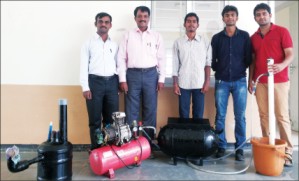
The 8th Semester students of ATME College of Engineering — Syed SuhailKadri, Pradeep and Suhas of Mechanical Engineering Department — under the guidance of K. Srinivasa, Head of the Department and Raghu, Asst. Professor, Department of Mechanical Engineering, have developed a technology to convert Raw Biogas to Enriched biogas, which has the potential to replace Compressed Natural Gas (CNG).
In present times, it is necessary to pay attention towards renewable energy sources such as solar energy, wind energy, biogas etc., due to fast depletion of conventional fuels like petrol, diesel and coal. In this regard, number of research works are going on in development of biogas technology. Biogas consists of 50-60% of methane and 20-30% of carbon dioxide. Due to this high percentage of carbon dioxide, the calorific value of fuel decreases and also affects the environmental pollution. In this project, the technology of enriching of biogas involves increasing the methane content in biogas from 50-60% to 70-80% by reducing the carbon dioxide content using Water Scrubbing process. On doing this, the calorific value of the fuel increases and environmental pollution reduces. This technology can be used for CNG also.
The students thanked the college for their support and facilities provided. The students were congratulated by Chairman of the institution, L. Arun Kumar, college Principal Dr. L. Basavaraj and teaching, non-teaching and management staffs.
source: http://www.starofmysore.com / Star of Mysore / Home> General News / July 17th, 2014
The winners of District Level U-13 Chess Championships conducted by Mysore Chess Centre and MDCA at Mysore are seen with their medals and prizes.
Mysore :
Chaithanya Ganesh of EPS and M. Supraja of Sadvidya won the Mysore District Under 13 Chess Championship in boys & girls categories respectively. The tournament was conducted by Mysore Chess Center in association with Mysore District Chess Association on July 19 and 20, 2014 at Mysore Chess Center Kuvempunagar Branch.
Chaithanya emerged as clear winner by scoring 6.5 points in 7 rounds. While Supraja won all the five rounds in girls section to clinch the title.
Top two players from boys & girls category will represent Mysore District in Karnataka State Under 13 Chess Championship which is scheduled to held in Bangalore in August. Renowned singer Guruprasad, MDCA Secretary Nagendra Muralidhar, Mysore Chess Center Director S. Suresh and Chief Arbiter B. Babita were present during the prize distribution ceremony.
Winners: Boys
1. Chaithanya Ganesh (6.5 pts), 2. S.N.Jatin S N (6 pts),
3. S.N. Nitin (6 pts)
4. Sumit Deshapande (5.5 pts)
5.S.Chiranjan(5.5 pts)
Best Youngest Players:
S. Vishwajith and V.M. Amay (both 5-years-old)
Winners: Girls
1. Supraja Mahadewaswamy (5 pts)
2. R. Akshatha (4 pts)
3. Ananya R. Patel (4 pts)
4. K.N. Sanjana (4 pts)
5. K.G.R. Anangha (4 pts)
Best Youngest Players:
Tejaswini (4 years) & S. Shreya S Gowda (5-years-old)
source: http://www.starofmysore.com / Star of Mysore / Home> Sports News / July 21st, 2014
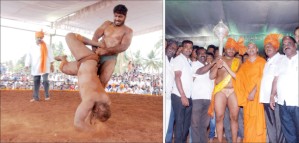
Residents of the Kannegowdana Koppal (KG Koppal) and surrounding areas in city were in for wrestling feast as they got an unique opportunity to witness some of the best wrestlers fighting it out at the wrestling court in BGS Stadium during the wrestling competition organised on the occasion of Goddess Chamundeshwari Vardhanti celebrations yesterday.
People gathered in large numbers to witness the fights. Wrestlers various parts of the country to come to participate at the tournament. Pahelwan Karthick Kaate of Davanagere emerged as the winner of Pahelwan Basavaiah Memorial Wrestling competition defeating Maharashtra’s Pahelwan Sachin Chamdwar. Meanwhile, in the other match Pahelwan Nandakumar of Maharashtra won against Pahelwan Vijay Guttal of Kollapur.
Pahelwan Karthick Kaate was awarded with Pahelwan Kannegowda Award, while Pahelwan Nandakumar was awarded with Pahelwan Basavaiah award.
Earlier, wrestling competition was inaugurated by Sri. Somanatha Swamiji, Head, Adichunchanagiri Mutt , Mysore Branch. Former MUDA Chairman L. Nagendra, BB and Sons owner B. Boraiah, JD(S) City President Rajanna and others were present.
source: http://www.starofmysore.com / Star of Mysore / Home> Sports News / July 21st, 2014