Dr P R S Chetan, additional chief officer, commanding Quick Response Team (QRT), Civil Defence and his team rescued hundreds of flood victims in the State last year.
Bengaluru :
Dr PRS Chetan, additional chief officer, commanding Quick Response Team (QRT), Civil Defence and his team rescued hundreds of flood victims in the State last year. These include 186 people stranded at the Hippie Islands along the Tungabhadra River.
Dr Chetan has been awarded with the President’s Civil Defence Gallantry Medal for saving several lives in 2019 in the Tungabhadra River Flood Rescue Operation. This is the first Gallantry Award to Civil Defence in the last 50 years.
Dr Chetan narrated to TNSE his experiences running rescue operations and his own near-death experience in the crocodile-infested river. “Around 200 people — mostly foreigners — were stranded at the Hippie Island in Virupapura Gadde. The only option was to either airlift or ferry them across the river to safety. We rescued 186 people and the rest were airlifted,” he said.
The rescue team had members from the Civil Defence (12) and the National Disaster Response Force (20). “Four of us were in a boat, which capsized. Two caught hold of a lifebuoy and floated to the shore, one caught hold of a tree and was airlifted by a helicopter. I was washed away and struggled to swim ashore for four-and-a-half hours.
Fortunately, I was wearing a life jacket, else I would have drowned within minutes. There were strong undercurrents. I couldn’t hear and my eyes started getting tired. I thought I would die when suddenly my legs got entangled in weeds. I got something to hold on to and managed to swim ashore. I blew the whistle, but no one heard it.
I was injured and my body was sore. I walked for 2km, when villagers spotted me. I was taken to the nearest hospital,” said Dr Chetan. Two days in the hospital and on August 14, 2019, he went back to work. “I faced death in those hours in the river. I would like to rescue as many people as I can. It’s my service to the country,” said Dr Chetan.
source: http://www.newindianexpress.com / The New Indian Express / Home> States> Karnataka / by Bala Chauhan / Express News Service / August 16th, 2020
Science Gallery Bengaluru will hold its first digital exhibition from August 21 to 30
Science Gallery Bengaluru (SGB) will hold its first digital exhibition, ‘PHYTOPIA’, which will explore the past, present and future of plants, from August 21 to 30.
Science Gallery Bengaluru Mediators, a group of selected and trained young adults, will hold 60-minute sessions every day to engage in conversations with visitors based on the theme of the exhibits.
On Fridays and weekends, there will be talks and events by prominent scholars and artists such as on ‘Who feeds Bengaluru’ and ‘On documenting indigenous food culture’.
In addition, there will be workshops, and an opportunity to submit articles that look at plants critically and creatively.
“The United Nations generally has research-led years. For example, last year was the International Year of the Periodic Table. This year, it’s the International Year of Plant Health. Last year, we did our first pop-up exhibition called ELEMENTS. This year, we thought of plant health. We haven’t done it narrowly on plant health, but took that as a starting point to think about what is it that excites us about plants,” said Dr. Jahnavi Phalkey, founding director, SGB,
Stating that while the exhibition is open to everyone, she says the programming, including workshops, and masterclasses, is specifically targeted at young adults between the ages of 15 and 28.
The exhibition has been developed in partnership with the John Innes Centre, an independent, international centre of excellence in plant science and microbiology based in the UK. The programme partner is Bengaluru Sustainability Forum and Bangalore International Centre is the outreach partner. Chemical ecologist Shannon Olsson, ecologist Harini Nagendra and independent scholar Sita Reddy are the academic advisors to the exhibition.
As for the challenges of holding an exhibition online for the first time, Dr. Phalkey said, “We are an institution that was meant to produce physical exhibitions. It meant we had to retool ourselves and reimagine what our programming would look like. We want to provide a high quality experience but not necessarily limited to the 10 people who have high-tech devices. It was about being able to produce an interesting exhibition while trying to catch people’s attention. Because those who can, are already consuming so much online right now, from shopping to education. So, how do you create something that will draw them in? That, for us, is a challenge and a debate.”
The city has a long history of revolts and expressions of resentment against the British
Remembering them: A memorial at Mysore Bank Circle in Bengaluru to commemorate some of those who died in the freedom struggle. | Photo Credit: Special Arrangement
Mysore Bank Square, August 17, 1942. For the ninth consecutive day, thousands of Bengalureans came out to protest peacefully in response to Gandhiji’s Quit India call. People surged and flowed along Avenue Road and slogans suffused with hope and anger rented the air: “Quit India!”, “Inquilab Zindabad!”
But that Monday, some protesters set fire to a post office at Aralepete; others broke into a police station and tried to attack the post office at Chickpet. When the police issued warnings, defiant protesters barricaded the road with carts and boulders and then hurled soda bottles at the policemen, while others threw stones from their rooftops.
The police opened fire, six people died and more than 30 were injured. Bengaluru has a long history of revolts and expressions of resentment against the British. Even in 1800, people were arrested for singing songs against the British and in praise of Tipu Sultan.
Attempted mutiny
Twenty-five years before the First War of Independence swept through India, there was an attempted mutiny in Bengaluru by soldiers who dreamt of overthrowing the British here and then inciting mutiny all over India; their plan was thwarted by a snitch.
From the late 1800s, like the rest of the country, Bengaluru too was gripped with nationalistic fervour. This was fanned by the activities of organisations such as the Vokkaligara Sangha, established in 1906, which did much to raise awareness and education in the community, and the Theosophical Society, which established a branch here in 1886.
Big stimulus
A big stimulus to the still-nascent freedom movement was the return of Mahatma Gandhi from South Africa in January 1915. His first visit to Bengaluru was in May 1915. His second visit in 1920 ushered in a movement for spinning khadi. Khadi sales were frequently held, as were other gatherings — to celebrate Gandhiji’s ending a fast, to mourn the passing of C.R. Das, or protest against a water tax. Such meetings usually began with Gandhians speaking about non-cooperation, Hindu-Muslim unity, against untouchability, and against alcohol.
Hundreds attended these gatherings which were held in the so-called Gandhi Maidan opposite Minto Hospital, Doddanna Hall, which was opposite Bengaluru Fort, and sometimes, even Tipu Palace. Many such meetings had an attendee whose job was to report on them to the Mysore administration: one such report by a spy in 1925 records the speeches made and then dutifully notes that khadi worth Re. 1 and 2 annas was sold.
Except for when he was here to recuperate from illness, Gandhiji’s visits had him criss-crossing the city, holding meetings at Mahila Seva Samaja, the RBANMs school and grounds, a home on Lalbagh Road, a shop at Commercial Street, and so on. Thousands thronged to listen to him speak passionately about non-violence and the evils of untouchability. A meeting in a house on Victoria Road, for example, drew 2,000 people, at National High School, 25,000 people. Many people who attended these meetings donated generously to the cause, sometimes even giving away their jewellery.
But not everyone was so moved: some people held meetings where they denounced Gandhiji’s anti-caste stand as “subversive of Hindu dharma”. The 1920s and 1930s also saw frequent student rallies, boycott of classes, and picketing of shops selling foreign cloth. In that pre-WhatsApp and social media era, when even telephones were uncommon, how did organisers get the word out about upcoming meetings? Enter the cheap flyer. Hundreds of these indispensable handbills were churned out at several small presses around the city and were then distributed door to door, in markets, and stuck on strategic lamp posts.
Turning point
A turning point in the freedom struggle in Bengaluru came in 1937 when K.F. Nariman, president of the Bombay Congress Committee, was invited to speak here. The Mysore government had banned him from addressing gatherings because of his earlier “incendiary” speeches. On October 24, at Banappa Park, as soon as Nariman came on to the stage to address a crowd comprising mainly students, he was arrested. The next day, when students gathered to protest his arrest, police opened fire on the unarmed protesters. One person was killed and 73 people were injured that day.
Little-known memorials at Banappa Park and at Mysore Bank Circle commemorate some of those who died in the 1937 and 1942 incidents.
(Meera Iyer is the author of ‘Discovering Bengaluru’ and the convenor of INTACH Bengaluru Chapter)
source: http://www.thehindu.com / The Hindu / Home> Opinion> Columns / by Meera Iyer / August 14th, 2020
As a student and young professional, Saveen Hegde always assumed that oration is an inherent skill.
Saveen Hegde
Bengaluru :
As a student and young professional, Saveen Hegde always assumed that oration is an inherent skill. That was until he was one of two persons to represent India at the 86th Annual International Convention which was held at Vancouver, Canada in August 2017. Now on August 27, Hegde will address a gathering from around the world at the International Convention of Toastmasters’ first-ever Virtual Convention, where he will talk about design thinking in the 30-minute slot. The 34-year old is the only person to represent South Asia and South East Asia region (Singapore, Cambodia, Laos, Mynamar, Bhutan, Vietnam and Malaysia). While it was supposed to be held in Paris, the pandemic has led to the summit going virtual.
In his upcoming talk, Hegde, who has a certification from Harvard Business School, will delve into design thinking as a way of life. “It’s important to incorporate creativity and flexibility in the work space. Design thinking combines creative and critical thinking that allows information and ideas to be organised, decisions to be made and situations to be improved. It’s about looking at a business from an artist’s point of view,” says Hegde, who decided to start his own firm, unboxexperience.com, after leaving an automobile design company in 2011.
Around the same time, Hegde felt the need to hone his public speaking skills. “I then came across Toastmasters’ clubs and felt that a platform where feedback is provided would help,” he says. Hegde is also an improvisational theatre artiste who performed over 300 live performances in four countries for over 2,00,000 people. He is the founder of the Indian Improv Tribe and learned improv theatre at the UCB Theatre in New York, and has played a cameo in two South Indian movies – Humble Politician Nograj and the upcoming Ten.
While he previously feared acceptance, especially on a global forum, regular participation in Toastmasters’ programmes have rid those. “This summit is different from the World Championship, which I previously participated in. This is not a competition but instead it has 14 select educational speakers from across the world. Some years ago, a non-native English speaker won the World Championship, which broke the glass ceiling about how anyone can do it,” he says.
The takeaways from the session, Hedge points out, will be learning why design thinking is effective for leaders in today’s changing world; using it to develop an open, flexible mindset; and applying it to better organise ideas and improve situations.
source: http://www.newindianexpress.com / The New Indian Express / Home> Cities> Bengaluru / by Vidya Iyengar / Express News Service / August 19th, 2020
Every year, on Aug. 9, bibliophiles celebrate Book Lovers Day. It is an unofficial holiday that encourages people to pick up a book or two and spend the day reading. On the occasion of Book Lovers Day, Star of Mysore spoke to a resident of Mysuru who has been very passionate about books and this avid reader has turned her home into a mini library.
Writer and an voracious reader Anasuya S. Kempanahalli is a resident of T.K. Layout, Bogadi 2nd Stage. Her mini library in her house has over 5,000 books. Her book collection includes numerous authors on various subjects, most prominently on Sharana, Janapada and Kannada literature as well as about freedom fighters and achievers in various fields.
Popular Kannada writers are also her favourite picks with a huge collection of books at home including those of Kuvempu, Dejagow and CPK.
Speaking to Star of Mysore, Anasuya said that she started collecting books in 2005. She holds Ph.D and said that she never forgets to buy a book whenever she attends any book release function in city.
She has also been an editor of numerous books including Beda Valmiki Mahile: Srujanashilathe, Ranjita Chutukugalu, Kuvempu: Kelavu Notagalu, Dejagow-96, Kannada Janapada Kathegalalli Atte-Soseyaru, Kavyaradhane, Dejagow Avara Ittichina Kathegalu, Maharshi Valmiki Divya Darshana (Part-1), Nudi Pushpanjali, Badukina Deevige, Maharshi Valmiki Divya Darshana (Part-2), Kannadiyalli Kadamba and Chutuku Sahitya – Ondu Sameekshe.
A recipient of numerous awards, Anasuya has also acted in a shot film, ‘Amma.’ She has worked as a Kannada and Political Science lecturer in Mahajana FGC and Karnataka State Open University and is currently working as a non-teaching faculty in Sri Jayachamarajendra College of Engineering.
Collecting books and reading is my favourite hobby. Books are our best friends. I have gifted hundreds of books to my students. I always encourage them to keep their mobile phones away and instead pick up a book to read, says Anasuya S. Kempanahalli, Bibliophile and writer.
source: http://www.starofmysore.com / Star of Mysore / Home> News / August 17th, 2020
Through the years of its widening reach, aficionados as well as critics of social media platforms have agreed on one thing — that it has democratised expression of opinion.
Mayank Bidawatka (left) and Aprameya Radhakrisha
Bengaluru :
Through the years of its widening reach, aficionados as well as critics of social media platforms have agreed on one thing — that it has democratised expression of opinion. Turns out, there is a lot of scope left to expand the web to more users. This is what the founders of Koo App aim to do with their micro-blogging site, which enables Indians to express themselves in local languages. It was recently selected among the winners of the government’s Digital India AatmaNirbhar Bharat Innovate Challenge.
Koo, which was launched in March, is available in Hindi, Kannada, Tamil and Telugu. “Just 10 per cent of our country understands English. Over a billion speak one of the hundreds of languages and dialects that we have,” says Mayank Bidawatka, who co-founded the platform with Aprameya Radhakrishna. “Twitter largely caters to the English-speaking urban audiences.
Catering to regional audiences needs a fair amount of Indianisation of the product,” adds the city-based entrepreneur, who is upbeat about being one of the 24 winners from 7,000 entries. The innovation challenge was held to identify the best Indian apps in eight categories that are already being used by citizens and can become world-class platforms. Koo shared the second spot in the social networking category with the writing app, YourQuote, while short video app Chingari stood first.
The idea for Koo struck the founders after they came up with Vokal, an expert-based knowledge-sharing platform in Indian languages. “There was no microblog for regional Indian language speakers,” says Bidawatka, a graduate from Asian Institute of Management, Manila, and a former banker. They made the product in some months and first test-marketed it in micro-geographies. So far, Koo has had about eight lakh downloads, and the founders hope to cross 1 million by August-end.
The app has various features like a keyboard that auto-transliterates the English script to the target Indian language. Its people feed shows the top creators, and users can view who visited their profile. Creators can ‘koo’ through 400 characters of text or 1-minute audio or video. “All instructions are in Indian languages,” says Bidawatka, revealing that while he uses the platform in Hindi, Radhakrishna ‘koos’ mostly in Kannada.
“Koo already has Union Ministers Ravi Shankar Prasad and Mansukh Mandaviya, Karnataka Deputy Chief Minister Ashwath Narayan, and celebrities like Anil Kumble, Javagal Srinath, Sadhguru, Ashutosh Rana and Ashish Vidyarthi using it.
They have seen more traction on Koo because of the use of an Indian language,” says Bidawatka, who hopes that Prime Minister Narendra Modi will join soon too. “There are very few platforms that prominent Indian personalities can use,” he adds. “They’d love to use Koo because it helps connect the best of India with the rest of India.”
source: http://www.newindianexpress.com / The New Indian Express / Home> Cities> Bengaluru / by Pallavi Srivatsava / Express News Service / August 13th, 2020
Her popularity as a Doctor was so much, some patients even named their daughters ‘Indra’
When Sam Cherian called me on Saturday morning and gave the news of Dr. Mrs. Indra Amla’s demise, I rushed to their house and paid my last respects to her. In the afternoon when I was sitting at home I remembered some of the events over four decades of association.
Dr. Indra Amla was always seen by us in CFTRI campus during 1972 (when I was a student) as a serious Doctor who spoke less and would go to her work at Cheluvamba Hospital and return for lunch and again go back to work in the evening in a Herald car, I think.
As a Doctor by profession, she was very busy as one could see. Her popularity as a Doctor was so much, I know some patients who have even named their daughters Indra in reverence to Dr. Indra Amla.
Over a period of time when I came back from the USA, Dr. Amla and family too had returned from USA after her stint at the World Bank. I was working as a Scientist at CFTRI and I saw her involved more with some of the Projects on Proteins and Nutrition at CFTRI and other Hospitals of Mysore, in spite of her busy schedule with the local Hospitals — especially pertaining to Nutrition and Paediatrics.
Many people at CFTRI came to know her more at that time. After I took over as Director, she used to bring us new thoughts with JSS Hospital involvement where she was working and after her retirement from Government service.
Her interest in the subject of ‘under-nutrition’ became more and more intense. We made a draft of a project towards that and sent it to the Government. But, like it happens to Governments, it did not move forward fast enough which frustrated Dr. Amla who once mentioned to me “How much does it cost? I will take care of the expenditure and let us move ahead.” It was a small project. That showed her commitment to children and women and to help them somehow. In the end, the project did not take off but Dr. Indra Amla’s passion to serve women and children did not die.
Over the years we used to visit Dr. Amla’s residence on Contour Road, Gokulam and later in Hinkal. She was an excellent host and conversationalist. And her conversations inevitably always led to something to do with service to society.
She had another side too — her love for animals, especially her two dogs Boney and Mint. After retirement the family settled in their own home near Hinkal in a small coconut grove. But the dogs were still attached to the CFTRI campus and would land up at the campus making their way from far off Hinkal. Dr. Amla, who would visit the campus for half-a-day would then meet the dogs on campus and indulge them in a sort of conversation, as if to know how their day went. She would then drive them back home, like a mother picking up her children after school !
Dr. Indra Amla was a committed worker not only during service but even after retirement. I feel with the passing of Dr. Indra Amla, the iconic era of exceptional women doctors who stood for a cause in Mysuru, has come to an end.
May her soul Rest in Peace.
source: http://www.starofmysore.com / Star of Mysore / Home> Feature Articles / by Dr. V. Prakash, Former Director of CFTRI and Distinguished Scientist of CFTRI / August 03rd, 2020
The United States dropped an uranium atomic bomb on the city of Hiroshima on 6th August 1945. Nearly a lakh of civilians died instantly or were severely injured. Another plutonium atomic bomb was detonated over the city of Nagasaki on 9th August 1945 with a similar devastating effect. This resulted in Japan’s announcement of an unconditional surrender to the US Forces, on 15th August 1945. The supreme commander of the allied forces, Gen. Douglas MacArthur, received the formal instrument of surrender on 2nd September 1945 on the US naval ship Missouri, and he continued as the military administrator of Japan. The General arrested all the main decision-makers like the Prime Minister, Chief of Military and a number of others and imprisoned them. One of the main accused was General Hideki Tojo, Prime Minister of Japan (1941-44).
The US and the allied powers were keen to punish the top decision-makers in the Government and the military who started the war. They called them the war criminals. They constituted the International War Tribunal for the Far East, on the lines of the Nuremberg Trials of Germany. The Tribunal had eleven Judges drawn all over the Western world and British Commonwealth. The Judges came from England, France, New Zealand, United States, Philippines, India etc. Popularly known as the “Tokyo Trials”, the trials started on 14th May 1946 and lasted for two-and- a-half years. The final judgement was delivered in November 1948. The defendants included former Prime Ministers, Foreign Ministers and prominent military Generals who were involved in the decision- making to wage and continue the war.
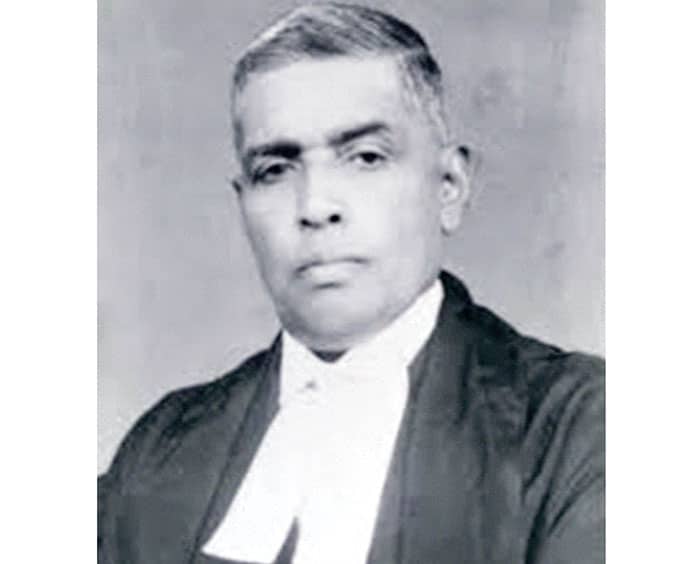
The Tokyo War Trials were long and went on for more than two years. The trials had 816 sessions, more than 4,000 witnesses and 48,412 pages of transcripts. The sentences were pronounced in November 1948. Slowly each of the Judges pronounced the defendants to be guilty. The 11th Judge thundered “NOT GUILTY” and stunned ten other brother Judges and the whole Courtroom. The man who gave the dissent and exonerated all the accused was “Justice Radhabinod Pal” from India.
Justice Pal was born in a small village in present day Bangladesh and educated in Calcutta. He worked as a Professor of Law, retired as a Judge of Calcutta High Court and later was appointed as the Vice-Chancellor of Calcutta University. He was known for his legal erudition and expertise in international law. He was nominated as a Judge on the Tokyo War Tribunal by the then British Government of India in 1946. Justice Pal wrote a lengthy dissenting judgement of 1,250 pages. It seems that Jurist Pal rarely went out of his hotel room in Tokyo and personally typed his lone lengthy dissenting judgement. He felt that the trials themselves were illegal. He opined that like the European countries who had Colonies, Japan too was entitled to acquire its own Colonies. He pointed out that Japan cannot be tried for crimes against humanity. He felt that the large devastation and deaths inflicted by the American atom bombs were as much, if not greater, crime against humanity.
He gave a number of arguments terming the Tokyo War Trials as irregular and illegal. Justice Pal’s dissenting opinion was severely criticised all over the western countries. Pal’s view was “aggressive war was reasonable because it is about National Sovereignty”. He pointed out that the Western countries acquired their Colonies by brutal wars and hence did not have a moral right to stand in judgement. He was of the opinion that conquerors should not pass judgement on the conquered and the Tokyo trials were more of a victor’s revenge. In his judgement, Pal was very severe towards Japan too, but his criticism of the US was very serious.
The War Tribunal and the Western Governments did not like the dissenting opinion of Justice Pal and decided not to publish his 1,250-page-long judgement. Japan signed a Peace Treaty with the United States in 1952, and the military administration of Gen. Douglas MacArthur ended, and Japan was once again a sovereign free nation. Soon afterwards the Japanese Government published the 1,250-page-long dissenting judgement of Justice Pal.
Pal’s opinion that Japan was not legally culpable, was accepted and hailed by a large section and particularly the upper classes of the country. The Japanese society appreciated the courage and passion of Justice Pal. It is said thus Justice Pal’s opinion highly mitigated the shame and remorse felt by the Japanese people and particularly the ruling elite.
A group photo of the Judges of the Tokyo War Trials.
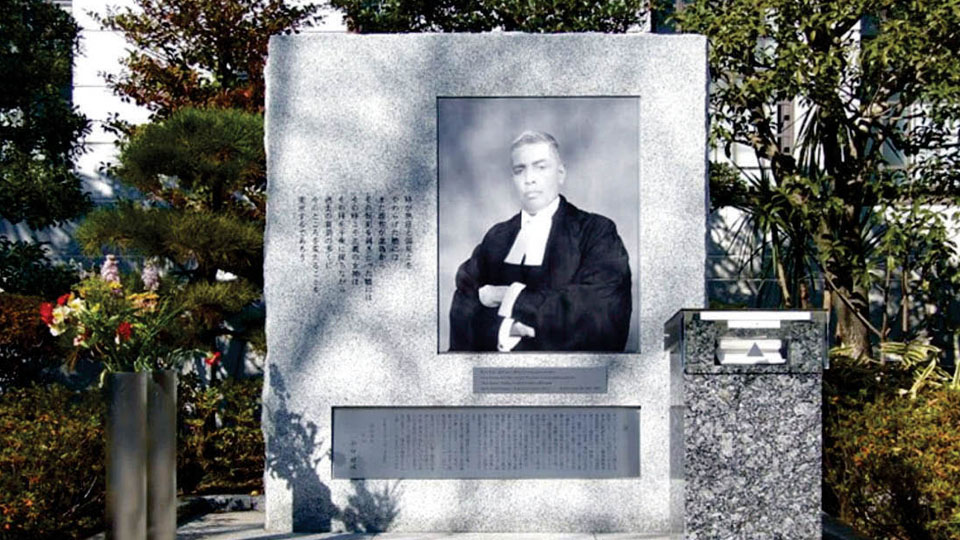
After the Tokyo Trials, Pal was elected to the UN International Law Commission, where he served illustriously from 1952 to 1966. Japan felt very grateful to Justice Pal. The Emperor bestowed on him the nation’s highest honour “Order of the Sacred Treasure” in 1966. He was invited twice more to Japan for lectures. The Government of India honoured him with the title “Padma Vibhushan.” After his death, the Japanese Government erected a memorial for Justice Pal in “YASUKUNI SHRINE”, which is a memorial for the National and War Heroes of Japan. When Prime Minister Abe visited India, he went to Calcutta to meet the son and family members of late Justice Pal.
For his dissenting judgement exonerating Japan, Jurist Pal was highly criticised and vilified all over the Western world. But Justice Pal had the courage of conviction to go against the opinion of all the ten of his fellow Judges and the wishes of the allied powers of the United Kingdom, United States and Russia. This Indian Judge showed exemplary courage in telling the world that in a war, there is no ‘good side’. Justice Radhabinod Pal is almost forgotten in India but remains a greatly admired and adored hero in Japan.
source: http://www.starofmysore.com / Star of Mysore / Home> Feature Articles / by Dr.C.D. Sreenivasa Murthy /August 03rd, 2020