Legend has it…

According to a legend, a local powerful Jain woman, Padmavati, fell in love with a Shaivate merchant, Abbayya, who had come down to Lakshmeshwar.

Abbayya agreed to marry her on the condition that she should adopt Shaivism. After their marriage, the idol of Somanatha, which Abbayya brought with him from Saurashtra was installed inside the structure, which was originally a Jain shrine.

Though this story is not backed by historical evidence, historians opine that the temple was originally a Jain shrine and was called Suvarana Basadi.

It was believed to have been constructed in 1080 AD and has the features of Kalyan Chalukya, Rashtrakuta and Vijayanagar style of architecture.

source: http://www.thehindu.com / The Hindu / Home> National> Karnataka / December 26th, 2015

Fundraisers to support experiential music museum

Two fundraiser concerts are being organised in the city in support of India’s first experiential music museum, IME (Indian Music Experience) to be launched next year.

Carnatic vocalist Manasi Prasad and veena artiste Suma Sudhindra will be presenting two fusion concerts at Chowdiah Memorial Hall, on December 27 at 6 p.m. Sukanya Ravi Shankar is a special invitee.

Manasi Prasad, accompanied by Sahana Ramachandra and Aditi Prahlad on vocals, will present ‘Samarpan’ as a tribute to renowned Carnatic vocalist M.S. Subbulakshmi’s centenary proceedings, with B.K. Raghu on violin, Shadrach Solomon on keyboard, B.S. Anand on mridanga and Adarsh Shenoy on tabla.

The ‘Naada Chitra Crossover Project’ that follows will be an instrument ensemble with artist B.K.S. Varma painting on the stage as the music progresses. Suma Sudhindra on Carnatic veena will be accompanied by Rakesh Chourasia on Hindustani flute, Ned McGowan on the western key flute, Anoor Ananthakrishna Sharma and B.C. Manjunath on mridanga, Karthik Mani on western drums, and Satyajit Talwalkar on tabla.

“The 41-crore project is from the IME Trust that is looking forward to getting funds. The museum concurrently started its research wing for content acquisition for its exhibit space of 20,000 sq ft with varied installations and two mini theatres,” says Suma Sudhindra, director, Outreach, IME.

“One may choose to have their name engraved in the bricks of IME museum building at J.P. Nagar by contributing Rs. 5000,” she says.

source: http://www.thehindu.com / The Hindu / Home> News> Cities> Bengaluru / by Special Correspondent / Bengaluru – December 25th, 2015

Karnataka Sangeetha Nrutya Academy’s annual ‘ Kalasri ’ Awards

KalasriBF25dec2015

by M.L. Krishnaswami

Karnataka Sangeetha Nrutya Academy, a Government-sponsored body, institutes and gives away ‘Karnataka Kalasri’ Awards every year for the most deserving artistes in several sectors of music and dance, after a careful selection process. This is an important annual event organised by the Academy at Bengaluru.

This year the glittering event took off at Ravindra Kalakshetra in Bengaluru on Saturday, the 19th instant. Eighteen most deserving artistes were honoured on the occasion.

Mysuru City, the cultural capital of Karnataka, is lucky to bag three ‘Kalasri’ awards in its kitty and aptly so. The awardees are: G. Pushpalatha for Sugama Sangeetha; Rajalaskhmi Sridhar for Classical Music and Krishnagiri Ramachandra for Gamaka.

Of the above three awardees, I happen to know Pushpalatha for over three decades and this article will mainly highlight her achievements. Rajalakshmi is a classical musician and is well- known in that circle. She was the Programmes Executive of AIR Mysuru. She has given many programmes in old Mysuru State and Chennai.

Krishnagiri Ramachandra is a retired Executive Engineer of the State PWD and holds a post graduate degree in Hydraulics. His father was late Krishnagiri Krishnarao, better known as KKR, who was perhaps the most leading Gamaka Vidwan in the old Mysuru State. His son Ramachandra learnt the nuances of Gamaka from childhood and is well-known as a gamaki and teacher. His wife is the well-known Dr. Tulasi Ramachandra, a leading danseuse and a Bharatanatya teacher.

Now about G. Pushpalatha: I happen to know this lady for over thirty years. By sheer dint of hard work and dedication, she has risen to great heights in the field of Sugama Sangeetha. My initial connection with her dates back to about thirty years when I, along with A.D. Srinivas, Lakshmisha, Shivashankara Swamy, Manjunath, M.G. Ravi, U.P. Gita, Pushpalatha and my own daughter Madhulika formed and nurtured an Organisation called “Tharangini.” Under this banner the above team gave many light music programmes in Mysore and beyond including a remote place like Hubballi. Vocational calls of the boys and marriages of the girls of the troupe cast the curtain down on this outfit and all the artistes dispersed according to their individual calls.

I, a non-performing entity sort of a head-master-remained in the background as a ‘Historian of the joyous plain,’ to recall O. Goldsmith.

Pushpalatha joined Mysore Akashvani, actually she was in Bhadravati Akashvani for sometime and in 1992, she was directly selected as the high-grade music composer in-charge of Sugama Sangeetha and devotional songs. This platform gave her tremendous opportunity to innovate and grow in her chosen field briskly. She has worked in all platforms of Akashvani including voice identity committee, cultural club, youth music society as also in many music sabhas. She founded “Sneha Sangama,” a cultural platform and has trained several boys and girls to nurture their arts individually. She is a good trainer in all fields of light music and her enthusiasm and dashing nature have helped her score high points in her chosen field. She had an indirect stint in the cinema field also in that she helped Yoganarasimha, film music director in his work. Naturally, her talent and drive have helped her basket several awards from various organisations like “Stree Kala Shakti,” “Shaswathi Sthree,” “Kala Tapasvi” and many more.

What strikes me most is her ability with which she instantly beautifies any Kannada verse (poem) with appropriate raga and tala and presents the same instantly on stage to the applause of the connoisseurs. This seems to be an innate quality very few light musicians are blessed with. Kudos to her and this has made her an A-Top artiste in her branch of music in such a short period.

She is able to assemble a group of artistes, both vocal and instrumental, and put up a glittering show on stage at short notice. The Karnataka Sangeetha Nrutya Academy has decorated her with ‘Kalasri’ award for 2015-16 which she richly deserved.

This is to wish her many more years of active years in her chosen field. She is happily married to Mr. Renu and the couple has a son and a daughter.

source: http://www.starofmysore.com / Star of Mysore / Home> Feature Articles /  Friday – December 25th, 2015

Bengaluru scientists find drug which could cure malaria with one dose

The Bengaluru solution – Triaminopyrimidine (TAP) comes with many advantages over existing drugs

Bengaluru :

Three scientists from Bengaluru, who led a team of global reserchers looking for an antimalarial drug, have found a fast-killing solution.  After completing some tests, it’ll go in for clinical trials on humans. That this drug has the potential to cure the dreaded disease in one dose makes it more attractive to healthcare providers.

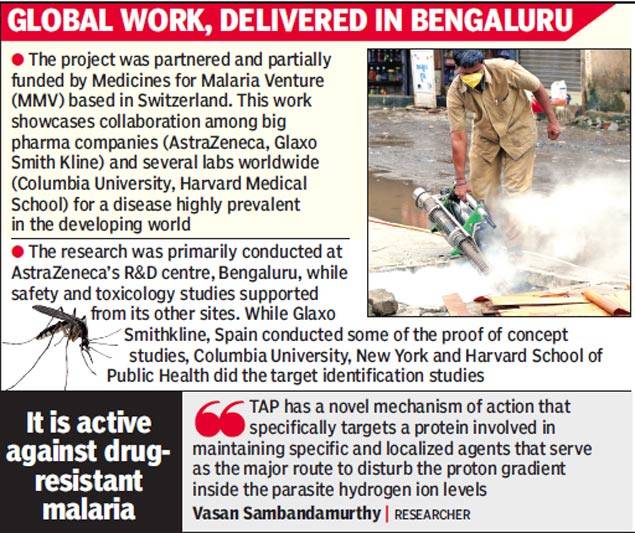
The Bengaluru solution — Triaminopyrimidine (TAP) — comes with many advantages over existing drugs. Vasan Sambandamurthy, one of the senior authors of the research paper, said: “It’s a fast-killing and long-acting antimalarial clinical candidate. TAP acts exclusively on the blood stage of Plasmodium falciparum (the stage responsible for clinical symptoms) in a relevant mouse model. This candidate is equally active against causative agent Plasmodium vivax.”

He added, “The compound has shown good safety margins in guinea pigs and rats. With a predicted half-life of 36 hours in humans, TAP offers potential for a single dose combination.”

The rapid spread of Plasmodium falciparum, the parasite which causes malaria in humans, has left nations battling it with a weakened arsenal and coping with thousands of deaths every year. This parasite has gradually become resistant to available medication.

The World Health Organisation (WHO) estimates that 3.2 billion people in 97 countries, including India, are at risk of being infected with malaria. In 2013, WHO reported an estimated 198 million cases and the disease was responsible for an estimated 5.84 lakh deaths, including 4.53 lakh children less than five years old.

Every person infected with malaria has to deal with millions of parasites and existing drugs have a limited effect in humans. “The half-life, which isn’t more than 2 hours, means it allows parasites to bounce back. Existing drugs are not fast-killing, which means that not only does a human need more doses but each dose is capable of only killing a few parasites,” he said.

GlobalWorkMPOs26dec2015

Besides, a potential side-effect of existing drugs is liver damage. “This doesn’t happen all the time, but the possibility does exist. Also, the parasites have become resistant to these drugs. With TAP, there are now known side-effects and the parasites are unable to develop resistance at the same pace as they do for existing drugs,” he said.
TAP was discovered by a team at pharmaceutical company AstraZeneca. “The main research happened in its R&D centre in Bengaluru between 2011 and 2014, which has since been shut down. It took us three years of rigorous work by teams across the globe. Today, we confidently nominate TAPs as a clinical candidate to treat drug-resistant malaria,” Vasan said. Shahul Hameed and Suresh Solapure were the two other team leaders.

Times View
The discovery of a malaria drug, yet again, highlights Bengaluru’s leadership in scientific research. The promise that the new medicine can kill the virus in a single stroke and act for a long time is good news for malaria patients. While the scientists deserve compliments on working towards a remedy free of side-effects, the companies that will eventually massproduce the drug should look at making it affordable to the aam aadmi. For their part, public health administrators must renew their battle to prevent vector-borne diseases, which cause untold suffering.

source: http://www.timesofindia.indiatimes.com / The Times of India / Home> City> Bangalore / by Chetan Kumar, TNN / April 01st, 2015

Science fiction comes alive as Indian startup grows human liver in lab

Liver team at Pandorum Technologies: Dr. Abdullah Chand, senior scientist (left); Arun Chandru, co-founder and managing director (centre); and Dr. Sivarajan T., senior scientist / @ABHINAV_MAURYA

Pandorum Technologies, a Bengaluru-based biotech startup, has developed an artificial tissue that performs the functions of the human liver.

Pandorum said these 3D printed living tissues made of human cells would enable affordable medical research with reduced dependence on animal and human trials. It will also eventually lead to full scale transplantable organs.

Arun Chandru, 30-year-old co-founder of Pandorum, said liver toxicity and drug metabolism are the key hurdles, and contributors to failed human trials.

Pandorum’s 3D bio-printed mini-livers that mimic the human liver will serve as test platforms for discovery and development of drugs and vaccines. The firm said these drugs would have better efficacy, less side-effects and be developed at lower costs.

“We developed everything here in India,” said Mr. Chandru. “We can grow thousands of these tissues in the laboratory and test the efficacy of drugs on them for diseases including cancer.”

He said large pharma companies on an average spend about $10 billion (Rs. 66,290 crore) and 10 years on research and development to get a single new drug to the market.

Tuhin Bhowmick (34), another co-founder of Pandorum, said development of artificial organs has numerous clinical uses. The cell-based miniature organs can be used to develop bio-artificial liver support systems for preserving life in patients who have developed liver failure.

“In the near future, such bio-printed organs will address the acute shortage of human organs available for surgical transplantation,” said Dr. Bhowmick, who holds a Ph.D. from the Indian Institute of Science.

Pandorum was founded by a group of friends in 2011 who were pursuing their higher studies at IISc. They came together to work on the development of artificial human organs after winning a business competition.

Surviving initially on money from friends and family, the team approached the Department of Biotechnology with their vision. The company was awarded funding support by the Biotechnology Industry Research Assistance Council in 2012. The same year, the company got incubated by the Centre for Cellular and Molecular Platforms in Bengaluru.

Mr. Chandru said they created the innovation with a funding of about Rs. 1 crore, more than half of which came from the government.

Scientists and startups across the globe are growing artificial organs made of human cells to better study diseases and help test drugs. A team of researchers led by Hebrew University professor Eduardo Mitrani is growing pancreas in a petri dish to better regulate blood sugar in diabetic patients.

The global artificial organ and bionics market is expected to reach $38.75 billion (Rs 2.5 lakh crore) by 2020 at an estimated CAGR of 9.3% from 2014 to 2020, according to a study by Grand View Research.

Pandorum’s ultimate aim is to make personalised human organs such as lungs, liver, kidney and pancreas on demand, according to Mr. Chandru.

Pandorum’s innovation takes the area of making artificial organs to the next level. Bengaluru-based bioinformatics firm Strand Life Sciences founded by IISc. professors had earlier developed a virtual liver that mimics the functions of liver through software simulation. It is a predictive method that integrates data and insights for deeper understanding of the impact of a drug on the liver. The platform can predict the toxicity of several known drugs and toxins and explain the mechanism.

source: http://www.thehindu.com / The Hindu / Home> Sci-Tech / by Peerzada Abrar / Bengaluru – December 23rd, 2015

Udupi company’s MasterChef game earns $5 million

Bengaluru :

Want to be aggressive like Gordon James Ramsay, the Scottish-born British chef and restaurateur. Or would you like to be the likeable and lovable judges of MasterChef Australia, George Calombaris, Matt Preston or Gary Mehigan?

Star Chef, a mobile game developed by Udupi-based 99Games, is making waves on the iPhone. Revenue from the app has just crossed $5 million on Apple’s App Store, giving an indication of its popularity among people trying to becoming a MasterChef in the virtual world.

Anila Andrade, associate vicepresident-operations, says: Star Chef is a lovingly crafted cooking and restaurant management game where players progress from chefs to five-star chefs, and expand their restaurant business in the process.

“The game mainly targets women aged 20-55 and those who love cooking-related apps and games.When players begin, they start off as an amateur chef and are given a small restaurant space with one cooking appliance. Customers start dropping in, requesting different items from the menu. While the menu catalogue is limited during the initial phases, newer recipes are unlocked as the game progresses,” Anila says.

There are eight to 10 cuisines – American, French, Korean, Italian, et al – and over 100 recipes to unlock as the game evolves. The player can purchase ingredients for the menu from in-game supermarkets. Eventually, the backyard is opened up, where they can farm and produce their own organic veggies.

The game has several fun social features, including an option to trade their produce with other realtime players via a Food Truck.

Star Chef was launched worldwide on the iOS platform in August 2014. The game is free to download and players can spend on the game eventually to buy upgrades like cook ing appliances, restaurant decor and other ingredients and goodies.

Star Chef is available in English, French, German, Spanish, Italian, Russian, Korean, Simplified and Traditional Chinese. “The game is showing strong potential when it comes to numbers. Where the most popular cooking TV show, Master Chef has a run time of 40 minutes, Star Chef has an average game time per day of 42 minutes including different sessions,” notes Anila.

“While it took us around six months to reach our first $500,000, it took us about nine months to get to $5 million,” she notes. The game is growing 20-25% month on month in revenue. 99Games has 16 games in their catalogue so far. Star Chef is their 15th game. She attributes success of Star Chef to a great combination of a good concept that has a universal theme (cooking), art, technology , analytics and well-targeted user acquisition. All these play a very important role in defining a great game with good monetization capabilities, she adds.

An Android version is already in development. The pilot launch will be done in Canada and Australia next week.

source: http://www.timesofindia.indiatimes.com / The Times of India / News Home> City> Mangalore / by Stanley Pinto, TNN / December 23rd, 2016
DBS surgery a boon for Parkinsons’ patients

Bengaluru :

In 2009, when Hari Prasad, in his early 50s first felt increased tremors in his left hand and associated slowness in his movements on the left side, it was Parkinson’s disease that was slowly creeping in. His passion to travel took a back seat. But six years on, he is back on road and travelling from Bengaluru to Bhutan and back for over a period of 41 days, covering 6000 km.

Though the onsite of Parkinson was seen in 2009, by 2011, the tremors had progressed to the right sided limbs with further worsening of body movements. “I could not work properly or sit for long meetings. It was difficult for me to drive. Even for day-today activities like shaving or dressing I required help,” said Hari Prasad.

Dr Raghuram G, Consultant Neurosurgeon and Spine surgeon, Columbia Asia Hospitals said Hari developed involuntary movement of his upper trunk and neck during the effect of the medication. “That is when we suggested DBS surgery and explained to Hari about the benefits it will bring in his condition,”said Dr Raghuram.

Hari underwent in Deep Brain Stimulation (DBS) surgery in March, 2015 and since then, life changed for good. DBS is a procedure used to treat various neurological disorders in which medical device called a neurostimulator is implanted in brain to induce electrical impulses, through implanted electrodes, to specific parts of the brain.

Hari responded well to the surgery and the post DBS programming was initiated after a week. It took two weeks for the parameters to settle and he responded to the stimulation really well. His symptoms of Parkinson’s diseases including tremors, slowness and stiffness stopped and his gait improved significantly,” said Dr Guruprasad Hosurkar, consultant neurology, Columbia Asia Referral Hospital.

source: http://www.timesofindia.indiatimes.com / The Times of India / News Home> City> Bangalore / Sunitha Rao R / TNN / January 22nd, 2016

Creativity is her USP

All things handmade
All things handmade

Reetika Vaish discovered the art of decoupaging, fell in love with it, and made it her profession

Most people belonging to the growing breed of crafters in the city have “always cherished” the dream of starting their own art/craft venture. But, Bengaluru–based Reetika Vaish has a different story. “I was never an art or craft person until my son was born two and a half years ago. As I stayed home to care for him, I surfed the net and chanced upon the nuances of decoupaging (art of decorating an object by gluing coloured paper cut outs onto it in combination with special paint effects, gold leaf and so on.) What started out as a hobby soon turned into something I was extremely passionate about to make a career out of it,” says the founder of RTK’s Creations (www.facebook.com/rtkcreations).

Reetika
Reetika

Reetika’s work primarily revolves around exhibiting prints of Indian culture and the beauty of nature. She says, “I do my best to keep my creations unique and not use the prints again for another product. I also customise them with my clients’ pictures to their products.”

With time, her product line has expanded and RTK’s Creations now offers items such as handmade trays, coasters, watch organisers, keepsake boxes, metal planters, etc. Wallets, mobile cases, tablet sleeves, up-cycled bottle lamps, and candles are also among her popular products. In addition to creating and retailing, Reetika also conducts workshops over weekends.

Reetika, who holds a double post-graduation in finance and commerce, says, “The need to exhibit my creativity and connect with people encouraged me to give up the corporate world and pursue my passion. Having the full support of my family and friends sure made the switch easy,” Reetika narrates.

She adds, “That apart, things weren’t easy for me when I started this. I had no clue how to market my products. Gradually I started posting my work on craft portals like Bangalore Craft Lovers and Fevicol Hobby Ideas. I finally got down to creating a page of my own on Facebook and that’s when orders started coming in. Free time is still an issue as my son keeps me on my toes when he is awake. So I work on my projects/experiments/orders in the night after he sleeps or over weekends. My husband has also been my biggest encouragement.”

Like many other crafters, Reetika too took to the internet for lessons. Later, she attended workshops to learn the techniques in depth and to gather contacts of suppliers to source base materials. The challenge she faces is to “convince people that these products are handmade and that it involves time and effort. It is therefore a challenge to explain our pricing to them. But personally, the most interesting challenge is to keep experimenting and enhancing the appeal of my products.”

This column features those who choose to veer off the beaten track.

source: http://www.thehindu.com / The Hindu / Home> Features> MetroPlus / by Neeti Sarkar / Bangalore – December 01st, 2015

Medallists aim high

Winners of the gold medal in various fields at the convocation of the Karnataka State Dr. Gangubai Hangal Music and Performing Arts University in Mysuru.— PHOTO: M.A. SRIRAM

R. Raghu, son of Ramu, a truck driver in KMF, got two gold medals in B.A. in classical music at the Karnataka State Dr. Gangubai Hangal Music and Performing Arts University. Mr. Raghu said that he got interested in music from his school days and is aiming to pursue his studies in classical music before being a teacher.

Ashwini, who also secured two gold medals in M.A.(Hindustani Vocal), said that she is the disciple of the granddaughter of Gangubai Hangal – Vaishnavi Hangal. She wanted to do PhD in Hindustani music. M.S. Archana, who got the gold medal in M.A. in Bharatanatyam, is the daughter of a priest in Kolluru Mookambika temple. Her husband is a vocal artist. She said that she was inspired by musicians and noted dancers who had come to Kolluru.

S.C. Katyayini who got the gold in B.A.(Bharatanatyam) said that she was disappointed when her teacher refused her to include in the dance troupe to perform at the school day function. Then she decided to learn dancing.

source: http://www.thehindu.com / The Hindu / Home> National> Karnataka / by H.S. Narasimha Kumar / Mysuru – December 01st, 2015

Hyderabad-Karnataka’s first private varsity to start functioning soon

Sharnbasav University, the first private university to be established in the Hyderabad-Karnataka region, is all set to start functioning from the ensuing academic year, offering undergraduate and postgraduate courses in different disciplines here.

The private university is a dream project of Poojya Sharanbasvappa Appa, president of the Sharanabasaveshwar Vidya Vardak Sangh and the 8th peetathipathi of the Sharanabasaveshwar Samasthan.

The University has cleared all the hurdles of getting permissions and is awaiting the visit of a high-level team of State government officials to inspect the infrastructure facilities available.

Based on the findings of the high-level team, the State government would formally give a notification for the establishment of the private university and notify the courses which would be available for the students, which was only a formality.

The government has already given its green signal for using the 61 acres of agriculture land available on the outskirts of the city for the construction of the buildings to house the Sharnbasav University.

Dr. Sharanbasvappa Appa told The Hindu that the establishment of the private university was his dream. All out effort would be made to provide quality education at an affordable cost, which has been the hallmark of the educational institutions run by the Vidya Vardak Sangh.

Dr. Appa said as per the conditions imposed by the State government, a corpus fund of Rs. 10 crore would be kept in the joint account of the State government and the Vidya Vardak Sangha.

Another Rs. 5 crore as bank guarantee would also be provided. The State government would allow 25 per cent of the interest accrued from the Rs 10 crore deposited in the joint account for the development work of the university every year and the remaining 75 per cent would be added to a corpus fund. Dean of the Appa Institute of Engineering Technology Anilkumar Bidwe, who is closely involved in the work of establishing the University, said that all the unaided undergraduate and postgraduate courses offered in different educational institutions of the Vidya Vardak Sangh would be affiliated to the private university.

source: http://www.thehindu.com / The Hindu / Home> National> Karnataka / by T.V. Sivananadan/ Kalaburagi – December 01st, 2015