Boot camp biryani

Once grimy haunts of roving soldiers, Bangalore’s military hotels have smartened up

Food1BF17jul2014

Mention Kannadiga food and most people think of Udupi hotels: dosa, idli, bisi bele bhaat and a general air of puritan vegetarianism. But there is a long tradition of Bangalorean food that is all about meat: the Hindu military hotel.

How did the military hotel get its curious name? “Most hotels were run by the Maratha descendants of Shahaji Bhonsle who conquered Bangalore in 1638. They added the prefix Hindu to make it clear that they did not serve beef or pork,” says artist and art historian Suresh Jayaram. Others believe the hotels served Bangalore’s many roving soldiers, both British and Indian. “People believed that soldiers needed meat every day to fight. They used military hotels to meet and plan their campaigns,” says Rajiv L who runs the Shivaji Military Hotel in South Bangalore.

In those days, most hotels were tiny, grimy dives, with an all-male clientele and service so curt it verged on the insulting. The food was served on banana leaves laid on the floor and cooked on a wood fire. They stuck to what they were good at: biryani , mutton chaap (or chops), kaima (keema by another name), local chicken, and ragi mudde (ragi balls), washed down with country liquor.

These days, most military hotels have smartened up with laminated tables and proper seating. Customers now range from office goers and students to politicians and film stars — and the Hindu prefix has been dropped. Nearly every military hotel claims to have Kannada film star Ambarish as a customer; perhaps his macho image makes for the perfect poster boy. Like the Udupi hotels, the emphasis is on fast turnover; this is not a place to linger on. Somewhere along the way, they also stopped serving liquor. Prices have risen from a reputed eight annas for a plate of food (at the beginning of the previous century) to around Rs 140 for a biryani in the smarter hotels.

Food2BF17jul2014

The granddaddy of most military hotels is undoubtedly the Shivaji hotel in Jayanagar, started in 1924. At peak lunch hour, the queues stretch out to the pavement. When I visit, my choice of dish is a no-brainer: the famous donne biryani in chicken or mutton, named after the leaf bowl in which it is served. I get a generous, overflowing portion, enough for two, plus a fiery gravy, pachdi (a South Indian version of raita) and a rasam, all for Rs 140. The biryani is piping hot and delicious, that perfect balance between greasy and dry, the rice fluffy, but not chewy, and generously peppered with chunks of chicken.

So busy are Rajiv and his brother Lokesh, the third generation of hotel owners, that it takes me three days to pin them down for an interview. When I finally speak to them, I do it in the kitchen, where a row of massive cauldrons bubble and boil over charcoal fires. Lokesh stirs a soupy concoction of rice, mutton and spices in the biggest one, at least five feet wide.  Shivaji’s has a staff of 15, but only Rajiv, Lokesh and two other close family members do the cooking, using carefully guarded family recipes. “The staff don’t have our kaiguna (loosely translated as haath ka jadu),” says Rajeev. “And you must have that goodwill, that passion, to make it right for the customer.”

At 28, Manoj Kumar is one of the younger customers, but he has been coming nearly every single day since he was ten. “This is the best biryani I have ever had, across India. The charcoal fire gives it that special taste,” he says. Other regular customers agree, “This is the only place where the biryani still tastes the same as it used to a decade ago.”

While Shivaji may be the most popular, its competitors have their fans too. The Ranganna Military Hotel, not far away, began as a roadside shack. Now, it’s a spotlessly clean Udupi-style joint. But a bit of its past history still survives on the walls, which are covered with black-and-white photos of the owner, Munirangappa, a wrestler in his heyday. His sons, Sunil Kumar and Sendil Kumar, walk me through the long menu.

I am told to try the leg soup — known up north as paya — as an appetiser. The soup arrives in a steel tumbler, the trotters neatly laid on a plate. It’s like a very meaty rasam, fiery, peppery and a kick in the palate. This is the Kannadiga version of chicken soup, a cure-all for every ailment. “Very good for women who have given birth,” assures Sunil. “It’s full of calcium.” The waiter tries to persuade me to eat the trotters too, but I can’t manage that, or the thale mamsa (literally head meat, from a goat) that he assures me is the house speciality. Instead, I go for the safer option:  flaky Kerala parathas crisp as paper, and kaima redolent of garlic and coriander.

Food3BF17jul2014

The ragi mudde, a palm-sized ball of ragi with the consistency of Play-doh, is a quintessential Kannadiga dish. If properly made, it can be delicious. If not, it can be like eating a cannonball. Luckily, the ragi mudde at Ranganna’s is soft as a cloud, perfect for soaking up the chicken gravy that goes with it.

If the slightly gentrified environs of these hotels don’t do it for you, try S G Rao Military Mess, which, at over a hundred years, is probably the oldest military hotel in Bangalore. This is a true dive, tucked away in a tiny street in Akkipet in the heart of old Bangalore pete (town). Most dishes here are priced below Rs 80 and everything seemingly unchanged from how it used to be a century ago. The mutton korma here is particularly good, rich and creamy.

Nati (local or country) chicken is best had at Maratha Darshan, run by Naveen Lad and his mother. Right behind local Congress headquarters, this hotel is crammed with party members and politicians. One bite of the peppery, spicy chicken may bring tears to your eyes, even so you may find yourself ordering seconds.

Despite their general air of living contentedly in the past, change is catching up with military hotels. Most now have a separate family room. At Shivaji’s, young Jayanagar moms in jeans jostle for a table with elderly gentlemen in snowy white veshtis. The waiters now wear plastic hair nets and gloves, and the brusqueness of old has given way to a disconcerting politeness. Ranganna’s has switched to cooking on gas stoves because getting wood for a proper fire is difficult. They also serve fried fish. But most customers refuse to wallow in nostalgia. “Change is good,” says one of the fiercely loyal customers at Shivaji’s. “It’s clean now. No liquor-shiquour. Earlier, I could not bring my wife here. Now I even bring my daughter.”

As prices rise and competition gets fiercer, owners hope their children will carry on the family tradition. “When I was young, I worked all morning in the hotel, then studied the rest of the day for my bachelor’s degree,” says Rajiv, the emotion apparent in his voice. “Three generations of us have slaved for this hotel. I hope we can keep the Shivaji name going.”


Where to go

It’s best to get to your hotel early if you want to avoid waiting in a queue. Carry cash; they won’t accept credit cards.  All the hotels here are open Tuesday–Sunday.

Shivaji Military Hotel

780 1st C Main, 45th cross, 8th block, Jayanagar
8 am to 3 pm
Ph: 91 9845149217

Ranganna Military Hotel

KR Road, Banashankari, Bangalore
7.30 am to 4 pm, 7 pm to 10 pm
Phone: 080 6452 8777

SG Rao Military Mess

OTC Road, Akkipet, Chickpet, Bangalore
6.30 am to 3 pm
Ph: 91 98459 58799

Maratha Darshan

4, Miller Tank Road, Queens Road Cross, Cunningham Road, Bangalore
12.30 to 4 pm, lunch only
Ph: 91 9880551328

source: http://www.business-standard.com / Business Standard / Home> Beyond Business> News / by Kavitha Rao / July 12th, 2014

Gold found in Hullambi hamlet of Dharwad

Hubli :

Hullambi, a nondescript village tucked away in the forest area in Kalghatgi taluk of Dharwad district is now attracting a good deal of attention, with reports of the presence of gold ore.

A team of geologists from the Geological Survey of India, Bangalore, and forest officers visited Hullambi two days ago and conducted some tests.

Geologists had in 2005 conducted a survey in the reserve forest area that falls under Tumarikoppa limits in Kalghatagi, and taken soil samples for testing. A positive report on the presence of gold ore in the top soil prompted geologists and forest officials to visit this place again for a further survey and test, said sources.

Udayakumar Jogi, assistant conservative forest officer, Kalghatagi, who is also part of the team, told TOI there are reports of the presence of gold ore in Bangargatti hill, bearing survey no 252 in Hullambi of Tumarikoppa reserve forest area.

“We conducted a preliminary survey in the area and also identified about 10 strategic points to dig pits up to 2-3 feet in depth to confirm the presence of gold ore. This process will be carried out by the Geological Survey of India, Bangalore, probably from next month as it has to seek permission to go ahead with its plan from the forest department and central government,” he added.

GSI, Bangalore, is likely to get permission shortly and begin its operations. After digging pits, the soil will again be sent for tests for a clearer report. “Our intention is to dig up deeper pits to confirm at what depth gold can be found,” he said.

It may be recalled that this is the second village in the district to report gold ore presence in the forest land. Exploration of gold ore was going on for a few years in Mangalgatti village of Dharwad district.

source: http://www.timesofindia.indiatimes.com / The Times of India / Home> City> Bangalore> Namma Metro / TNN / July 12th, 2014

Visually impaired attains Ph.D, prepares for IAS


S. Kavyashree (centre) is seen showing her thesis on former Chief Minister Kengal Hanumanthaiah to NR Group Chairman R. Guru (second from left) during the graduation day held at Ranga Rao Memorial School for Visually Challenged in city yesterday. Others seen are (from left) District Disabled and Senior Citizen Welfare Officer Balaram, B. Siddaramu and Meenakshi, Kavyashree’s parents. It is said that the valuators of Kavyashree’s thesis impressed by the amount of research put into the work have recommended the University of Mysore to convert the same into a book.

by Nandini Srinivasan

When S. Kavyashree expressed her views on life at the graduation ceremony at the Ranga Rao Memorial School for the blind in the city yesterday, she was reflecting on her own life. All the threats that seemed to loom large in her life were turned into opportunities, thanks to her grit and the continuous support that she received from her family and well-wishers.

The visually challenged Kavyashree, who was born completely blind, today has completed her Ph.D in Political Science. Her thesis on ‘Dynamics of Administration in Karnataka with special reference to Kengal Hanumanthiah regime,’ has been accepted by the University of Mysore which has notified that she be awarded the Ph.D and is eligible to receive the degree in the next convocation of the varsity.

Her parents B. Siddaramu, a retired Commercial Tax Inspector and mother Meenakshi, swell with pride at their daughter’s achievements. All the fears and agony that they underwent when they realised Kavyashree was completely blind, when she was around 8-months-old, seemed unfounded as they saw her outgrow her shortcomings and excel in everything she did. Kavya’s elder sister and brother have been her main pillars of strength.

“I was always fascinated by the ‘Doctor’ tag with one’s name. I knew I couldn’t become a doctor because of my blindness. It was my siblings who encouraged me and said I can get a ‘Dr’ tag if I get a Ph.D” she says laughingly and warmly recalls the efforts of one Nataraj, who initiated her into schooling even as her parents were unsure about any school that would admit her. Nataraj, who had just then completed his training in Braille script, persuaded her parents to enrol Kavyashree in the MTM Government School in Ashokpuram. It was here that Kavyashree was ably supported by the teachers of the school, especially the music teacher R. Krishnaiah and Nataraj who drove home the importance of education and fuelled her interest to pursue her education in spite of all odds.

Kavya later joined the Ranga Rao Memorial School for the blind where she studied from 5th to 7th standard. It was here that she strengthened her skills in Braille and was able to give a clear structure to whatever she studied. She came into the main stream of education from the 8th standard when she joined the Jayalakshmi Smaraka High School in Ramakrishnanagar. The teachers were impressed with the kind of interest Kavyashree evinced and were extremely supportive. “They would go slow when dictating notes, so I could take them down in Braille script. They patiently explained when I had doubts and were more happy than me when I scored well in the exams,” says Kavyashree.

The same support from the faculty and friends continued during her PUC at the Sri Vivekananda Composite Junior College in Jayalakshmipuram and her BA degree at the Vishwakavi Kuvempu First Grade College.

“During those days we had to completely rely on Braille and the lectures in class. There were no recorded texts or computers that we use today. My father always read out to me and I made my notes during the lectures. I also knew that if I needed to get a good job and settle down in life, a mere degree would not help. I had to achieve something more which will not only help me overcome my physical disability but also ensure that I can aspire for a decent job” says Kavyashree who has a passion for teaching and is eagerly looking forward to taking up the profession. She has already cleared the National Eligibility Test too and is now preparing for the IAS exams.

Having studied up to MA (Political Science from Manasagangotri) in Kannada medium, Kavyashree till then did not find the necessity to learn English and was happy with the little knowledge of the language she had. However, when she decided to pursue her Ph.D, she met her Guide Dr. Midathala Rani, who insisted that she wrote her thesis in English and encouraged her to learn the language. Though very apprehensive about learning English well enough to write her thesis, Kavyashree decided to give it a try. She also realised that she would need English if she had to use the software for the blind. She did pick up the language quickly and today she speaks English fluently, fluent enough to write articles for reputed national dailies and Journals and present papers at Seminars.

Kavyashree has presented papers on Social Work Ethics and Human Values in Ananthapur, Andhra Pradesh and on Politico Administrative Relations at the Sri Venkateshwara University, Tirupathi.

With the progress in technology, new software helps the blind read and work on computers. Kavyashree took up a six-month computer course at the JSS Polytechnic. The special software JAWS helps the blind to scan books, read and work on the computers.

“The Manasagangothri library has some very good equipment and not many are aware of this. The sad part is that there are so many facilities for the blind but many of them are still unaware. If the people concerned take a little more responsibility in sharing basic information, it would be of great help to the needy,” says Kavyashree and added that all the schemes and projects envisaged for the visually challenged are indeed praiseworthy but will be beneficial only when they are actually implemented.

The first visually challenged lady, who has got a Ph.D degree from the University of Mysore, Kavyashree dreams of earning enough to be able to give a good life to her parents who have given her so much. She proudly says that she helps her mother with all the household chores, except cooking.

The only challenge she faced during her studies is mobility as she had to depend on her father to take her around everywhere. She has no complaints about life whatsoever. “Society has been kind to me. There are problems in everyone’s life and we need to go ahead getting over them. Nothing special about me. May be I had to strive a little harder,” she says.

Kavyashree’s say to the world is to look at her and treat her as a normal person, which makes life much easier. She eagerly awaits the next convocation as she is again back to her books preparing for her IAS exams. ‘Life looks beautiful! I may not be able to see it, but I surely can feel it with my heart !’ she says with a beautiful smile on her lips.

source: http://www.starofmysore.com / Star of Mysore / Home> Sports Feature Articles  / July 11th, 2014

CSA Group Opens its First Testing and Certification Laboratory in Bangalore, India

CsaGroupBF15jul2014

CSA Group, a global leader in testing and certification services and a standards development organization, today inaugurated its first highly specialized testing and certification laboratory in Bangalore, India. The new laboratory will offer testing and certification for medical and healthcare, industrial control products, automation and IT/AV technology products, appliances, and control equipment.

“The launch of our new laboratory in India is a milestone for CSA Group and is a part of our overall global business growth strategy in Asia,” said Ash Sahi, President and CEO, CSA Group. “Today, India is increasingly moving towards efficient and sustainable manufacturing to meet global standards and product safety is becoming paramount to consumers and businesses.  Our new lab has been designed to provide sophisticated testing and certification services to Indian manufacturers and help them attain access, acceptability and competitiveness in the global marketplace.”

The new lab is staffed with highly trained engineers who provide the latest testing and certification services in accordance with applicable safety and performance standards, and consists of a digitilized training room and cutting-edge testing equipment from North America and Europe. Training and awareness programs will be offered to manufacturers, government officials and students on global standards and regulatory requirements for safety, the environment and sustainability.  These training programs will help encourage an understanding of the importance of standards as well as testing and certification in a global market.

“This new facility will offer Indian manufacturers world-class compliance services in multiple business segments to help them reach global markets,” said Saibal Mukhopadhaya, CSA Group Country Manager, India. “The lab will also provide testing and certification services for both local and global clients intending to sell products in India.  In a few months, we plan to expand our service offerings to provide hazardous locations testing and certification for manufacturers and exporters across markets.”

CSAbf15jul2014

CSA Group’s new 2,500 m2 lab is situated in the Beary’s Global Research Triangle (BGRT). The BGRT is the first building to receive the platinum LEED certification from Indian Green Building Council and United States Green Building Council with the highest energy savings of over 54 per cent and water usage reduction of more than 41 per cent. It is a zero discharge building fully dedicated to research and development facilities.

CSA Group is among the leading global testing and certification organizations with 37 offices in 14 countries.  CSA Group has been expanding to help meet the needs of clients in Asia. In addition to the new lab in Bangalore, CSA Group has labs in Shanghai, Shenzen, Guangzhou, Kunshun, Taipei and Seoul. These state-of-the-art facilities also provide testing and certification for industries including hazardous locations, alternative energy, medical and health care, automotive and appliances.

source: http://www.moneylife.in / MoneyLife / Home> Bangalore / July 08th, 2014

Workshop on Architectural Solutions

SJCE Principal Dr. Shakeeb-Ur-Rehman is seen inaugurating the workshop at SJCE premises this morning as architects M.P. Nagaraju, Chandrashekar, Shashi Kumar look on.

Mysore :

Arklines Architecture and Interior Design Studio, Kuvempunagar, in association with Sri Jayachamarajendra College of Engineering (SJCE) had organised a day-long workshop on architectural solutions for eco-habitat system at SJCE premises here today.

The workshop was attended by over 100 architects, designers and students.

Inaugurating the workshop, SJCE Principal Dr. Shakeeb-Ur-Rehman said that a serious thought should be given to check environmental pollution. He suggested to make use of the solar and wind power to its best, to tide over energy crisis. He added that the common man should be made aware of environmental protection and energy conservation. Arklines President and Architect S. Shashi Kumar, Architect Chandrashekar and others were present.

source: http://www.starofmysore.com / Star of Mysore / Home> Sports General News  / July 10th, 2014

ALBATROSS-Junior Tour Golf Tournament : Mysore’s Pranavi Urs triumphs

City’s Pranavi Urs (left) winner in the Category ‘C’ section and Vidhatri K. Urs (Third Place in Category ‘D’) in the Albatross-Junior Tour India golf tournament held at Pune recently seen with the trophies.

Mysore :

Mysore’s upcoming golfer Pranavi Urs, a product of JWGC, Mysore, taking part in the Albatorss Junior Tour Golf Tournament’s Western India Pre-qualifier at Poona Club golf course, Pune from July 4-5, 2014, won the title in the Category ‘C’ girls section with a two day card of 164 (86+78).

Pranavi had a good second day and came up with a card of 7 over 78 to clinch the title with a two-day aggregate score of 164. Kaurvika Avinash Kumar took the second place with a score of 174 (91+83). Samruddhi Yadav finished third with a cumulative score of 194 (93+101).

Pranavi Urs is a sixth student of National Public School, Mysore and is the daughter of Sharath Urs and Kaivalya Urs, residents of Lakshmipuram, Mysore. Incidentally, Pranavi had also won the sub-junior girls (11-12 years) title in the NR Group IGU Junior Girls Golf Championships held at Mysore recently.

In the category ‘D’ section, Mysore’s Vidhatri K. Urs also a product of the JWGC, Mysore and the daughter of Kantharaj Urs and Ramya Urs, secured the third place with a two day aggregate score of 186 (101+93).

Anushka Borkar won the title with a two day card of 170 (85+85) and she was followed by Hridhika with a two day aggregate score of 183 (73 + 90).

Both, Pranavi Urs and Vidhatri K. Urs qualified for the International junior golf tour-Asia circuit with this performance.

The results: Category ‘C’: 1. Pranavi Urs 164 (86+78); 2. Kaurvika Avinash Kumar 174 (91+83); 3. Samruddhi Yadav 194 (93+101); 4. L. Anushka 220 (112+108); 5. P. Mahi 247 (127+118).

Category ‘D’: 1. Anushka Borkar 170 (85+85); 2. Hridhika 183 (93+90); 3. Vidhatri K. Urs 186 (101+93); 4. Janhavi M 194 (101+93); 5. Ahika Jani 215 (111+104).

source: http://www.starofmysore.com / Star of Mysore / Home> Sports News  / July 09th, 2014

Voices from the grassroots : Lessons from our indigenous friends…

by Dr. R. Balasubramaniam

BalasubramaniamBF14jul2014Three books written by me were released last week. One of them titled ‘Hosa Kanasu’ (New Dreams) is a collection of columns that I wrote for a Kannada newspaper spread over more than year. This book reflects many anecdotes that essentially bring out my reflections and the learning’s that I gleaned from my interactions with indigenous tribals. I have dedicated this book to the tribal chieftains who opened their homes and hearts to me and let me live with them for more than two decades.

Mudalimadiah, who released these books, is the only surviving chieftain amongst them today. A few people walked upto me and congratulated me for the books that I had penned. A few discerning ones voiced that they were unaware of such wise and wonderful indigenous brethren of ours living so close to the city of Mysore. It was then that I realised that for many, these tribals were merely a set of people for whom the Government had created a mechanism of affirmative action. For a few others, they were people who lived a life different from that of the mainstream one.

While it is not surprising that we form our own conclusions based on our knowledge or ignorance, I felt that this would be a good time to portray them for what they rightfully are. With time and the acculturation process rushing them into a world that they do not understand, we will be left with only stories and memories of how things originally were. With so much debate globally about sustainable development, I think it is prudent to try and understand them at least through the narrow lens of this dimension at least.

There are five anthropologically distinct indigenous tribes living in Heggadadevanakote (HD Kote) in Mysore district. These indigenous people are categorised as Scheduled Tribes and find a separate constitutional status are known to have an anthropological history of more than 50,000 years. The three major groups are the Jenukurubas, Kadukurubas (also known locally as Bettakurubas) and Yeravas while the Bundesoligas and Paniyas constitute two other smaller groups. The perspective of sustainability in this column is mainly relevant to the Jenukuruba and Kadukuruba tribes.

These tribes were traditionally known to be ‘hunters-food gatherers’ who are now gradually turning to agriculture as a livelihood. Sustainability from their point of view needs to be seen from a holistic and an eco-system perspective and not narrowly limited to an economic and environmental domain. It encompasses their traditional lifestyle born out of the context in which they have lived and the cultural values that they have imbibed over the centuries. It encompasses their food practices, hunting and food gathering methods, agricultural practices, health issues, learning and education, housing and their system of traditional jurisprudence that determines how they resolve the conflicts that arise amongst themselves and between tribes. We also need to bear in mind the impact of modernisation along with the rapid acculturation that mainstream social and economic forces are bringing about.

These tribes are traditionally known to subsist on naturally available food like bamboo shoots, tubers, honey and berries. Agriculture was subsistence and did not use any ploughing, hoeing or aggressive cultivation. Locally available medicinal herbs took care of most of their health needs. The local medicine man also used traditional healing methods including ‘spirit-calling’ to address psychosomatic disorders. Most learning was by ‘word-of-mouth’ and revolved around survival techniques and was passed on from generation to generation. It did not demand expensive schools or specially trained teachers, with community elders and parents playing the role of teachers too. Housing was with locally available materials and built within a day or two and did not involve any stone masonry or expensive building materials. Conflicts were resolved and justice dispensed by the ‘Panchayat of Yajamanas’ (Council of Chieftains) and punishment in cases of violent crime was immediate and effective too.

Over four decades of rapid acculturation and shoddy integration into the mainstream culture has left these communities in confusion. Forest conservation laws that they can neither understand nor find relevance in has left them at a crossroad with neither a coping mechanism nor an alternate lifestyle. Economic and social demands of mainstream culture and life is forcing them to abandon their traditional methods which kept things simple and sustainable and adopt more expensive, government and NGO driven coping strategies which are neither culturally appropriate nor contextually relevant. These indigenous tribals can neither go back to the past nor have they successfully integrated with the present. The skills that they traditionally had no longer meet the demands of modern existence. All that exists is an insensitive and patronising system that talks of their development bereft of the dignity that they deserve.

Considering the unsustainable path that today’s world of consumerism demands, there is a lot to learn and emulate from these indigenous communities. We now need to explore and imitate lifestyles and consumption patterns that these communities have been practicing from centuries and see how one can effectively blend the benefits of both worlds. It calls for an empirical, pragmatic and non-romanticised understanding of these processes and integrating them into our everyday existence before it turns out to be too late for all of us. Collectively, we need to ensure that this traditional knowledge and wisdom is preserved not just for the tribals, but also for society as a whole.

[drrbalu@gmail.com]

source: http://www.starofmysore.com / Star of Mysore / Home> Feature Articles  / July 09th, 2014

TN CM Jayalalithaa’s sister meets brother in T.N.Pur

Mysore :

Shailaja, who claims to be the sister of Tamil Nadu Chief Minister J. Jayalalithaa, met her elder brother M. J. Vasudevan, who stays at Srirangarajapura in T. Narasipur taluk on Monday.

Shailaja who recently appeared in TV channels claiming to be the sister of Jayalalithaa, visited the residence of her step-brother Vasudevan at Srirangarajapura.

Shailaja, in a statement issued to a newspaper recently, had claimed that she was unaware about the whereabouts of her step-brother, who was the son of the first wife of her father R. Jayaram.

Vasudevan, upon reading the report, contacted the newspaper office and came to know of his step-sister, following which Shailaja met him at his residence on Monday evening.

JayalalithaaBF14jul2014

Jayalalithaa is a native of Mysore

R. Jayaram, who was the son of N. Rangachar, a Palace doctor during the era of Nalwadi Krishnaraja Wadiyar, had 2 wives named Jayamma and Sandhya. While Vasudevan was the son of Jayaram’s first wife Jayamma, Jayakumar, Jayalalithaa and Shailaja were born from his second wife Sandhya.

Jayaram, after separating from his first wife Jayamma, later lived with his second wife Sandhya at Lakshmipuram in city.

Meanwhile, Vasudevan said that he had contacted ‘Star of Mysore,’ when reports of Jayalalithaa’s birth place began to appear in newspapers and gave clarification in this regard.

Pointing out that Shailaja had prayed at Chamundi Hills and Srikanteshewara Temple in Nanjangud for the victory of her sister Jayalalithaa in the Lok Sabha Polls, Vasudevan said Shailaja visited Chamundi Hills and Nanjangud once again to fulfil her vows, following her sister’s success in the poll.

source: http://www.starofmysore.com / Star of Mysore / Home> General News  / July 09th, 2014

City magician’s blindfold ride for 30 kms

SudarshanBF14jul2014

Mysore :

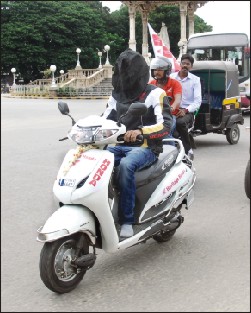
Seated blindfolded on a Honda Activa scooter, M.K. Sudarshan Jadugar, aged 21, resident of Lashkar Mohalla, today rode blindfolded from Siddalingapura to Srirangapatna and returned to Columbia Asia Hospital junction later today, after riding blindfolded for nearly 30 kms. Earlier, he did a trial run near the Palace.

Originally, Sudarshan was supposed to ride blindfolded from Mysore to Srirangapatna. However, he was denied permission by DCP M.M. Mahadevaiah who told Sudarshan to undertake the drive from Siddalingapura.

Before proceeding to Siddalingapura blindfolded, Sudarshan this morning offered pooja at Kote Anjaneya Swamy temple to symbolically begin his blindfolded ride in the presence of Ilai Alwar Swamiji and his friends and sponsors including Heritage Honda in city.

It is said that Sudarshan, who is aiming at entering into the Limca Book of Records, had ridden a bicycle blindfolded across the city in 2008 after being inspired by a show by magicians Ramesh and Uday while he was in a hospital.

Sudarshan, accompanied by an ambulance, an auto making announcement and a few friends on their bikes, claims that he would not violate any traffic rules during his blindfold ride including following traffic signals.

M.K. Sudarshan Jadugar is the son of M.K. Keshavamurthy and Vijayalakshmi, residents of Lashkar Mohalla in city.

source: http://www.starofmysore.com / Star of Mysore / Home> General News  / July 09th, 2014

Nirmala Bharat special drive launched

Rural Development Minister H K Patil said, a target had been set to free Karnataka of open defecation by 2018.

He launched a special drive under Nirmala Bharat by inaugurating a toilet at Keelara, near Mandya, on Monday. He said, the government hoped to construct 10 lakh toilets this year and this target could be achieved if one lakh of them were constructed in Mandya district.

“Under Gaurava scheme, the government plans to construct one lakh units, which would comprise of bathrooms as well as toilets. To make toilets user-friendly for senior citizens and physically handicapped persons, western commodes will be fitted in toilets, wherever necessary,” he said.

Drawing a comparison between south and north Karnataka, Patil said, the southern districts were lagging behind in implementation of various government programmes and schemes.

Directing the officials to lay stress on implementing the programmes, he said, even people demanded only roads and bhavans here. “They do not care to seek grants for playgrounds, drying yards, toilets, etc.”MP C S Puttaraju said, some shameful incidents had occurred in the district due to the lack of toilets, so people should take the issue seriously and make use of the scheme judiciously.

source: http://www.deccanherald.com / Deccan Herald / Home> District / DHNS – Mandya, July 08th, 2014