Rowing: Maharashtra, Karnataka win 2 golds each

Karnataka and Maharashtra won two gold medals each in the sub-junior and 17th Challenger sprint national rowing championships here on Friday.

Karnataka’s T.K. Keerthana claimed top spot in the girls’ single sculls event in the sub-junior category, and the senior men combination of K. Shiva and T. Madhusudhan Gokul added a second gold for the State in the double sculls.

The Maharashtra sub-junior team won the boys’ pair in 1:48.46s, and the senior women clinched the challenger double sculls in 1:56.97s.

The finals of 10 events will be held on Saturday, the concluding day.

The results (winners only):

Boys: U-13: Double Sculls: West Bengal. Sub-junior: Pair: Maharashtra. Men: Challengers double sculls: Karnataka. Girls: Sub-junior: Single sculls: Karnataka. Pair: Andaman and Nicobar. Under-13: Double sculls: Assam.

Women: Challengers pair: Orissa. Challengers double sculls: Maharashtra

source: http://www.thehindu.com / The Hindu / Home> Sport> Other Sports / by Sports Reporter / Bangalore – May 31st, 2013

When art form emerges from plain wood …

WoodBF05may2013

The exquisite and intricate artwork of wood inlay is no new thing to the city of Mysore. An art form renowned as Mysore Inlay and existent in the city since ages now, such is its beauty that it was once encouraged by the royals of Mysore in a big way.

This encouragement and demand for a work so dexterous inspired many, as a result of which, the count of wood inlay artists in the city only began to grow.

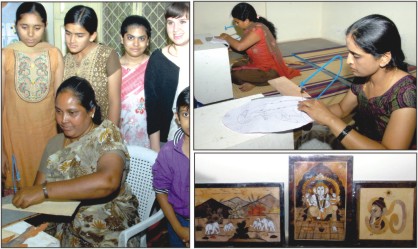
And one such artist from Mysore for whom the art of inlaying has become a way of life is Florence Ruth. Aged 37 and indulged in the artistry ever since she was a child, ask her what made her take to the wood inlay work and she humbly gushes, “I had to naturally take to it as I grew up watching the members of my family work on the same. As I ended up scoring less marks in my Pre-University, I had no option but to get into the artistry. However, I slowly started working it on a regular basis and today I am all into it and it has become a way of life for me.”

Wood Inlay work is a method of etching figurines in woods of different hues and embedding them in a rosewood frame to give it a final touch. “Each art piece that we create reflects a story. And accordingly, we select the wooden pieces of the right colour to etch the figurines and finally embed them all in the rosewood frame.” But this is no easy job she adds. “Äs we do not use any paint to add colour to the figures in the story, we will have to select woods of various hues and match them accordingly. But all thanks to nature, we have woods available in all the beautiful colours we require.”

What adds to the beauty of it all is that it continues to be a popular art form in practice in Mysore city even to this day. “There are thousands of inlay artists in the city,” says Florence, “and there are people who continue to produce the art pieces as beautifully as it was done ages ago, all thanks to the artists to whom the artistry has been passed on by their ancestors. So we need not really fear that the art form would fade away in city one day. But we artists of the present generation should continue working and ensure that the artistry is passed on to our next generation.”

And to ensure that she does her duty. Florence Ruth has been currently training a bunch of enthusiasts in the Indira Gandhi Rashtriya Manav Sangrahalaya (IGRMS) premises on Irwin Road in the city since a week now. What’s more, to promote wood inlay work, the lady has also toured across the nation; Courtesy: encouragement from IGRMS, to promote the art form.

“I have been to Bhopal, Kerala, Ooty and a few other places in India. And I feel happy that the institute thrives to promote not just the art but also small time artisans like me,” she says. The ongoing training programme at IGRMS ends on Sunday. [IGRMS may be contacted on Ph: 2448231.]

source: http://www.starofmysore.com / Star of Mysore / Home> Feature Articles / by Ambika Nagaraj / May 30th, 2013

Infosys trains uni professors to bridge India’s education gap

 Faced with the reality that fifty percent of India’s hundreds of thousands of tertiary graduates are unemployable, Infosys is addressing the imbalance by training professors at poorly regarded universities.

Mysore , INDIA:

To address the growing issue of unemployable graduates, Infosys is directly working with lower ranked universities to ensure that new recruits hit the ground running.

Education and research principal S. K. Iyer told ZDNet at the Indian outsourcer’s 340-acre purpose -built campus that the Campus Connect program trains university and college professors how to produce talent attractive to employers.
A recent study by consultancy firm Knowledgefaber found that 50 percent of school-leavers, predominantly from lower-tier 2 and tier 3 colleges, are unemployable .
Infosys, which employs thousands of “freshers” every semester, has increasingly targeted these overlooked institutions to address the imbalance, Iyer said.
“We invite the professors to stay for a month or so, provide them all the training facilities, and show them how to teach from the industry’s perspective,” according to Iyer, who teaches several subjects at the Mysore campus.
“The tiers today may not be so relevant. I do get very bright students from tier 3 colleges and they shouldn’t be ignored or left without the opportunities, or prestige, that are afforded to tier 1 and 2 students,” said Iyer who previously taught at an Indian Institutes of Information Technology (IIT) institute, part of the country’s top group of universities.
If a particular college alumnus has performed well in training, retention, and as an overall contributor, Infosys will return to the institution and professor to recruit more students.
The main focus is on practical experience rather than theoretical knowledge, and when it comes to identifying talent Infosys has one rule: consistency and performance.
Students must demonstrate steady marks–minimum 75 percent–throughout middle school, high school, and senior college. This is because the outsourcer trains “generalists, not specialists.”
“We don’t want a situation where we have someone trained in a particular skill but there’s no job for them. We need to use our resources effectively,” Iyer said.
source: http://www.zdnet.com / ZD Net / Home> IT  Employment / by Mahesh Sharma / May 31st, 2013

Australian delegate finds business potential in Edn. & Tourism in city

MCCI President Sudhakar Shetty, Austrade delegate K.N. Roopa and MCCI Hon. Secretary M.C. Bhansali during an interaction today.

Mysore :

The Business Development Manager from the Australian Trade Commission (Austrade) office at Bangalore, K.N. Roopa, who is in city for business-exploration, seemed to be highly impressed with the potential for education and tourism sectors in the city.

Speaking at the round-table meeting of the members of Mysore Chamber of Commerce and Industry (MCCI) and key companies, organised by MCCI at their office on Devaraj Urs road this morning, Roopa said that there was ample potential for business development and exchange in the fields of education and tourism in Mysore and emphasised on the need for an eco-system between the two countries.

She also invited a delegation of industrialists to Australia for a guided business exploration in the continent and said that the Austrade will help in skill development and R&D in the industrial sector.

MCCI President Sudhakar Shetty, delivering the keynote address, said that Australia is not only an advanced nation but also the happiest nation in the world as the education system there emphasises on skill development from the school level itself. Many of our industries have suffered because of the lack of skilled labour, he opined.

MCCI Past President and FICCI member R. Krishna also spoke on the occasion.

MCCI Secretary M.P. Bhansali welcomed the guests and Vice-President A. Satish proposed a vote of thanks.

source: http://www.starofmysore.com / Star of Mysore / Home> General News / May 30th, 2013

Bangalore records highest number of residential launches

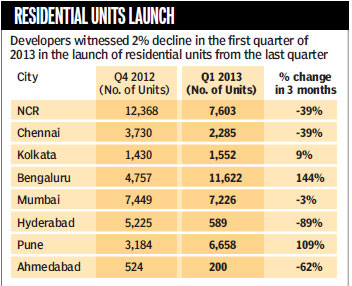
Developers across the country launched an estimated 38,000 residential units in the first quarter of 2013, an almost 2% decline from the previous quarter due to factors such as sufficient availability of stock, subdued demand and delays in regulatory approvals in certain markets.

Bangalore saw the highest number of launches in the first quarter at 11,622 units contributing close to 31% of the overall new supply in the top eight cities followed by NCR that saw 7,603 units being launched and Mumbai with 7,226 units, according to a new report by global real estate consultancy, Cushman & Wakefield.

ResidentialBF02jun2013

The NCR market saw a 40% decline in new launches over the last quarter. While Gurgaon accounted for 66% of the new launches, Noida saw only 34% launches — a decline of close to 70% due to subdued demand. This was also the main reason for the overall decline in the number of launches in Delhi NCR. Close to 80% units launched were in the mid-range segment, the report said.

Both Bangalore and Pune witnessed the highest number of unit launches (almost double) in the first quarter at 144% and 109% respectively. Hyderabad witnessed close to a 90% decline.

source: http://www.hindustantimes.com / Hindustan Times / Home> focus business> real estate / by Vandana Ramnani, Hindustan Times / New Delhi – May 24th, 2013

Transcending barriers for creativity

A Sharadhaa chances upon the success story of a spirited group of visually-impaired dancers | EPS

For the visually impaired, disabled and underprivileged youth, life is often a confrontation, with challenges coming in multitudes unlike an abled man or woman. It is often left to the individual alone to face these barriers and rise above his or her disability. There are many stories of such people who challenged life and overcame their incapability, either on their own or with a little support.

For a group of 14 people, being able to recognise the creative side in them, has taken them across the world; recognition coming in all forms.

Sunadha is a cultural group which was established in 1999 comprising visually impaired performers talented in dance, singing and mimicry. The group is an effort by Samarthanam Trust for the disabled. The group has performed classical and folk dances across India, US, UK, Malaysia and Thailand. Their popularity has increased by the year, so much so that they now embark on an annual two-month tour to the US and UK to showcase their talent.

The troupe has also won several awards including the first place at the All India Dance competition held in November 2010 in New Delhi. The troupe has nine dancers, four singers and a mimicry artist. The team is usually invited by corporates to perform as part of their corporate social responsibility initiative.“In 1999, Sunadha started its first cultural programme project outside India and our first programme was in the US for Veerashaiva Convention. Senior actor Shivaram accompanied us and made it a grand success,” said Vasanti Savanur, a 58-year-old volunteer and a trustee who has been travelling along with the troupe for the last 14 years.

“There is no fixed remuneration for the group. However, a minimum amount of `25,000 is charged for a performance of about an hour. The travelling and accommodation expenses are borne by the inviting party,” said Vasanti.

Recently, the troupe visited Malaysia where they performed for a month at every Sai Baba temple. “The main event was in Kuala Lumpur where they gave a two-hour performance in groups,” said Vasanti. For these students, performing at various shows has given plenty of exposure and for some, it has become their livelihood. “I have learnt a lot while I travel with them. This year, they have been invited by the Tamil Association in Dubai. We will be leaving in the month of September. I have almost attended 500 programmes with many groups and wherever we have gone till date, we never felt like outsiders. There are many challenges though. Sometimes their health dips but they don’t mess the programme. Their performances have left many people dumbfounded,” said Vasanti.

The group has also been trained to address another challenge – etiquette. “Since they participate in programmes that happen in India and abroad, they trained on how they should behave,” she said.

The spirited team

The troupe has Suma who is a visually impaired artist and has learnt the skills of Bharatanatyam, classical, folk, filmy, etc. She hails from Hiriyur, Chitradurga district. Suma has completed her degree in commerce from a reputed college in Bangalore and is a good dancer who has performed in Australia, Italy and the US as well as at prestigious events like the Hampi and Anegundi festivals.

“Initially we had a volunteer, Anumpama Jaisimha, who started teaching us Bharatnatyam. Then, we had Dr Raksha and, at present, it is Jai Lakshmi, who is handling the team. We have classes for three days in a week and we are taught only in the evening after our school and college hours,” said Suma who further added, “Public appreciation is our motivating factor. There were times when people have cried after our performance. We catch the enthusiasm when the audience appreciates. I never feel that I am blind when I participate in these shows.” For another special girl, Jayalakshmi, dancing was something that developed at a tender age. “I never had the opportunity back then, being disabled. But today I am glad to be part of the troupe,” she said. Lingaraju is the only male artiste in the dance troupe.

“He is visually impaired and hails from Tiptur. He started learning classical dance when he was only seven. Now, 22 years old, Lingaraju is an accomplished dancer. For more than seven years, he has been pursuing his passion for dance. In December 2010, he picked up the first prize for his performance at a national competition for the visually impaired,” said Vasanti.

The troupe is supported by a group of 12 singers and musicians, who are also disabled.

source: http://www.newindianexpress.com / The New Indian Express / Home> Cities> Bangalore/ by A Sharadhaaa— sharadhaa@newindianexpress.com – Bangalore / May 25th, 2013

Bengaluru’s connection to Nobel prize in Economics deepens

2013 ELINOR OSTROM AWARDEE – HARINI NAGENDRA

Bangalore ecologist Harini Nagendra is a 2013 Elinor Ostrom awardee, instituted in the name of the 2009 Nobel Prize winner.

For Bangalore-based ecologist Harini Nagendra, whose name has just been announced as a winner of the 2013 Elinor Ostrom award, it is a bittersweet moment.

Harini Nagendra and Dr. Ostrom at Kaikondrahalli Lake. Pic: Priya Ramasubban.

The award has been instituted in the name of Elinor Ostrom, the USA-based scholar who received the Nobel Prize for economics in 2009 for her long standing body of work on the governance of the commons. For Harini, Elinor was, apart from being one of the most brilliant, incisive and deeply humanistic scholars, a very dear friend, collaborator and mentor with whom she worked closely for 12 years. Says Harini, “The award (being) in Lin Ostrom’s name, and is a great honour.” Elinor passed away just a year ago in June 2012.

The very first 2013 Elinor Ostram Award  on Collective Governance of the Commons goes to eight individuals and organisations from around the world, including Harini. The award is given by a consortium of 15 international organizations including the UNESCO Man and Biosphere programme, Resilience Alliance and the International Association for the Study of the Commons. Harini will receive the award at IASC conference in Mt. Fuji, Japan, in early June.

The award has been given at end of a process in which experts and an awards council received many candidates and carefully evaluated them in three consecutive rounds.The other laureates are: Foundation for Ecological Security, the Open Spaces Society, Grupo de Estudios Ambientales A.C., Harini Nagendra, Ben Cousins, Charles Schweik, Eduardo Araral and Michael Cox.

Elinor Ostrom had a deeper connection to Bangalore. She had been herself studying lakes in the city and had deep insights into the way forward for citizen action on lake preservation. She passed away in Indiana, United States, mid last year after a short and intense battle with pancreatic cancer. During her trip to Bangalore in February 2012, she visited Kaikondrahalli lake on Sarjapur Road . Kaikondrahalli lake was restored through a collaborative effort by local communities and the BBMP, was one of the sites of research for Harini.

The consortium notes on its website that the Elinor Ostrom award is “to acknowledge Ostrom’s legacy for scholarship and policy-making while making it accessible to wider and more varied audiences, within and outside of the academia”. It also wants to promote academic research on the commons, collective action, and related institutions, as well as its application to the understanding of the governance of different types of commons. The website adds that the awards were also instituted to “multiply the impacts of Ostrom’s proposals on scholarship and policy-making, making her legacy a living one.

For her part, Harini has authored articles in Citizen Matters on environmental issues of Bangalore, and her July 2011 article chronicling the city’s green battles in detail is still an important read for those who want to understand how the city communities have been standing up to grave threat of losing lakes and green spaces to unregulated urbanisation.

She is currently a scholar at Bangalore-headquartered Ashoka Trust for Research in Ecology and the Environment or ATREE, and is also holds an Asia-level research position at Indiana University.
Harini, 41 studied at Bishop Cottons Girls School, Bangalore and National Public School Indiranagar. After her BSc from St. Joseph’s College of Arts and Science, she completed MS in Biological Sciences and PhD in Ecology from Indian Institute of Science. The mother of a 5 year old and National Geographic Conservation Trust grantee has said, “If anything I can do, in collaboration with others, can make the smallest dent in the situation-the likelihood of a better world for my daughter’s generation is worth it in and of itself.

source: http://www.bangalore.citizenmatters.in / Citizen Matters, Bangalore / Home> City> People / by News Desk / Citizen Matters – May 24th, 2013

Bangalore girl is medical topper

Subha Ashok
Subha Ashok

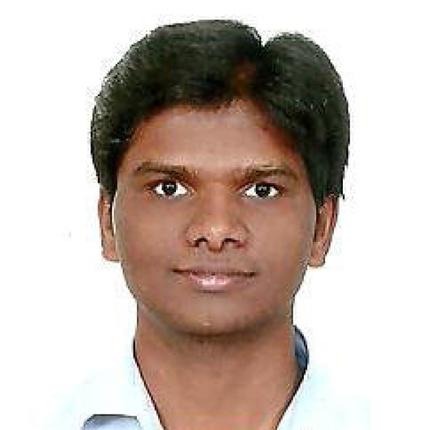
Bangalore girl Subha Ashok topped the test for the medical stream in the Postgraduate Entrance Test (PGET) held by the Consortium of Medical Engineering and Dental Colleges of Karnataka (COMEDK), the results of which were announced here on Monday.

COMEDK released the rank list for the test held on February 3 following the Supreme Court order allowing for examination authorities to do so.

comedk30may2013

Ms. Ashok, who was travelling, said that the result was a pleasant surprise.

“COMEDK PGET was the easiest. I will wait for the results of State PGET (conducted by Rajiv Gandhi University of Health Science). Persistent preparation is the key and I concentrated only on entrance tests,” she said.

The daughter of Kalyani Ashok, a special educator, and A.C. Ashok, principal and dean of M.S. Ramaiah Medical College, Ms. Ashok said that she would like to pursue surgery or radiology, preferably at the Karnataka Institute of Medical Sciences, Hubli, from where she graduated in 2012.

Harish C
Harish C

Bangalore got another rank with Harish C., a graduate of M.S. Ramaiah Medical College, coming third in the medical stream. His NEET-G rank was 40. He said that he was also hoping for a government quota seat as a COMEDK seat was expensive.

Aiming to pursue orthopaedics in KEM Hospital, Mumbai, he said that he spent six to eight hours everyday studying. “It is better to be consistent than going to coaching centres,” he said.

Santosh Narayanan
Santosh Narayanan

Santosh Narayanan, who stood second, graduated from A.J. Institute of Medical Sciences, Mangalore, with 17 gold medals — the highest given to an individual — in the recent RGUHS convocation. He is a native of Kerala.

Dental exams

Meanwhile, only one student from the State managed to make it to the top 10 in dental. Soumya P.V., a graduate of the 2010 batch of KVG Dental College and Hospital, Sullia, came fifth. A native of Kerala, she has now settled down in Bangalore with her endodontist husband. She is also awaiting the State PGET results. Top ranker Jeswin James is from Kerala, while the second and third ranks went to Vikas Sandilya from Udupi and Srirengalakshmi M. from Madurai, Tamil Nadu.

Breakup

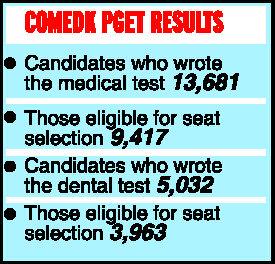
Of the 13,681 candidates who wrote the PGET for medical, 9417 became eligible for seat selection. Of these, 2534 candidates are from Karnataka and 6,883 are from other States. As many as 5,032 wrote the dental PGET; 3,963 have become eligible for participating in the counselling process. Of these, 518 are from the State and 3,445 are from outside.

Counselling will begin on May 27. Details are available on www.comedk.org

source: http://www.thehindu.com / The Hindu / Home> News> Cities> Bangalore / by Staff Reporter / Bangalore – May 21st, 2013

Karnataka’s popular Mavalli Tiffin Rooms to open first restaurant in Singapore

Bangalore, (ANI) :

Decades ago, elderly Bangaloreans used to take their morning walk around the Lal Bagh Fort, and at the end of it, visit the Mavalli Tiffin Room, known more popularly as MTR, for their breakfast. On some days, the Tiffin Room used to be full and one had to wait in a queue.

One could see persons belonging to the rich, middle and lower middle class waiting in the queue, waiting for their turn. There were no reserved tables. Till the end of the last century, Bangalore used to be a ‘fanless’ city, leave alone air-conditioning.

A good breakfast, for a Bangalorean, cost hardly a couple of rupees. It used to be rounded off with a warm glass of coffee.

The demand for MTR cuisine became so pressing that it had to prepare packed ingredients at their ‘factory’ near Bangalore. The packed food became a major attraction following the ‘research’ done by the Defence Research Laboratory in Bangalore in the sixties to ensure that the Indian soldier serving in far-flung posts along the northern border could have healthy food.

When MTR could prepare more food that was demanded by the armed forces, it decided to market the same in retail across India. Today, you can buy from the shelf, the ingredients for ‘Idli, Upma, Sambhar, Vada, Gulab Jamun and Kheer, to name only a few.

While other Tiffin chains, like the Woodlands, Dasaprakash, Udupi Hotels, the Sagar Ratna, Naivedyam, Ananda Bhavan and Sarvana Bhavan, to name a few, opened their branches all over India and abroad, the MTR did not. It is news now that the chain is opening a branch of the MTR Tiffin room in Singapore of all places.

Indian food consists of a wide variety of regional cuisines native to India, and given the range of diversity in soil type, climate and occupations, these cuisines vary significantly from each other and use locally available spices, herbs, vegetables and fruits.

Indian food is heavily influenced by religious and cultural choices, and the cuisine is popular not only among the large Indian diaspora, but also among the mainstream population of North America and Europe.

Apart from Europe and North America, Indian cuisine is also popular in South East Asia, because of its strong historical influence on the region’s local cuisines.

Indian cuisine has had considerable influence on Malaysian cooking styles and also enjoys strong popularity in Singapore.

It, therefore, comes as no surprise that Karnataka-based Mavalli Tiffin Rooms, known more popularly as MTR, which has been serving authentic South Indian food, is opening its first restaurant in Singapore on May 26.

India’s High Commissioner to Singapore, T.C. A.Raghavan, will be the chief guest at the opening ceremony of the restaurant  that is located at 438, Serangoon Road, opposite the Sri Sininivasaperumal Temple.

Mavalli Tiffin Rooms (MTR) was started in 1924. It was set up near Lalbagh Fort, Bangalore, by two brothers-Yajnanarayana Maiya and Ganappaya Maiya, who came down from from a place called Parampalli, near Udupi, Karnataka.

In 1936, Ganappaya Maiya decided to go back to Parampalli and Yajnanarayana Maiya assumed full charge of the restaurant .

It was originally called ‘Brahmin’s Coffee House’, but the name was changed when it was shifted to a bigger premises in 1960.

In 1950, Yajnanarayana undertook a European tour to see for himself how restaurants in other parts of the world functioned.

The cleanliness and hygiene there opened his eyes. He resolved that MTR would adhere to the same standard of cleanliness.

He distributed small booklets on health, proper eating habits and recipes. He introduced the system of opening up of the kitchen to the scrutiny of any customer who was interested.

In 1968, Yajnanarayana Maiya passed away and the restaurant was taken over by his nephew, Harishchandra Maiya.

1n 1976, at the height of the Emergency in India, the government called five of the most well known restaurants in Bangalore, including MTR, and told them that they had to reduce the prices of food at their restaurants according to government approved rates, to bring it within the reach of the common man.

The prices of the items were to be the same in all restaurants. Some restaurants paid up, others started compromising on the quality, but MTR did neither.

It kept the quality of the food as high as ever and put up a board stating the losses for the day outside the restaurant.

This practice continued for 16 days, and on the 16th day, MTR downed its shutters, and opened a small departmental store next to the hotel, from where it sold mixes for rava idli and other items.

The restaurant opened again after the emergency was lifted.

The food safety and quality assurance policies of MTR are their commitment to excellence.

Raw ingredients are selected after a careful process of quality checks and satisfying various food science attributes before the processing begins in their kitchen.

The preparation of food in MTR’s kitchens is based on traditional recipes complimented with food technology principles to blend old world charm of traditional Indian food with swift processing and consistent taste.

With the storage and supply chain dynamically based on “KAIZEN” principles, the following are the USPs of MTR – finest ingredients; all food freshly prepared; no preservatives added; no mono-sodium glutanate (MSG) and no use of eggs or reused oil. (ANI)

source: http://www.newstrackindia.com / News Track India / Home> Society / by ANI / Bangalore  – Thursday, May 23rd, 2013
Five cops receive ‘Best Police Constable’ Award


City Police Commissioner K.L. Sudheer, who presented the Best Police Constable awards to (sitting from left) Gurudevaradhya, Rame Gowda, Venkata Ramu, Babu Lokanath and Vanajakshi, at a function in city last evening, is seen with Inner Wheel West President Thein Perumal, Rotary West President Rtn. V.N. Prasad, Secretary Rtn. V.G. Nagaraj, Rtn. Dr. Jayaram and Inner Wheel West Secretary Jyothi Mukesh.

Mysore :

Five cops were honoured with the ‘Best Police Constable’ award for their services by Rotary Mysore West and Inner Wheel Club of Mysore West at Hotel Regaalis in city yesterday.

City Police Commissioner K.L. Sudheer presented the award to Babu Lokanath from Udayagiri Police Station (Law & Order Branch), Rame Gowda from Kuvempunagar Police Station (Crime Branch), Venkata Ramu from K.R. Police Station (Traffic Branch), Vanajakshi from Vijayanagar Police Station (Investigations Division) and Gurudevaradhya from Mysore City CCB.

Speaking later, Sudheer said Police protect the society from untoward happenings by toiling day and night. It is laudable that such cops are recognised and honoured by associations and clubs, he added.

Due to the hard work of the Police, the elections to both the Urban Local Bodies and State Assembly could be conducted smoothly, he said appreciatively.

Nowadays, more than higher officials, even Police Constables have higher education like degree and post-graduation and are well-versed in technology.

About 80 per cent of Constables do not have proper resi-dential or even basic facilities like higher officials, yet they do their work efficiently and maintain peace in society, Sudheer said praising his department’s staff.

source: http://www.starofmysore.com / Star of Mysore / Home> General News / May 22nd, 2013