The 8 ft. tall stone sculpture spreads message of oneness; Former CAVA student designs art work
(Top Left ) Stone brought from Sadarahalli being lowered at the circle in Nazarbad. (Top Right) The sketch drawn on the stone for carving the sculpture. (Bottom) The sculpture that symbolises ‘Welcoming all’ to spread the message of oneness.
Mysore :
A stone sculpture spreading the message “We are all one” has come up in Nazarbad making it as one of the attractive circles in city.
Mysore, known as the Cultural Capital and Heritage City, has added another artistic circle spreading the message of oneness.
The circle is named after late Dr. H.C. Vishnumurthy, Founder of Gopala Gowda Shanthaveri Memorial Hospital, who was also a writer, thinker and a social reformer.
Former MLC D. Madegowda had urged the MCC to name a circle or a road in the surroundings of the Hospital after Dr. Vishnumurthy and the MCC during a meeting decided to name the new circle opposite Ginger Hotel in Nazarbad after Dr. Vishnumurthy.
K. Lokesh, a BFA graduate in Graphic Designing from CAVA and a resident of Kuvempunagar in city, designed the art work. Speaking to SOM, he said that it was decided to install an unique stone sculpture at the circle as the family members of Dr. Vishnumurthy had told him that the sculpture should spread the message of oneness to the public.
According to their instructions, he created a design and showed it to them which they accepted. He further said that a 10 ft. height stone which was six feet wide and weighing nine tonnes was brought from Sadarahalli to the city and sculptor Roopesh with the help of two other artists created the sculpture in 25 days.
The sculpture is now 6 ft. tall, five feet wide in the bottom and three feet wide on the top with a carving of a human spreading the hands etched into the stone. “The open hands symbolises welcoming everyone and is a abstract work,” said Lokesh.
The MCC wanted a statue of Dr. Vishnumurthy to be installed but Dr. Rekha, wife of late Dr. Vishnumurthy and family members did not want that. Instead, they requested the MCC to install a artistic sculpture spreading the message of oneness in society. They also wanted an artistic sculpture as it went with the idea of Mysore being a cultural city.
Interestingly, the family also told the MCC that since there is water scarcity, the circle be developed as a dry one by using pebbles to decorate the circle instead of plants.
Dr. H.V. Santhrupth, son of late Dr. Vishnumurthy, speaking to SOM, said that he was grateful that the MCC and Mysoreans had acknowledged the contribution of his father to health care, education and literature. He said he was also thankful that the MCC agreed to his family’s request not to install a statue or bust of his father and instead have put a artistic sculpture.
Dr. Santhrupth also added that it was time the MCC created circles that were artistic and added ” It not only encourages artists, but also become a taking point among tourists and Mysoreans. It will also promotes Mysore’s image as an cultural and heritage city.
source: http://www.starofmysore.com / Star of Mysore / Home> General News / August 05th, 2014
It looks like Basavanagudi is lucky to have a good water table with a lot of open wells capable of providing water to its residents right through the year.
The Indian Institute of World Culture is located in the locality of Basavanagudi, one of the oldest layouts formed in the city in the 1890s. The road on which the building is situated is called the B.P. Wadia Road and is named after the founder of the IIWC, which was established in 1945. There is an excellent library for adults and for children on the rather large campus with the typical old style Bangalore building. Many old timers come to listen to lectures organised in the evenings on various topics. I was there to speak on the culture and tradition of the open well in India.
Since I was early I wandered about the premises speaking to the person looking after the garden and the premises in general. Casually I asked him if there was a well in the area. To my surprise not only did he take me and show me a functioning well but also assured me that the water was crystal clear and sweet.
The well, safely enclosed in a pumping room, dates at least to the 1940s and has been supplying water unfailingly ever since. Devaiah also told me about a large stone lined and stepped open well next to the building which was also there for long. It has now been filled up and a multi-storeyed apartment has come in its place. The apartment has drilled a borewell to supplement its water needs.
Two recharge wells
The Institute has done a nice thing for the well. It has taken all the rooftop rainwater from the two large building blocks on its premises and put it into two recharge wells 10 ft. deep. This ensures that the entire rainwater goes into the aquifer, thus enhancing groundwater levels.
In front of the Institute is the famous M.N. Krishna Rao Park. Here also is a water reservoir of the Bangalore Water Supply and Sewerage Board (BWSSB). This reservoir is filled daily from waters of the Cauvery a 100 km. away and 300 metres below the city. Ironically it also probably sits on a shallow aquifer with a high groundwater table that it ignores.
The area now known as Gandhi Bazaar was built upon a tank called Karanji Tank. This is close to the Institute. On the other end, not far away, is the Lalbagh Lake. Hyder Ali began the famous Lalbagh gardens with three wells for irrigation, says the traveller and chronicler Buchanan. It looks like Basavanagudi is lucky to have a good water table with a lot of open wells capable of providing water to its residents right through the year.
It only remains that we remember the well as a source of good and cheap water, that we protect and preserve the catchment so as not to pollute the resource and that we enhance it through rainwater harvesting measures. Areas such as these should be designated as groundwater sanctuaries and the groundwater legislation used to sustainably maintain that most precious of all resources for this city — water.
As a famous writer once said, this is a fight between memory and forgetfulness. The memory of the well must be retained and must be integrated with modern water needs but in ecological fashion.
source: http://www.thehindu.com / The Hindu / Home> Features> Habitat / by S. Vishwanath / August 08th, 2014
K. Shruthi of Shimoga with 5.5 points from six rounds won the title in the Karnataka State Women’s Chess Championships 2014, conducted by Mysore Chess Centre jointly with MDCA, SKR Foundation and Celestial Minds Chess Club, here on Saturday.
Isha Sharma of Dakshina Kannada finished second with 5 points while Shalone Joame Pais of Mangalore took the third place with 4.5 points. Mysore girl H. R. Manasa finished fourth with 4.5 points.
Final Placings: 1. K. Shruthi Shimoga-5.5 pts); 2. Isha Sharma (D.K-5 points); 3. Shalon Joame Pais (M’lore-4.5 pts); 4. H R Manasa (Mys-4.5 pts); 5. B N Gangamma (Mysore-4.5 pts); 6. I Sharanya (B’lore-4 pts); 7. R Neha Ananth (Mandya-4 pts); 8. Supraja M (Mys-4 pts);9. Hemadri S (3.5 pts); 10. S P Varshitha (Mys-3.5 pts).
U-15: 1. K. Pooja (3 pts); 2. Aneesha Satish (3 pts). U-13: 1. Akshatha Raju (3 pts); 2. K. N. Sanjana (3 pts); U-11: Chandana Prasad (3 pts); 2. Shriya M. Jaju (3 pts); U-9: 1. A.N. Shefali; 2. K.G.R. Anagha; U-7: 1.Dhatri Umesh; 2.Niharika Chandru. Best Veteran: K. R. Preemaleela (3.5 pts); Best Mysore Player- Vidya Nachappa (3 pts); Best Club-Mysore.
source: http://www.starofmysore.com / Star of Mysore / Home> Sports News / August 04th, 2014
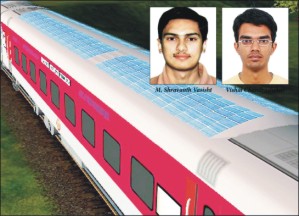
The students of The National Institute of Engineering (NIE) in city always come up with innovative ideas, keeping in mind their contribution to sustainable development. A young engineering graduate from NIE,M. Shravanth Vasisht, had designed Solar-Assisted Power Supply System for rail coaches as part of his academic project in the year 2010, which is now being implemented by the Indian Railways.
Young engineers from city M. Shravanth Vasisht, an Electrical and Electronics Engineering graduate from NIE, Mysore and Vishal Chandrashekar, a Mechanical Engineering graduate from PES College of Engineering, Mandya, have designed Solar-Assisted Power Supply System for Linke Hofmann Busch (LHB) Rail Coaches such as Rajdhani, Shatabdi Express, etc.
Speaking to SOM, Shravanth said that in 2010, as an academic project during the course of engineering at NIE, he had designed this System under the guidance of Dr. B.S. Sridhar, Scientist, Food Engineering Department, CFTRI, Mysore and A. Dhanyavathi, Associate Professor at NIE.
He said that this project was now initiated by him at the Indian Institute of Science (IISc.), Bangalore, along with another Mysorean, Vishal Chandrashekar, under the guidance of Prof. J. Srinivasan and Dr. Sheela K. Ramasesha and added that this would give a boost for the improvement of Railways, about which he had been very keen since 2010.
He said that the idea of installing solar panels on a car was given by Dr. Sridhar and the same was then extended for the conventional rail coach manufactured by ICF, Perumbur in Chennai. He said that this was written as a thesis and submitted to CFTRI and NIE.
A technical paper on the same subject by three authors (Shravanth, Dr. Sridhar and Dhanyavathi) was published in Electrical India in 2011.
When asked, Shravanth said that they found the implementation of solar PV system for a LHB rail coach to be more beneficial as they use EOG (End on Generation) System and added that EOG Scheme of power supply for rail coaches use two diesel generator cars on either ends of the train and their diesel consumption raised their eyebrows.
Coincidentally, a train consisting of LHB hybrid coaches was flagged off between Indore and Yeswantpur which was the first of its kind for South India and second train in India, he said and added they found LHB coaches were of a superior technology and felt that all the conventional rail coaches in India could be replaced by LHB coaches.
Elaborating further, Shravanth said that they felt that these were going to be the next diesel sucking culprits for the country which made us re-initiate this project at our workplace in IISc., where they spoke to their guides Prof. J. Srinivasan, Chairman, Divecha Centre for Climate Change, IISc. and Dr. Sheela K. Ramasesha, Research Scientist, IISc., who then provided a lot of inputs.
He said that spending time on this involved a lot of risk as they were not sure that the Railways would support them, mainly because of lack of encouragement in research fields and pilot projects.
Coincidentally, Union Railway Minister Sadananda Gowda quoted on this idea and we were recognised by the Indian Railways and the work was examined by the Chief Administrator of Indian Railways Organisation for Alternate Fuels, Ministry of Indian Railways, he said and added that they are very much interested in involving us to implement the same.
He said implementation of this scheme may not be possible immediately, as it involves step by step analysis on various experiments like aero-dynamics, vibration analysis, performance of the system in various locations during the transit, reliable control system design, protection from the impact of stones thrown at trains, etc. and expressed confidence that it will be a success if there is cooperation from public.
When asked, he said implementation of this idea is not an impossible dream and neither a novelty and added that probably they would be provided with a coach to carry out experiments.
Speaking about the cost of installation, he said that once the project becomes a success through pilot projects, there would be too many players in the market who can provide better engineering solutions for the challenges that will be faced for implementation which would also reduce the cost of installation and operation costs. If this pilot project becomes a success, one will be able to see Solar Panels mounted on all trains, which will be saving around 90,000 litres of diesel per train per year.
Shravanth has been invited to give a presentation on the same at an International Conference at USA in September this year.
Shravanth is the son of V. Murali Madhav of CFTRI and M. Lakshmi while Vishal is the son of Arun Chandrashekar, a retired Scientist from CFTRI and Lalitha Rangarajan, Associate Professor at University of Mysore. Both Shravanth and Vishal, residents of CFTRI Layout in city, are working as research fellows on Solar energy at IISc.
source: http://www.starofmysore.com / Star of Mysore / Home> General News / August 04th, 2014
While the animal adoption scheme of Sri Chamarajendra Zoological Gardens has become a big hit among animal lovers, the University of Mysore is mulling over initiating ‘Plant Adoption’ programme in a bid towards nature conservation.
The green friendly plans in the making is part of the Green Campus programme undertaken by the university under the University for Potential Excellence. The previous UPA government had allocated Rs one crore for the plantation drive, and the varsity had received Rs 50 lakh, said, Prof V Ravishankar Rai, Coordinator of the programme.
Rai said that through the Plant Adoption programme, the varsity wanted to involve youngsters, especially students and general public to keep the green cover intact, and also enhance the same with exotic and ornamental plants.
The varsity will provide the sapling for free, and also the space at its 700 acre odd campus comprising Manasagangotri (PG campus), Maharaja’s College and Yuvaraja’s College, he added. He also said that people will be allowed to bring saplings of their own choice. “To develop a bonding towards the nature, they will have to nurture the plants on their own,” said Rai.
A similar endeavour has been taken up at Tumkur University as part of the curriculum. A student who successfully nurtures the plant will be given bonus marks. Similar activities have also been undertaken at a larger scale in several foreign universities, said Rai.
As part of the green drive, works were underway to develop gardens both with natural and mexican grass, besides planting flower bearing and fruit bearing saplings to develop the food chain for birds and flies.
In the last three years around 5,000 saplings have been planted in the campus by the Horticulture department of the varsity. Under the recent programme, 1,500 of the total 2,000 saplings have already planted. On Friday, the planting exercise was completed in the area surrounding the main building of University College of Fine Arts.
source: http://www.deccanherald.com / Deccan Herald / Home> District / by Sreekantswamy B / Mysore – DHNS, August 08th, 2014
This innovator made the solar lamp a vehicle not just for electricity, but for education and independence.
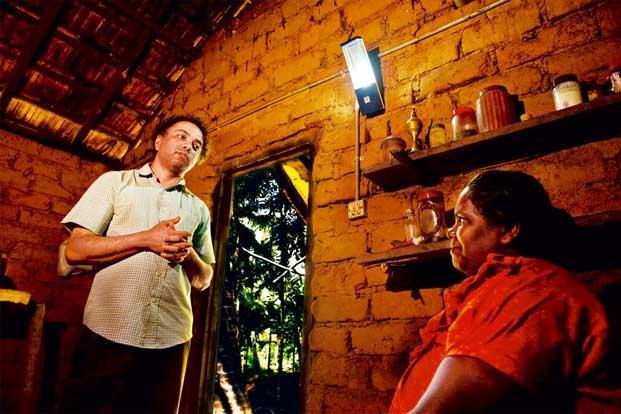
Harish Hande visits Rosamma Vergies in Vandse village, Karnataka. Her home is fitted with a two-light solar system. Photo: Gireesh GV
Freedom from darkness | Harish Hande
Harish Hande doesn’t care about electrifying India, he wants the solar lamp to transform this country. Of course he was pleasantly surprised when newly appointed Prime Minister Narendra Modi said he would back the growth of solar power so that every household in India has at least one lamp by 2019, but Hande has also observed, for the last 15 years or so, that the ministry of new and renewable energy unfailingly gets a new secretary every six months. “Some don’t feel it’s an attractive post, some are quickly shifted, some retire,” he says with the air of a veteran who has figured out how to make things work despite policymakers.
But these are all relatively minor niggles. Hande, 47, won the Ramon Magsaysay Award in 2011 because the ideas at Selco (Solar Electric Light Company—India), the solar energy equipment supplier company he co-founded in 1994, shine brighter than the lights it sells to the poor.
Take, for instance, Selco’s Light For Education project whose participants include around 30,000 children in Karnataka. Solar panels are installed on school premises and the battery, about the weight of a lunch box, is given to children. Children charge the batteries when they come to school. If they don’t come to school, there’s no light at home. “We stole the idea from the midday meals scheme,” says Hande. Stole and innovated.
Or the way Selco tackled the unique problem faced by a community of poor drum-makers in Bangalore. They were willing to pay for solar power, but they had one condition. They were often evicted, with only 15-20 minutes to gather their belongings. Could Selco design a system they could run with? No problem, a design school graduate who works at Selco conjured up a solar system on a cart.
Around 1.2 billion of the world’s population doesn’t have access to reliable electricity, and 400 million of these people live in India. Hande, who jokes that while growing up, his bread and butter came from a coal-fired plant in Rourkela (his father worked in power distribution at the Steel Authority of India), understood early that coal and gas wouldn’t be enough to meet India’s growing energy needs.
Yet, as an energy engineering student at the Indian Institute of Technology, Kharagpur, and a doctoral student at the University of Massachusetts, US, Hande’s interest in solar was restricted to its supply security dynamic (the sun as a source of energy is limitless) and its environmental impact. Until a visit to the Dominican Republic in 1991 taught him a new lesson in thermodynamics. He saw the poor paying for solar lights and realized that renewable energy could be a catalyst for social change. So he spent the next two years in Sri Lanka and India—in darkness.
He took time off to see how communities in both these countries lived without electricity. “I realized I didn’t know what happens after 6pm. We were just making decisions based on Excel sheets,” he says. He learnt a few things: The moment you don’t know a language (Sinhalese), the artificial hierarchies of a formal education crumble and you are treated like anyone else; none of his formal education was useful, except perhaps the confidence he had gained by living in a hostel. In Sri Lanka especially, communities came together after dark, usually in Buddhist temples, to vent their frustrations; in India, the lost time was usually spent in isolation and the kerosene lamp made people even more depressed. “It was my most efficient period of time, I joke,” he says. That’s also probably when he realized that the poor don’t want sympathy. They want partners and collaborators.
He worries about the hierarchies he believes English-speaking India imposes on the rest of the country. He knows he may not be able to influence the thinking of a top dog at a Bangalore-based research firm who asks him how he ever manages to have “intellectual discussions” in rural India. Or the suit who eagerly shares that his children “teach” their rural counterparts every weekend. But he hopes he can someday convince urban children to partner with fellow Indians who don’t speak their lingo. “How do I tell kids that we are all part of the same society? That they need to learn from each other to create some sort of social equity? How to make kids interested in solving problems?”
Selco gets hundreds of internship applications from masters’ and PhD students every year but very few are Indians. Of the 300 applications last year, five were from this country. “I’ve now resorted to guilt-tripping parents and students when I speak to them. In the next 10 years if you complain that Americans and Europeans know more about India than you do, then you are to blame, I tell them,” Hande says.
____________________________________________
“How do I tell kids that we are all part of the same society? That they need to learn from each other to create some sort of social equity?” _____________________________________________
At Selco at least, they try to break these barriers. Nearly 85% of Selco’s employees, including chief operating officer Mohan Hegde (a practising folk artist on weekends), come from rural India. Hegde and K. Revathi, president, have been running the company since 1 June when Hande retired as managing director to take charge of the Selco Foundation, the company’s think tank. All the brainstorming for solutions and innovations to help fight poverty takes place at the foundation. The business side executes the ideas and the company’s incubation cell teaches entrepreneurs how to replicate these successes across India (four projects are already under way in Manipur, Rajasthan, West Bengal and Madhya Pradesh; Selco is helping 25 more entrepreneurs raise funds).
Formal qualifications are not a prerequisite for any job at Selco. Twenty-eight-year-old Raghu, who greets me when I arrive and gets us tea at the Selco office in Bangalore, started out as a driver and now handles administrative duties. “He’s going to be a branch manager by the time he’s 32. That’s our goal for him,” says Hande. In rural areas they joke about Selco’s hires: Are you part of the laptop or the non-laptop crowd?
Hande checks all the boxes of someone who truly believes in sustainability. He doesn’t own any asset, he says he has about three-four pants and shirts, he borrows his father’s 1994 Maruti 800 when he needs a car, and his daughter Adhishri was 8 when she first started saying: “Is it needed or is it wanted?”
He got his cues from mentors like Neville Williams, his co-founder and a solar energy pioneer who made it to the CIA watch list after a trip to Vietnam to protest the “American War”; from photographer Jon Naar, who was a British spy in World War II; and from Paul Maycock, who predicted way back that the cost of producing solar energy would plunge by 2015. “These are guys who talked about sustainability in a very different manner. I miss their passion. Now you go to a meeting and it’s all about ties and suits.”
Hande sees the poor as asset creators, and not as a bottom of the pyramid sales opportunity. “Don’t sell to the poor. That’s our fundamental rule. And if you’re selling to the poor, make sure that the value you’re giving to the poor is much more than the monetary value they give you back,” he says.
So when Selco representatives found that 32 Sidi families in rural Karnataka spent more money annually on candles, kerosene and to charge their mobile phones than it would cost to set up a simple solar system, they had to fix this. No bank was willing to lend the money to these families, so Selco offered a 100% guarantee on their behalf. Six months later, the bank reduced this guarantee to 20% as the payments were regular. “The best response was from the Sidis,” says Hande. “They said, light is great but once the solar loan is done, I will take a loan for a sewing machine.” They had become bankable.
source: http://www.livemint.com / Live Mint & The Wall Street Journal / Home> Lounge> Business of Life> Indulge / Home -Leisure / Priya Ramani / Saturday – August 09th, 2014
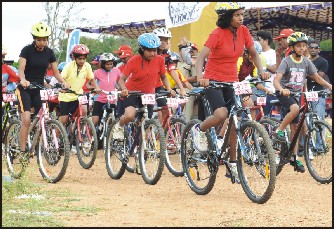
The two-day 10th State-level Mountain Biking Championship-2014 organised by the Mysore District Cycling Association (MDCA) in association with Karnataka Amateur Cycling Association (KACA) commenced this morning at the rugged terrain near Lalitha Mahal Helipad here.
About 150 cyclists in various age categories drawn from many districts of State are participating in the championship. The terrain track stretches for 5.2 km with different laps.
City Police Commissioner Dr. M.A. Saleem flagged off the championship. KACA Vice-President Rajiv Biradar, Secretary S.M. Kurni, MDCA Secretary Arun Patil, International Cyclist N. Lokesh and others were present on the occasion.
In the morning session events, the first three winners are – Under 16 boys: Santosh (Bijapur); Yellappa Shiredar (Bijapur) and Tejaswi (Mysore; Under 16 gilrs: Megha Gugad (Bijapur); Rajeshwari (Bagalkot) and Sridevi Nikam (Bijapur).
source: http://www.starofmysore.com / Star of Mysore / Home> Sports l News / August 02nd, 2014
Errant rainfall, lack of proper government policies and general ignorance resulted in the Great Famine of 1867-68. S Narendra Prasad looks back in time and deconstructs the misery and loss that affected a major part of South India.
The Great Famine of 1867-68 was a famine that befell many parts of southern and western India, before it spread to the north. Various reasons – social, economic, geographic and climatic have been attributed to the cause of this famine.
Two years prior to the first signs of famine in 1876, there was heavy rainfall in Bangalore and Kolar districts. This had destroyed ragi crops. The following year, there was only scanty rainfall and in some areas, it was much below the average rainfall due to which, by the end of 1875, most of the tanks had dried up. This highly affected the cultivation of paddy and other crops.
C B Saunders succeeded R A Dalyell as the Commissioner of India during the time. It was during the regime of Saunders, that the famine was tackled. Since the famine had occurred in most regions of the Deccan, it had severe repercussions at all levels, even in Mysore. Loss in human population
In his address on October 7, 1881, in the Dasara Representative Assembly at Mysore, C Rangacharlu, the Dewan, put forth the losses incurred.
The address read as follows: “A general census was taken on the night of the February 17 under careful arrangements. The results which are being tabulated in great detail will furnish interesting statistics when completed. The population as returned by this census numbers 41,82,000 and shows a loss of 8,74,000 as compared with the census taken in 1871, but, allowing for the usual rate of increase in the intermediate good years, the loss of population by famine may be assumed to be fully a million or 20 per cent.”
Along with the loss in population, a great portion of livestock perished. Cattle, especially milching cows and bullocks starved to death due to lack of fodder. The procurement and marketing of crops declined and there was also a steep fall in the supply of food crops from neighbouring regions which were also famine-stricken.
According to statistics found in the government records during the fiscal years of 1874-75, Rs 109 lakh was collected as revenue. But during 1876-77, it stood at Rs 82 lakh and at Rs 69 lakh during 1877-78. And during 1880-81, it crossed the 10 million mark.
Relief measures
To tackle famine-related problems, the administration used all its machineries. For instance, it opened famine relief kitchens to feed people, whose numbers began to swell in towns, especially Bangalore.
The small town of Bangalore became a heaven for the huge influx of people who migrated for food and work from other parts of the state. These people were engaged in civil works and in turn were paid in grains. Around 20,000 migrants were employed for construction of the Bangalore-Mysore railway line.
The government gave its permission for grazing of cattles in forests, which resulted in a man-animal conflict. New tanks were constructed and renovation and repair of old tanks were also taken up in a war footing manner.
Large quantities of grains were imported from the neighbouring Madras Presidency. Separate officials were appointed to distribute the stock. Since the famine related conditions were same in major regions in the Deccan, the severity alarmed the officials in Calcutta. As a result of this, a separate Commissionerate with attached officials was created to supervise the famine relief works in Mysore.
The famine commissioner
The increase, both in the loss of human population and the death of livestock alarmed the government. Initially, Sir Richard Temple was sent as special Commissioner to begin the early relief works.
The visit of Lord Lytton to Mysore State in September 1878 resulted in the deputation of several experienced officials from other parts of British India. Hence came in Elliot who took over as Famine Commissioner. Surveyors, engineers and suboverseers were appointed to channelise famine relief work.
The statistics, related famine relief works and their outcomes are to be found in The Report on the History of Mysore Famine, 1876-1878. The report was submitted to the government. This report is considered to be of much historical value as it throws light on the different dimensions of the famine and its effects.
Likewise, the administrative reports published by the Government of Mysore annually starting from 1870 onwards are also extremely informative and valuable.
Consequences
The census figures in Mysore during later years showed an increase in population figures. The state incurred a debt of Rs 80 lakh. In Mysore, the famine severely retarded the agricultural process.
It reflected upon the gradual commercialisation of agriculture, increase in agriculture debt and the hand-to-mouth existence of nearly 40 per cent of the peasants in Mysore.
Inconsistency in the affairs of administration and in delayed tactics adopted to tackle the famine caused more concern. Added to this, the officialdom and the apathy of bureaucracy aggravated the situation.
But, looking at the second half of 19th century in India, many major famines have occurred after the 1860s. But Madras, Bombay, Mysore and Hyderabad regions which were affected by this great disaster had to wait for years to get over these setbacks and cope with the situation.
The Dewan in his speech in the 1881 Dasara Representative Assembly admitted, “As you are aware, the conditions of the Province has been very much affected by the great calamity which recently struck us. The ruinous effects of the famine are so fresh in your minds that I need not dwell on them.
It will suffice for me to say that it cost the state 160 lakhs of rupees. It also involved the government in a debt of Rs 80 lakh and withal deprived the province of a million of it. It also adversely affected the population and crippled its resources for years to come.”
source: http://www.deccanherald.com / Deccan Herald / Home> Supplements> Spectrum / S. Narendra Prasad / DHNS – August 05th, 2014
Dr. Thomas Chandy has a collection of over 400 musical instruments from around the globe.
Meeting Dr. Thomas Chandy is not easy. The chance to see the orthopaedic surgeon’s collection of over 400 musical instruments was cancelled twice as the good doctor is called away for emergency operations. Finally when we do meet up, the musician-doctor takes us through his collection, which is arresting not just for its variety, but also for the insight it offers into Dr. Chandy’s interests. Walking through his house, is like stepping back in time.
A range of antique swords are on the ground floor and a host of musical instruments, including an ancient harp, occupy vantage points in his drawing room.
“I would advise everyone to be associated with music from a young age,” says Dr. Chandy, who first sang in a church choir when he was barely seven. He was later trained to play the guitar, saxophone and the piano. “Learning an instrument is a bonus for surgeons. Like musicians, brain-eye-hand co-ordination is vital for us.”
Dr. Chandy is Chairman and Managing Director of HOSMAT, and has done 30,000 operations in 30 years. After graduating from St. John’s Medical College, Bangalore, he moved to the U.S. in 1976 for his residency and returned to India in 1993 to start an orthopaedic, neuro and accident-trauma hospital.
“I am spiritual and worship my music,” says Dr. Chandy as he leads us into the humidity-controlled space that houses his instruments. Neatly stacked and labelled, he picks up each to play and explain. As he plucks on the strings of the harpsichord, he explains that it usually has two keyboards with two or more strings for each note. The concert harp and the 100-year-old lute from Germany have their sounds intact.
The U.S-based Society of Musical Instrument Collectors has recognised his collection as the biggest in Asia. Amongst his priced possessions are the South American Marimba (a large wooden percussion instrument with resonators;) a pedal steel guitar, a Steinway piano; a vibraphone; the stringed Chinese koto and the oldest 14th century keyboard clavichord from Germany. “I also made an electric guitar while I was in PUC.”
Thomas Chandy. Photo: Bhagya Prakash K. / The Hindu
Plucking on the psaltery that looks a giant violin, the doctor says: “I have nearly 70 guitars, more than a dozen saxophones and western flutes, several clarinets and host of percussion instruments including drums, marimba, xylophone and the Indonesian Anklung.”
Dr. Chandy, is a jazz vocalist, and heads the 14-year-old ensemble, Jazz Revival Band. The deep-toned native Australian Didgeridoo is an aboriginal wind musical instrument that looks like a straight wooden trumpet. Dr. Chandy remembers the instrument being confiscated by airport authorities as it looked like a missile!
He has travelled 15 times around the globe for his instruments that are from the U.S., Africa, China, Japan, S. America and Europe. Growing up in a family interested in music, young Thomas was warned by his strict father that music could be pursued, but not at the cost of studies. St. Germain High School at Frazer Town provided opportunities for weekly jam sessions at 3 Aces and Gaylords restaurants. “The pocket-money we earned made us enjoy our singing much more,” says Chandy, who nurtured his vocals and tried his hand on the guitar during his college days at St. Joseph’s College days. “Being part of music groups helped me develop team-spirit apart from being noticed by girls!”
Chandy moved from rock to folk music during his third year at St. John’s Medical College forming the Barbershop Harmony group. Later moving over to the U.S. was a boon not just for his post-graduate studies, but for his formal study of Western music at the Brooklyn Conservatory of Music in New York. On his return to India, Dr. Chandy joined the Bangalore School of Music and built the Cecilian Choir. “Music is therapeutic and invigorating.”
source: http://www.thehindu.com / The Hindu / Home> Features> MetroPlus> Society / by Ranjam Govind / Bangalore – August 05th, 2014
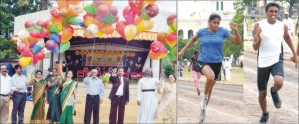
A day-long south zone II Athletic Meet (2014-15) for students of high schools coming under BEO, South Zone jurisdiction, was organised at Oval Grounds, near the DC’s office in city on Sunday. The meet was jointly organised by city’s St. Thomas Institutions, Vishweshwarnagar, in association with Mysore Zilla Panchayat, Department of Public Instructions and BEO, South Zone, Mysore.
Dr. C. Krishna, Director of the Department of Physical Education, University of Mysore (UoM), inaugurated the meet by releasing balloons.
Speaking on the occasion, he said that taking part in sporting events boosts the mind and body and called upon everyone to get involved in sports for better health.
Rev. M.O. Oommen Jr., Vice-President, Mar Thoma Education Society, Presided. B.N. Shivarmegowda, BEO, South Zone, was the chief guest.
M.P. Nabhiraj, former Varsity Swimming coach, Sarojini, Co-ordinator, Physical Education, BEO South Zone and others were present.
Nearly 150 students, representing different High Schools falling under South Zone BEO jurisdictions, took part in the Athletic Meet, which featured events such as 300 mt. running race, shot-put, high-jump, discus throw, long-jump, triple jump and javelin throw.
Results:
Women Category
Running Race – 100 mts: Jahnavi of Marimallappa High School (first), Supriya Raj of CKC High School (second), Bhuvana of Geetha Bharathi High School (third); 200 mts: Jahnavi of Marimallappa HS (1st), Bhuvana of Geetha Bharathi HS (2nd), Bindu of St. Mary’s HS (3rd); 400 mts: Jahnavi of Marimallappa HS (1st), Harshita of Geetha Bharathi HS (2nd), Meghana of Avila HS (3rd); 800 mts: Bhavana of Geetha Bharathi HS (1st), Nikhita M. Gowda of Avila HS (2nd), S. Kavya of Srikanth HS (3rd); 1500 mts: Jahnavi of Marimallappa HS (1st), Chandana of Sadvidya (2nd), Alisa Mary of Avila HS (Third); 3000 mts: Jeevita of St. Mary’s HS (1st), S. Divya of Geetha Bharathi HS (2nd), T.M. Divya of Avila HS (3rd).
Long-jump: Avijna D. Nayak of Marimallappa HS (1st), T. Kanchana of Avila HS (2nd), Soma Kumari Sharma of Nalanda HS (3rd).
Triple-jump: Avijna D. Nayak of Marimallappa HS (1st), Kanchana of Avila HS (2nd), Bindu of St. Mary’s HS (3rd).
High-jump: Vidya of Marimallappa HS (1st), T. Monisha of Nalanda HS (2nd), Aishwarya of CKC HS (3rd).
Shot-put: S.G. Soundarya of Sadvidya HS (1st), R. Chaitra of CKC HS (2nd), Apoorva of Geetha Bharathi HS (3rd).
Discus-throw: Maria Supriya of CKC HS (1st), Ananya Bhat of Marimallappa HS (2nd), R. Vaishnavi of Avila HS (3rd).
Javelin-throw: D. Lakshita of Srikanth HS (1st), N. Shakti of SBS HS (2nd), Surabhi R. Gowda of Teresian HS (3rd).
400 mts Relay: Marimallap High School wins.
Men’s Category
Running Race – 100 mts: D. Sharan of Marimallappa HS (1st), Rahul of SBS HS (2nd), C.S. Nagarjuna of Sadvidya HS (3rd); 200 mts: Rahul of SBS HS (1st), P. Sharan of Marimallappa HS (2nd), C.S. Nagarjuna of Sadvidya HS (3rd); 400 mts: Vishnu of St. Thomas HS (1st), S. Praveen of Gopalaswamy HS (2nd), Syed Yasin of Sadvidya HS (3rd); 800 mts: C. Chandu of D. Banumaiah HS (1st), Girish of Marimallappa HS (2nd), Sujat of Kanakagiri Govt. HS (3rd); 1500 mts: Harshavardhana of Geetha Bharathi HS (1st), H. Sukshit of Maharaja HS (2nd), Lakshimnarayan of St. Thomas HS (3rd); 3000 mts: R. Sharat of Geetha Bharathi HS (1st), T. Niranjan of Sadvidya HS (2nd), Sharat Gowda of Maharaja HS (3rd).
Long-jump: D. Deepak of Sadvidya HS (1st), B. Rajesh of Lakshmipuram Govt. HS (2nd), B. Rahul of Gopalswamy HS (3rd).
High-jump: D. Manoj of Marimallappa HS (1st), Rahul Raj of Nalanda HS (2nd), K. Rakesh of Kanakagiri Govt. HS (3rd).
Triple-jump: Santosh of JSS HS (1st), Aditya R. Nayak of St. Thomas HS (2nd), Goutam of JSS HS (3rd).
Shot-put: Mohamed Shaklin of Geetha Bharathi HS (1st), B. Rajesh of Lakshmipuram Govt. HS (2nd), Chetan of St. Thomas HS (3rd).
Javelin-throw: Praveen of Gopalswamy HS (1st), Prajwal Kumar of Nalanda HS (2nd), Mohamed Shaklin of Geetha Bharathi HS (3rd).