Pages from history : Remembering Kamaladevi Chattopadhyay

KamalaDeviBF16may2014

By Prf. A.V. Narasimha Murthy, former Head, Department of Ancient History & Archaeology, University of Mysore

Recently, I had an occasion to preside over a function in which a biography of Kamaladevi Chattopadhyay was released. The book in Kannada is written by Sevanthi D. Rai, well-known to Kannada readers by her publications. The others who participated in the function also praised the author for this easily readable biography of the great lady, a genius of yesteryears. The life and achievements of Kamaladevi Chattopadhyaya are simply amazing.

She was born in 1903 at Mangalore in a rich Saraswat Brahmin family. Most people do not know that Kamaladevi is from Karnataka because of the association of her name with her husband’s name Chattopadhyay. Her parental house consisted of 14 rooms with a huge garden. Her father was a top government officer. Thus she grew in such good surroundings. When she was just ten years old, she had the good fortune of meeting Annie Besant, the great freedom fighter.

Kamala was married at the age of 14 to Krishnarao, who unfortunately passed away after a couple of months and Kamaladevi became a widow. But she went to Madras and studied at the Queen Mary’s College. At that time, she met Harindranath Chattopadhyay and they got married. Harindranath was a great poet and a free-lance writer. Both of them went to England and Kamaladevi completed her education. They lived happily and had a son Ramakrishna. Slowly, Harindranath began to lead a licentious life and developed affairs with many young women. Kamaladevi tolerated all these bad qualities of her husband for the sake of her son. But things did not improve and ultimately Kamaladevi got a divorce from Harindranath Chattopadhyay in 1933 when she was 30 years of age. But the name Chattopadhyay continued to be with her name.

Kamaladevi thought that her son would give her company and grow according to her wishes. This did not happen because Harindranath used to take away his son for days together for wanderings in different places. This made Kamaladevi unhappy. She was particularly upset when her son divorced his wife and married a woman elder to him by many years.

These unhappy family affairs made her to take more interest in the freedom movement under Gandhiji. She boycotted Simon Commission and was beaten by the lathi-wielding Police. Once somebody was trying to dishonour the Congress Tricolor. As soon as Kamaladevi saw it, she ran towards the flag and protected it and in the process she was injured and blood was oozing from her body. Gandhiji heard of this and was supremely happy and congratulated Kamaladevi for her devotion to the flag.

At her insistence, Gandhiji was compelled to permit Kamaladevi to take part in the Salt Satyagraha. During this time she was attacked by the Police and sustained injuries. Subsequently, she worked with Ram Manohar Lohia and explained his Philosophy to the ordinary people in public lectures. She was arrested during the Quit India Movement and was sent to Vellore Jail. Though no case was filed against her, the British kept her in the jail for almost two years. As her health deteriorated, the government released her from the jail.

On some pretext or the others, she was being arrested frequently and sent to Vellore and Yerawada jails. The living conditions in these jails were inhuman and the jail staff were always cruel and often misbehaved with women prisoners. Kamaladevi used to object for these atrocities and wrote to higher authorities. But no improvement took place.

Kamaladevi felt sad about the pathetic position of women in society, particularly in rural India. She felt that the age-old system is responsible for this state of affairs than the discrimination by men. She thought that this could be rectified by starting women’s organisations to educate them. She started All India Women’s Organisation in Pune in 1927 which was presided over by the Queen of Baroda. Kamaladevi was made the Secretary. When she had a chance to be in Germany, she took part in the International Alliance of Women. In 1944 she had presided over that Session in Bombay. The British government had ordered that she should not enter Bombay. But many influential people including H.V.R. Iyengar requested the British government to postpone this punishment order.

The conference was a great success and it was attended by Sarojini Naidu, Chagla, Minu Masani, Wadia and others. It brought pressure on the government to pass many pro-women bills. She also took up the cause of women labourers who were treated in an inhuman way.

Mangalore was famous for cashew industry and women were employed to remove the cashew from the outer nut. It was harmful to the fingers. Under the leadership of Kamaladevi, women labourers did Satyagraha and the owners of the cashew industries had to yield and they permitted the use of small knives to separate cashew nuts. This brought great relief to the women labourers working in cashew industry at Mangalore.

Even from her childhood, Kamaladevi was interested in music, dance, drama and other fine arts. In the beginning with the help of her husband Harindranath, she had taken part in many dramas which were enacted even in England. She herself wrote many social plays for educating the people against dowry, ill-treatment of women, widows, slavery of children, prostitution etc. Most of these dramas had a free entrance and people used to flock at these shows.

Kamaladevi acted in silent movies also in 1931. She acted in Vasanthasena, Tansen, Shankar-Parvati etc. Subsequently, she started Indian National Theatre in Bombay. She also arranged a ballet based upon The Discovery of India by Nehru. Nehru saw the ballet and said that this ballet was more interesting than his book.

At the request of K.V. Subbanna, she went to Heggodu and stayed there for some days and saw the practice of drama at Heggodu. She also opened a branch of International National Theatre. All these activities brought Kamaladevi the coveted Magsaysay Award in 1966.

After Independence in 1947, thousands of refugees came to India and Kamaladevi took up their cause and established them in different camps by providing food and shelter. She saw to it that lands were granted to many of these refugees.

Another important contribution of Kamaladevi was the revival of Indian handicrafts. She made popular Pochampalli, Paithani, Patola, Kalamkari sarees by providing necessary guidance. She also helped the sculptors. She was made the first President of Arts and Crafts Council of India. Though Nehru was an admirer of Kamaladevi, Indira Gandhi was not well disposed towards her. Kamaladevi wrote to Nehru, ‘please ask you daughter not to interfere in my work.’ Indira Gandhi took vengeance on her and abolished many art centres. In disgust, Kamaladevi resigned from all the posts. Kamaladevi visited Mysore and saw the Chamarajendra Technical Institute (CTI) and requested Sri Veerappa to rejuvenate Mysore ancient crafts.

Kamaladevi had become a celebrity and the government offered her the positions of Vice-President of the country, Governorship, Central Ministership or an Ambassadorship. But she did not accept any of these. She was honoured with Padma Vibhushana and Hon. D. Litt from Banaras Hindu University. By her overwork without proper rest, she fell sick and was hospitalised in Bombay and passed away on 29th October 1988. Thus ended an illustrious and bright career of a self-made woman. But she remains in the hearts of artists, craftsmen and in the memory of the great institutions she built which are still working. A great woman indeed !

source: http://www.starofmysore.com / Star of Mysore / Home> Feature Articles / May 10th, 2014
Cyber law and forensics training centre set up at NLSIU

SUMMARY

The centre has already launched its Post Graduation Diploma course in Cyber Law and Cyber Forensics from June 2013.

A cyber lab to train government officials including police in tackling cyber crime has been set up in the National Law School of India University (NLSIU), Bangalore. The lab, located on its campus in Jnanabharati, will be unveiled on Tuesday.

Dr Nagarathna A, senior assistant professor of NLSIU, said the cyber lab is the first of its kind in any legal academic institution in the country. The lab is co-funded by the Department of Electronics and Information Technology (DEITY) and the Ministry of Communication and Information Technology, Government of India.

The Advanced Centre for Cyber Law and Forensics will have 30 computer systems equipped with basic cyber forensic tools procured from C-DAC. Here, judges, police officers, prosecutors, lawyers and IT security experts involved in investigating cyber crimes will undergo training in cyber forensics. The centre will also offer training programmes to banking and other professionals who are looking for knowledge of cyber technology and forensics crucial to detection and investigation of cyber crimes.

Nagarathna, who is the chief investigator of the centre, said the lab will be be inaugurated by Shyamal Ghosh, former secretary to the Govt of India and Dr Gulshan Rai, DG of the Indian Computer Emergency Response Team. R Venkata Rao, Vice-Chancellor of NLSIU, will be present at the event.

“This is the first such lab in an legal academic institution. The centre will be upgraded with more technical and forensics tools in the near future so as to offer a more sophisticated platform for teaching cyber laws and forensics to various stakeholders,” Nagarathna said.  The centre has already launched its Post Graduation Diploma course in Cyber Law and Cyber Forensics from June 2013. Senior police officers from across the country have reportedly sought admission to the diploma course.

source: http://www.indianexpress.com / The Indian Express / Home> Cities> Bangalore / by Santosh Kumar R B / Bangalore – May 04th, 2014

Prime Minister’s fellowship to CFTRI researcher

Mysore :

Padma Shankaran, a young researcher at the Food Engineering Department of the CSIR-Central Food Technological Research Institute (CFTRI), Mysore, has bagged the prestigeous Prime Minister’s Fellowship for Doctoral Research for the year 2013.

She is the second researcher to receive this fellowship. Nidhina M. Bhaskaran, another doctoral student at CSIR-CFTRI had bagged the fellowship for the year 2012.

The fellowship is a novel scheme started a year ago to encourage young innovators to take up research relevant to the industry. Every year a maximum of 100 awards are given. However, till date only 62 fellowships have been granted of which among the biological sciences, CSIR-CFTRI researchers have received the fellowships in consecutive years.

The awardees are selected by a Core Committee consisting of both members of academia as well as industry partners from the Confederation of Indian Industries following rigorous evaluation of the research problems proposed by the candidates. The award carries a fellowship of Rs. 50,000 per month for the doctoral research by the awardee, and is shared equally by the Science and Engineering Research Board, Govt. of India, and private industries.

source: http://www.starofmysore.com / Star of Mysore / Home> General News / May 09th, 2014

Parents elated by Vasudha’s achievement

VasudhaBF15may2014

Mysore :

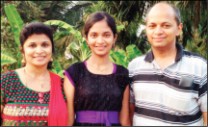
Every parent would dream of their children excelling in studies and later in their field of interest. When the dream comes true, there are no words to express the joy. Such is the situation of Dr. Dinesh, Assistant Professor, Department of Anaesthesia, Mysore Medical College and Research Institute, Mysore, and Vidya Dinesh, a homemaker. The reason for joy, D. Vasudha, their daughter, has emerged State Topper scoring 594 out of 600 marks.

Vasudha, a student of Sadvidya Pre-University College, has scored 100 each in Chemistry, Biology, Mathematics and Sanskrit, 99 marks in Physics and 95 in English. Speaking to Star of Mysore, Vasudha, expressed happiness over the results and thanked her parents and teachers for their constant guidance.

Speaking about her future plans, Vasudha said that she had not decided on the future but added that it would depend on the CET result which is to be announced shortly. “There was no specific planning to prepare for the examination. I used to study during the free time but I made sure that I spent 3-4 hours a day to prepare for my examination”, said Vasudha.

Talking about her parents, she mentioned that both her father and mother had been supportive throughout and it is because of them that she could achieve the fete. Vasudha also thanked her teachers in the college for their continuous help and guidance.

Speaking to Star of Mysore, Dr. Dinesh, said that he had expected a good result, but there was a little anxiety. “When the result was announced we got to know that she had emerged a topper. But, still there was a little anxiety. When we got the confirmation about her topping the State, we were relieved”, said Dr. Dinesh.

He further said that Vasudha had been given an open invitation from the Birla Institute of Technology and Science, Pilani, Rajasthan, on which they were yet to decide. Dr. Dinesh also mentioned that Vasudha had also done well in Manipal University Entrance Examination which was held yesterday in Bangalore.

“My first priority is to get my daughter admitted in one of the institutions in Mysore, which depends on the CET result. But, the final decision will be taken after the CET result are announced in which we are expecting high ranking”, said Dr. Dinesh.

Vasudha previously had emerged 2nd topper in SSLC where she had scored 621 marks out of 625 studying in Sadvidya High School. By going one step further, Vasudha has made her parents and teachers feel proud.

source: http://www.starofmysore.com / Star of Mysore / Home> General News / May 09th, 2014

Felicitation to Padma Bhushan awardee

Mysore :

JSS College of Arts, Commerce and Science on Ooty Road has organised a function to felicitate Padma Bhushan awardee Dr. M. Mahadevappa, Chairman, Task Force, SC/ST and Rural Development, Department of Biotechnology, New Delhi and Director, JSS Rural Development Division, JSS Mahavidyapeetha, Mysore, at the college premises on May 10 at 11.30 am.

Dr. Mahadevappa received the Padma Bhushan from the President Pranab Mukherjee at Rashtrapathi Bhavan in Delhi on April 26.

The valedictory of PG Cultural Forum of the college will also be held on the occasion. Prof. T.D. Subbanna, Director, College Education Division, JSS mahavidyapeetha, will preside.

source: http://www.starofmysore.com / Star of Mysore / Home> General News / May 09th, 2014

Congress leader Broadway Shivanna passes away

Mysore :

Shivanna, a Congress leader, popularly known as Broadway Shivanna owing to his association with a company by that name in Mumbai, passed away at his residence in Vidyaranyapuram here this morning.

Shivanna (69) was the Secretary of OBC cell of KPCC.

He leaves behind his wife, two sons and two daughters.

Shivanna and other family members were in celebration mood last evening as Shivanna’s granddaughter Chandana, a student of Marimallappa’s PU College had passed II PU examination securing 90% marks. Destiny had something in store in a tragedy the next morning.

Chief Minister Siddharamaiah visited the house today and paid his last respects. City Congress President C. Dasegowda, MLA M.K. Somashekhar, Minister H.S. Mahadevaprasad and others too paid their last respects to the departed soul.

Last rites will be held in the evening at the foot of Chamundi Hill, according to family sources.

source: http://www.starofmysore.com / Star of Mysore / Home> General News / May 09th, 2014

Karmakar wants STC for disabled athletes

Bangalore :

Commonwealth and Asian Games medallist disabled swimmer Prasanta Karmakar is looking forward to the day when the Sports Authority of India will start a specialized SAI Training Centre (STC) for disabled athletes after receiving the Diploma in Sports coaching on Wednesday.

“I wanted to learn more about sports and that was the reason why I joined this course. And today I feel that all the elites in our country should find some time to do this course. It will surely help them to prolong their careers by few years,” said Karmakar, who landed from Mumbai just in time to receive the certificate of honour.

“I have requested the SAI director to start special courses to train para athletes. He has promised to look into the matter but I hope something positive happens,” said Karmakar echoing the sentiments of disabled athletes in the country.

Karmakar, who was the first Indian to win a medal in the Commonwealth Games for disabled and Asian para Games, is confident that the diploma will help to do well as a coach. “I’m employed by the Haryana government but I will get leave so I can go to train athletes,” he said.

Karmakar was one among the 102 students who got provisional certificates for successfully completing the 10-month course at an impressive ceremony at the National Institute of Sports, Southern Centre here. The new coaches will get their certificate and mark list on the completion of their two-month internship at the various SAI centres across the country.

The highest number of coaches passed out in athletics (24) followed by swimming (21) and kabbadi (18). Surprisingly, tennis (6) had the lowest number of coaches followed by badminton (7).

‘Appoint them as assistant coaches’

Olympian Ashwinini Nachappa, who was the guest of honour asked SAI to give the graduates more exposure by attaching them to the national camps.

“Two months of internship is not enough. They should be appointed as assistant coaches with the foreign trainers as it will help them to learn a lot,” she said.

Bangalore University vice-chancellor BN Thimme Gowda exhorted the new coaches to acquire more skills and do research in sports. “You should all try and go to the next level. Try and do the masters and take up research,” he said.

SAI director Ramachandran, head of academics Nataraj, former national champion in badminton U Vimal Kumar were also present at the graduation ceremony.

The winners:

Best Student: Siju Joseph (volleyball).

Toppers: Athletics: KS Peter, Badminton: Ravikant Singla, Hockey: K Vishnu Kumar Prashant, Kabaddi: Dharmendra Kumar, Lawn tennis: Resham Singh, Swimming: Tejas Nayar, Taekwondo: Vishal Arya, Volleyball: Siju Joseph. GTMT – Vishal Arya (taekwondo), Kinetics/Biomechanics — Deepak PC (hockey), Sports medicine/anthropometry – Shobana (hockey), Sports physiology – Asha J (swimming), Sports psychology: Shobana (hockey).

source: http://www.timesofindia.indiatimes.com / The Times of India / Home> Sports> More Sports> Athletics / by Biju Babu Cyriac, TNN / May 01st, 2014

Growers happy as arecanut prices more than double in a year

The price of rashi, idi, api and chali varieties of arecanut, which was around Rs. 130 a kg during the same period last year, is now Rs. 320 a kg. The price of saraku variety that was around Rs. 180 a kg last year is being traded at Rs. 370 now. / File photo / The Hindu

Prices of local varieties have gone up from Rs. 130 a kg to Rs. 320

Arecanut prices have more than doubled in a year bringing cheer to growers. Factors such as gutka ban and the rumours on a possible ban on arecanut itself have not affected the optimistic mood prevailing in the market.

D.B. Shankarappa, director, Shimoga Arecanut Merchants’ Association, told The Hindu that the decision taken by the Centre to hike the minimum import price of arecanut and the decline in production owing to climatic changes were the reasons for the sharp increase in the prices.

The price of rashi, idi, api and chali varieties of arecanut, which was around Rs. 130 a kg during the same period last year, is now Rs. 320 a kg. The price of saraku variety that was around Rs. 180 a kg last year is being traded at Rs. 370 now.

The Central government decided on May 13 last year to hike the minimum import price of arecanut from Rs. 75 to Rs. 110 a kg. This decision triggered an upward movement in the prices of locally grown arecanut. The prices of rashi, idi, api and chali varieties that was at Rs. 130 a kg in the first week of May last year reached Rs. 180 a kg by the end of the month.

The growers were under the apprehension that the prices might crash following the decision taken by the State government on May 31, 2013, to ban gutka. However, after the ban, gutka entered the market in a new avatar.

As mixing of arecanut with tobacco was banned, firms engaged in the production of gutka began selling arecanut and tobacco in separate pouches. Even after the ban, the prices continued to rise. The prices of rashi, idi, api and chali varieties reached Rs. 210 a kg by the first week of August and remained stable for six months after.

In September 2013, Union Ministry for Health and Family Welfare wrote to the Food Safety and Standards Authority of India to examine the scientific evidences on the harmful effects of arecanut on human health, with a view to classify it as an injurious substance and prohibit its use as an ingredient in food products.

A section of growers saw this as a first step to ban arecanut. The protests and debates that happened in January this year over the issue again led to the concern that the prices may fall. Interestingly, the prices remained insulated from these developments. The prices of arecanut began to move northwards again from the first week of February this year.

Owing to heavy rain that lashed the Malnad region and coastal Karnataka in the 2013 monsoon, more than 50 per cent of arecanut plantations were infected with kole roga, also known as fruit rot disease. The yield declined by more than 30 per cent resulting in a mismatch between the demand and supply for arecanut, owing to which the prices increased since February. Arecanut merchants here anticipate a further increase of 10 per cent in the prices by the end of this month.

source: http://www.thehindu.com / The Hindu / Home> News> Cities> Mangalore / by Veerendra P.M. / Shimoga – May 02nd, 2014

Brigade Group to come up with 8 hotels in south India

Brigade Group that currently has two operating hotels – The Grand Mercure, Bengaluru and the Sheraton Bangalore Hotel at Brigade Gateway in the country has confirmed to come up with eight new hotels in south India soon.

Nirupa Shankar, Director, Brigade Group said, “We currently have eight hotels in the pipeline – one in Chennai, two in Mysore, two in Kochi and three in Bengaluru. The hotel in Chennai and one of the hotels in Mysore will be launched in 2015. None of them are opening in 2014, as they are still under construction or under design development.”

Brigade Group has a signed management contract for the two hotels opening up in 2015. They are Holiday Inn-Chennai, Old Madras Road (managed by IHG) and Grand Mercure in Mysore (managed by Accor). The management of the remaining hotels is still under discussion with major international operators mentioned Shankar.

source: http://www.hospitalitybizindia.com / HospitalityBizIndia.com / Home> News Travk / by Shweta Ramsay, Mumbai / Friday – May 02nd, 2014

Among the Artists with love

R. Puttaraju and his gift

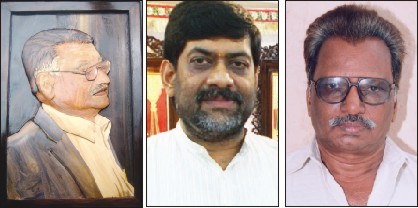
 1) Marquetry artwork of yours truly 2) R.G. Singh 3) R. Puttaraju
1) Marquetry artwork of yours truly 2) R.G. Singh 3) R. Puttaraju

I am no great connoisseur of art. However, whenever opportunity presents itself to see art works and paintings, I simply give in. This is because of my dalliance in advertising for some years in Mumbai and Pune where I learnt the difference between fine arts and commercial arts. While the former is for the soul, the latter is for stomach. Advertising agencies are the practitioners of commercial art, to sell products and services. Fine art is of metaphysical in character, no matter whatever the form — abstract, surreal, still life, cubism, portrait etc.

Before the advent of photography, painting was the only way to capture the images of natural scenes, of flora and fauna and human beings. Portrait painting was thus patronised by Royal Courts and the aristocracy. If one is art, the other is craft; some times the dividing line becomes blurred so much so the practitioners of both are called artists.

On 2nd March 2014 I had been to Ramsons Kala Pratishtana’s Pratima Gallery of R.G. Singh, city’s art collector and patron of artists known to encourage specially Karnataka artists. As I know, because of him some unknown have become known and some in strained financial position got relief. The occasion was a lecture on Ganjifa Raghupati Bhatta’s works on Ram Setu. It was a select gathering of artists from city and art lovers. Krishna Shetty, former Chairman of Karnataka Lalith Kala Academy, was the speaker on the subject. Among the artists present was artist R. Puttaraju, a product of the renowned Chamaraja Technical Institute (CTI) on Sayyaji Rao Road, the original avatar of the present CAVA in the same place. He had specialised in inlay works, marquetry and fine arts.

On 28th April 2014 I was again at the Pratima Gallery to inaugurate ‘Kuncha Bhramari,’ an exhibition of late Mukta Venkatesh’s art works of flowers with her daughter, equally talented Mrs. Girija Madhavan and her husband, former Ambassador A. Madhavan. After the vote of thanks, R.G. Singh said he would like me to meet one famous artist R. Puttaraju. To my surprise he was there holding what I thought was an inlay work. He seemed much delighted to meet me, garlanded me and presented a framed art work of my portrait in profile. R.G. Singh explained the work was not inlay but known as marquetry, created by inlaying wood pieces one above the other creating the image with raised surface. I had not seen this kind of work before. It is unlike the usual inlay works we see in handicraft shops.

I then asked R.G. Singh out of sheer curiosity, why this special affection. And thereby hangs a tale. I have to narrate this tale even at the risk of being immodest writing about myself.

But before I come to that, a brief bio of Puttaraju who hails from Mulloor, a non-descript village near Kollegal.

Early in his childhood, he was influenced by the oil paintings and beautiful statues at the St. Francis Assisi Church at Kollegal which he used to visit regularly. His sketches of biblical stories at the Sunday classes at the Church caught the eye of a German priest, father Handy Kohrt, who encouraged the lad to draw more.

In 1956, Father Kohrt persuaded Puttaraju’s parents to send him to CTI to be trained in art. Puttaraju finished the inlay certificate course in four years. He took up another five-year diploma course in fine arts at CTI. He stood first in the class all four years.

All the while he was getting nostalgic about the church back home in Kollegal. He wanted to create something new in inlay. He extensively experimented with wood collage and in 1968 created a panel ‘Submission with devotion’. This was the first ever relief work in wood collage; it fetched him the coveted first prize at the Mysore Dasara Exhibition.

Puttaraju’s friend who went to Madras coaxed Puttaraju to join him. Thus Puttaraju came to Madras in 1969 and was supplying his inlay creations to Victoria Technical Institute. He worked in Madras Film industry as an assistant art director and later set up a small workshop in Madras. In 1993, Puttaraju returned to Mysore and in 1995 he married Philomena who was working as a teacher.

In 2003, a person took all of Puttaraju’s works promising to pay handsomely but he neither paid nor returned the artefacts. His house at Tilaknagar, workshop and a thriving business of inlay handicrafts, everything was lost during that financial crisis. Now Puttaraju lives in a rented house and along with his wife and three assistants toying to reinvent himself at age 76.

It is said that luck is when opportunity meets preparedness. Puttaraju was all prepared with talent and skill but opportunity eluded him many times. One example is when an invitation to teach his technique and hold exhibition of his creations, specially wooden collages, came from Chicago which was sent to St. Philomena’s hostel address in Mysore but he was in Madras. He received the invitation one-and-a-half years too late. Like most artists his life too seems chequered.

However, the star of Puttaraju seems to have brightened after he came in contact with R.G. Singh. He was honoured with Rotary Ramsons Kala Pratishtana Award in June 2005. But the higher award awaited in 2008 when he received the much coveted Rajyotsava Award from the Karnataka Government.

To revert to where I left off at Pratima Gallery, I wanted to know why Puttaraju chose me for his gift.

R.G. Singh had commissioned Puttaraju to recreate some of Raja Ravi Verma’s more celebrated paintings into inlay — marquetry work — some years ago. This had projected Puttaraju as an important artist among the art community in Karnataka and also abroad. However, the critical acclaim he received was possible mainly because of Star of Mysore and Mysooru Mithra, which published his works with a detailed report.

The people of Kollegal who had forgotten their native son all these years suddenly discovered him through Mysooru Mithra and wanted to honour their famous son. So it was, Puttaraju was felicitated, after being taken in a procession, by placing a silver crown on his head and presenting a citation.

Eversince that day, R.G. Singh told me, Puttaraju wanted to personally thank me. An opportunity presented itself when he saw me at Pratima Gallery on March 2, 2014. I was photographed that evening very ‘discretely’ specially for creating my profile in marquetry. So it was, I was presented with his masterpiece of my marquetry image on Apr. 28. Does it look like me? I asked R.G. Singh and Raghupathi Bhatta. Absolutely, they said in chorus.

Thank you Puttaraju. May your star keep glowing bright always with support from patrons like R.G. Singh.

e-mail: kbg@starofmysore.com

source: http://www.starofmysore.com / Star of Mysore / Home> Abracadabra….Abracadabra / by K. B . Ganapathy / May 08th, 2014