Success Secret: Toppers Stayed Calm in Exam Season

Bangalore :

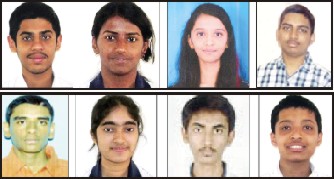
Apoorva Narayanaswamy was expecting good marks, but she had never imagined she would end up in the national toppers’ league.

A student of St Paul’s English School, Apoorva has scored 98.6 per cent in the Indian Certificate of Secondary Education (ICSE) exams.

“I guess studying and spending some time on hobbies helped me. I watched TV whenever I was stressed,” said Apoorva, a resident of Bannerghatta Road, who studied for three to four hours a day. At the start of the academic year, she would go back from school and study to make sure she wasn’t stressed as exams approached.

Apoorva’s favourite subject is biology and she wants to pursue a career in medicine.

For Shreyas Sudhaman of Sri Kumaran Public School, who scored 98.6 per cent, the results were a shock.

“I was shocked in a positive way, of course. What I believe is if you are consistent and organised in your preparation, it is not impossible to score high,” he told Express.

A resident of J P Nagar, Shreyas is looking forward to becoming an engineer.

“I plan to take up chemical engineering. It can be used in various places,” he said. The Council for Indian School Certificate Examinations (CISCE) considers the best scores in five subjects (best-of-five) to declare the percentage.

In the Indian School Certificate (ISC) exams for Class 12, it is the best of four that is taken for calculation.

Rajat Vadiraj from St Paul’s School secured 98.4 per cent and celebrated it with his family.

“I’ve always loved science since I was a kid. It is very exciting, especially physics and mathematics,” said Rajat, who did not have sleepless nights preparing for the exams. “If you keep calm, it should be easy.”

Dipayan Sinha from Bishop Cotton Boys Schools knows what career he wants to pursue. “Everyone in my family is an engineer and I want to follow them,” said Dipayan, who scored 98.2 per cent.

Studying in Bangalore for eight years, Dipayan’s mantra is hard work, patience and focus. “I don’t keep timetables. I would revise whatever was taught in school the same day,” he said.

With 98.16 per cent in his kitty, Tejas Kumar from Presidency School is chasing two dreams. “I am very good at computers and I think I can develop this into something by becoming a computer science engineer. Further, I want to become an IAS officer and serve the country”.

source: http://www.newindianexpress.com / The New Indian Express / Home> Cities> Bangalore / by Express News Service / May 22nd, 2014

Youngster from city walks the red carpet at the famed Cannes Film Festival

by S.N.Venkatnag Sobers

Every person dreams of walking the Red Carpet at premier film festivals or at least to be a part of the festival in some way or the other. This is a talented Mysorean has had that opportunity.

Vaishak Vasanth Kumar, son of Rajyotsava awardee Vasanth Kumar Thimkapura, city’s renowned Agricultural Scientist, has just fulfilled his dream of walking the Red Carpet at Cannes Film Festival held this year.

A student at the University of Pennsylvania, USA, Vaishak was one among the 30 students selected to be a part of the Cannes Film Festival from the University.

Vaishak has been pursuing his studies in Bachelor of Arts with Political Science and Economics as his major subjects in the University.

Speaking to Star of Mysore, Vaishak said that every year his University gets 30 invitations from the organisers of Cannes Film Festival and the University conducts a selection process which includes writing essays and one-on-one interviews to select the team to represent the University at the Cannes Film Festival.

He added that he was the only student from India and the only non-American to be a part of the student delegation.

“The interview involves writing about the history of cinema and the Cannes Film Festival as well. Only after getting through the two rounds I got an opportunity to be a part the team which visited Cannes,” said Vaishak.

During his 13-day stay in Cannes, the student team was given the task of watching 25 films screened at the festival. But, Vaishak making good use of the given opportunity watched 30 movies one among them was the ‘Winter Sleep,’ a Turkish movie, which won the prestigious PALME D’OR (Golden Palm Award) this year.

He added that it was his first visit to the Cannes Film Festival and said that he got an opportunity to meet the representatives of Warner Brothers and Disney.

Vaishak also added that he also met actors James Mc Avoy of X-Men fame, Jassica Chastian of Zero Dark Thirty fame, Salma Hayek, Zoe Saldana and Indian actors Ranvir Shorey and Shashank Arora.

Speaking about movies, Vaishak said that when compared to Hollywood movies and films from other countries, Indian movies had very little international appeal as it is made only for the Indian audience and it was very hard for the producers to pitch in the Indian movie for international audience.

“There is much more to be done in Bollywood if Indian movies have to be showcased in International Film Festival like the Cannes. The only movie which was showcased was ‘Titli’ of Yash Raj Films. People in Hollywood and film makers around the world take risks while scripting a movie, but in India such risks are not taken. There is a need for film fraternity in India to also give importance for parallel movies compared to the mainstream commercial movies,” said Vaishak.

source: http://www.starofmysore.com / Star of Mysore / Home> Feature Articles /by S.N.Venkatnag Sobers /  May 29th, 2014

We are the biggest southern state now

by: S Shyam Prasad & Sridhar Vivan

Creation of Telangana and AP has restored geographical supremacy to the state 450 years after the Battle of Talikota. We track the journey of the region from kingdoms to modern-day Karnataka

​History was created on Monday with the creation of Telangana, the 29th state in the Indian Union. It marked another change in the contours and boundaries of southern India and although Karnataka had very little to do with the bifurcation of Andhra Pradesh, the creation of Telangana changed the history of Karnataka — ever so slightly.

Karnataka officially became the biggest of the South Indian states in terms of geographical area (the seventh biggest in the country). With an area of 1,91,791 sq km, Karnataka leads the ‘pack’ in the South, followed by what now remains of Andhra Pradesh (popularly called the Seemandhra region) with 1,60,205 sq km of area.

Being the biggest state in terms of area would have been a great advantage in the age of kingdoms, but no longer. Karnataka may gain very little — indeed nothing — from being the ‘biggest’. Political representation in Parliament is based on the population which means Tamil Nadu will continue to have a bigger say with its 39 MPs. Andhra Pradesh will have a diminished voice as its 42 seats would now be whittled down to 25.

But the ‘biggest’ tag does reflect (historically at least) a sort of pre-eminence. From the beginning of the sixth century, empires founded in Karnataka ruled over much of present day Karnataka, Andhra Pradesh and Maharashtra. These included the Badami Chalukyas, Rashtrakutas, Kalyani Chalukyas, Hoysalas and the Vijayanagara Empire.

According to eminent historian S Shettar, the most enduring (in terms of time) dynasties of Karnataka were the Gangas and the Kadambas. But they ruled small principalities. “The biggest imperial house was that of the Rashtrakutas,” said Shettar. “They were the most influential rulers in India of anytime. Samudra Gupta is just highlighted due to North Indian bias. The Kailasanatha temple, in Maharashtra, alone is testimony to their eminence. Their battles reached the Himalayas and Bengal.”

Karnataka-based empires stayed the biggest in the South until the collapse of the Vijayanagar Empire 450 years ago when the hegemony ended. “The Vijayanagara Empire was different in many ways,” said Shettar. “For the first time people speaking Kannada, Telugu, Tamil, Oriya and Marathi were one empire.”

This year marks the 450th anniversary of the Battle of Talikota (also known as Battle of Rakkasa-Tangadi) which put an end to more than 1,000 years of Karnataka’s pre-eminence in politics of south India and the Deccan.

The political pre-eminence led to some of the most famous medieval cities, centres of trade and temples in India. The most famous of these was the Vijayanagara capital — now Hampi — which is said to have taken six months to destroy. Following the battle in 1565, the Vijayanagara Empire continued to exist nominally for nearly a century. Scores of Vijayanagara feudal lords began ruling over petty kingdoms. Kannada-speaking areas were never united again until 1956.

“The 1565 battle was a colossal loss,” said Shettar. “Like the French will never celebrate the Battle of Waterloo, similarly the Battle of Talikota cannot be celebrated. But there is much to learn from defeats. Now some intellectuals and politicians from the Hyderabad-Karnataka region are demanding a separate state. It is because of the belief that there is neglect and also to some extent jealousy. This is similar to the demand for Telangana. But we have to learn from that battle (1565) and stay united.”

Ironically, says Shettar, the fight for linguistic states began in Andhra Pradesh because they felt dominated by the Tamils of Madras Presidency. “In south India, the opposition to linguistic states was confined only to a small extent from the Tamils because they feared losing territory. But slowly there are feelings that linguistic identity is not giving the requisite economical benefits. People of Karnataka are more or less emotionally reconciled to a linguistic state now.”

MOST BORDERS IN SOUTH

With the creation of Telangana, Karnataka now shares its borders with six states —Maharashtra, Goa, Kerala, Tamil Nadu, Andhra Pradesh and Telangana. The state administration has to get in touch with the Telangana as well as the residual Andhra Pradesh for inter- state issues. Apart from river water sharing — for example, Karnataka needs to deal with Andhra Pradesh for Tungabhadra and Telangana for Krishna —and other border issues, the transport body also has to have new agreement on travel.

‘KARNATAKA’ IN HISTORY

* Sanskrit texts: Shudraka’s Mruchhakatika, Varaha Mihira’s Bruhat Samhite, Somadeva’s Katha Saritha Sagara refer to Karnata
* 455 CE: Kadamba king Shantivarma called, “The master of the entire Karnataka region”
* 7th Century CE: Feudatories Rashtrakutas refer to Chalukyan Army as ‘Karnataka Bala.’
* 850 CE: Amoghavarsha’s Kavirajamarga calls land between Kaveri and Godavari as ‘Karnata.’
* 10th Century CE: Rajashekara’s Kavyamimase: Karnataka
* 14-16 Centuries: Vijayanagara Empire referred to as Karnata Empire by its people.
* After Talikota battle the first of the Aravidu dynasty ruler Tirumala Deva Raya called ‘reviver of the Karnata Empire’ in the Telugu work Vasucharitamu.

THE BATTLE OF 1565

The first skirmishes of the Battle of Talikota started on December 29, 1564. It was on January 26, 1565 that a full-scale historic battle took place at Rakkasa- Tangadi villages — near what is Bijapur district today. The five Deccan sultanates of Ahmadnagar, Berar, Bidar, Bijapur and Golkonda defeated the Vijayanagara army, a defeat that resulted in the dramatic capitulation of the Vijayanagara Empire. For more than 1,000 years prior to that battle, Karnataka as we now know it was part of empires such as Badami Chalukyas, Rashtrakutas, Kalyani Chalukyas and later the Hoysalas. These were the largest empires in South India. The loss in 1565 was so severe that Karnataka was to have a united rule again only in 1956. In between, large swathes of Karnataka were briefly united under Hyder Ali. By the time Karnataka was unified post-Independence, the region was under 20 different administrations ranging from the Wodeyars to the British and a host of small principalities.

source: http://www.bangaloremirror.com / Bangalore Mirror / Home> Bangalore> Cover Story /  S Shyam Prasad & Sridhar Vivan / Bangalore Mirror Bureau / June 03rd, 2014

Karnataka sites make to Unesco world heritage tentative list

Mysore :

Architectural jewels in Belur and Halebid in Hassan, historical monuments in Srirangapatna and remnants of history from Deccan sultanate are in line to be declared as the world heritage site by the Unseco.

Put together, these sites represent the pluralistic spiritual beliefs that the state government is planning to preserve and promote.

The three sites have been included in the Unesco’s world heritage tentative list, thanks to the department of heritage, archaeology and museum which is now working with experts to prepare dossiers of each of them. Experts from across the world will evaluate the submission of the department and make recommendations. To be included on the world heritage list, the sites must be of outstanding universal value, according to the Unesco.

The chief minister Siddaramaiah on Thursday announced the inclusion of the three sites in the tentative list of the Unesco indicating that the government is serious in protecting the monuments. He linked it to tourism promotion in the region where the government is planning to create a tourist circuit comprising Mysore, Mandya, Hassan and Chamarajnagar to revive the local economy pointing out that many nations depend on tourist inflow to sustain their economies.

Heritage commissioner C G Betsurmath said he submitted the proposal to the Union ministry of culture in mid-February. “We consulted the experts and prepared the proposals focusing on the unique character of each of the sites identified,” he told The Times of India. The sites of Belur and Halibedu throws light on the pluralistic spiritual beliefs of Vaishnavism, Shaivism, and Jainism. Here the spiritual intersected with ordinary people while monuments at Srirangapatna we’ve projected different developmental stages of defence architecture in Hindu and Islamic traditions, he stated adding that the fort is a symbol of strength given that it was breached only four times. The Deccan sultanate properties indicate the convergence of different styles of Islamic architecture and their intersections with the prevalent Hindu architecture of the period, he stated.

A string of monuments in historical Srirangapatna, including the Fort, Bahmani monuments at Gulbarga, Bahmani and Barid Shahi monuments at Bidar and Adil Shashi monuments at Bijapur and properties of heritage value at Belur and Halebid have made it to the tentative list. He has received a communication from Shikha Jain, the member-secretary of the advisory committee on world heritage maters, in the Union ministry of culture asking him to work on presenting the dossiers. There are several parameters and we are keenly working them out, Betsurmath stated.

The world heritage site gets international attention for conservation and helps attract visitors from across the globe. The state’s prized possessions have passed the stage two among the five stage process. The next is be evaluation by two advisory bodies– the International Council on Monuments and Sites and the World Conservation Union. They will provide the world heritage committee with evaluations allowing it to make a decision. According to Shikha Jain, the dossiers can be submitted after February, 2016.

Presently group of monuments at Hampi and at Pattadakal are recognized as the world heritage sites by the Unesco. This comes a decade after Srirangapatna, Bidar among other towns were declared as heritage cities.

source: http://www.timesofindia.indiatimes.com / The Times of India / Home> India / by H M Aravind, TNN / May 22nd, 2014

Minister to release Dr. M.R. Ravi’s books

Mysore :

District in-Charge Minister V. Sreenivasa Prasad will release Additional Regional Commissioner Dr. M.R. Ravi’s books — ‘Ee Jeevana Nammadu,’ ‘Modern Education & Social Change’ and its Kannada translation ‘Adhunika Shikshana mattu Samajika Badalavane’ — at a function to be held at Rani Bahadur auditorium, Manasagangotri, here on May 31 at 6 pm.

Dr. Shivamurthy Murugha Sharanaru, President, Sri Muruga Mutt, Chitradurga, will grace the occasion. MP R. Dhruvanarayan will be the chief guest.

Prof. A.V. Narasimhamurthy, former Head, Department of Ancient History and Archaeology, will speak on the book. Star of Mysore Editor-in-Chief K.B. Ganapathy will preside. Author Dr. M.R. Ravi will also be present on the occasion.

The books have been published by Samvahana, Mysore.

source: http://www.starofmysore.com / Star of Mysore / Home> General News / May 28th, 2014

CET: City’s Chinthan Maiya secures 16th rank in engineering

Chinthan Maiya, Y. Poojitha, Apoorva, Aditya, P.S. Ganesh, Ananya G. Bhat, Nitin V. Gowda, Rakshith

Mysore :

U. Chinthan Maiya, a student of Mother Teresa PU College, Srirampura, has secured 16th rank in Engineering CET conducted by Karnataka Examination Authority recently.

Chinthan’s father, Prof. U. Krishnamurthy Maiya, is a Professor in Department of Commerce at Devaraja Urs Degree College and his mother Neerada is a home-maker. Chinthan had scored 576 in II PUC with 100 marks in both Physics and Mathematics.

M.A. Aditya of Vijaya Vittala PU College secured 54th rank in Engineering and P.S. Ganesh Subramanian of VVS Golden Jubilee PU College has secured 66th rank in Engineering.

M.P. Apoorva, a student of Sadvidya PU College, has secured 52nd rank in Medical. Nithin V. Gowda of Marimallappa PU College secured 72nd rank in Medical; Ananya G. Bhat of Mother Teresa PU College has secured 67th rank in Medical and 103rd rank in Engineering. Rakshith R. Gore of the same college secured 80th rank in Engineering. Y. Poojitha, also of Mother Teresa PU College, has secured 35th rank in National Aptitude Test in Architecture (NATA).

Speaking to SOM this morning, Chinthan expressed his happiness over emerging a topper in Mysore and added that it was a surprise for him to have got 16th rank in the State.

Chinthan added that he wants to pursue Computer Science engineering in any one of the top colleges. He also said that he had secured good ranking in some of the other entrance exams and was yet to decide on the college.

Meanwhile, Poojitha, who has secured 35th rank in NATA, said that she wanted to pursue Architecture since her childhood. She expressed her gratitude to her parents and teachers for their support in all her endeavours. She also thanked Gowri, who trained her for NATA.

Poojitha said that she would join R.V. Engineering College or BMS College in Bangalore to pursue her Architecture course. Poojitha had scored 563 marks in II PUC with 98 marks in Physics and Chemistry.

M.A. Aditya of Vijaya Vittala PU College, who has secured 54th rank in Engineering, said that he wanted to study Aerospace Engineering and Nithin Gowda of Marimallappa PU College, who has secured 72nd rank in Medical, said that he wanted to be a Cardiologist.

The students of Deeksha Network at Mother Teresa PU College have also excelled in Manipal University Competitive Exam, results of which were announced on May 23. Manipal Institute of Technology- Ananya G. Bhat (Rank -160); U. Chinthan Maiya (Rank – 16); Manipal Institute of Medicine- Ananya G. Bhat (Rank – 130)

source: http://www.starofmysore.com / Star of Mysore / Home> General News / May 28th, 2014

State ranking veterans TT: City’s Mamatha wins Women’s title

Mysore :

City’s Table Tennis player J. Mamatha won women’s Singles title by beating Nagarathna (KPCL) 11-9,11-4,12-14,14-12 in the L.M. Inamdar Memorial State Ranking Veteran’s TT Tourney-2014 played at Malleshwaram Association, Bangalore, on May 25.

City’s K.V. Krishnamurthy lost to K. Sathyanarayana of Bangalore 10-12,7-11,14-12,12-14 in the Men’s 70 plus Singles final.

Results

Men 40+ finals: M.K. Shivakumar (GUL) bt Jagadish Bidarkoti (HOR): 9-11,11-9,11-3,8-11,11-5; Semi-finals: M.K. Shivakumar (GUL) bt S.S. Sundeep (CRJ) 11-6,11-2,11-4; Jagadish Bidarkoti (HOR) bt D.P. Gopinath (BNG) 7-11,12-10,6-11,12-10,14-12.

Men 50+ finals: Ravinarayan (CRJ) bt Manideep Sen (DELL) 7-11,11-9,11-3,6-11,11-7; Semi-finals: Ravinarayan (CRJ) bt Y. Gangadhar (BNG) 10-12,11-6,8-11,11-3,11-4; Manideep Sen (DELL) bt H.K. Umesh (RBI) 11-6,9-11,11-8,11-4.

Men 60+ Finals: Prasannakumar (MY) bt Hyder Alikhan(BNG) 6-11,11-4,10-12,11-5,11-5; Semi-finals: Prasannakumar (MY) bt G. Manoharan (BNG) 11-9,8-11,7-11,11-8,12-10; Hyder Alikhan (BNG) bt S. Mani (BNG) 15-13,11-6,10-12,4-11,13-11.

Men 65+ finals: S.K. Balakrishna (MALL) bt Sannakki (DWD) 11-4,11-4,11-6; Semi-finals: S.K. Balakrishna (MALL) bt Udayshankar Rao (CU) 11-7,11-3,7-11, 5-11,12-10; Sannakki (DWD) bt Damodharan (MALL) 11-7,11-5,8-11,7-11,13-11.

Men 70+ finals: K. Sathyanarayana (BNG) bt K.V. Krishnamurthy (MTTC) 12-10,11-7,12-14,14-12.

source: http://www.starofmysore.com / Star of Mysore / Home> Sports News / May 27th, 2014

Indian state of Karnataka commissions largest solar power plant

It is hoped the project will help alleviate blackouts and increase energy security in the state of Karnataka. Image: Welspun.

Sustainable energy developer, Welspun Renewable Energy has announced the commissioning of the largest solar project in the southern state of Karnataka, India.

The twin project totals 19MW, the first 8MW was commissioned last year, four months ahead of schedule, while the remaining 11MW took just three months to complete, coming online ten months ahead of schedule.

The solar power plants use tracker technology to increase the project’s yield and generate more power for the state of Karnataka, which suffers from frequent blackouts.

The project is located in the Chitradurga district and will supply the grid for the next 25 years with enough clean energy to power 48,000 homes.

The 9MW project won a tender in the first phase of Karnataka’s state solar auction, of which, no other entries have commissioned projects yet.

The 11MW project was awarded a tender in the second phase. Welspun is the first project to be commissioned out of 13 other developers who received state Letters of Intent (LoI) as part of the second phase.

Karnataka’s state solar policy for 2011-2016 is for 126MW of solar power to be installed during 2013-2014.

Karnataka Electricity Regulatory Commission (KERC) has set the mandate of 0.25% of new energy procurement to come from solar farms, increasing to 3% by 2022.

According to government run Karnataka Renewable Energy Development, there are 232MW of solar allotted, and 41MW commissioned.

Vineet Mittal, Vice Chairman Welspun said the project will also contribute to the state’s energy security targets.

source: http://www.pv-tech.org / PVTech / Home> News> Article / by Lucy Woods / May 14th, 2014

Startup Fever Spreads Among Bangalore’s Tech-Savvy Millennials

FEATURE SERIES: FOCUS

Although most tech startups still focus on services, a new trend puts products and innovation center stage.

A Friday afternoon crowd of young men and women packs a microbrewery. The Wi-Fi is free and the music is loud. Jeans and t-shirts abound. So do cell phones and conversations about technology, startup funding and business strategy. Outside, a black Porsche speeds by.

It could be a scene in any high-tech enclave in the United States—were it not for the torrent of motorbikes and auto-rickshaws that also careens past, along with stray dogs and a blue-horned cow foraging roadside. In fact, we’re at  Toit—one of several brewpubs in the trendy Bangalore neighborhood of Indiranagar.

Dubbed the “Silicon Valley of India ,” the southern Indian city of Bangalore is a high-tech hotbed where multinational Titans from Google and Samsung to Microsoft and IBM maintain large outposts. And while outsourced tech support services are still a major turbine in India’s economic engine, innovation is increasingly the name of the tech game.

“Yes, we were predominantly a services and support country, but that’s changing,” says Raghu Mohan, 25, a product manager at HackerEarth, a startup that helps companies recruit programmers. “The age of the product companies has arrived in India and we will slowly see more of them.”

Rise of the Product Startup

Today, India is home to more than 10,000 technology-based startups, with up to 8,000 new ones sprouting every year, according to YourStory.com , a startup in Indiranagar that promotes the country’s entrepreneurial ecosystem. Factoring in survival rates, that’s an effective growth rate of 25 percent to 30 percent, the company says. Most are based in Bangalore.

“The startup climate in Bangalore is extremely hot right now,” says Tushar Vashisht, 29, co-founder and CEO of Indiranagar-based startup HealthifyMe, which helps people track their nutrition and lifestyle. “Ten years ago, starting up meant large capital and major infrastructure plays, whereas today it’s a very democratized process.”

If Bangalore is the heart of India’s vibrant startup scene, then Indiranagar is its pulsing ventricle. Here, many residential houses double as bare-bones offices for scrappy startups run by entrepreneurs working long hours and riding a tide of creativity. A growing number of startups are bringing new products to market—most recently in mobile, healthcare and education.

“We’re at a point where there is actually great innovation, great ideas being seeded and built by Indians in India with Indian money,” says India watcher Louis Selincourt, a managing partner at Better Faster Further, an executive coaching company in the San Francisco Bay Area.

Opportunity From Chaos

Bangalore’s fertile ground for startups owes much to Silicon Valley. The outsourcing movement has not only forged close ties between both places, it has also contributed to a flattening of the technology playing field.

“Entrepreneurs here are completely up to speed with the latest technologies in the States,” says Shripati Acharya, co-founder and managing partner at AngelPrime, a seed fund and one of several tech incubators in Bangalore.

Little wonder that product companies stateside are turning to Bangalore to hire skilled development teams. Case in point, Los Angeles-based dotstudioPRO, a social video platform that democratizes the distribution and monetization of video. CEO and Co-founder Joe Pascual says he had much greater success finding good developers in Bangalore than in other Indian cities.

“Just evaluating résumés, it’s completely night and day,” Pascual says. “We’re looking at people who have minimum four years’-plus experience and have already been exposed to technologies that are even brand new to the U.S.”

Further enriching the startup soil—perhaps counter intuitively—is the lack of organization that pervades Bangalore and India in general. Exhibit A is redBus—one of the biggest startup success stories in India. In 2005, the Bangalore-based company took on the overwhelming chaos of the country’s bus ticketing system. Today, it is India’s top bus ticketing platform, allowing the country’s 1.2 billion inhabitants to choose from over 1,500 bus operators and 80,000 routes.

“Where there is chaos, there is opportunity,” Acharya says. “And India is highly chaotic.”

Risking It All vs. Playing It Safe

With a failure rate of about 75 percent, versus about 50 percent in the United States, according to YourStory.com, the startup route is not for the faint-hearted. Some say it’s a bit of a fad.

“It’s quite romantic for young adults when they see only the success stories,” says Jivtesh Singh Chhatwal, a 25-year-old software engineer who flirted with a startup in college before landing a full-time job at Cisco’s huge Bangalore campus, and who hints he’s not done with the startup scene yet.

Indeed, there’s no denying the lure of the male-dominated startup world, even for some Indian women.

“Sometimes you just get tired of a monotonous way of living,” says Nidhi Tyagi, 26, a female software engineer at Cisco in Bangalore. “You have those three or four years before you turn 30 and settle down where you can take that risk. And if it doesn’t work out, it’s OK.”

For Aishwarya Jain, a 23-year-old in charge of business development at HackerEarth, the startup option was a no brainer. “I wanted to break and make things, and that is only possible in a startup,” he says.

And what of security? “That doesn’t really matter,” Jain says. “I’m still very young.”

For Mohan, working at a big company pales beside the opportunity to do what he calls “big work.”

“There’s so much at stake in what you do at a startup,” he says. “You mess up, the whole company messes up. You do well, the whole company does well. That sort of thing keeps you burning all the time.”

###

 The contents or opinions in this feature are independent and may not necessarily represent the views of Cisco. They are offered in an effort to encourage continuing conversations on a broad range of innovative technology subjects. We welcome your comments and engagement.

Used with the permission of  http://thenetwork.cisco.com/.

source: http://www.newsroom.cisco.com / Cisco – the network / Home> All News> Feature Series: Focus / by Lawrence Cruz / May 18th, 2014
Oil Palm Planters Hope for A Drought-Free Year

Mandya :

Despite severe droughts for the past three years, oil palm cultivators in the district have started planting as they are hopeful of a good monsoon this year.

A total of 267 farmers in seven taluks have taken up the oil palm cultivation in about 270 hectares in Mandya. It has been reported that 86 farmers who planted in 103 hectares got a good yield of 550 metric tonnes in 2013-14. The rest of the area where the oil palm is grown is still in the initial stage.

The Central government has proposed to spend `3,507 crore during the 12th Five Year Plan to boost oil seeds output and bring additional area of 1.25 lakh hectares under oil palm.

Under the Rastriya Krishi Vigyan Yojana (RKVY), the government has allocated `22.28 crore to the state for Oil Palm Area Expansion (OPAE). The government has signed a memorandum of understanding with five companies – Ruchi Soya Industries Ltd, Godrej Agrovet, Badhravathi Balaji Oil Mills, Simhapuri Agro Industries Ltd and 3F Oils Ltd regarding the implementation of the oil palm cultivation.

Ruchi Soya Industries Ltd AGM (Plantation) S Janardhanan told Express that the farmers can get an average yield of 25 MT/Ha by applying the recommended dosage of fertilisers and regularly irrigating the crop.

He said a farmer at Hebbani village has 13.95 hectares of oil palm and he got a yield of 272 MT last year with an average yield of 19.50 MT/Ha. His yield is expected to increase to 25 MT/Ha this year. The farmer has become an inspiration and model for other farmers, he added.

In 2013-14, 85 hectares of oil palm was planted in the district and in 2014-15, the plantation has been increased to 125 hectares by the Horticulture Department in co-operation with Ruchi Soya Industries.

Assistant Director (Horticulture) M Shantha told Expres: “With proper maintenance a minimum yield of 25 MT/Ha can be achieved and a minimum profit of `1 lakh to `1.25 lakh per hectare can be earned.”

source: http://www.newindianexpress.com / The New Indian Express / Home> States> Karnataka / by Express News Service / May 19th, 2014