Bengalurean hopes to pedal his way to Guinness World Records

26-year-old Ashis Kumar, is set to hit the road with an aim to break the Guinness World Record in the category of ‘Longest Journey by bicycle in a single country (Individual)’.

So far, Ashis Kumar has cycled over 7,200km on a bicycle in India

Bengaluru  :

Come June and Bengaluru-based cyclist Ashis Kumar is set to hit the road. The 26-year-old is working with a single-minded focus to break the Guinness World Record, currently held by Australian cyclist Benjamin Woods in the category of ‘Longest Journey by bicycle in a single country (Individual)’.

While the Australian cyclist created a record of 18,922 km in February 2018, Kumar plans to pedal over 30,000 km across the country during a two-year span to clinch the title. But he is turning to the public to raise a sum of `5 lakh (which will cover accommodation and food expenses), which will help him in his attempt to create a world record. On his journey, he will also be spreading awareness on #Rally4Rivers and MARD (Men Against Rape and Discrimination).

Inspired by a cyclist from Hyderabad, Nagaraj, whom he met two years ago, Kumar said, “I was motivated to cycle after hearing his travel stories and experiences.

I saved some money that I earned from my part-time job with an adventure company, as well as from organising treks for the corporate, from which I bought a basic model of MTB and started cycling,” said Kumar, who has cycled over 7,200 km on a bicycle in India so far, and even clocked 3,450 km between October 10 and November 23, 2018.

Despite a long ride coming up, Kumar says he hasn’t ridden his bike since November 2018. “For me, it’s more about mental stability than physical strength. In fact, when I used to speak to travellers, motorcyclists and cyclists, who told me that physical strength isn’t all that important, I did not agree. But when I started long rides, I realised they were right,” said Kumar, who is seeking a response from public on his email address a.ashiskumar22@gmail.com.

While he doesn’t fear wild animals as much, he worries that he might be robbed or stabbed by someone, despite not having faced any untoward incident till date. “I carry my laptops and cameras, and worry that I might get robbed or stabbed. But I don’t feel so scared when I pass by wildlife,” he said.

source: http://www.newindianexpress.com / The New Indian Express / Home> Cities> Bengaluru / by Akhila Damodaran / Express News Service / March 27th, 2019
‘Hidden Lily’: a documentary on Gajendragad’s weavers

HiddenLillyBF27mar2019

Hidden Lily tells the story of Gajendragad’s weavers as part of crafts project, Social Weavers

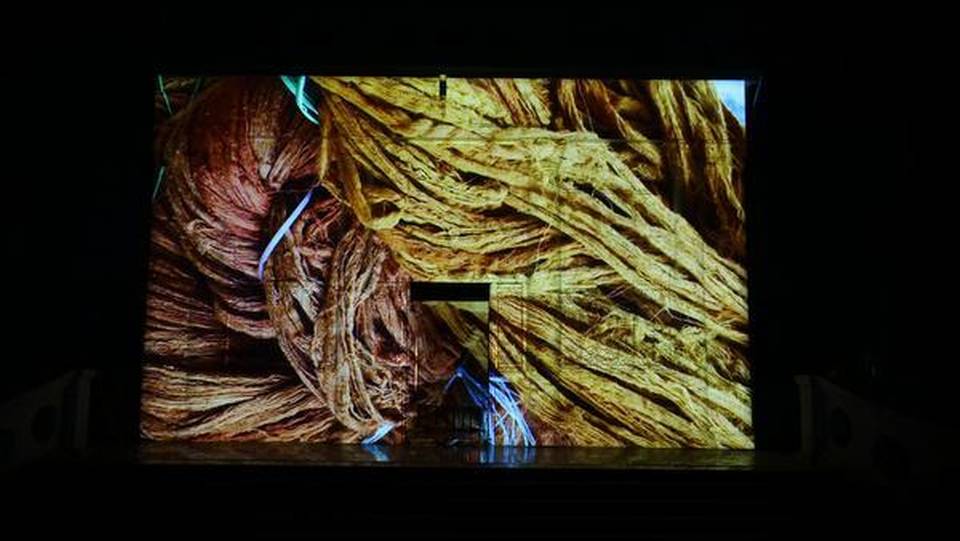
I walk through the dark entrance of the Government College of Fine Arts on a quiet Saturday evening. From outlines and vague shadows, I figure out that a motley group of people has gathered before the magnificent white-coloured main building of the college. It’s no secret that the building is one of the most beautiful heritage structures in the city. Soon, the very building would transform into a screen on to which a documentary film will be projected. When the clock strikes seven, to the background of the rumbling of a distant train and the howling of street dogs in a fight, the building starts narrating the story of handloom weavers in Gajendragad. The projection takes the shape of the building, replete with parallel scenes that run on either aisles, apart from the central frame. A performance in the form of spoken poetry too, happens in front of the structure.

Hidden Lily, a documentary film, is part of Bengaluru-based 3rd Space Lab Collective’s long-term collaborative project, Social Weavers, in association with the handloom weaving societies of Gujarat, Odisha, Andhra Pradesh and Karnataka and textile artists Shatrughan Thakur and Priyanka Kumari. The goal of Social Weavers is to develop a series of 300 hand-woven saris that interpret landscape as a metaphor, which will culminate in an exhibition. The documentary was developed in collaboration with artist and projection mapping specialist G Craig Hobbs.

Yarn that narrates

The quest started in 2016 for this collective of artists, whose projects are on collaborating cultures. The collective was started in 2012, by Shalini Agrawal and Trena Noval from California and Lalitha Shankar and Shamala Nandesh from Bengaluru. “Shamala and I were on the San Francisco Golden Gate Bridge and were looking at the tourist maps and guides. Then, we came to know that the cable used in the bridge goes around half the Equator in terms of distance,” artist Lalita Shankar says, about the inception of the project. This led Lalitha and Shamala, also an artist, to look at the rich culture of handloom in Bengaluru. “Then the idea of using yarn to cover the distance between San Francisco and Bengaluru came up. But we were sure of using organic cotton and natural dyes to make saris that would cover the distance,” she continues, adding that the geographical landscape, then becomes a metaphor. The distance they were trying to bridge was that of two completely different cultures. And the number of saris required for this, would be 323. “Thirty-five kilometres of yarn will be used to make one sari (warp and weft included)”.

These saris will, in turn, act as canvases. Art from different locations and specific to different communities, will feature on them. And of the 323 saris, 25 have been woven as of now. Lalita hopes that in the next two years, the collective would be able to finish all the 323 works of art. “We have looked at Bhuj, Andhra Pradesh, Gajendragad and Odisha now.” Their next stop is Narayanpet in Telangana. “The design is very specific to the environment it is in. The loom and the way they weave adds to the end product,” she explains, adding that the collaboration with artisans from different locations, was an eye-opener for them. However, she also says that it is not always easy to gain the weavers’ trust. “It is difficult to build trust in them. There is something that pulls them back when it comes to projects like these,” she concludes.

The video mapping (projecting a film on to a building) was done in connection with the Chennai Photo Biennale, on March 22 and 23.

source: http://www.thehindu.com / The Hindu / Home> Entertainment> Movies / by Gowri S / March 25th, 2019

Gymnast shows how to shake off agony and pick yourself up

Anantha Rao B, a former national-level gymnast, is defying all odds to make a return to the sports field after being involved in an accident which left him paralysed.

Anantha Rao
Anantha Rao

Mysuru :

It’s 4 in the evening. A 30-year-old man in a wheelchair comes out of his house and takes ad 1.2 km-long ride to the nearest public park. After a 10-minute-ride, he reaches the park. His wife assists him by locking the wheelchair brakes, moving the footrests out of the way of his feet and putting the armrest on the side. He then takes out a wooden club from his bag and throws it from the sitting position. His wife picks it up and gives it back to him. He again makes the farthest throw…

Anantha Rao B, a former national-level gymnast, is defying all odds to make a return to the sports field after being involved in an accident which left him paralysed.  He has bagged over 100 medals at the state, south zone and National level gymnastic events.In  2010, while he was doing a somersault at the Mysuru Dasara games,  he landed on his neck which injured his spinal cord and made him immobile.

Nine years after this incident, he is now trying to achieve something in the field of Para Sports. He is preparing to compete in the Club throw — a sport which is currently practised only by athletes with disabilities.Following the tragic incident in 2010, doctors found that Anantha’s spine was shattered. He underwent treatment in a hospital for nearly two years but showed no improvement. That’s when the doctors of HCG Foundation came to his rescue. In an attempt to regenerate the  cells in his spinal cord, a team led by Dr Ajay Kumar gave Ananth stem cell therapy and injections.

This helped him sit – he was bedridden for two years. In 2014,  he approached Ayurvedic therapist Chandraprabha who suggested new treatments.  They both fell in love and got married.  Chandraprabha became his support system. Anantha who always kept himself busy in the sports field was missing something and he became interested in video editing, VFX making. He spent hours browsing and watching video tutorials on VFX and started acquiring editing skills.

During this period he browsed about various para-athletes, their achievements and how they set their goals. He then became determined to pursue sports and shine. In the meantime, Satyanarayana, National Para Athletics coach,  appealed to him to take part in a Para Sports event like Club throw.

Ananth, who was not ready to let fate have the final say, started learning the skills of Club throw. Over the past one year, he has been practising this track and field event. To improve his throwing skills, he ordered a wooden club, weighing around 400 gm,  from the United Kingdom as they are not found in India. Every day he and his wife visit the nearby park, spend an hour practising the Club throw. His wife helps in getting his throw measures and picks up the club and gives it back to him.

When he initially started throwing clubs he could throw it to a distance  of just 9.75 m. But after a few months of practice, he can throw up to 16 m. Last year, he participated in the 18th National Para Athletics championship held in Haryana. Though he did not bag a medal, it gave him a great learning experience, he says. He is hoping to participate in an international Para Sports event this year.

Anantha’s wife Chandraprabha says, “He has the passion for the sports. I can sense the improvements in his throw and there is a meteoric rise compared to his initial days. He  possesses great confidence. What he needs now is a good trainer and coach who can train him and suggest some good techniques.”

FINANCIAL CRUNCH Anantha receives 
Rs 3,000 as pension from the government. His father, an auto driver who stood by him,  passed away three years ago. Though a few individuals and organisations had provided funds in the past, he needs financial support to continue his passion.

source: http://www.newindianexpress.com / The New Indian Express / Home> States> Karnataka / by Karthik K K / Express News Service / March 24th, 2019

Christian Missionaries used Panchatantra translation to convert Japanese: expert

Monika Zin, KHK Visiting Research Fellow 2015 and Associate Professor, Indian Art History in the Department of Asian Studies, Institute of Indology and Tibetology at Ludwigs-Maximilian Unversitat Munchen in Munich in Germany, delivering a lecture at the Central University of Karnataka at Kadaganchi in Aland taluk on Tuesday.— PHOTO: ARUN KULKARNI

‘They, based on the Jataka Tales, claimed that the Buddha was originally a Christian’

Research Fellow and an authority on Buddhist art and architecture Monika Zin has traced the root of a beautiful, early third century Buddhist relief found during excavations in the Amaravathi sites to the Jataka Tales in the Panchatantra and how the Christian Missionaries, who used the translated version of the Panchatantra from Persian, Arabic and other languages, converted a large number of Japanese to Christianity with the claim that the Buddha was originally a Christian.

Delivering a lecture at the Central University of Karnataka at Kadaganchi in Aland taluk in Kalaburagi district, Prof. Zin, who is a KHK Visiting Research Fellow 2015 and Associate Professor, Indian Art History in the Department of Asian Studies, Institute of Indology and Tibetology at Ludwigs-Maximilian Unversitat Munchen in Munich in Germany, said that the relief found at the Nagarjunakonda Museum in Telangana has striking similarities in the figures shown in the Panchatantra translated into Pahlavi language and later into Arabic and other languages.

The beautiful relief

Prof. Zin said that the beautiful relief, which is still intact, shows an unidentified king, initially looking angry, being prevented by a couple of women from attacking a sage and later, paying obeisance to the sage. It has an interesting scene of a man hanging over a well holding onto two branches of a tree over which are a tumbling elephant and a white and black mice. In the well below, there are four figures of serpents creeping up and another with its fangs open.

She said that this picture of a man hanging from two branches of a tree over a well and all the other details is found in all translations of the Panchatantra in other languages. The Panchatantra tales were first translated for the Persian royals in Pahlavi language in the sixth century and later, into Arabic in the eighth century. In both these translations, the sequence of this relief is brought out in a pictorial form with all the details. It was the translation of the Panchatantra first to Pahlavi language and later to Arabic language that led to the translation of the tales into other languages.

However, the translation of the Jataka Tales by John of Gapna in the 13th century to Latin language was significant as it also carried the details of the relief in pictorial form.

The Greek translation in the 10th century of the Panchatantra titled “Barlaam and Josephat” was used by the missionaries working in Japan to claim that the Josephat in the tale was the original Buddha and that he was a Christian, leading to conversion of a large number Japanese to Christianity.

source: http://www.thehindu.com / The Hindu /Home> News> States> Karnataka / by Special Correspondent / Kalaburagi – January 13th, 2016

This app connects patients to doctors almost instantly

The app mfine connects patients with doctors almost instantly, cutting down on the time spent in-clinic and money spent in-transit

Imagine you are stuck in traffic and you have a doctor’s appointment. You have either missed it and are going to have to reschedule or just see another doctor. It is these kind of bumps that mfine aims to conquer, through their app, with a back-end system that runs on Artificial Intelligence.

Front-end functions

The app has tie-ups with about 375 doctors, 80 hospitals, across 20 specialisations, with on-ground services in Bengaluru, Hyderabad, Chennai, Pune, and Delhi. You log in and put in the symptoms. This will lead you to the doctors’ listing page, where you can opt for a particular specialist, if you like. This choice may depend on experience, testimonials, and place of operation (in case you need offline help). The idea is to put you in touch with a doctor in a minute. If you are unsure though, the system will assign a specialist to you.

 Ajit Narayana, co-founder of mfine app and Chief Technology Officer
Ajit Narayana, co-founder of mfine app and Chief Technology Officer

Alternatively, you may be very specific about which doctor you’d like to see, especially if you’re coming back to check about something. “Most often, you’ll get connected within 30 to 40 minutes,” says Ajit Narayanan, a co-founder and the Chief Technology Officer, based out of Bengaluru. “The whole idea is that you access care when you need it,” he says. Once you enter the symptoms or even return with a doubt, the query goes to a ‘care team’ of doctors that looks at it before a senior specialist does.

You get an appointment and pay up — every service is payable, and every interaction is seen as a consultation, though follow-up treatment within a week, whether online or offline (if you choose to visit the doctor at his location) is not charged.

A shot of the mfine app

Prescriptions may be given, even conditions diagnosed, unless the doctor feels he needs to see you. Dosages may be tweaked, uncomfortable questions answered, and a second opinion offered. “It’s better than Dr Google, because you can reach a doctor just to clarify what to do for a headache, rather than popping pills or assuming you have a particular problem,” says Dr Manjula Anagani, Managing Director and Chief Gynaecologist, MaxCure Suyosha Hospital, Hyderabad, who is one the senior-most doctors on the app. Gynaecology, dermatology, and general medicine are the three specialisations that see the most traction.

If the doctor asks you to take a test or some medication, the system will remind you to do so. You can then upload the reports. Past medical records too can be uploaded, so it is all consolidated.

There is now a medicine delivery service in Bengaluru and Hyderabad (they deliver within 60 minutes), as well as a lab-test service that ensures someone comes home.

The anatomy

The app runs on artificial intelligence (AI), which means that it is learning as it goes along. For starters, when the app went live in December 2017, data was fed in from publicly-available medical literature. There was some tweaking to incorporate customisation with doctors’ inputs. Then, as conversations are had, prescriptions made, and more medical research fed into the system, the system keeps evolving. “The quality (of advice) improves, because the knowledge is built up,” says Ajit.

So when you key in your symptoms, say cold, sore throat, low-grade fever, the AI system will auto-suggest to the care team what the possibilities are. This ensures that human error is minimised.

“In a month or so, the system will be able to read and capture information from lab reports,” says Ajit. There will be a photo snippet of the key findings, in case the doctor wants to refer to it. The company is also working on the system’s ability to ‘read’ X-rays as well.

All this cuts down on commute time to the doctor and cost per doctor visit. The app generally charges ₹450 for a consultation, which may be what you pay when you make an in-person visit in Hyderabad and Bengaluru; if you’re accessing it from say, Delhi, it is a huge difference. You can also subscribe at ₹2,000 for six months, for upto six family members.

It also helps bust myths during pregnancy (women can reach out to the doctor without a family member). Baby- and child-related doubts can be quickly addressed, especially if you don’t have a paediatrician who is easily available.

source: http://www.thehindu.com / The Hindu / Home> Sci-Tech> Health / by Sunalini Mathew / March 18th, 2019