A look at the iconic 56-year-old Thomsons Bakery in Cox Town, where wood-fired ovens run through the day.
Tradition runs deep with this modest bakery owned by CT Abraham, popularly known as Thomsons Bakery. Founded in 1962 by the late C I Thomas and wife Anita, who moved to Bengaluru in 1943.
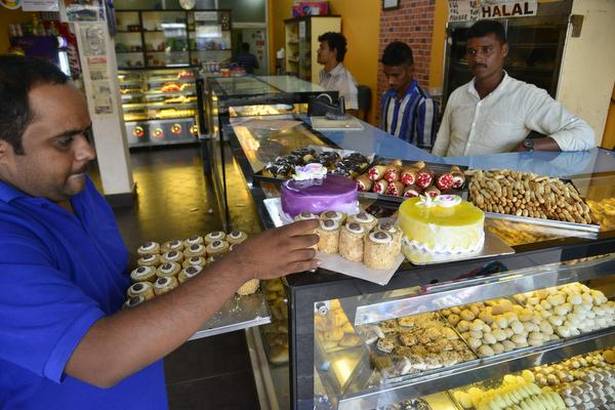
Business started small, in a nook tucked away in a street next to St Peter’s Church, Cox Town. Although the bakery is small, it has made its mark in Bengaluru and attracts the local population and has connected with its customers over the years. As you enter the bakery, a mouth watering aroma of freshly baked bread greets you and lures you in. The bakery is stacked with goodies rows of rich brown plum-cake, crispy samosas and light, flaky macaroons.
The Thomases initially started supplying bread and other bakery goods in bulk to industrial canteens like ITI and MICO, besides the Army and Air Force canteens as their quality and reasonable prices made them popular.
“When World War II broke out, Dad came down from Kerala to look for a job, as a lad of 25. He worked in various places and after picking up experience in business, decided that it was a good idea to get into the food business because bakery products were always in demand and there were no established bakeries in east Bengaluru,” says son C T Abraham, a chartered accountant.
Thomsons Bakery has, over the years, gained popularity for its plum cakes. The secret, says Abraham, is the wood fire technique. “It give the plum cake a unique flavour which is hard to get in any other oven. Even our bread and other products have a distinctive flavour because of this,” he says.
The fireboard is set aflame every day at 9:30 am. The wood is burned for an hour, after which the ashes are removed and the baking process begins, going on for about 45 minutes or so, and voilà, a fragrant batch of 150 loaves is out. The concept of using a fireboard and following tradition is quite crucial as they believe that using it adds a woody flavour to the bread. “It is indeed a big responsibility to maintain quality day in day out and especially in a food business. Support of family members is crucial”, added Abraham.
Just as son Abraham took over the bakery, loyal customers have extended to new generations too. The bakery has seen a number of weddings, having supplied plum cakes and other goodies too. Their products are bought by customers to gift to friends and family abroad.
Abraham says, “Business blooms in the wedding season as well as during Christmas, when over 6000kg of plum cake is produced.” Their recipe goes back generations, with roots in English tradition. A lengthy process is followed, involving the fermenting of fruits for six months. The cakes last for two to three months at least.
The bakery has a menu with 45 to 50 varied items that range from apple cake, cream cookies, chocolate pastries and jam roll to chicken puffs, samosas and vegetable cutlets. The 56-year-old bakery does quite well, while remaining on the quieter side with its advertising and promotion, and reaching out to retail customers. They have no plans of expanding as they prefer to stay that way such that quality can be maintained.
“It takes a lot of commitment, hard work and constant supervision to produce a few tons of quality plum cakes every year to satisfy our customer base and reputation,” included Abraham.
Big brands and bakery chains have left a dent in Thomsons business, but Abraham knows that no mechanized bakery can beat their plum cakes.
The bakery produces most of its products in its own small factory located down the road from the bakery. Nine employees work within the humble ambience of the bakery and factory. Even with the steady pace of business, the future of the bakery is uncertain because of the probable absence of someone to take over the enterprise in future.
—Pariza Khan
source: http://www.timesofindia.indiatimes.com / The Times of India / News> City News> Bangalore News / TNN / May 26th, 2018
Mango cultivators in Hogalagere village of Kolar have reason to cheer. The yield has doubled as more than 600 mango trees can be grown within one acre of land as against the previous limit of 60.
Lavanya, project manager at the Kolar centre of excellence for mango cultivation and horticulture, said this has been possible only due to the partnership between India and Israel. “The tie-up has helped us get better yields since 2016,” added Lavanya. Earlier, it was possible to grow only 60 mango trees in an acre but employing the root stocking technique, where grafting is done to increase production, has upped the number to 600. “This method reduces the lifespan of trees. Normally, a mango trees lives for 100 years but the technology decreases it to 25 years,” explained Lavanya.
The partnership began with a project called Mashav, initiated by the Israeli foreign ministry, which is aimed at achieving sustainable development and ensuring food security. Under the project, work is on in four main sectors — agriculture and rural development, socio-economic development, rural and urban development and education. It began in 2008 was later extended.
At present, the Kolar centre is growing Mallika, a mango variety which is being sold at Rs 80 per kg. “The yield has been comparatively good. We use drip irrigation to water the trees and don’t depend on rain,” said Lavanya.
The Indo-Israel agricultural cooperation has benefited both the countries, said the deputy chief of mission, Embassy of Israel, Dana Krush. “The new Karnataka chief minister HD Kumaraswamy had visited Israel in August and wanted to send state farmers to the country to learn new technologies and implement them here,” said Krush.
source: http://www.timesofindia.indiatimes.com / The Times of India / News> City News> Bangalore News / TNN / May 25th, 2018
The proposed variety is an improvement on the Amrapali variety, to get red colour from Vanraj
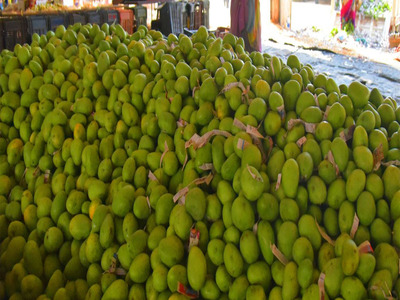
The biggest mangoes (Tenneru variety from Andhra Pradesh), with each fruit weighing around 2 kg, alongside smaller varieties. | Photo Credit: Handout E Mail
If mango is the king of fruits, the Alphonso variety is the king among mangoes due to its taste, attractive colour and moderate size. However, horticultural scientists are in the process of developing another elite mango variety, which is said to be superior to Alphonso.
What is a matter of pride for the State as well as the Garden City of Bengaluru is that the research is taking place in the Hessarghatta-based Indian Institute of Horticultural Research (IIHR).
Dr. M. Shankaran, principal scientist in IIHR’s Fruit Crops Division, told The Hindu that the researchers are trying to get ‘red shoulders’ for the proposed elite variety from the Vanraj variety of mango. “The new variety is going to be an improvement on the Amrapali variety of mangoes by getting characteristics responsible for colour from the Vanraj variety,” he said. “The research has entered the fifth year,” he pointed out.
The new elite variety is expected to be preferred for exports, he said.
IIHR researchers are also working towards developing mango varieties that can be grown in saline soil. If successful, several non-mango regions of the country, particularly coastal areas, may see cultivation of the fruit, Dr. Shankaran said.
For this, the scientists have chosen root stocks from the natural varieties, which have resistance to salinity. These root stocks will be grafted with other improved varieties to get good quality fruits with resistance to salinity, he said. “Presently, such natural varieties do not have quality fruits while the varieties with quality fruits do not have resistance to salinity,” he noted.
Meanwhile, the three-day mango and jackfruit diversity fair began on Thursday at the IIHR campus in Hessarghatta with 350 varieties of mango and 150 varieties of jackfruits, including those grown by farmers, on display.
The varieties of mango on display include appe midi (used as pickles), table varieties and those preferred for juice. A dozen exotic varieties from various countries, including the US, too were on display.
The jackfruit collection had interesting variety in terms of taste, colour and size.
Custodian of genetic diversity
In a bid to encourage farmers to protect native varieties, the IIHR on Thursday nominated farmer Shankaraiah from Hulikatte of Gubbi taluk in Tumakuru district as custodian of an unique variety of jackfruit being grown by his family.
The jackfruit with copri red flakes is very sweet in taste and weighs around 3 kg. As per the agreement, IIHR scientists will take up multiplication of the variety and also sell them. Proceeds from the sale would be shared by the farmer and the institute.
This is the second such farmers’ variety to be identified by the IIHR under the custodian of genetic diversity scheme. Recently, another jackfruit variety titled ‘Siddu jackfruit’ from the same district had been chosen.
Cine personality-turned-environmentalist Suresh Heblikar inaugurated the three-day fair in the presence of environmentalist Yellappa Reddy and IIHR Director Dr. M.R. Dinesh and Additional Director of Horticulture Dr. Parashivamurthy.
A mango that weighs two kg
It was not just the variety, but also the variations in size, colour and shape that mesmerised visitors.
The fair displayed the biggest mangoes with each fruit weighing around 2 kg (Tenneru variety of Andhra Pradesh) and several small-size varieties whose fruits weighed just around 40 gm.
There was one variety from Andhra Pradesh titled ‘elephant head’, as it resembled the head of a pachyderm.
source: http://www.thehindu.com / The Hindu / Home> News> Cities> Bengaluru / by B S Satish Kumar / May 24th, 2018
Studies and surveys have revealed that India’s current per capita water consumption is at 150 litres a day. The country is expected to suffer persistent water shortage by 2020 with the per capita accessibility of water coming down to less than 1,000 cubic meters.
One source of water wastage is vehicle washing and this number is set to soar as more vehicles get on the road. Mysuru has over 3 lakh private vehicles and assuming 10 litres of water is needed on an average for a single vehicle wash, the wastage of water is humongous — nearly 30 lakh litres of water every day.
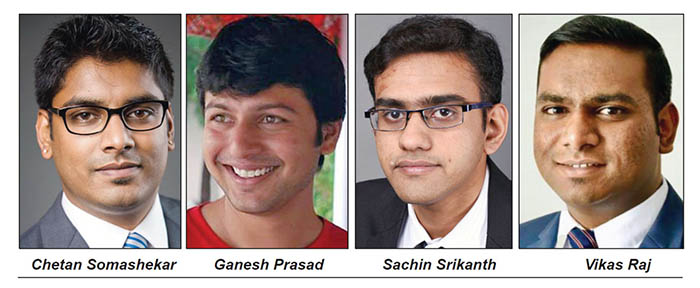
In what could be tagged as a pioneering initiative to provide an environment-friendly car wash service in Mysuru, a group of automobile enthusiasts have started ‘Clean Our Car’ — Waterless car wash. This group consists of four friends who have studied engineering — Vikas Raj, Chetan Somashekar, Sachin Srikanth and Ganesh Prasad.
Vikas and Chetan have done their Master’s in Automobile Service Technology from Germany while Sachin has done his Master’s in Surface Technology (Germany) and Ganesh Mechanical Engineering in Malnad. These like-minded friends have quit their jobs and thus ‘Clean Our Car’ took birth in Mysuru.
Speaking to Star of Mysore, Vikas Raj said, “Lots of water is being consumed for washing cars and during summer and drought situations, washing cars and scarcity of water is a huge concern. We are related to the automobile industry and were experimenting with this idea from Sept. last year. It became a reality in Nov.”
About water savings, he said, “This can save lots of water. A normal car wash in service stations requires about 160 litres of water per car and so does the traditional and automated car washing techniques. The latest foam wash method too consumes about 90 litres of water for a single car. We wanted to change this concept. We use only about 3 to 5 litres of water per car and we provide door-step service to customers. The response in Mysuru has been very good.”
The team uses a biodegradable solution to wash the car. The surfactants in their formula helps remove dirt and suspends it from the car’s surface. It creates a thin film between the paint surface and the dirt, which helps clean the surface without scratching it. The solution dilutes mud, sand and dust particles rather than dissolving them.
Their formula contains active agents which lift dirt and grime from the pores, encapsulating it and making the surface easier to clean. The solvent is a protector-cum-shiner. It contains natural wax which protects against dust and ultraviolet rays, preventing fading of plastic and fibre parts.
Clean Our Car ensures that your car is neat and clean within one hour. Though the team has their office set up in Kuvempunagar, customers can ask for door-step service. And the prices that they offer are reasonable. They charge about Rs. 260 for a basic car wash, around Rs. 290 for exterior as well as interior car wash and Rs. 320 for a special exterior and interior plus car wash. They also have several other packages.
Vikas adds, “We use this biodegradable formula which has no harsh chemicals and thus it does not damage the surface of the body. The dust does not stick to the surface of the car as the solvent has the formula of a blend of wax coating. Customers can use Clean Our Car App. Once registered, with just a click of a button we will be there at their doorstep to wash their car. We have services like exterior cleaning, interior cleaning, interior polishing, tyre dressing, wheel shine, interior vacuum, door sill cleaning, door pads cleaning, etc.”
source: http://www.starofmysore.com / Star of Mysore / Home> Feature Articles / by V. Shourabh / May 18th, 2018
The city has got a unique store which endorses some of the Geographical Indication (GI) products such as Channapatna toys and Devanahalli pomelo among others. This is also said to be the first GI-based products store in the country.
Located in HSR Layout, the store has been started by a group of GI product enthusiasts and will display unique items from artists and agriculturalists. The GI tag that is given to products that possess special features corresponding to a particular geographical location. This tag can be used for agricultural, natural and manufactured goods, emphasizing the heritage of each location.
Around the world, 10,000 products have GI tag, out of which 350 are from India with Karnataka leading it with 36. The products include Mysore silk, Mysore agarbatti, Bidriware, Channapatna toys and dolls, Nanjangud bananas, Byadagi chilli, Devanahalli pomelo among others.
“It feels nice to set up a store for all GI products because this showcases the culture of the country,” said S J Tejas, owner of the store, which was started under the banner of Geographical Indications Tagged World Premium Products Limited (GITWPL).
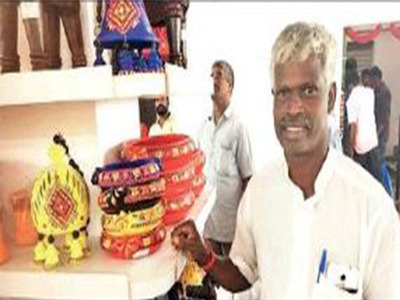
The famous Villianur Terracotta works with huge statues of horses and elephants caught the eyes of many visitors at the shop on the first day. “We’ve been practising this artwork for many years now but after the GI tag was given to us, it gave more confidence and pride,” said artist V K Munuswamy. Because of the GI tag, he could take his art to Geneva, he added.
Ravi Kumar, an industrialist, said: “This is a unique store with products ranging from fruits to ornaments.”
source: http://www.timesofindia.indiatimes.com / The Times of India / Home> News> City News> Bangalore News / TNN / May 11th, 2018
Kiran Mazumdar-Shaw’s tweet comes on a day Walmart group acquired a controlling stake in Flipkart for about $16 billion.
India’s largest e-commerce company, second largest IT services exporter and a biotechnology major share one thing in common: Koramangala, Bengaluru.
A suburb in the south-eastern part of Bengaluru where Flipkart, Infosys and Biocon were born. That’s not about it. All these offices were rented, says Biocon chairperson Kiran Mazumdar-Shaw on microblogging site Twitter.
And Ms Mazumdar-Shaw’s tweet comes on a day Walmart group acquired a controlling stake in Flipkart for about $16 billion – the biggest acquisition by the US retailer.
Terming Koramangala as a “lucky suburb”, the Biocon chief said: “Infosys & Biocon also started in rented offices in Koramangala…” Ms Mazumdar-Shaw, founder of Biotech, also serves as independent member of the board of Infosys.
The first storey of a two-storey Bungalow in Koramangala became the first office from where Sachin and Binny Bansal founded the e-commerce start-up Flipkart in 2007 that later turned into India’s first unicorn.
Located in 447-C, 12th main, Koramangala, the bungalow is located in a leafy lane of a residential suburb that is now inundated with scores of restaurants, restro-bars and fitness centres, according to Flipkart Stories, the official website that publishes latest news updates about the e-commerce company.
Flipkart sold 77 per cent of its stake to Walmart group in a deal that values the 11-year-old company at $20.8 billion.
And it’s not just Ms Mazumdar-Shaw who thinks Koramangala is lucky. SM Fathaulla, a retired government employee, who owns the 447-C, 12th main, Koramangala property also thinks so. “…447-C – the office that had been blessed by Lady Luck,” an article on Flipkart Stories cites Mr Fathaulla as saying. “For many years, the genial landlord recalls warmly, Sachin called on him in person to pay the rent,” it reads.
Besides the three industry leaders – Flipkart, Infosys and Biocon, other major companies headquartered in Bengaluru include Wipro, Britannia Industries, GMR Group, Tata Coffee, Strides Shasun and Shapoorji Pallonji Group.
source: http://www.ndtv.com / NDTV Profit / Home> Corporates / by Sandeep Singh / May 10th, 2018
For more than 80 years, people have been queuing up at Bengaluru’s Excelsior Bakery for cakes, milk bread and biscuits
In the 1940s, young Army recruits volunteered to knead the dough at this bakery because they wanted to build upper body strength. They were paid for their services with a loaf of bread.
The Excelsior Bakery in Bengaluru’s bustling Shivajinagar Market is not difficult to find: I just let the smell of freshly-baked bread lead me.
The family-run bakery began as an Indo-British partnership between Sahadevan, a local baker, and a British Lady Emery, in 1930. The establishment is currently run by Saipreeth, Sahadevan’s great-grandson and his father, Muralidharan.
For residents of the cantonment, Excelsior is the go-to place for milk bread, cakes and goodies such as ribbon cakes, cummtee cakes, kal kals, milk cakes, rose cookies, fresh cream cakes, masala biscuits, pastries, puffs and rolls.
“My great-grandfather was a confectioner, who began working at Honour Bakery, that was run by an Englishman in the 1920s. When that shut down, he set up Excelsior along with Lady Emery,” says Saipreeth.
Early birds
“Our bread and cakes were in huge demand. When the store opened at six in the morning, there would be a crowd waiting for a fresh loaf. We had to hand out tokens and only the first 100 customers got the bread! It was not uncommon for people to travel from the other side of town for our cake and a fresh loaf of bread. Even today, we have a huge demand for our plum cakes during Christmas. Our coconut barfi is also a huge hit, and there is also a demand for our day-old bread, since that works better for making sandwiches. I know a lot of people whose staple breakfast fare is our milk bread,” says Muralidharan.
Of course, Excelsior no longer has Army volunteers and now their kitchen is upgraded and less labour-intensive. There have been a few tweaks here and there, but the recipes have essentially remained the same for more than 80 years. Some of its staff have been with them for two generations. They say this has helped in maintaining quality.
The mornings are the busiest for them. The head baker arrives at six and the baking begins in right earnest, says Saipreeth.
“We deliver our products to many colleges and schools. Since we do not use any preservatives, most of our products do not have a very long shelf life, so we strictly follow a routine every day.”
In this weekly column, we take a peek at some of the country’s most iconic restaurants
source: http://www.thehindu.com / The Hindu / Home> Life & Style> Food / by Nikhil Varma / May 03rd, 2018
From suave bags fashioned from tetra paks, denim and other textile wastes to fancy tea coasters made using motherboards and vinyl records, Rimagined’s range of upcycled products is indeed a revelation.
India produces 1,00,000 metric tonnes of solid waste on a daily basis, and this amount is higher than the combined solid waste generated by many other countries.
While one can argue that the demographic and area-population ratio perspectives are skewed and debatable while comparing such statistics, it is high time that we admit that the country has failed to manage the insurmountable waste generated by an increasingly burgeoning population, and is in the throes of a crisis.
Therefore, instead of routing the waste to overflowing landfills and putting together half-baked and clumsy measures that are hazardous to the environment, we have to start looking for solutions that are sustainable and can reduce our waste burden.
India’s waste burden. Source: Flickr.
Come to think of it, before materials like plastic and styrofoam entered the country, what exactly were our grandparents or great-grandparents using in place of every synthetically generated item that we have become habituated to?
It wasn’t as though they weren’t practising waste management. On the contrary, their traditional way of life incorporated upcycling even before coinage of the term, and our forefathers truly believed in and practised zero wastage to perfection.
Upcycling is once again becoming popular in India but is currently an option for a limited few. This could be attributed to our age-old aversion towards garbage, and the offensive idea of using products that are made out of somebody else’s waste.
However, some ventures are making a mark with their range of upcycled products in recent times, and we bet that most people wouldn’t be able to distinguish from regular products if not enlightened beforehand.
Rimagined is one such entrepreneurial venture founded by Bengaluru resident Shailaja Rangarajan in 2016, which not only provides supercool and interesting upcycled products in diverse categories such as furniture, jewellery, clothes, and home décor but also employs women from underprivileged sections of the society to offer them a dignified source of livelihood.
With 15 years of experience as a business consultant in the IT sector, Shailaja’s tryst with waste management began when the local residents association began actively practising waste segregation and in-house composting.
The brains behind the venture, Shailaja Rangarajan.
This paved the way for her to begin volunteering with two NGOs—Whitefield Rising and subsequently, Solid Waste Management (SWM)—for about three-and-a-half years.
“This period was a great eye-opener for me, given the massive mounds of waste generated in Bengaluru on a daily basis. Looking at my little daughter, I often wondered what kind of world were we leaving for our children that was overflowing with garbage and extremely depleted of resources. During this volunteering period, I noticed that a large percentage of waste could be put to better use instead of being cast away to landfills. Recycling was an available alternative, but I felt that alone wasn’t enough,” says Shailaja to The Better India.
At that point, she knew many people who were already practising upcycling but in a restricted manner. For them, their customer base was confined to their friends’ circle, and their ventures weren’t about making money or profit.
Understanding that the waste crisis was man’s own creation, she decided to step down into the field herself and spent the next seven to eight months conducting extensive research on upcycling and meeting people associated with waste management in every possible scope.
This would eventually lead her to conceptualise and give wings to Rimagined.
She quit her job and in April 2016, she placed Rimagined on an online marketplace with 10 vendors and 60 products. To gain a greater reach and better visibility, she also put up stalls with these products at local events hosted in Bengaluru.
“The whole purpose of taking this forward was to drive upcycling as a movement rather than just selling products. Also, this was an opportunity to push for conscious consumption in an otherwise consumerism-driven population. Because our products were skilfully crafted with a trendy finish, it took our customers by complete surprise when they came to know these were upcycled products. The wow factor and word-of-mouth together helped in gradually taking Rimagined to greater heights,” Shailaja remembers.
Seven months later, she launched Rimagined as a label.
This happened thanks to an intervention from Devika Krishnan, a well-known designer in Bengaluru, which led to a collaboration, with Rimagined becoming the retail face for Joy@Work.
Devika Krishnan (behind, left) along with the womenfolk of Bengaluru unit. Courtesy: Rimagined.
With a production unit comprising a group of women artisans from a low-income background, Rimagined now envisioned to provide them sustainable livelihoods through upcycling.
“This also proved to be a great learning curve as now I got to witness every stage first-hand in a social entrepreneurial venture—right from waste procurement to the end sales. With a growing customer base and greater demand of products, Rimagined finally had its retail outlet set up in Whitefield in July last year, which is more on the lines of a prototype store,” she says.
In November, Shailaja visited her friend, Debopriya Biswas in Kolkata, who was a teacher at a special needs school for children hailing from underprivileged sections of the society.
“What I had noticed here was that many mothers spent close to 4-5 hours waiting for their children in the school premises. These were impoverished women whose financial state was in shambles due to the lack of opportunities, and we decided to change that,” she mentions.
Shailaja decided to expand the scope of Rimagined’s workforce. Following a discussion with the women who readily showcased interest, she chalked down a training period of three months.
“They surpassed my expectations, and within a month, production-ready pieces with quality finish were laid before my eyes. Now, we have a production unit in Kolkata with around 45 women, and another batch of 35 women are waiting to be trained. There is another team of 15 women in Odisha which will shortly materialise to reality as another production unit,” she proudly adds.
While the implementation of upcycling to this extent in itself is a noteworthy factor, what makes Rimagined’s undertaking even more significant is how the venture is helping women from financially strapped households to take control of their lives with dignity and pride.
“These talented women have proved that if they are given right opportunities, they too can shine. Through this venture, we want the women to rise over their financial circumstances and feel empowered through their capabilities and skills,” Shailaja clarifies.
From suave bags fashioned from tetra paks, denim and other textile wastes to fancy tea coasters made using motherboards and vinyl records, Rimagined’s range of upcycled products is indeed a revelation for even the most cynics.
The best part is that these are not too expensive when compared to other upcycled products in the market, thus giving an opportunity to people from all walks of life to consider purchasing upcycled products and become conscious and responsible consumers.
Also, each product that you see on Rimagined’s website has an assigned score based on the decomposition rate of its content materials and its contribution to overall waste.
Optimal utilisation of Tetra packs, broken glass pieces and fabric wastes to make new products. Courtesy: Rimagined.Stools made of fabric waste and bed sheets fashioned out of denims. Courtesy: Rimagined.
“This will give one an insight over the quantity of waste materials that he or she just pulled away from a landfill by purchasing any one of our products,” she explains.
Having upcycled approximately 60-70 tonnes of varying categories of waste until now, Shailaja hopes to take the concept of upcycling across the country as a movement and bring back the traditional way of living practised by our ancestors, besides helping the country manage its waste in a creative and sustainable manner.
Folks in Bengaluru can reach out to Rimagined if they wish to contribute old denim, fabric waste, e-waste and any segregated solid waste that they think can power their vision.
Rimagined will shortly flag off operations in Indiranagar, one of Bengaluru’s busiest zones, from a new retail unit and we wish the team a great and successful journey ahead.
To check Rimagined’s awesome range of upcycled products, click here. You can reach out to the team at contactus@rimagined.com.
(Edited by Gayatri Mishra)
source: http://www.thebetterindia.com / The Better India / Home> Bengaluru / by Lekshmi Priya S / May 04th, 2018
Paresh apartments was build in 1974 by contractors H N Anantharaman (top right) and H N Dwarkanath
Bengaluru :
While Bengaluru today is dotted with apartment complexes and housing societies, many may not know that one of first steps in this direction was taken by H N Anantharaman, now aged 91, and his 89-year-old brother H N Dwarkanath way back in the 1970s.
Having been hired as contractors by the Paresh Apartments Cooperative Society , the duo built the city’s first apartment complex in 1974, which stands tall in Malleswaram even today.
“In the early 1970s, 24 of us got together and bought this plot of land. Anantharaman and Dwarkanath were the contractors, and we all respect them for building such a solid structure,” said Sooryakanthi Madiman, who moved into her flat in 1974 at the age of 27, following her marriage to Madiman, who was a DRDO scientist.
Sooryakanthi says that while newer and fancier buildings are plagued with problems like seepage and leakage, theirs has a strong foundation. “When workers carry out repairs in our houses, they find it very hard to even drill a nail into the wall,” she added.
The complex comprises a cluster of three-storey buildings, and a majority of the original 24 families continue to live here even though the surroundings have rapidly transformed, with individual houses giving way to large apartment complexes.
Born in Hiremagalur, a hamlet in Chikkamagaluru, the brothers were brought to Bengaluru — where they studied engineering — by their older brother who was working here. After a few years, during which they worked in Tamil Nadu, the brothers decided to get into business and started building water tanks, water treatment plants and civil structures.
“They were ahead of their time. They realised that with the rising growth rate, people would start running out of land to build houses on. So, they started constructing multi-dwelling units and venturing into joint-development projects, which was rare at that time,” said Narayan Babu, Dwarkanath’s son.
“They wanted to build homes for people who had saved their hard-earned money for the purpose, unlike today when people are entering the industry purely for business gains,” said Gopinath, Anantharaman’s son.
The duo worked in tandem — while Anantharaman handled financial matters by meeting people and raising funds, Dwarkanath designed the structure and monitored the work.
The brothers, however, are unhappy with the current state of affairs under which members of lower-income groups are unable to find affordable homes within city limits and so have to live on the outskirts.
Honour for pioneer
Anantharaman was recently honoured by Rotary Bangalore Downtown, and conferred the Rotary Pioneer award in recognition of his “pioneering contributions to the field of group housing and construction by developing the first apartment block in Bengaluru, and establishing the industry association KOAPA (Karnataka Ownership Apartment Promoters’ Association), the precursor to the present CREDAI.”
source: http://www.timesofindia.indiatimes.com / The Times of India / News> City News> Bangalore News / by Niharika Alva / TNN / April 28th, 2018
All it took was an introspective six-month sabbatical from their tech jobs to give-up comfortable paycheques and turn into ecommerce entrepreneurs. This story is pretty much routine now for new-age Bengalureans but what’s different here is that Nirupesh Joshi and Mercy Amalraj found their calling in the offbeat business of watch-making in India. While Joshi worked for Akamai Technologies in Hong Kong for ten years, Amalraj was a freelance mobile app developer and quality assurance engineer.
Few weeks ago, the husband-wife duo launched Bangalore Watch Company. The fine watch-making brand based out of the IT city manufactures mid-segment gentleman’s timepieces, priced at about Rs 40,000 each.
Interestingly, their first collection of 500 limited edition pieces pays a tribute to the legendary Indian watch brand Hindustan Machine Tools (HMT) by incorporating design details like vintage arrow-head indices and dauphine-shaped hands on the dial.
Plan is to narrate Indian stories in all their successive collections too. Even their brand logo incorporates the geometric interpretation of the coat of arms symbol from the erstwhile kingdom of Mysore.
Joshi says, “I often wondered why fine watch-making never took off in India the way fine jewellery has made a mark. Indian watch brands like Titan have a cult following but they are not in the luxury category. Final turning point came when legendary brand HMT shut down in 2015. We quit our jobs and turned our passion into a business plan.”
Joshi has turned into a watch designer. His assembly unit located in Kanakapura brings together components sourced from across the world to manufacture these pieces.
In the last three weeks, they have found takers in tech-executives, entrepreneurs, artists and architects above the age of 30. “They appreciate things of Indian origin and want to add our watch to their existing collection of timepieces,” adds Joshi. The brand’s next collection will be rolled out in October this year.
source: http://www.economictimes.indiatimes.com / The Economic Times / Home> ET Home> RISE> Startups> News Buzz / by Smita Balram, ET Bureau / April 25th, 2018