Preventing privatisation of water

KshihjitUrsBF310ct2015

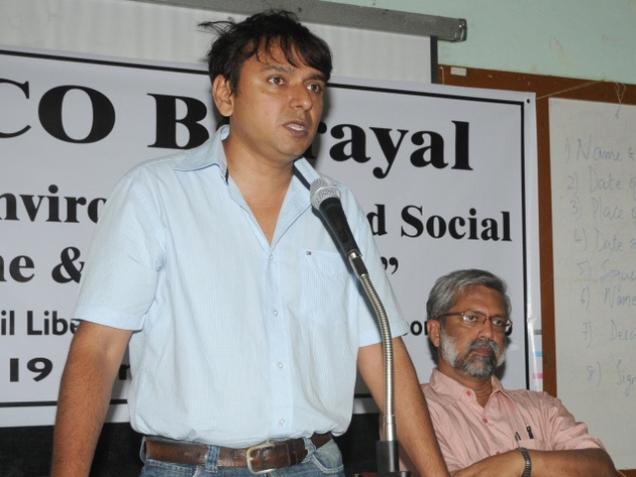
Kshitij Urs has spent the past two decades reminding society and the government that water belongs to the people

With rivers dying and lakes becoming bowls of sewage, water is being prophesised as the centre of the next great power struggle.

Amidst grave concerns, Kshitij Urs has spent the past two decades reminding society and the government that water belongs to the people. “Water, to me, has historically been a source of power. Because of this, it is also a source of discrimination. If one were to look at urban deprivation, lack of access to water is as important as food or education,” he said.

Privatisation

The battle for water started in 2004 when he accessed a government agreement with an NGO to “manufacture consent” among the people on water privatisation.

“We realised that this was a new era of public participation where consensus was going to be manufactured. We needed a State-level mobilisation of opinion on the actual impact of the move,” said Mr. Urs who then co-founded the Campaign against Water Privatisation.

Through a sustained campaign that focussed on the commoditisation of water over three years, the State government backed off from the reform. However, the ‘war’ is far from won. “They have tried their hand at Hubbali and Mysuru where opposition to the move resulted in water coming back to the municipality…In Bengaluru, we are seeing privatisation in other forms, such as Unaccounted Flow of Water project, where operations of water supply is being given to private companies,” said Mr. Urs.

Since 2007, the organisation has transformed into People’s Campaign for Right to Water (PCRW), which strives for the protection of water bodies. Their legal action has seen encroachments on Sarakki lake being removed – a development that set off anti-encroachment drives on lakes across the city.

The advocacy by PCRW was also crucial for drafting of the Karnataka Lake Conservation and Development Authority Act, which will see all lakes coming under one body, he said.

Trained as a medical doctor, Mr. Urs’ interest in social justice and deprivation started in 1993 when he met two sisters — one 10 and another 12-year-old — while volunteering at an NGO. “They were diagnosed with HIV. Deprivation had pushed them from a slum in Banashankari to prostitution in Bombay…Nothing in my upbringing had prepared me for this,” he said.

The ‘awakening’ saw him delve into the social sector with a masters in development studies from London followed by a Ph.D from National Law School of India University in the water sector.

Projects working on

Democratisation of water sources

Empowering local communities to raise issues relating to lakes

Following up implementation of Karnataka Lake Conservation and Development Authority Act

Suggestions to government

Understand social conservation of water

Involve local communities in managing water sources

Suggestions to citizens

Understand the importance of traditional wisdom to secure inter-generational rights of water

Demand protection of lakes, tanks

Get involved in policy making

source: http://www.thehindu.com / The Hindu / Home> News> Cities> Bengaluru / by Mohit M. Rao / Bengaluru – October 27th, 2015
KMC, Manipal launches Karnataka’s first chest pain clinics in Udupi district

Manipal  :

With an aim to save lives from cardiovascular diseases, Manipal Hospital launched Karnataka’s first ‘Chest Pain Clinics’ (CPC) in the Udpui district, on Wednesday.

To be operated under the ‘hub and spoke’ model, this initiative will include five ‘spoke’ hospitals (Chest Pain Clinics), one ‘hub’ hospital (KMC Manipal) and will reach out to thousands of people in the district, said Dr Ranjan Shetty, Head of the Department for Cardiology at KMC-Manipal at press conference.

Explaining how CPC are difficult from current health care services related to cardiovascular diseases, Ranjan said these clinics will enable small hospitals and nursing homes in and around Manipal to provide timely and quality emergency cardiac care to citizens and save more lives. Each Clinic will be a small healthcare facility equipped with Philips EfficiaECG-100 systems to wirelessly transmit ECG reports of patients in real time from the ‘spokes’ to the ‘hub’.

The report is transmitted to expert doctors in hub swiftly and team immediately analyzes condition of the patient and suggest further treatment if needed. “Once a patient is confirmed as suffering from a Myocardial Infarction, known as a Heart Attack, he/she is immediately transported via an ambulance from Clinic to hub, for primary Percutaneous Coronary Intervention (PCI) within the golden hour. While doctors at the hub keep everything ready for treatment and it saves times as well patient,” he pointed out.

He said that usually when a person has heart complications, he/she has to go a clinic equipped with electrocardiogram (ECG), after the reports consult doctor and undergo treatment. While new system will save all such procedure and aim to provide quick and timely health care service.

Philips Healthcare will support KMC with exhaustive training for the staff, recording and storing all ECG related data, developing protocols and periodic review of data, said Srinivas Prasad, CEO, Philips Innovation Campus.

source: http://www.timesofindia.indiatimes.com / The Times  of India / News Home> City> Mangaluru / by Kevin Mendonsa, TNN / October 28th, 2015

Boy from Bengaluru sets up hostel in old house

Bengaluru :

The footloose too need a place to recoup and resume their journey. While stakeholders in tourist destinations have always seen in overnight stays only an opportunity to mint money, a backpackers’ hostel is coming up in Mysuru with a minimalist mission: keep that spark in wanderers alive.

The backpackers’ hostel is the brainchild of Bengalurean Hiren Sreenivasan, and is set for a November 1 launch. After graduating in mechanical engineering, Hiren decided he needed a break, packed his bags and moved to Goa to help a friend with his real estate business in 2013.

“A lot of my foreign backpacker friends had a hard time finding a hotel that would fit their tight budget. It made me think how tough it must be in my own state!” says Hiren, 25.

After working for two years with setting up backpackers’ hostels in Vagator, Panaji and Anjuna, Hiren returned to Bengaluru in 2015. “The traffic and fast life got to me so I travelled to Mysuru in July, looking for some solace. The hostel idea was at the back of my mind, but I had to find a place to start,” he recalls.

And he did. Walking around Mysuru, he stumbled into a massive abandoned house about 2km from Mysuru Palace, and built around the same time as its magnificent neighbour. “I stood outside and stared at it for a few minutes. It was perfect. The 16,000 sqft property amid greenery was going to be my backpackers’ haven.”

The excited young man found out from neighbours that the property belonged to Sahukar Siddanna Memorial Trust. “I managed to get in touch with the house owner, who was intrigued by my idea. He told me the house was lying vacant and I could do something worthwhile with it.”

The bungalow, though, was in bad condition, and needed to be completely restored. The sewage line had to be redone and toilets built. Hiren worked tirelessly on the house for four months, doing everything from buying furniture to adorning the walls with paintings.

Virtually from scratch, he’s come up with a backpacker hostel with 20 bunk beds that can accommodate 40 people. There are also four private rooms upstairs. Hiren tied up with Zostel, a chain of backpacker hostels across India who will launch the property for him.

“I’ve already had thousands of visitors calling up, excited about staying here. From their stories, I know this place will benefit many backpackers who absolutely love travelling and don’t want to spend too much hard saved money on expensive hotels,” Hiren asserts.

source: http://www.timesofindia.indiatimes.com / The Times of India / News Home> City> Bengaluru / by Aditi Sequeira, TNN / October 26th, 2015

City Rly. Station gets automated ticket vending machines

TicketAtmsBF27oct2015

Mysuru :

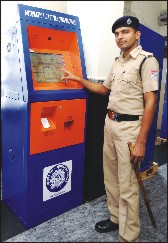
Now passengers will not have to stand in long queues for the tickets at the City Railway Station. The South Western Railway (SWR), in an effort to ease ticket purchase, launched the Automatic Ticket Vending Machines (ATVMs) at the Railway Station this morning.

The machines were commissioned by SWR DRM Rajkumar Lal at the entrance of Railway Station in the presence of SWR Senior Divisional Commercial Manager Anil Kumar.

The AVTMs, which are introduced for the first time in Karnataka, works on smart card which is made available at the ticket booking counters. A total of five machines are installed at the City Railway Station. While three machines are installed at the main entrance, the other two are installed at the back entrance (CFTRI gate). Passengers can top-up the smart cards in multiple of Rs. 50 to a maximum of Rs. 5,000. Initially, passengers have to pay Rs. 70 (Rs. 50 towards security deposit and Rs. 20 towards ticket value).

Passengers can purchase unreserved and platform tickets and also renew season tickets through smart cards.

Smart cards come with a one year warranty after which it can be renewed. The security deposit is refundable after deducting Rs. 10 in case a passenger decides to return the smart card.

The operation of ATVM facility is similar to that of Bank ATMs and for the benefit of the public the display is made available in Kannada, Hindi and English languages.

This apart, the much awaited e-toilet, battery operated vehicles for senior citizens and electrically operated laundry facilities will be launched on Nov.3, according to the South Western Railway authorities.

source: http://www.starofmysore.com / Star of Mysore / Home> General News / Tuesday ,October 27th, 2015