2-day Seed Savers meet, Seed Festival in city

‘Desi’ Cooking Contest tomorrow

Mysuru :

With an aim to create awareness on conservation and revival of crop genetic resources and to exchange seeds, a two-day Seed Savers Meet and Seed Festival have been organised at Nanjaraja Bahadur Choultry in city on Oct. 28 and 29 from 10 am to 8 pm.

Zilla Panchayat President Dr. Pushpa Amarnath will inaugurate the Fest at 11.30 am on Oct. 28. Legal expert and policy analyst from Delhi – Shalini Bhutani, Joint Director of Agriculture (Mysuru) M. Mahantheshappa, farmer leader Nandini Jayaram, Convenor of Alliance for Sustainable and Holistic Agriculture Kavitha Kuruganti and Bharat Beej Swaraj Manch Convenor Jacob Nellithanam will be the chief guests. National Award winner Farmer-Scientist Shankar Guru will preside.

Cooking Contest

To attract people towards local food and country breed, a ‘Desi Aduge Spardhe’ (Traditional Cooking Contest) has also been organised at the venue at 10.30 am tomorrow (Oct. 28). Entry is Free.

Participants should cook food using Siridhanya, Desi Akki, Kempakki, Kale Gida, Kaadu Gida and Medicinal Plants or prepare cuisine using any of the above items.

About 50 Seed Saver groups from seven States of India, working on farm conservation and promotion of seed diversity and related knowledge, will participate.

Over 1,500 varieties of crop seeds will be on display, along with relevant posters and literature. Books, organic products, organic food and some seeds will be available on sale.

The Festival will also feature parallel talks, presentations, film shows and a cultural programme of song and music at the same venue. For details about the Seed Festival, contact Shantakumar on 94487-74871 or 95351-49520.

source: http://www.starofmysore.com / Star of Mysore / Home> General News / Tuesday ,October 27th, 2015

German honour for V K Nayak

Mangaluru :

V K Nayak, managing director of CNC Ball Screws and Bearing Co Pvt Ltd, was felicitated for being a good corporate citizen. Karl Neff of Neff Gewinderiebe Gmbh, Stuttgart Germany, presented the award to Nayak at MOTEK 2015, an automation trade fair held in Germany.

The award, in the form of a miniature Tata Nano car, was given to him, for his contribution to the welfare of his workmen in his industry at Mangaluru. It may be recalled that Nayak gifted Nano cars to his factory employees in March 2015.

Hartmut Wandell, managing director, NEFF, and Esther Leib, sales and marketing executive, were present on this occasion.

source: http://www.timesofindia.indiatimes.com / The Times of India / News Home> City> Mangaluru / TNN / October 24th, 2015

Kittur Chennamma’s victory over British celebrated

The 192nd anniversary of the victory of Kittur queen Chennamma against the British was celebrated in a simple manner in view of farm suicides and drought, here on Friday.

The programme was organised by Veerashaiva Sanghatana Samiti. Gurusiddha Rajayogindra Swami of Moorusavir Mutt and others garlanded a statue of Rani Chennamma.

Recalling the fight of the queen against the British, the swami said that the courage and valour of Rani Chennamma should motivate us to face any odds in our life and called on farmers not to lose hope. President of the samiti, Viranna Kallur, Channabasappa Dharawadshettra, C.H. Gobbi, and P.M. Hooli were present.

In a programme held by the Basava Parisara Samrakshana Samiti, tributes were paid to the Kittur queen. Releasing pamphlets against the use of crackers during the forthcoming Deepavali festival, president of Karnatak Chamber of Commerce and Industry, Ramesh Patil, said that the State government should take steps to celebrate the occasion annually.

President of Basava Parisara Samrakshana Samiti S.V. Pattanashetti, and secretary Suresh D. Horakeri were present.

Meanwhile, in a programme related to Dasara celebrations by Moorusavir Mutt, Gurusiddha Rajayogindra Swami and the former Chief Minister Jagadish Shettar gave away compensation cheques to the family members of six farmers who committed suicide in Hubballi taluk.

The mutt had decided to celebrate Dasara in a simple manner this year in the wake of farmers’ suicides and utilise the amount saved by cancelling the grand procession to give compensation to the farmers’ families.

source: http://www.thehindu.com / The Hindu / Home> National> Karnataka / by Special Correspondent / Hubballi – October 24th, 2015

Isro receives 1st astronomer’s telegram

Bengaluru  :

The first astroronomer’s telegram (Atel no. 8185) from the Scanning Sky Monitor (SSM) observations on-board Astrosat – India’s first astronomy satellite – has been received by Isro.

The SSM was pointed to “GRS 1915+105”, an X-ray binary star system which features a regular star and a black hole, and caught it exhibiting the ‘beta’ class of variability on October 14, one of the many types of variability this source exhibits, some of which are associated with its spectral states.

“On October 15, the Soft X-ray Telescope (SXT) door was opened successfully and it will observe the sky after 10 days,” Isro has said.
Earlier in the month on October 9, Astrosat spotted the Crab Nebula using the Cadmium Zinc Telluride Imager (CZTI) instrument. The Crab Nebula is the brightest hard X-ray source in the sky.

Isro officials described the sighting of the Crab as significant and said that this furthers Isro’s chances of other celestial X-ray sources, aiding researchers. Astrosat has also spotted and viewed Cygnus X-1, a black hole source and now, the High voltage of Near UV, Visible channel and Far UV channel of the UV Imaging telescope (UVIT) has been switched on and detectors have been tested with low gain and found satisfactory and put back in off condition.

source: http://www.timesofindia.indiatimes.com / The Times of India / News Home> City> Bengaluru / by Chethan Kumar, TNN / October 21st, 2015

K S L Swamy, a very energetic and passionate artiste

swamyBF22oct2015

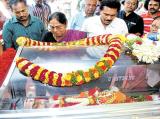
Veteran Kannada filmmaker K S L Swamy ‘Ravee,’ known for his ‘classicist movies,’ passed away here on Tuesday. He was 77.

Kikkeri Shamanna Lakshminarasimha Swamy, who underwent treatment for respiratory problem at a private hospital last week, died at his residence in Horamavu early Tuesday morning. A native of Kikkeri village in Mandya district, he is survived by wife and actress B V Radha and daughter Dhanalakshmi.

Scores of people from various walks of life paid their last respects to Swamy after his body was kept at Samsa Open Air Theatre at Ravindra Kalakshetra.

Swamy breathed his last when he was working on his dream mega serial ‘Sri Shankara Digvijayam’, based on the life and achievements of Adi Shankara, the proponent of Advaita Vendanta.

50-year film career
A BSc graduate from Mysore University, Swamy was known to be a ‘very energetic and passionate’ artiste of both big and small screens.

In his nearly 50-year film career, Swamy preferred parallel and classic cinema, says his close associate and senior journalist-writer K N Venkatasubba Rao who wrote the teleplay and dialogues for the serial ‘Sri Shankara Digvijayam.’

After his graduation, while working at the cultural exhibitions as part of Mysore Dasara, Swamy developed keen interest in singing as well as filmmaking.

In 1966, he directed his maiden film ‘Thoogudeepa’. The films ‘Gandhinagara’ (1968), ‘Bhagya Jyothi’ (1975), ‘Masanada Hoovu’ (1984), ‘Malaya Marutha’ (1986) brought him much fame, while his film ‘Jamboo Savari’ (1989) received the Best Children’s Film at the 37th National Film Awards. ‘Savira Mettilu’ (2006), which he co-directed, was his last film. Swamy also played the lead role in two popular Kannada television serials – ‘Moodala Mane’ and ‘Mutthina Thorana’ directed by Vaishali Kasaravalli.

Body donated to hospital
The family of K S L Swamy donated his body to M S Ramaiah Hospital in Bengaluru.


Quoting Swamy’s wife B V Radha, hospital authorities said it was decided upon earlier that the family would donate the veteran director’s body and did so accordingly. His eyes were donated to Narayana Nethralaya.

source: http://www.deccanherald.com / Deccan Herald / Home> State  / DHNS – Bengaluru , October 21st, 2015

Hubballi youngster gets patent for three products

Hubballi  :

When Anup Vijapur, 26, was in his final year of mechanical engineering studies, he received three job offers. However, hepatitis affected his progress. He had to attend the examination, carrying a glucose bottle. He failed in one subject, but fortunately cleared it after applying for revaluation.

When Anup failed in the exam, it was Nanopix CEO Sasisekar Krish who recruited him and encouraged him to develop his innovative ideas into products. Thus started Anup’s success story. He now heads the innovation department of Nanopix, a startup. Anup aimed at social entrepreneurship when he was in college. Now he is realizing his dreams, emerging as an innovator to simplify the lives of farmers.

Recently, the youngster got three patents for his innovation. These innovations pertain to grading of cashew nuts. While a normal grading machine can probably classify cashew nut into three qualities, Anup three patents are more than a notch better. With his technology of installation of camera, pick and place mechanism for irregular object and conveyor and grading machine, one can classify cashew nuts into seven categories.

Though Anup pursued BE (mechanical) at Proudhadeveraya Institute of Technology, Hospet, he is well versed in computers and technology. Speaking to TOI, Anup said that he got opportunity to materialize his ideas at Nanopix. He has special words of gratitude towards Krish. “We have already got three international patents for our products. If we get all applications approved, it will be a pride for our company and a tier-2 city like Hubballi,” he said.

There is more in store as his 28 applications are waiting for patent. Anup said that he developing a technology to read the face of drivers. “To prevent road accidents, we are developing a camera that can recognize facial expressions of drivers. If the driver is sleepy, it will warn him immediately. If the vehicle is connected with some networks, corporations or companies, it will alert their control room so that the backend can intervene and avoid possible accidents,” he said.

Pramod Tonapi, public relation officer at Nanopix, said that Anup’s innovation has given a boost to the startup. “He is very passionate about science and even teaches engineering students at a private study centre during his leisure time. His innovations are going to change the food processing industry in the coming days. Because of his innovation, we have been able to apply for patent for 28 more products,” he said.

source: http://www.timesofindia.indiatimes.com / Times of India / News Home> City> Hubballi / by Sangamesh Menasinakai, TNN / October 21st, 2015

Wins medal in Aquatic championship

Mysuru :

City’s Charted Accountant S. Achutha bagged silver medal in 100 mts butterfly event at the recently concluded 17th State Masters Aquatic Championship held at Basavanagudi Aquatic Center in Bengaluru.

source: http://www.starofmysore.com / Star of Mysore / Home> Sports News / October 19th, 2015

Remembering legendary M. Veerappa and his iconic Mysore toys

1) Self-potrait of Smt. and Sri M.Veerappa. 2) Veerappa’s grandson Sanjay with his wife Sowmya and his uncle M.V. Subramanya.

Last month I went to a friend in Vontikoppal on some personal errand. Ah! He was overjoyed. It was a Sunday and wanted to host a pure vegetarian Madhva lunch served seated on a low bench, food served on a banana leaf…

Since it was lunch time I agreed more to make my friend happy than to satiate my gourmet taste. However, as we got down from the car, my friend mentioned of an interesting house nearby on the same road that he would like to show me. That was how we forgot about the Madhva Bhavan lunch and moved to a house eponymously named ‘Chitralaya,’ a sort of art gallery with mementoes in memory or in honour of a patriarch of the family who was also a well-known artist — painter, sculptor, craftsman — M. Veerappa, the man behind the famous Mysore Toys. He is also known as the first person, nay artist, to paint pictures, both water colours and oil on canvas, based on subjects from Vachana Sahitya of Saint Basavanna.

I was told M. Veerappa (1901-1969) lived here in his house which was demolished and a new one was built with the name ‘Chitralaya’ by his grandson Sanjay, an industrialist who is the son of Veerappa’s second son Gowrishankar. Apparently in partition, Gowrishankar must have inherited the property and now his son Sanjay.

M. Veerappa was one of the five sons and three daughter of his parents Muddappa and Gangamma, running a provision store at Hosur, border of Tamil Nadu and Karnataka, near Bengaluru. Though there was no history of anyone in the family having artistic talent, Veerappa was seen painting pictures from the books he was reading as a student. While none in the family, including his parents, took Veerappa’s interest in painting seriously, interestingly, it was a journalist who noticed the boy’s talent and decided to help him in his passion.

Reading about this incident from a booklet given to me by Sanjay, I was delighted for two reasons. After all, I too am a journalist and more importantly the name of the newspaper of which the journalist Y. Virupakshiah was the editor was ‘Mysore Star’ since defunct. I think this city Mysuru can’t resonate to its people without a newspaper bearing the name ‘star,’ so we have now a ‘Star of Mysore’ newspaper since 1978! Pardon me if I sound immodest !!

This Virupakshiah of a journalist-relative had gone to Hosur for a wedding where he saw the works of this young boy and was impressed. He urged Veerappa’s parents to send the boy with him to Mysore to school him properly in arts. He was admitted to Chamaraja Technical Institute (CTI) on Sayyaji Rao Road, now known as Chamarajendra Academy of Visual Arts (CAVA). Rest was history. Veerappa never looked back thereafter. Wonder, how one noble gesture on the part of a journalist changed the course of life of an individual.

Once again it was another noble gesture on the part of a Judge, G. Paramashivaiah, that enabled Veerappa to further his studies in art and sculpture at the famous JJ School of Arts, Bombay. Veerappa must be a lucky person to get help in his early life in this manner. Rightly it is said luck is when opportunity meets preparation. He had the preparation (talent) and got the opportunity, thanks to noble persons like Y. Virupakshiah and G. Paramashivaiah. And luck smiled on him.

Veerappa later joins CTI as a teaching faculty and heads the Fine Arts Section, becoming the Assistant Superintendent. He was also running a toy manufacturing unit which became famous as Mysore Toys. He had also gone to Japan sponsored by Government of India for training in packaging.

I learn that M.S. Nanjunda Rao, who established Mysore Chitrakala Parishat, now Karntaka Chiktrakala Parishat, in Bengaluru, was the student of M. Veerappa. Two of his sons, Praful Chandra, an octogenarian, was carrying the tradition of Mysore Toys till recently while his brother Shivanna set up his own unit known as ‘Wood Life’ which made a name for itself.

Other children pursued different vocations but one of his grandsons, as I mentioned earlier, Sanjay Gowrishankar, an industrialist, has set up a mini museum-gallery of Veerappa’s works in his house ‘Chitralaya.’ Worth visiting by those who have an interest in fine arts and crafts. I was immensely happy to have visited this gallery-cum-house, a sort of two-in-one-house!

While leaving the gallery, I expressed my appreciation for taking so much trouble and providing so much space in his living house to show-case the works of his grandfather and commemorate his memory. Sanjay Gowrishankar said ‘thank you’ and a modest man he is, he added: “But I must admit it is because of my wife Sowmya’s dedication and passion that we are able to present the gallery at its visual best with cleanliness.”

By now it was past 2 0’ clock and the aroma of a Madhva meal was seducing us!

e-mail: kbg@starofmysore.com

source: http://www.starofmysore.com / Star of Mysore / Home> Abracadabra…..Abracadabra / October 19th, 2015

Pages from History : Dasara through the ages

DasaraBF180ct2015

by Prof. A.V. Narasimha Murthy, former Head, Department of Ancient History and Archaeology, University of Mysore

Navaratri or Dasara is one of the most popular festivals in our country but it is celebrated in a variety of ways in different parts. Actually it is a festival symbolising the destruction of evil and establishment of good (dushta sikshana and shista rakshana). This festival has a hoary antiquity going back to the time of the puranas and epics. The word Dasara is derived from the Sanskrit Dashahara meaning ten days. Basically, Navaratri is a festival of Mother Goddess who received power from no less than Vishnu, Shiva and Agni. Each one of the Gods gave different powers to Her so that She could free the world from the tormentors of different types. Thus was born the indomitable energy personified in the form of Goddess and people heaved a sigh of relief. Navaratri means paying respects and showing gratitude to Mother Goddess.

As the demons had obtained various boons from Shiva or Vishnu, the Goddess had to assume different forms to achieve her goal. She is worshipped in the following nine forms namely, Mahakali, the destroyer of Madhu Kaitabha; Mahishamardhini, the destroyer of Mahishasura; Chamundi, the vanquisher of chanda-munda; Kali, the killer of Raktabija; Durga, the harbinger of destruction of Kamsa; Raktadantri, the great destroyer; Shakambari, the destroyer of famines; Durga, the destroyer of demon Durga; Bhramari, the killer of demon Aruna. Thus Devi assumed these forms to accomplish her task. In course of time, the worship of Saraswati and Lakshmi were also added.

Another significant aspect of this ritual is the exalted position of unmarried girls (kannikas) who are supposed to personify the great Goddess. These unmarried girls are worshipped as Kumari, Trimurti Kalyani, Rohini, Chandike, Sambhavi, Durga, Subhadra and Kali. Each one of them is worshipped during the nine days; they are fed and given gifts too.

It has been our unique tradition that these festivals are recommended to human beings only after they are tested by the Gods. The Gods themselves did this after vanquishing the demons. It is said that Sri Rama invoked the Goddess and achieved great victory over Ravana on the day of Vijayadashami. Thus even Sri Rama worshipped her before taking up a major fight. Even the great epic Mahabharata extols the greatness of this festival.

The Pandavas, who had hidden their weapons under the Shami tree (banni mara) worshipped the Goddess, took out the weapons and started their Digvijaya or Victory March and consequently achieved great success over the Kauravas. It has to be noted that in all these instances, the great Goddess is invoked and worshipped not for any personal gains but for the annihilation of the wicked people, upholding of dharma and to save the good people.

Thus when it was useful to the Gods, the human beings felt that it should be useful to themselves also and hence began celebrating Navaratri. No dobut, it was celebrated in the ancient period but it has not been recorded either in literature or in inscriptions till we come to the medieval period. It was believed that Samudragupta, Harsha, Vikramaditya VI, Ballala II, Singhana and a host of others started their Digvijaya on the Vijayadashami Day.

However, with the dawn of Vijayanagar period, historical records are available in plenty. Particularly, the writings of the foreign travelers who stayed for a short period in Vijayanagar empire have given graphic description of the various rituals and durbar during this period. The earliest reference to Dasara festival during the Vijayanagar period is seen at the time of King Devaraya II (1424-1446). Abdul Razzak, a Persian traveler, who was invited as a guest for Dasara, was greatly impressed by the festival and has given a long description. The infidels of this country who are endowed with great power are fond of displaying their pomp and glory. Navaratri was celebrated at Mahanavami platform (dibba) in Hampi. All the subordinate kings assembled here and made gifts to the emperor. Elephants played an important role besides horses. There were many pavilions and some of them revolved around. The King sat on the gold throne kept on the ninth storey. Acrobatics displayed were of high order and people enjoyed it. The King gave prizes to the participants who included men and women. The last three days, namely Durgashtami, Mahanavami and Vijayadashami were spectacular. Krishnadevaraya’s Dasara was held from morning till night and thousands of lamps were lit during the night. Wrestling was a great attraction. Fire works were of high order.

On the Vijayadashami Day, the King held a review of the forces. Another traveler by name Nuinz has also given a similar description, besides Barbara, Nikitin and others. From all these features, it becomes clear that Vijayanagar Kings laid the firm foundation for the pompous but religious celebration of Dasara.

The Wadiyars of Mysore can easily be regarded as the cultural successors of Vijayanagar empire. They improved upon the Dasara of Vijayanagar period to suit their own needs and requirements in such a manner that it became more pompous and dazzling than Vijayanagar Dasara. In fact, Dasara has become synonymous with Mysore Wadiyars.

The earliest reference to Wadiyar Dasara is found during the period of Raja Wadiyar, who ruled from 1578 to 1617. Not only did he celebrate it at Srirangapatna but codified the rules and regulations for its celebrations. Though his son Narasaraja died a day earlier (7.9.1610) to Dasara, he celebrated the Mahanavami festival and further ordained that the death of a close relative of the royal household should not become a cause to stop or postpone Dasara. Dasara of this period was celebrated in three stages: The first one was the celebration of first eight days; the second is the Mahanavami festival and the third is the Vijayadashami. This has become more or less standardised from the period of Raja Wadiyar. He took up diksha by wearing a separate dress and kankana and worship of the Navagrahas, worshipped the throne and ascended it. The relatives, brahmanas and officials paid respects to the King. On the moola nakshatra day, Saraswathi Puja was performed. The Mahanavami Day was reserved for the worship of Royal Sword (Pattada Katti). Then the homa at Chamundi Hill concluded with poornahuti. In the evening, the durbar took place. On the Vijayadashami Day, he sent the weapons to the Banni tree with royal honour. In the evening he went in a procession to that place, worshipped the Banni tree and returned in the night with lights.

During the period of Kanteerava Narasaraja Wadiyar, the festival was celebrated with traditional grandeur. Special worship was offered to the images of Ranganatha and Narasimha. During the durbar, the chiefs, feudatories and others would pay respects. The tenth day was reserved for public procession of the King to conduct Sami puja.

Krishnaraja Wadiyar III (Mummadi) performed Dasara in the traditional manner. Queen Mother Lakshmammanni also worshipped the throne and blessed the King. The Maharaja used to come from the Palace in Nazarbad and return after the function. British Durbar was an added attraction. One particular day was specially reserved for them from 1814.

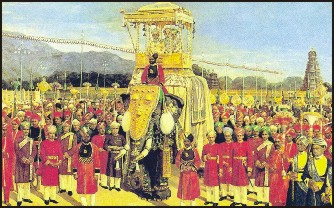
In the meantime, the present Palace was completed in 1912 and it became the venue of Dasara durbar. Krishnaraja Wadiyar IV (1895-1940), who won the admiration from Mahatma Gandhi and generally referred to as Rajarishi, conducted Dasara in a pompous and meaningful manner. On the very first day of Dasara, he worshipped Goddess Chamundeshwari on the hillock. The evening durbar was meant for officers and invitees. They had to come in a special dress of white trousers, black long coat, uttariya and a laced turban to be in the durbar. All the invitees were garlanded according to their status. On the ninth day, he performed Ayudha Puja which included worship of Lakshmi, Royal sword, royal horse, royal elephant, royal chariot etc. On Vijayadashami Day the Maharaja used to go to Bannimantap sitting on a howdah mounted on an elephant. Maharaja, Yuvaraja Kanteerava Narasaraja and Jayachamaraja Wadiyar were seated in the howdah. The same procedure was followed during the rule of Jayachamaraja Wadiyar. As Ashoka road was too narrow, the procession passed through Sayyaji Rao road and the whole route was illuminated. This type of Dasara was held till 1969.

In the year 1970, Dasara was not held publicly. The Karnataka Government decided to hold Dasara as Nada Habba or the festival of the people. However, religious ceremonies were performed in private at the Palace. Cultural events, poets meet, cultural and industrial exhibition were conducted. On Vijayadashami Day, an idol of Goddess Chamundeshwari in the golden howdah was taken in procession. At Bannimantap, the Governor took the salute at the torch-light parade. Thus Dasara or Navaratri became a cultural event and a festival of the people and not of the royalty. This festival not only reminds us of our past glory but is a symbol of our unity and strength to move towards our democratic goal. Whatever may be its form, we pray to Goddess Chamundeshwari to shower her blessings on all of us for a better tomorrow.

source: http://www.starofmysore.com / Star of Mysore / Home> Feature Articles / October 17th, 2015