Prof. G.H. Nayak gets Sahitya Academy Award for collection of Essays

Mysuru :

Noted city based Kannada writer and critic Prof. G.H. Nayak has won the Kendriya Sahitya Academy award-2014 for ‘Uttarardha,’ a compilation of his essays on literary criticism.

The award carries a cheque of Rs.1 lakh, an engraved copper plaque and a shawl. It will be presented at the festival of letters, the annual function of the academy to take place on Mar. 9, 2015.

‘Uttarardha’ got the award along with works of Ashwin Mehta (Gujarati) and Madhav Sardesai (Konkani).

The awards were recommended by Jury members representing 22 Indian Languages and approved by the Executive Board of the Academy in New Delhi on Friday.

Originally hailing from Surve in Ankola Taluk of Uttara Kannada District, Prof. G.H. Nayak, 79, a resident of Saraswathipuram in the city, had served as Kannada Professor at University of Mysore.

Prof. Nayak, a Pampa award recipient in 2010, has many works to his credit which include Harishchandra, Kavya, Odu, Vimarshe, Anivarya, Samakaleena, Dalita Horata, Nijadani, Sahitya Sameekshe and Sakalika.

Speaking to ‘SOM’ after the announcement of the award, Prof. Nayak shared his joy saying that he was delighted to get the award.

source: http://www.starofmysore.com / Star of Mysore / Home> General  News  /  Saturday , December 20th, 2014

CID Dy. SP T.K. Dharmesh passes away

DharmeshBF26dec2014

Mysuru  (SBD&RNN) :

T.K. Dharmesh (58), Deputy Superintendent of Police in the Criminal Investigation Department (CID) passed away at a private hospital in city yesterday night, following a cardiac arrest.

It is reported that Dharmesh, who was not doing well for some time had been admitted to Vikram Jeshta hospital in city three days ago where he had been kept under life-support system.

He leaves behind his wife Dr. Shailaja, a senior scientist at CFTRI, a daughter who works at a hospital in Pune, three brothers, one sister and a host of relatives and friends.

Hailing from Thirumanahalli near Halebeedu in Hassan district, Dharmesh joined Karnataka Police Service as a Sub-Inspector in the year 1981 and worked at many places like Mysuru, Chamarajanagar and Bengaluru before being promoted as Dy. SP of CID.

He was a member of the select team of officers hand picked by former City Police Commissioner Kasturirangan to curb rowdyism in city. He was also a member of the Speacial Task Force formed to undertake operations against forest brigand Veerappan.

He had also faced a probe over his alleged involvement in poaching of a spotted deer in Bandipur Forest Range. Last rites were held at his farm house in Gurur of Mysuru taluk today morning.

source: http://www.starofmysore.com / Star of Mysore / Home> General  News  /  Saturday , December 20th, 2014

Yes, our homage should go to him

THE PIONEER: There were four Kempe Gowdas and it was the first who founded Bangalore. — FILE PHOTO: SAMPATH KUMAR G.P.

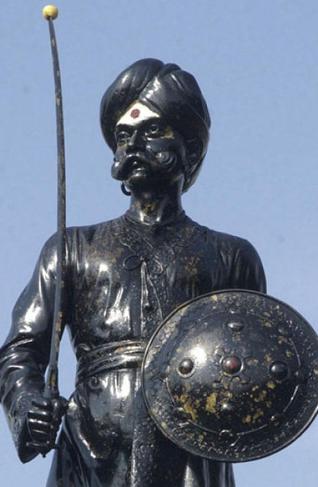
This year even as we’re celebrating the 500th birth anniversary of Kempe Gowda I, there is some confusion among the people over which Kempe Gowda founded our city, considering four Kempe Gowda ruled over the region for over two centuries.

Historians are unanimous that it was Kempe Gowda I (1513-1569) who is the architect of Bangalore. His ancestors immigrated from Kanchipuram after falling out with the ruler there and settled on the outskirts of what was later to be Bangalore.

Yelahanka beginnings

Kempe Gowda I, who was in charge of Yelahanka, built a mud fort in 1537 and with the help of the king Achchutaraya of the Vijayanagar Empire, built the little towns of Balepet, Cottonpet and Chickpet inside the fort. Today, these areas are thriving commercial market places.

According to historians, it was Kempe Gowda I who annexed Ulsoor and Hesaraghatta and erected the Ulsoor Gate, Sondekoppa gate, Yelahanka gate and Anekal gate.

King Achchutaraya granted him the neighbouring villages of Begur, Jigani, Varthur, Kengeri, Banavara and Kumbalgod, besides many hamlets. Kempe Gowda built the cave temple of Gavi Gangadhareshwara at Gavipuram, the Bull Temple in Basavanagudi, Kempambudhi tank and Dharmambudhi tank.

The four towers

He famously built four towers near the present Ulsoor lake, Kempambudhi lake, Lalbagh and Mekhri circle to mark the outmost boundaries of Bangalore. Though the city has grown far beyond these boundaries, the towers still fascinate people.

Kempe Gowda I’s successor Kempe Gowda II built the Ulsoor lake, Sampangi tank, Ranganatha Temple of Balepet and augmented the Someshwara Temple of Ulsoor. He built colonies such as Tigalarpet and Kumbarpet to ensure their welfare.

The capitals

According to S.K. Aruni, Chairperson, Indian Council for Historical Research (ICHR), it was Kempe Gowda I, who shifted the capital from Yelahanka to Bangalore; Kempe Gowda II shifted it from Bangalore to Magadi.

Four Kempe Gowdas have ruled this region. While first three chieftains are Kempe Gowda I, II and III, the fourth was Kempa Nanje Gowda.

Chiranjeev Singh, retired IAS officer and member of the consultative committee for the Kempe Gowda Museum, also backs Kempe Gowda I as the architect of Bangalore: he and his team did in-depth research before setting up the Kempe Gowda museum.

source: http://www.thehindu.com / The Hindu / Home> National> Karnataka / by Muralidhara Khajane / Bangalore – May 10th, 2011

Monumental men who want to preserve Bangalore

Bangalore :

Bangalore is 477 years old or at least the record books say so. From the times of Kempegowda to its Silicon Valley  days, this city has stood witness to several stories, some told, some untold and many forgotten.

In search of this treasure trove of tales, a group of architects and a few likeminded others started some years ago Bygone Bangalore, a group on a social networking site. Their objective is to revive and relieve those forgotten stories. What started as page for sharing old photographs is now turning out to be among the few groups mirroring the city’s heritage.

“Did you know Chhatrapati Shivaji got married in a temple in Malleswaram?” asks Naresh Narasimhan, an architect who has been a part of Bygone Bangalore from its initial days. “In fact, his father owned a huge house in Chickpet. That’s the thing, the more you know about your city’s past, the more you love it,” he says.

From the outset, the group had its goals defined: to bring to the fore old and inspiring photographs of the Garden City, to prompt conversations about the place, especially on social networking forums and among the new migrant population.

“Unlike Chennai, New Delhi or Mumbai, our photo archive is minimal. We wanted members of this group to share old frames from their albums to increase this database. Thanks to the network, we have been able to exhibit some rare photos of Bangalore,” says Kiran Natarajan, another member of Bygone Bangalore.

As was conceived, these photographs soon led to conversations, even explorations. “Recently we found the tomb of Hyder Ali’s maternal uncle, Ibrahim, in Kumbarpet. Ibrahim was instrumental in making Hyder a king and this piece of history was lying unattended there,” says Mansoor Ali, an architect.

Members of the group also looked back to trace the history of Russell Market. And what they found was quite intriguing. Inside the present building, which is almost 133 years old, stands a 150-year-old clock tower. “Earlier it was called the New Market. It was an open ground where hawkers sold goods to British officers. The British later decided to a build a concrete structure there. It was one straight corridor with a clock tower on it.

The market was expanded again in 1921, but the original construction remains. In fact, some people are keen on getting that clock ticking once again,” says Kiran.

As the explorations continue, every trivia from the yesteryears is shared with those interested during heritage works organized by the group. “Recently, we organized a food walk in Basavanagudi. We wanted to explore the history of Basavanagudi through the traditional eateries in the area. This is one part of the city which retains its old-world charm,” says Ali.

The group also delves into issues of conversation. “There were 1,880 documented buildings in Bangalore, today there are less than 400 remaining. While some of these are with government, those owned by individuals are being demolished to accommodate real estate boom,” says Naresh.

Heritage isn’t just about concrete structures. It’s going back in time to Bangalore’s old way of life. If you want to experience it, step out and look for it. Even though places like Madiwala and HSR Layout have turned into concrete jungles, they too have a history. For instance, the temple of old Madiwala village still exists, and the temple fest still happens. What’s heartening is that more people are coming forward to participate in these celebrations that keep the Bangalore of yore alive

Kiran Natarajan | Bygone Bangalore member and what they know is shared to those interested, through heritage walks by the group.

source: http://www.timesofindia.indiatimes.com / The Times of India / Home> City> Bengaluru> Namma Metro / by Arun Dev, TNN / May 05th, 2014

Wildlife Calendar ‘ BANADA BADUKU ‘ released

BanadaCalendarBF25dec2014

Mysuru :

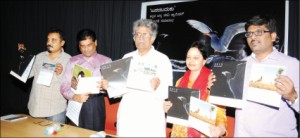
“Skill in a job alone can bring best results,” opined Sarod Maestro Pandit Rajiv Taranath.

He was speaking after releasing the wildlife calendar ‘Banada Baduku’ brought out by photographer Lokesh Mosale at a function organised at Rani Bahadur auditorium in Manasagangotri here on Wednesday.

Taranath pointed out that skill was fading in many jobs and a few people like politicians, only deliver lectures and show no performance. He commended the creativity and skill of Lokesh Mosale.

Mysore University VC Prof. K.S. Rangappa said that Lokesh Mosale had captured the beauty of wildlife and compiled the calendar in a beautiful way.

Environmentalist Rajani Patil, entrepreneur S.P. Madhu, Lokesh Mosale and others were present.

source: http://www.starofmysore.com / Star of Mysore / Home> General  News  /  Friday , December 19th, 2014

Award for DFRL Scientist

A. Ramakrishna (second from right), Scientist ‘F’, Defence Food Research Laboratory, is seen receiving Dr. M. Mahadevaiah Award-2013 from Krishnendu Narayan Chowdhury, Minister of Food Processing & Horticulture, West Bengal, at the 70th Annual Conference of AIFPA at Kolkata on Dec.12.

Mysuru :

A. Ramakrishna, Scientist ‘F’, Defence Food Research Laboratory (DFRL), Defence Research & Development Organisation (DRDO), Siddharthanagar, Mysuru has been conferred with Dr. M. Mahadevaiah Award-2013.

The award, comprising a silver plate and a citation, was presented to him by Krishnendu Narayan Chowdhury, Minister of Food Processing & Horticulture, West Bengal on Dec.12 at the 70th Annual Conference of AIFPA at Kolkata.

About the Award: The award was instituted by Dr. M. Mahadevaiah, a renowned Food Scientist & Technologist in 2009, to be given to any industry or a person for significant contribution to the development of ‘Food Packaging Technology’ or ‘Food Processing Technology’.

About the awardee: A. Ramakrishna is a M.Tech graduate from University of Mysore. He has vast experience of 30 years at DFRL and has contributed significantly for the development of food packaging and processing industries through his R&D work.

He has got eight patents and nine awards for developing packaging and processing machineries. He has published and presented 52 research papers in reputed Indian and International journals and conferences. He was also recognised as Outstanding Ajmer Best Scientist.

source: http://www.starofmysore.com / Star of Mysore / Home> General  News  /  Friday , December 19th, 2014

Rs.100 crore for Development of Heritage Structures in Mysuru

Belagavi :

The Government has earmarked Rs. 100 crore for development of heritage structures in Mysuru, which houses as many as 201 heritage structures for the year 2014-15, announced Urban Development Minister Vinay Kumar Sorake here yesterday.

Answering a query from MLC Sandesh Nagaraj in the Council, Sorake said that the funds would be utilised for renovating Lansdowne building, Devaraja Market, installing the statue of Jayachamaraja Wadiyar at Hardinge Circle, concreting Jumboo Savari Route, widening and developing Irwin Road and development of houses around the flower market located south of Devaraja Market.

Sorake also said that works of asphalting the stretch of B.N.Road from Hardinge Circle to Basaveshwara Circle, Albert Victor Road, Nelson Mandela Road and adjoining roads in city would also be taken up.

source: http://www.starofmysore.com / Star of Mysore / Home> General  News  /  Friday , December 19th, 2014

A precious bond


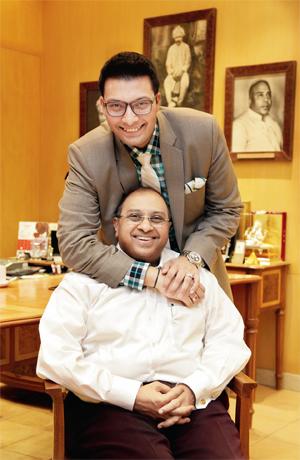
Vinod Hayagriv (54) & Chaitanya V Cotha (28)
Friends, critics and business partners — this father-son duo who run a 145-year old jewellery house get candid about their relationship in and out of office 
As a class four student when Chaitanya V Cotha was diagnosed with dyslexia, his father, C Vinod Hayagriv, the Managing Director of C Krishniah Chetty & Sons (CKC), felt like there was a wall in front of him. “What was the future going to be like, where would this lead to, what would he be, will he be himself, would it be a difficult life?” Hayagriv recalls asking himself. Referring to his elder son as a Taare Zameen Par kid, he adds, “Initially, we felt terrible as parents. It just wasn’t easy.”
But, today, when he looks back, Hayagriv is a proud father. Full of praise about how Cotha not only overcame his disability but also went on to manage the 1869 founded family-run business as its Executive Director, the 54-year-old also points out how Cotha has spearheaded three ventures of his own. When we meet the father-son duo at The Touchstone, off Cubbon Road on Friday morning, Hayagriv says, “He’s got a fighting determination. Most people would have given up midway.”
Which is the reason Hayagriv would be present at every parent-teacher meeting to make note of his son’s progress. “That’s something I didn’t do for my younger son,” he says, even as father and son unanimously agree that Shreyas is the “smartest” in the family. Talking about how Cotha has trained himself well in the last 10 years — from not being able to read long passages to pursuing a course in gemology and an MBA course, we are told that he is called back to school (Mallya Aditi International School) to talk to students facing similar issues.
When Hayagriv entered the family-run business in the ’80s, it was considered a natural progression for him to join his father CV Hayagriv (known as Hayagriv senior). But it was a different story when Cotha, who completed his Masters in Business Management from Regis University in 2009, was to enter the business in 2010.
Although the idea of joining the family business was always at the “back of his mind”, Cotha had begun applying for jobs back in the US.
He even got an offer from a leading jewellery brand in the world, which incidentally was also a family business. Wanting his father to aid in the decision-making process, Cotha asked his dad to come over and take a look at the place he might be working at. Never mind the speeding ticket that they got while driving down from San Diego to Arizona (which Cotha admits was his fault), Hayagriv laughs as he tells us that he was impressed with the line-up of Rolls-Royce and Porches in front of the store. “It’s a fine life that he gave up. If I were him, I might still take that option,” Hayagriv says. To which Cotha immediately reminds him that he was recently offered a position to head the store in California.
“It was completely his decision. We had a couple of brainstorming sessions with my sisters, one in Mysore, and the other in the US, to give their suggestions,” Hayagriv says. To which Cotha says, “But, right at the beginning my father had set things straight; I remember him saying, ‘The business is not built for you.’ That way he’s very open in how he thinks, he never forced us to come back.”
Starting from scratch
When Cotha finally took the decision of coming back to India, he didn’t join his father as one would have expected. Instead, he started a new business of his own —1869 Guild, a manufacturing and wholesale jewellery business. Having taken no financial assistance from his father, Cotha, who was working out of an office space on Avenue Road, found himself going to small jewellers in Karnataka, Tamil Nadu and Andhra Pradesh, Punjab to get dealers for his venture. And within a span of 18 months, he had tied up with 250 stores.
Going from jeweller to jeweller, “without being the shadow of his father” was tough, he admits. But, looking back, he is thankful for the experience of spreading the word about the set-up and learning the ropes of the business. “When you go out there, people don’t know who you are. I was out travelling to smaller places in the state, at least 20 days a month. I must admit, it was hard, but I enjoyed it. People looked at me as me — not part of CKC,” he says.
It was a similar story when Cotha’s younger brother, Shreyas was contemplating his plan of action after graduation. But, following his elder brother’s example, Shreyas too ditched the offer to work for the “second largest jewellery company” in the world to join the CKC in 2012.
Work and play 
When it comes to working with his sons, Hayagriv makes no bones when he admits that it’s “very tough”. A generation gap, different mindsets and conflicting viewpoints are some of the reasons for this. “When I was working with my father, it was different. I used to do as he said. But with my sons it’s different. They are opinionated, there are numerous debates, and all this requires a lot of tolerance. But, in a way, it is positive,” says Hayagriv, who consults his father even today when it comes to taking decisions. “But whatever happens, we never walk out of arguments,” Cotha adds.
For instance, at present, they are working on a wealth and asset management structure that would work for each of the four families (Hayagriv senior, junior, the two sons and their families). Hayagriv and his father are planning a safety net (in terms of old age, health) for each of the family members. “My father has done a lot of family settlements and partitions in his life. These are the areas that his experience comes in handy,” he says.
When it comes to their working styles too, they’re like chalk and cheese. Though Hayagriv thinks about work 24/7, with dinner table conversations revolving around the business, Cotha switches off once he’s out of office. “No screen time post work hours. I must credit that to my wife Yagnika,” says Cotha, who spends his free time with his toddler son.
When Hayagriv does unwind, he often heads outdoors — golfing or trekking. In fact, earlier this year, Hayagriv used a Trikke to commute to work. “Actually, Dad is a fun guy off work,” Cotha reveals. As a principle though, the family, we’re told, never goes on vacations together. It’s planned in such a way that one of them is there to ensure the business runs smoothly.
The women in their lives 
Behind these successful men, are their wives, who they credit for keeping them going through ups and downs. Hayagriv turns to his wife Triveni for financial advice, although he doesn’t heed it all the time. “Especially in stock market matters, there are times that she has told me that I should just sell them but I didn’t,” he says, regretting the I-told-you-so moments this gives rise to.
Although Cotha turns to his father for advice on business, he’s also influenced by his mother, who is involved in charity work. “She cares a lot for people in general. Those are some qualities I hope to inherit,” he adds. Looks like this is one family with ties as solid as gold.
source: http://www.bangaloremirror.com / BangaloreMirror.com / Home> Columns> Sunday Read / by Vidya Iyengar, Bangalore Mirror Bureau / December 21st, 2014
This Bangalore based startup has recycled 500kg of e-waste in two months

With e-commerce evolving, buying an electronic gadget is only a click away at any time. All you have to do is select the preferred product and order; and the product is at your door step within no time. But have you wondered about the disposal of that same electronic gadget? More than 90 per cent of e-waste ends up in land fillings.

Bangalore generates around 86,000 tonnes of e-waste and 15 per cent is generated from homes. We make sure we dispose off all other wastes, but not knowing what to do about e-wastes, we generally tend to hoard it or simply give it to scrap dealers. Though giving e-waste to scrap dealers is easiest, we should know that they are not equipped enough to dispose it off appropriately. Achitra Borgohain, Founder of BinBag, provides a solution to manage your e-waste in the best possible way.

BorgohainBF25dec2014

After completing his schooling from Sainik School in Assam, Borgohain did his engineering and MBA from Gujarat University. He worked with an infrastructure advisory group in Bangalore and also spent a few years with a venture capital firm in Ahmedabad. “May be the Gujarati entrepreneurial nature rubbed onto me,” says Borgohain, explaining how BinBag was born.“I could not find a quick and safe disposal mechanism for my e-waste. And when I looked at the problem in the larger context, everyone was struggling to dispose off household e-waste,” he explains.

The two-month-old startup is incubated at NS Raghavan Centre for Entrepreneurial Learning (NSRCEL), IIM Bangalore. BinBag picks household e-waste from people’s doorstep and sends it to authorized recyclers.

At the backend, BinBag works with certified recyclers. The startup also rewards and recognizes those who dispose-off their e-waste responsibly. Borgohain aims to create a frictionless disposal mechanism through which customers can request pick-up on call or even email or walk-in into partner outlets to drop their e-waste.

Recently, the startup experienced a happy day when a Bangalore resident drove from one corner of the city to the BinBag office to upload his e-waste for authorized recycling.

“Our differentiation is that we are a focused e-waste company and are addressing a segment of the market which has been completely ignored by recyclers. We also reward people for responsible disposal,” adds Borgohain.

Within a few days of operation, the company has helped in recycling more than half tonne of e-waste. The company was also awarded at the Unconvention|L, an initiative by Villgro.

Under the current model, BinBag works with individuals- apartments and communities; institutions- schools, colleges, and NGOs; and micro enterprises. Borgohain is solely handling and managing the company, but he plans to build a team.

Customers reach out to the company via telephone calls, email or social media. The received order is then aggregated for a week or so and vehicles are scheduled for picking up the e-waste.

“We award green points to customers who dispose off their e-waste with us, we reward out customers with ‘green points’ which could be redeemed with our shopping partners,” says Borgohain. “We are also placing bins across various outlets in Bangalore and people can dispose their e-waste there; we pick them up on a regular basis,” adds Borgohain.

The startup is also evolving a model with NGOs where they conduct a joint program and part of the proceed goes back to the respective NGOs.

The founder has faith in using word of mouth to create awareness. “We have recycled 500 kg of e-waste in the last two months without spending a single marketing dollar,” says Borgohain.

The company’s revenue model known as ‘green point’ follows the concept of a credit card. Under the green point model, customers are linked to green and sustainable brands. Institutions can redeem the green points for something interesting.

“Credit card has been the single biggest innovation in financial services since World War II. It linked consumers and merchants. Our green point model follows a similar strategy,”Borgohain explains.

Borgohain is optimistic about the future and wishes to scale the model pan-India by leveraging technology and building a professional team. He aspires to bring in people from the informal sector and providing them with a better standard of living by training and deploying them.

Borgohain’s not the only one desiring an anti-e-waste earth, there are other players in the sector too. Eco Recycling Ltd, Attero Recycling and Karma Recycling are a few front runners in this field.

source: http://www.social.yourstory.com / Social Story-YourStory.com / Home / by Pallavi Sinha / December 22nd, 2014

Experts to plan revitalisation of two heritage markets

Project mooted after BBMP meets with city’s conservation architects

MarketsBF25dec2014

There is some hope on the horizon for the 18 heritage markets of the city that are on the hit list of BBMP which is proposing to bring them down and go in for reconstruction. Following an online campaign by INTACH, conservation architects and like-minded Bengalureans -Bengaluru Heritage Markets Campaign, a meeting was held in the BBMP on Tuesday to come out with a Plan B.

Markets standing committee chairman B R Nanjundappa and former Mayor B S Satyanarayana met Indian National Trust for Art and Cultural Heritage (INTACH) rep resentatives to discuss the issue. “Some of the markets are of no revenue value to us like Johnson Market where traders do not pay rents. But still, we are open to looking at a revitalisation plan and have asked the INTACH members to prepare a project for two markets. We will see the plan and de ide whether or not to take it forward,” Satyanarayana told Bangalore Mirror. As a pilot, rejuvenation plans for two markets will be readied by the conservation architects and if it is through, the rest of the structures will be n handled. INTACH’s campaign on Facebook is gaining traction (see box). The campaign is see c ing strong support with con servation architects putting up some history nuggets about the markets.

For instance about Murphy Town Market, a post reads: “So you love the stone facade of the Bible Society building on MG Road? This is its poor cousin.Poor only because it was neglected. This is also one of the 18 demolition candidates announced by the BBMP on Nov 26. What this needs is rejuvenation, not demolition! Make the BBMP retain heritage and culture aspects during such projects, especially in historic quarters of the city like this one! Murphy Town Market has its old world charm as reflected by the century old reading room in the market area. If BBMP has its way, all this would soon give way to a mall! Do we need a city stripped of all its community spaces and bazaars, old buildings razed and second generation shop keepers displaced? With no existing law to protect heritage buildings, it’s up to us to lend our collective voices to save them.” Publicising the Chikkamavalli Market in VV Puram, campaigners have posted: “Spanning a good block in the historic quarter of Chikkamavalli, just next door to Lalbagh and food street, adjacent to a Kempegowda Uyyale Udyanavana (Park).”

INTACH is also holding photo walks and the first one was held at Johnson Market last week.

The FB Campaign
INTACH’s campaign on Face book has so far got 750 sup porters. Bengalureans who are interested in heritage and traditional value of these buildings have fished out old photographs of the markets and have posted them. A Bengaluru Heritage Markets photo contest has also been announced with the tagline “Show your appreciation so that they never succumb to a sledgehammer.”

source: http://www.bangaloremirror.com / BangaloreMirror.com / Home> Bangalore> Civic / by Kushala S , Bangalore Mirror Bureau / December 24th, 2014