10-Day Workshop on Classical

Kannada begins at CIIL

ClassicalKannadaBF11nov2014

Mysuru :

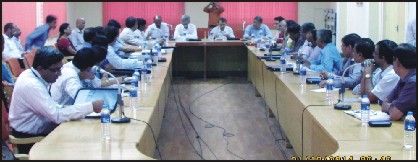
A 10-day workshop on Classical Kannada organised jointly by the Centre of Excellence for Studies in Classical Kannada (CESCK) and Central Institute of Indian Languages (CIIL) at CIIL premises began in city this morning.

Noted Kannada littérateur Nadoja Prof. M. Chidananda Murthy who inaugurated workshop said that Kannada language had a history of more than 2,300 years as there were several examples of Kannadigas residing in areas spreading across River Cauvery to River Godavari. He also added that Karnataka, in ancient years expanded till Maharashtra.

Prof. Chidananda Murthy also expressed his anguish over the state fighting for Belagavi. He added that there was a situation today where Kannadigas were fighting to retain Belagavi in Karnataka, the place which actually had to be the capital of Karnataka. “In this process of the retaining Belagavi we might witness bloodshed in areas surrounding the Karnataka and Maharashtra border,” said Chidananda Murthy.

He also advised the Kannada research scholars not to restrict themselves to libraries to conduct their research works but to travel across the State to know about the language, culture and tradition.

Around 60 persons including M. Phil and Ph.D. research scholars and high school teachers are participating in the workshop. The event was presided by Workshop Director and Kannada Scholar Prof. T. V. Venkatachala Shastry. Former Kannada University Vice Chancellor Prof. H.J. Lakkappa Gowda, former Maharaja College Principal Prof. C. Sarvamangala, Workshop Asst. Director Prof. Nilagiri Talwar, Theatre Critic Prof. Kikkeri Narayana, CIIL Senior Fellow Dr. H.M. Maheshwaraiah, CIIL Asst. Director Dr. M. Balakumara and others were present.

Prior to the inauguration of the workshop, members paid tributes to former CIIL Deputy Director Dr. R. Subbakrishna, who passed away yesterday.

source: http://www.starofmysore.com / Star of Mysore / Home> General News / Wednesday, November 05th, 2014
Retd. CIIL Dy. Director passes away

SubbakrishnaBF11nov2014

Mysuru :

Dr. R. Subbakrishna (61), a retired Deputy Director of CIIL and a resident of Jayalakshmipuram here, passed away yesterday afternoon.

He leaves behind his wife Rohini, son Sriranga and a host of relatives and friends. Last rites were performed this morning at the foot of Chamundi Hill.

A native of Yelandur, Dr. Subbakrishna had served at CIIL as a Researcher, Head of Classical Kannada Department and also as Deputy Director.

Actively involved in social work, Dr. Subbakrishna, started Yelandur Gowramma Rangaswamaiah Charitable Trust and served the poor and needy rural people by arranging health camps and distributing free medicines. Also, he was providing scholarships for poor students and had renovated the old Kashivishwanatha Swamy Temple at G.B. Saragur in Mysore.

source: http://www.starofmysore.com / Star of Mysore / Home> General News / Wednesday, November 05th, 2014
‘Vocational Training has a bright Future’

Says Syed Amanulla, ‘National Brand Ambassador’ from Mysuru

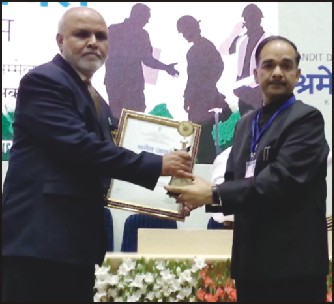
Amanulla is seen receiving the award from Alok Kumar, Director General of Employment and Training, Ministry of Labour & Employment, GOI.

As a general trend, pass-outs from education system do not take admission in ITIs as their first choice. They mostly end up in ITI after exhausting all other options for higher education. This is because the blue collar work is not respected and regarded in society. But there are many who have excelled professionally after passing ITI.

Meet A. Syed Amanulla, who passed ITI course in ‘Fitter’ trade in the year 1975 at his native, Kolar Gold Fields. He is presently serving as Principal-cum-Deputy Director of Government ITI, Srirangapatna. He was awarded ‘National Brand Ambassador of Vocational Training-2014’ in the Service Sector (Salaried Employee) by the Ministry of Labour and Employment, Government of India, at a National-level Programme held at Vigyan Bhawan in New Delhi on Oct.16, 2014 for his exceptional achievements and excellence in Vocational Training. He received the award from Alok Kumar, Director-General, Department of Employment and Training, New Delhi and was honoured by Prime Minister Narendra Modi.

After passing ITI and getting a job, Amanulla did not stop his education. Along with his job, he completed Diploma in Mechanical Engineering and B.E, both with a first class by attending evening college. He is an example for the saying “Education has nothing to do with age” because at the age of 50, he did his Master’s in Business Administration (MBA). Throughout his education, he has been a topper and received many merit scholarships.

Amanulla is married to Shaheen. He has two children, who are married and well settled in Bangalore. Amanulla resides in Rajivnagar, Mysuru, with his mother and wife.

Star of Mysore caught up with this ‘Brand Ambassador’ and spoke to him regarding vocational training sector and his professional achievements. Excerpts…

by Arafat Ahmed Aizaz

SOM: What got you the ‘National Brand Ambassador of Vocational Training-2014’ award?

Amanulla: I have provided 100% placement to all my students who have passed ITI course. They are working in reputed firms and drawing high salaries. I am in good terms with companies and factories in India as well as abroad because of which they contact me to get ITI pass-outs for their firms. My students are highly skilled and sought after by the companies. I have consistently maintained pass percentage of 95% at Government ITI, Srirangapatna. I have personally met wealthy people and NGOs and made them to donate for poor meritorious students of Government ITI, Srirangapatna. Regarding my career success, academically I have grown from ITI-level to Master degree and professionally from Instructor to Deputy Director. Considering all these achievements, the Government has honoured me with the ‘National Brand Ambassador of Vocational Training-2014.’

SOM: Recently you were featured in Doordarshan Channel. Tell us about it.

Amanulla: Doordarshan TV channel crew had come all the way from Delhi to Mysuru to interview me on my achievements. The interview was telecast in DD’s ‘Hunarbaaz’ programme on Aug. 31, 2014.

SOM: What are your other achievements?

Amanulla: I was selected as Hajj Officer by Ministry of External Affairs during 2001-02 and 2005-06; I was appointed as Wakf Board Administrator in Hassan district. I was also honoured with “Eminent Engineer Award” by the Institution of Engineers (India) on Sept.15, 2013 during 46th Engineer’s Day. I have met Dr. A.P.J. Abdul Kalam at his office in the year 2006, when he was the President of India and apprised him about improving Vocational Training in India.

SOM: Do Vocational Training (ITI) pass-outs have better career opportunities?

Amanulla: Yes. Just by studying for two years after 10th, ITI pass-outs can get jobs in both Government and Private sectors. They can even establish their own Industries. ITI pass-outs get jobs quickly because of shortage of skilled labour in India. After ITI, along with earning through a full-time job during day, one can upgrade his qualification by pursuing courses such as diploma in Engineering and Bachelor of Engineering in evening colleges.

SOM: Even PU course pass-outs can get jobs. What advantage does ITI have over PUC (12th)?

Amanulla: Blue-collar job requirement for any industry is more compared to white-collar jobs. For example in a factory, there will be hundreds of workers who indulge in production but there will be few Administrative staff. Blue-collars’ salaries are high these days because there is shortage of workers of this class. So, ITI pass-outs have an edge over Pre-University Course (12th standard) pass-outs. And even promotion chances are more for blue-collar jobs.

SOM: Usually in Government ITIs, faculties are not punctual. You being the Principal-cum-Deputy Director of Government ITI, how do you check on their attendance and discipline?

Amanulla: They are Government employees and they can take their leave for which they are entitled. But I don’t spare the teachers who are lazy and those who are not punctual. I visit all the classes daily and take the feedback from students regarding classes and teachers. When a staff goes on leave, I engage the classes myself.

SOM: Prime Minister Narendra Modi honoured you recently when you were awarded ‘National Brand Ambassador of Vocational Training-2014.’ What is Modi doing to improve Vocational training?

Amanulla: Narendra Modi has a good view for Vocational training. He is giving priority for the improvement of Vocational Training in India. Modi has said “ITIs are shishu mandir of technical education. Those who may have knowledge other than that of books, that of skills, must be respected. The talented among the ITI graduates must get new opportunities.” To fulfill ‘Make in India’ vision Modi believes in skill development among the youths in India.

SOM: Why are they calling ITI pass-outs as ITI graduates these days?

Amanulla: Western countries consider ITI pass-outs as ITI graduates. According to me, not only persons who have passed 10+2+3 is a graduate, but also those who pass ITI after 10th should be called ITI graduates in India hereafter because graduate means “a person who has successfully completed a course of study or training and acquired some skill.” Even Narendra Modi has called them as ‘ITI graduates’ in his speech at New Delhi recently.

SOM: Your message to students and parents?

Amanulla: China has improved because of skilled labour. India has shortage of skilled labour. I request the parents to admit their wards into ITI courses so that India can get more skilled labours and become a developed country soon. Vocational Training too has a bright future and more youth should opt for this stream.

source: http://www.starofmysore.com / Star of Mysore / Home> Feature Articles / Tuesday, November 04th, 2014

‘Explore BioTechnology to Enhance Quality Silk Production’

Says Dr. Mohammad Aslam, Advisor, Dept. of Bio-technology

 A section of delegates at the Brain-storming Session on Mulberry and Silkworm at CSR&TI.
A section of delegates at the Brain-storming Session on Mulberry and Silkworm at CSR&TI.

 Mysuru :

“Explore networking technology to enhance quality silk production,” said Dr. Mohammad Aslam, Advisor, Department of Bio-technology (DBT), New Delhi.

He was speaking during the one-day Brain-storming Session on Mulberry and Silkworm sponsored by DBT and organised at the Central Sericultural Research and Training Institute, (CSR&TI), Mysuru, on Oct. 31.

He recalled the 20-year association of DBT with CSB in this area. He informed that during this period, DBT has organised a series of brainstorming sessions at different places across the country including North – Eastern States.

Speaking about the major objectives, he said application of biotechnology for increasing the productivity, improving the host plants, enhancing the silk quality, productivity utilisation and developing areas like silkworm seeds should be focused.

“The expert group had decided to have a separate session on silkworm and mulberry to develop the road map for the next 3-5 years and review the research outcome generated so far,” he informed and hoped to develop some transgenic network programmes in both on silkworm and mulberry.

He further added that DBT has taken up collaborative work with CSR&TI in this area. He appreciated Dr. Sivaprasad, Director, CSR&TI, Mysuru, for his initiative to organise this session.

Dr. L. Shashidhara of IISER, Pune, in his address, felt that research goals have already taken an in road in agriculture and now, it is the turn of sericulture to join and explore the possibilities of utilising it by working together with other institutes for the betterment of the industry.

Mentioning about the brisk technology activities of the world, he evinced keen interest in the collaborative studies in the field of sericulture.

Appreciating the phenomenal growth of silk industry, Dr. M. Uday Kumar, UAS, Bengaluru, spoke about few major constraints like irrigation and yield gap. He said that there is a need for genetic enhancement to improve the quality and the productivity. “The transgenic technology could be of immense use in this area,” he felt.

Dr. Sivaprasad, Dr. Mohd.Aslam, Prof. L. Shashidhara, Prof. Paramjit Khurana, UDSC, New Delhi, Prof. M. Udaya Kumar, UAS, Dr. S.K. Ashwath, CSR&TI, Mysuru, Dr. K.P. Arun Kumar, CDFD, Hyderabad, Dr. A.K. Awasthi, SBRL, Bengaluru, Dr. V. Satyavathi, CDFD, Hyderabad, Dr. P.J. Raju, APSSRDI, Hindupur, Dr. Nataraja Karaba, UAS, Bengaluru, Dr. Girishi Naik, CSR&TI, Mysuru, Dr. Jhansi Lakshmi, CSB, Dr. M.S. Sheshashayee, UAS, Bengaluru, Dr. B. Rita, CSB, Dr. T. Mogili, V.Kota, Dr. Rajashekar, CSR&TI, Mysuru were the invited speakers on the subject.

Various areas of networking and its applications in sericulture were discussed and the vital areas to be focused for the improvement of silk industry were earmarked in the session.

Eminent scientists from DBT, New Delhi, IISER Pune, CCMB, Hyderabad, CDFD, Hyderabad, UAS, Bengaluru and several Universities, R&D Institutes of Central Silk Board and State Governments participated.

Dr. Thippeswamy, Dr. Girish Naik and Dr. Ashwath co-coordinated the programme.

source: http://www.starofmysore.com / Star of Mysore / Home> General News / Tuesday, November 04th, 2014

The Man Who Is Solving Some Of India’s Biggest Agriculture Problems With His Simple Inventions

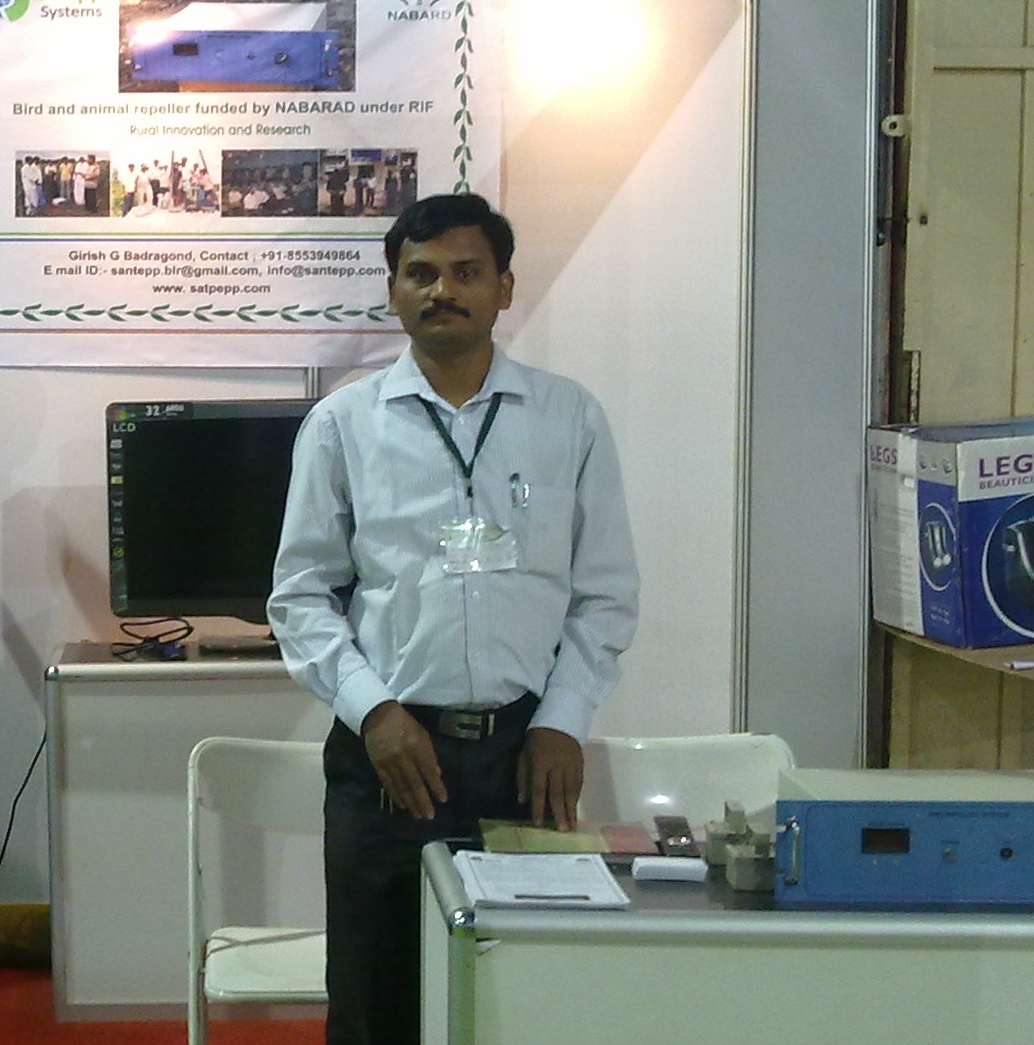
Girish Badragond, a 28 year old guy from Bijapur District came to Bangalore in 2006 with a laptop, a wireless router and one way bus fare. Now, after six years he is a partner at Santepp Systems, a fast growing technocrat proprietary firm in the field of agricultural technology manufacture.

“Ever since I was a child, I loved playing with the machines. My first experience in machine was when I dismantled my cousin’s watch and fixed it again,” Badragond says.

Girish01BF09nov2014

As we walk inside his office, the light switches on automatically and turns off as soon as we leave the room. His eyes sparkle as he talks about the sensors in his office space. “This saves around 60 percent of the energy,” he says.

When he first moved to Bangalore, he had no money with him. He stayed with his friends for a couple of days and then found a room on sharing basis. With the help of an old DTH antenna he enhanced his router and sold the bandwidth upto 10 kms and earned some money.

SSLC pass Badragond didn’t get an opportunity to study further but this didn’t come in the way of his dreams. When he was in High school, he could easily do projects like making an inverter, power supplier etc. for engineering students.

Supported by NABARD and NIF, Santepp Systems, provides simple solutions to various agricultural needs. Some of his inventions include-

Bore well Scanners

Studying underground water has never been easier. The Borewell scanners have a camera with flash and180 degree rotation in horizontal space. The equipment can click pictures, check inflow and outflow of the water.

“It also checks whether the borewell has stagnant water. There is no point digging a borewell when there is no proper inflow of water as it is waste of money,” says Badragond.


Bore well scanners can also check for leakages and holes.

Advanced Mode Micro irrigation system

Girish02BF09nov2014

This unique irrigation controller helps you to operate the pump sets and irrigation valves from remote places without physically being there.

Micro irrigation controller regulates the flow of water and feeds water to plants to the extent of their requirement. There by water wastage is minimized and available water is put to max usage.

“Drip irrigation sometimes leads to excess water to the crops which spoils the crop, while this system works according to the crops’ needs,” says Badragond.

The solar sensors are inserted in the soil at various places, these sensors send signal to the unit. The unit will automatically turn on the motor for water flow according to the priority and turn off after the requirement is fulfilled.

The system can cover over 10 acres of land and costs Rs. 1.5 lakhs. The basic version of the machine covers 2-3 acres of land and costs Rs. 20, 000-Rs.25,000.

Bandragond has also developed an android app for the system.

Bird Repeller

Girish03BF09nov2014

This equipment with eight speakers and a timer repels the bird through various noises. The farms are located in outskirts of the village and noises won’t trouble the villagers. The main unit is kept near an electric point. It also has 3 days battery backup.

Urban Terrace Gardening

You are going on a vacation with no one to look after your garden? This equipment by Bandragond switches on the water flow every day at prescribed time and stops after a certain time. The system costs Rs.5,000.

These are just a few of the many incredible innovations this brilliant man has up his sleeve. For more information about his inventions, please contact Girish: +91 9902133996 or email him: info@santepp.com

source: http://www.thebetterindia.com / The Better India / Home> Innovations> Agriculture / by Shreya Pareek / May 26th, 2014

Dizzying rise of Kannada Wiktionary

KannadaWictionaryBF09nov2014

What happens when techies turn wordsmiths? The Kannada Wiktionary goes from a paltry 250 words to 2.5 lakh in just five years.

By sparing a few hours on weekends, a band of techies has catapulted the Kannada online dictionary to second largest among Indian languages, with a whopping 2,50,088 words. This also makes it one of the only three in Indian languages with more than one lakh words (Tamil and Malayalam being the other two) and the 21st largest among all languages in the world, in its online avatar.

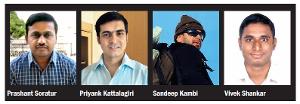
Techies Vivek Shankar, Prashant Soratur, Sandeep Kambi and Ratheesha Ratnakara form the core of this group. Ratheesha is in the US and contributes from there. Priyank Kattalagiri, a techie and contributor, said most of them got connected through the group ‘Banavasi Balaga’. From there, they started contributing to the Kannada promotion portal ‘Honalu’.

He says the concept of Wiktionary started in 2009. “Some people had started the Kannada Wiktionary and put up some 250 words. We have taken it forward from there.”

Vivek Shankar said they all had weekends to spare and put them to good use. “On an average, each of us put in five to six hours per week on this project. It is a team effort. There are contributors like Raman Subba Rao, who are not part of our group, but who have made an immense contribution too.”

Shankar says they got the idea in 2009 when they realised that searching for the meaning of a word was not easy. “As techies, we try to solve problems through technology. People have moved away from buying fat books. We want everything on our phones and within grasp. Wiktionary tries to be a one-stop point for all Kannada words.”

Kambi said a target was always on the horizon. He recollects when he joined the team, the 50,000 target had already been achieved. “The next target was one lakh words. We would also set smaller targets for the day or week. Earlier, it would take us one or two hours to put up 10 words. Gradually, our efficiency improved; we have surprised even ourselves by pulling off this achievement despite being a small group.”

But it’s not merely a numbers game as another key contributor, Prashant Soratur, explains. “The expanse of Wiktionary is bigger than dictionaries. You can not only add voice (to indicate pronounciation), but photos and videos as well. For example, to explain a dish called muTagi that is common in Kalburgi, but not in other places across Karnataka, I added a video.”

Wiktionary, unlike Wikipedia, does not allow creation of new words on the site itself. The words have to be from an existing dictionary or a word from common usage. So the team referenced existing dictionaries. “From Kittel (Ferdinand Kittel who compiled the first modern Kannada dictionary) to the latest ones, we have several, including a dictionary on scientific words. It is a never-ending process just like the development and evolution of language,” says Shankar.

UB Pavanaja, one of the biggest contributors in Kannada to Wikipedia and Creative Commons, is all praise for the youngsters. “They have done a great job. Their contribution to Kannada Wiktionary is immense,” he says. Soratur, however, says team work made it possible.

“Wiki projects are community projects. If we work in isolation we may repeat things and be goal-less. We could motivate each other because we worked in a group,” he says.

However, along with the bouquets, the group is receiving its fair share of brickbats too, with the foremost criticism being their staunch ‘achcha Kannada’ attitude that is seen as ‘anti-Sanskrit’. They have been panned for creating new words for existing words which they perceive to be too Sanskritised.

For example, the word for Internet in Kannada, ‘antarjala’, has been substituted with ‘mindana’ which was coined only a few years ago. The group popularised it in their web posts along with words like ‘minche’ for e-mail.

“Love for Kannada should not become hatred for Sanskrit or any other language,” says another techie familiar with the group. But Kattalagiri says there is nothing wrong in the ‘experiment’. “It is a cultural experiment. Sourcing new words from older Kannada words does not mean hatred for Sanskrit.
“Moreover, the group is not coining words for Wiktionary, but for common usage that may end up in the online dictionary if it fulfills the criteria.”

source: http://www.bangaloremirror.com / Bangalore Mirror / Home> Bangalore> Others / by Shyam Prasad S, Bangalore Mirror Bureau / November 07th, 2014

Byappanahalli once belonged to Visvesvaraya’s ancestors

Sir M Visvesvaraya on his 99th birthday on September 15, 1959 with then chief minister of Mysore B D Jatti

It’s only fitting that an engineering marvel such as Namma Metro should first run through Byappanahalli, a hamlet that was once gifted to the ancestor of Sir Mokshagundam Visvesvaraya, engineer par excellence.

Wonderful nuggets of history came to light when the seventh generation of Sir M Visvesvaraya’s family — the Byappanahalli clan that lives in Jayanagar — was putting together their family tree on the occasion of their matriarch’s hundredth birthday. Savithramma, now 102, is the wife of late Byappanahalli Mokshagundam Lakshmipathaiah. She has eight children, some 15 grandchildren and over 20 great-grandchildren and is the oldest in the clan.

“I’ve heard there is a 112-year-old person in Karnataka. People of our generation are stronger and healthier,’’ said the toothless grand old lady, who eats ragi mudde for meals and can chew chakkli-kodbele (local snacks) with her gums! Barring a recent hip bone fracture which has bound her to the wheelchair, the centenarian is otherwise healthy and her memory razor sharp.

“Tracing the family tree was tough, but we did it,’’ said M Chandrashekar, Savithramma’s son.

Their search for roots through black-and-white pictures and inputs from the oldest surviving members culminated in a comprehensive family tree that originated from Mokshagundam village.

The roots

The Mokshagundam family gets its name from a village in Andhra Pradesh from where Sir M Visvesvaraya’s family hails. Several generations before MV, Lakshmipathi Bhatta was the Dewan of Doddabyrappa, the chieftain (Palegaara) of Avathi near Chikballapur.

The chieftain was so impressed with his Dewan’s work that he gifted him three villages — Byappanahalli, Muddenahalli and Bandepalli, all falling along the Bangalore-Kolar stretch. Bhatta’s property was inherited by three grandsons — Byappanahalli by Chikkavenkappa, Muddenahalli by Thimmappa Shastry, the great grandfather of Sir MV, and Bandepalli by Muddukittappa.

Byappanahalli’s growth

Once a hamlet tucked away between Bangalore and Hoskote, Byappanahalli, later associated with public sector undertaking NGEF, was considered the city’s farthest end. Over the years, it came to be looked upon as Indiranagar’s poorer cousin. But today, Byappanahalli is almost the heart of the city, with Namma Metro connecting this once-anonymous village bursting at its seams with the central business district. After the Metro was commissioned, realty prices shot north, touching Rs 7,000 per sqft.

Savithramma’s sons recall how their father — an amaldar (now called tahsildar) in the erstwhile British and Karnataka governments — would always talk about the family’s lands in Byappanahalli that went unclaimed.
“Since the entire village belonged to our clan, the family had huge tracts of lands. In fact, my father used to often say that we should have searched for the properties and got possession. Of course, nobody really put their heads together and since then, the lands must have changed many hands,’’ said M Prabhakar, retired HoD from the Government Women’s Polytechnic College.

The lands may have gone, but the memories remain. “As far as we remember, my father and Visvesvaraya’s son were in touch with each other and we have a  picture of them together,’’ said Chandrashekar.

Visvesvaraya, who constructed the Krishna Raja Sagara dam in Mysore and was knighted commander of the British Indian Empire by King George V, is held in high esteem in the international engineering circuit. In fact, his birth anniversary which falls on September 15 is celebrated as Engineers’ Day in India.

Savithramma’s husband used to talk about the family’s lands that went unclaimed

source: http://www.bangaloremirror.com / Bangalore Mirror / Home> Bangalore> Others / by S. Kushala / Mar 04th, 2012

M. S. Ramaiah Memorial State-Level TT

City’s Vedanth wins Jr. boys title

VedanthBF08nov2014

Bengaluru :

Mysuru lad Vedanth M. Urs taking part in the M. S. Ramaiah Memorial State Ranking Table Tennis Tournament at Bengaluru won the junior boys singles title on Sunday.

In the final, Vedanth Urs of Vidhyaashram College beat Karan Gollarkeri of Belgaum 11-7, 11-9, 12-14, 11-3, 5-11, 2-11, 11-4 in the final. Earlier in the semi-finals, Vedanth got the better of Rohan Jamadagni of Horizon TT 11-9,11-4,11-9,11-8. In the quarter-finals, Vedanth got the better of Neeraj Raj 11-4, 4-11,11-4,11-13,11-9,12-10.

The results, Junior boys singles – Final: Vedanth M Urs (Vidhyaashram) bt Karan Gollarkeri (Belgaum) 11-7,11-9, 12-14,11-3,5-11, 2-11,11-4.

Semi-finals: Vedant M. Urs (Vidhyaashram) bt Rohan Jamadagni (Hor) 11-9,11-4,11-9, 11-8; Karan Gollarkeri (BNM) bt Shreyas Kulkarni (MSSTTA) 5-11,11-13,11-4,8-11,11-5, 11-1,11-9.

Junior girls singles, Finals: Gayathri Tankasali (MM) bt Koumudi Patankar (CTTC) 8-11,11-9,11-9,11-7,8-11,11-4.

Semi-finals: Koumudi Patankar (CTTC) bt Sejal Kaushik (Joshi) 10-12,11-4,11-7,11-6,11-4; Gayathri Tankasali (MM) bt Anarghya Manjunath(Omtti): 9-11,11-5,11-2,11-5,10-12,11-9.

source: http://www.starofmysore.com / Star of Mysore / Home> Sports News / Monday, November 03rd, 2014

India Masters Golf

City’s Yashas Chandra wins Amateur Trophy

YashasBF08nov2014

Bengaluru :

Mysuru lad Yashas Chandra of Jayachamaraja Wadiyar Golf Club (JWGC) taking part in the Asian Development Tour’s TAKE Solutions 70,000$ India Masters at the Eagleton Golf course on Saturday won the trophy for the best amateur golfer in the tournament.

Incidentally, Bengaluru’s S. Chikkarangappa won the title for professionals with a total of 18-under 270 (64,70,69,67).

Yashas Chandra won the trophy for the Best Amateur as he was the lone amateur to make the cut and finished overall 45 with a total of six-over 294.

source: http://www.starofmysore.com / Star of Mysore / Home> Sports News / Monday, November 03rd, 2014

Shariff’s City’s First Home Appliance Store

checks out… but checks into a new location

ShariffsMPOs08nov2014

by S. Kenneth Shishir

City’s first home appliance store Shariff Electricals, established in 1938, is now on the move. The present store housed in the old building opposite the Bata Showroom on Sayyaji Rao road, which also housed other old popular stores of Mysore like Krishnaswamy Stationeries and Panchacharya Press, is now being vacated as the building is weak and the old iconic stores are finding new locations. And so Shariff’s, the most popular among the shops and the most sought after place for home appliance in city for more than 75 years too is moving out. Luckily for the old customers they are not moving very far from the old. The new store is still on Sayyaji Rao road opposite Devaraja Market main entrance.

M.A. Shariff, Managing Director of Shariff Electricals and his father late Hyder Shariff, were electrical contractors who not only dealt in electrical items but also specialised in wooden electrical casing. Hyder Shariff did most of the electrical casing work in the Mysore Palace and then his son M.A. Shariff ventured into electrical appliance business and took up distribution of GEEP torches, dry cells and bulbs under the name Shariff Sales and General Agencies on Old Bank Road in city. Soon companies such as Philips, Crompton Greaves, Usha and Khaitan came calling noticing that Shariff had become Mysore’s one-stop-shop for basic home electrical items. As business grew, in 1981 they opened their official electrical appliances store, Shariff’s-1. Then the second Shariff’s-2 was opened in 1995. In 2006 Shariff’s-3, a multi-brand and multi-storeyed showroom of home appliances began. M.A. Shariff’s children Maqsood and Faizy now manage these stores.

When M.A. Shariff was asked how he felt about moving out of the old store, he says “it feels bad, but it was bound to happen. The building was old” and adds “but I have to thank our customers in Mysore who made us what we are today.” When asked how he has managed to have such loyal clientele, he says “in sales you must make customer the king…and service is the king- maker. That’s what makes customers keep coming back.”

Speaking of the new challenge posed by online retail, Maqsood, the elder son of M.A. Shariff says, “we have to accept the challenge and we must learn from it. The best way is Omni-line: have both an online store and a brick and mortar shop. This way it removes the hassle of returns and service. It also helps the touch and feel factor which is missing in online stores.” Maqsood says Shariff’s will launch their shopping website soon.

Faizy, the youngest son of M.A. Shariff, speaking about the new multi-floored Shariff’s says that with the large space available now, they can display more products and also stock more. He adds, ” ‘NO, we don’t have that’ is something our customers will never hear from us.” Looks like the mantra of “service is king-maker” rings deep in this family.

source: http://www.starofmysore.com / Star of Mysore / Home> Feature Articles / Monday, November 03rd, 2014