‘Beeja Jathre,’ a festival of seeds and grains will be held at Nanjaraja Bahadur Choultry in city on July 5 and 6 under the aegis of Sahaja Samrudha.
Farmers and consumers can apprise themselves of nearly 1,500 indigenous varieties of seeds, of which more than 900 will be of different varieties of paddy, said G. Seema of Sahaja Samrudha and State Coordinator of Save Our Rice Movement here yesterday.
Krishnaprasad, founder of Sahaja Samrudha, said that more than 50 groups of seed conservators from all over South India will participate and showcase at least 35 varieties of ragi, 50 varieties of brinjal and more than 900 varieties of rice.
In addition, indigenous delicacies made of organic products will be displayed and also sold during the festival.
This is the first such seed fest being held in Mysore, and on the occasion, the organisers will felicitate some farmers who have taken up seed conservation.
The festival will be inaugurated by Zilla Panchayat CEO P.A. Gopal. A book titled “Beeja Bangara” authored by G.S. Jayadeva of Deenabandhu Trust will be released on the occasion.
source: http://www.starofmysore.com / Star of Mysore / Home> General News / July 03rd,2014
The students of Automobile department, PES Engineering College, Mandya, have invented a new machine using Bullet motorbike that can be used for watering crop, sprinkle fertilisers, and can also light a bulb during night.
Terming it a farmer-friendly vehicle, the students said that their innovation would help in minimising expenses related to labour and power bills.
The students who were involved in the project are Irfanuddin, Mir Mazhar Ali, and Nagesh H R. They were guided by Prof B Dinesh Prabhu, and encouraged by HoD Dr J Venkatesh.
Pumps water
A 2 HP water pump motor has been fixed to the clutch shaft on the left side of the 350 CC diesel bullet vehicle. This will pump 20 to 25 litres of water evey minute, say the students.
Sprinkle pesticides
A pesticide sprinkling machine with one HP capacity has been fitted near the water pump.
The pesticide tank has been fitted on the rear of the vehicle.
It has the capacity to sprinkle four litres of pesticides in one minute, and can cover one acre in one hour.
Lights
The machine can also used by the farmers even during night. By strengthening the magneto electric power, a 12 volt battery has been used to light a bulb.
One of the students Nagesh said that they had spent around Rs 20,000 to develop the machine.
The vehicle can be run for ninty minutes with one litre of diesel.
AC buttons, which are used in cars have been fixed near handles.
The machine gets activated when the buttons are switched on and the vehicle can be driven normally on roads, when these buttons are switched off, they added.
source: http://www.deccanherald.com / Deccan Herald / Home> District / Mandya – DHNS, July 01st, 2014
Mysore city is blessed in more ways than many other cities of South India. Its location is ideal. An imposing hill with a temple of Goddess Chamundeshwari. River Cauvery flows just 12 kms away. River Kabini is just 35 kms away. A green cover all around with a salubrious climate. Even summer is forgotten as fast as one started complaining of the heat with the monsoon setting in by May end.
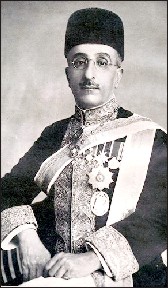
If these are nature’s bounty bestowed on our city, providence too has been kind with the Wadiyar dynasty ruling the Kingdom of Mysore with this city as its capital. And blessed are the people because the Kings who ruled after 1800 AD have all been good kings with most of them being patrons of art, literature and music. And during the long reign of Krishnaraja Wadiyar IV the Kingdom became a Rama Rajya as Gandhiji called it and the King himself was a Rajarishi. Philosopher-king. It was this king who ruled the kingdom with the help of renowned Dewans [Prime Ministers]. One among them was Sir Mirza Ismail.
For some years I was a member of ‘Freemasons,’ sort of secret club known as The Grand Lodge of India, Lodge Mysore. Recently I was going through its publication known as ‘The Square and Compasses’ and was intrigued to find the name of Sir Mirza Ismail being mentioned in it in glowing terms just as his work in Mysore was much appreciated.
His name was mentioned in connection with the problems the ruler and administrators faced in the Kingdom of Jaipur, Rajasthan, from vested groups. The situation was similar to what happened during the building of the Great Temple in Jerusalem after Jews were freed from their Babylonian captivity after 70 years of exile.
It appears during the year of exile of Jews, there was no government of any kind in the country and many outlaws, murderers, debtors and others with dubious characters from neighbouring countries came and settled in the Jewish country, specially in the city of Jerusalem. These people resented the arrival of Jews, from their Babylonian exile, trying to restore law and order. There was daily strife between the two warring sides which compelled the labourers at the temple area literally to work with the ‘trowel in hand and sword by the side.’ This, of course, has become part of the traditional ritual in the Freemason ceremony.
Recalling this historic ancient incident, the report in the magazine connects it to an incident in modern times. It says, “In our own times, we have heard of Sir Mirza Ismail — Special Officer entrusted with the task of beautification of the city of Jaipur in Rajasthan. With undaunted courage and determination, he went on with pulling down dozens of houses as per his masterplan without fear or favour, even those of big and influential citizens who naturally tried to oppose his doings.”
No wonder the grateful citizens of Jaipur named a major road after Sir Mirza Ismail. Now compare this with ourselves. Is there a road named after this great Dewan of Mysore Sir Mirza Ismail? I don’t know. Is there a road named after Sir M. Visveswaraya? I do not know. Yes, someone told me there indeed is a Mirza Road but it does not run even a km length in Nazarbad. In Jaipur, I have seen Sir Mirza Ismail Road, a double road, running to a few km length in keeping with his stature. Yes, there is also one inconspicuous Circle named after Sir MV ! Could they not have a statue of Sir MV there just like the other two statues of Maharajas?
Incidentally, the message from the Grand Master Most Worshipful Brother Vasudev J. Masurekar, OSM, has the opening paragraph that takes you to 2nd century BC and then brings you to 2014 AD. It speaks of Delphic Oracle in Greece where I had been about five years back, hence my interest. The Grand Master says:
The temple of Apollo at Delphi, built in the 2nd century BC, has three phrases carved into the stone. First is, “Know thyself,” second “Nothing in excess” and the third is “Make a pledge and mischief is nigh.”
These three statements have made the Oracle of Delphi famous universally.
All the three statements are profound and impacts on every individual’s life. Because we do not try to know ourselves, we delude ourselves as someone that we are not. Buddha has taught us to follow the golden path, the middle path. Nothing in excess. Neither more nor less. The third statement is rather complex. No wonder over the centuries there have been many interpretations of these words and debates by philosophers and scholars.
However, let me venture to interpret the third statement in the light, nay in the dim light, of my own wisdom. It says, “Make a Pledge and Mischief is Nigh.” These are the days where politicians in our democratic country keep making pledges, from swearing on our Constitution, to protect and preserve it, to provide a good administration and infrastructure. But, our experience has been that they seldom keep their pledge. That is why I interpret this statement to mean, ‘when you make a pledge, you are near a mischief.’ You are upto some mischief! Read politician in the place of you. Howzzat?
e-mail: kbg@starofmysore.com
source: http://www.starofmysore.com / Star of Mysore / Home> Abracadabra….Abracadabra / by K.B. Ganapathy / July 02nd, 2014
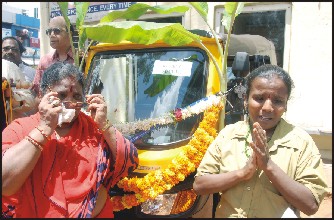
Veena, the beneficiary of Lions Club’s donation of an autorickshaw, is seen overwhelmed with emotion in front of the gifted autorickshaw along with her mother Lakshmamma.
Mysore :
The first woman auto driver in city, Veena, was all smiles today as she got an autorickshaw from Lions Club of Mysore Heritage City at a function organised at the premises of Mangalore Motors on Dewan’s Road here today.
The Lions Club, which felicitated Veena during Women’s Day celebrations recently, had agreed to get her an autorickshaw and the keys of the same were handed over to Veena by Kiran Bolar, Proprietor of Mangalore Motors and President of Lions Club of Mysore Heritage City.
Speaking to Star of Mysore, Veena, 39, mother of two daughters, said that she was deserted by her husband 10 years ago and was living with her mother since then. She said that she was unable to eke out a livelihood by driving a rented auto and was now happy to have one of her own.
When asked about the behaviour of male auto drivers with her, she said that they were very cordial and had no qualms.
Club Vice-President C.H. Mallepura, Secretary Gangadharappa, Treasurer K.S. Kumar and Veena’s mother Lakshmamma were present.
source: http://www.starofmysore.com / Star of Mysore / Home> General News / July 02nd, 2014
Karnataka’s top ranked chess player from city, IM M.S. Thejkumar of South Western Railways, won Chaturya 1st Satara FIDE Rating Open Rapid Chess Tournament 2014 held at Satara on June 28 and 29.
Thejkumar, sponsored by M/S.Saanvi Technologies, USA and www.mysoresport.com had an unbeaten record in the tournament and with his performance in this tournament has added 6.3 points to his present rating of 2446.
Thejkumar won his last round match against Soham Dattar of Pune and won a cash prize of Rs.15,000 along with a trophy.
He had wins over Dalal Ambar Abhay of Goa, Mokashi Rohit of Sangli, L. Saurabh of Nagpur, Gopal Rathod of Sholapur, Bhambhure Shantanu of Pune, S. Bartakke Amardeep, Kulkarni Rakesh and Soham Dattar. He drew his lone game against WFM Pujari Rucha of Kholapur.
Bhambure Shantanu of Pune finished second with 7.5 points and was followed by Kulkarni Rakesh (7.5 pts), WHM Pujari Rucha and B. Amardeep of Railways with 7 points each.
source: http://www.starofmysore.com/ Star of Mysore / Home> Sports News / July 01st, 2014
Cricket is the sport followed by many in the country. The sport has grown such a way that it is regarded as a religion in our Country. Every child is seen playing the game with a ball and bat along with his friends in the streets of every town and village in India. Most of them dream of pursuing the sport in a professional level and to represent the country in International level.
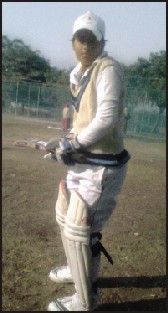
Today, women’s cricket in India is gaining momentum and the current Indian Women’s Cricket Team is regarded to be one of the strongest in the world. With players like Julan Goswamy , Mithali Raj, Anjum Chopra and others having made a mark in cricket world, every young girl now dreams of donning the Indian colours. One such talent is M. Sowmya Naik.
Having started to play cricket at a young age, Sowmya travelled from Mysore to Bangalore to attend coaching classes. Though, the family’s economic status being poor, Sowmya’s father M. Mahadev bought her a cricket kit to encourage her interest in cricket. Unfortunately, Mahadev died owing to illness, but not before his encouraging words asking Sowmya to work hard towards her goal to play for the country.
Initially, Sowmya went around Bangalore visiting various cricket academies with a willingness to learn the sport. Later, she found out that Kapil Cricket Academy located at Rajajinagar in Bangalore catered to women cricket and approached the academy. Observing her interest in the sport, the academy took her and nurtured her talent.
During one of matches played in Hyderabad against Chennai, she was noticed by the members of Amateur Federation of India of Gujarat and was invited to join their cricket academy in 2012. She was also made the captain of the U-22 team and since then she has been performing well.
Sowmya has already played against Nepal, Bhutan and Sri Lanka including six T20 matches. She was also adjudged the Women of the Match, Best Bowler and Best Batswoman of the tournaments held at Nepal and Bhutan. Sowmya has also shown her skills behind the stumps as a wicket keeper. Currently being trained under B.D. Verma, General Secretary, Amateur Cricket Federation of India, Gujarat.
Sowmya, speaking to Star of Mysore, expressed her desire to start a women’s cricket academy in Mysore and also to coach the girls. She mentioned that a coaching camp had been started at Raghavendranagar in city.
Sowmya said that she would seek permission from Karnataka Exhibition Authority to conduct coaching classes for girls at Dasara Exhibition Grounds.
She also expressed of reaching greater heights on being given a sponsorship. Such a talent from city must be encouraged and city’s philanthropists must come forward to help Sowmya in her endeavour to scale up her professional cricketing career.
source: http://www.starofmysore.com/ Star of Mysore / Home> Sports News / by M. T. Yogesh Kumar / July 01st, 2014
“We both have an in-born desire to engage ourselves in our fields of interest and work hard. I am interested in academics and Yadu in arts. We both have the ambition to live, survive and come up in life.”
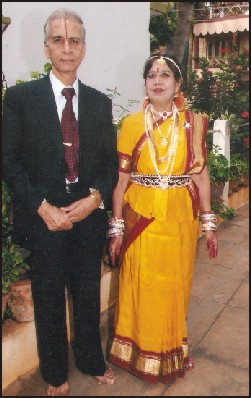
He is the body and she is the soul. That’s how the couple Prof. M. N. Gopalan and Yadugiri Gopalan live together. Suffering from paralysis from past fifteen years, Gopalan, who is a Ph.D holder, is presently trying his hands at his D.Litt Degree. Prof. Gopalan has seen a tremendous cure, yet he barely steps out of his home. If so he does, his wife Yadugiri has to be with him holding his hand. Yadugiri Gopalan looks after her husband day and night, yet finds time to practice, portray and involve herself in numerous creative and art competitions in and around the city. The couple are supporting each other to fulfil their desires and ambitions. He is 80 and she is 70 now…
by Phalgunn Maharishi
Unfortunately, the Gopalan couple have no children. Yet they say, “We both ourselves are children for each other.” Prof. Gopalan added, “I am her son and she’s my daughter.” Enthusiasm has not faded away from the couple. They both, in spite of their current circumstances, still want to achieve something more. While talking about the sources of their wide interests, Prof. Gopalan said, “We both have an in-born desire to engage ourselves in our fields of interest and work hard. I am interested in academics and Yadu (in short for Yadugiri) in arts. We both have the ambition to live, survive and come up in life.”
Prof. Gopalan was associated with IIT Bombay for thirty five years from 1960 to 1995, before which he completed his B.Sc Honours in Statistics from Maharaja’s College and M.Sc in Statistics from the University of Mysore. After the completion of his studies, he joined the Bureau of Economics and Statistics in 1958 and later stepped into IIT Bombay. While talking about his tenure at IIT Bombay, Prof. Gopalan recalled, “I had joined IIT Bombay as a technical assistant in 1960 and after consistent promotions, I landed with the post of a lecturer. I was then granted a paid leave for two years to pursue my Ph.D at IIT Madras where I coached M.Tech students part-time. Later, I was appointed at IIT Bombay as an assistant professor and then, I retired in 1995 as the HoD for Interdisciplinary Programme in Reliability Engineering, which is a part of Total Quality Management.”
Mr. and Mrs. Gopalan came into each other’s life through arranged marriage. When they got married in 1965, Gopalan was a lecturer at IIT Bombay. When Gopalan shifted to IIT Madras to pursue his Ph.D in Reliability Analysis of Systems, Yadugiri Gopalan came back to Mysore to pursue her PUC in Fine Arts at Lalitha Kala Academy. She has practised Karnatak Music and Light Music under the able Professor Gauri Kuppaswami, Vidushi H. N. Manjula and H. R. Leelavathi. She has also specialised in Embroidery and Rangoli. Her attractive rangoli designs can be found in their home on the floor and also on walls!
It can surely be mentioned that if you come across any fancy dress competition, rangoli competition or any other cultural programmes in the city, you are sure to find Mrs. Yadugiri Gopalan there with her own unique dress. “My husband feels very happy when I return home bagging a prize. Yet, he has always motivated me to participate in such competitions, not just to win. But I have won more than 200 prizes till now,” said Yadugiri Gopalan and giggled with a wink. With no waste of time, Prof. Gopalan commented, “I am her personal assistant you see! I follow-up all her competition and programme dates,” with a million dollar smile.
Yadugiri said, “He cannot come and watch my stage performances live due to health issues. But he does enjoy it when we receive the photographs. That’s my husband!”
Both Mr. and Mrs. Gopalan are known in their own fields of interest. Prof. Gopalan has been a respectable fellow member of various professional bodies like “The Institution of Engineers,” “Operational Research Society of India,” “Systems Society of India” and “United Writer’s Association of India” and many honours have been bestowed upon him by various organisations for his contributions in the field of education and literature. A few such honours are “Sir M. Vishvesvaraya Award,” “Sahithya Sindhu,” “Sadbhavana Award,” etc. He is also the recipient of “Life-time Achievement Award” conferred by the Operational Research Society of India at Delhi in 2007. He also served as an Emeritus Fellow of the All India Council for Technical Education and University Grants Commission (UGC).
Apart from this, he is into writing too and several articles by him have been published in various newspapers, magazines and journals. He, even today, upon special requests visits many schools with his wife to address the students about various educational facilities and to ward off the societal problems and eradicate social evils. His D.Litt degree application is currently in process and the topic is Interdisciplinary Programme Connecting Management Science and Philosophy.
Yadugiri is no less than her husband. She has so far won a number of awards from various organisations in the city for her unique talent and enthusiasm. “Karakushala Praveene,” “Sthree Kala Prapoorne,” “Kala Tapaswini,” “Kala Saraswathi,” “Kalaratna Prashasthi” are a few among many. She portrays many historical and societal personalities to spread and mould the younger generation and love for the Nation.
When a person visits their residence at Saraswathipuram, he is surely going to come out with an increase in his knowledge and a whole lot of freshness. Such humble and society-oriented couple are surely worth giving a hand and applaud and say proudly, these are our Mysoreans !
source: http://www.starofmysore.com/ Star of Mysore / Home> Feature Articles / July 01st, 2014
Open air exhibition on traditional terracotta and sculptures soon
Mysore :
The Indira Gandhi Rashtriya Manav Sangrahalaya (IGRMS), a National Museum of Mankind at Southern Regional Centre (SRC), Mysore, is developing an Open Air Exhibition on traditional terracotta and sculptures at its premises on Irwin road in city.
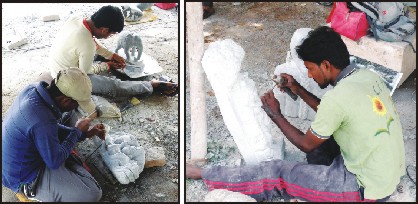
In this connection, stone sculptors (craftsmen) from Karnataka and Orissa are taking part in a workshop at IGRMS since May first week.
In all, five artists each from Odisha and Karnataka are participating in the workshop. They are: Sudarshan Sahoo, Dharnidhar Rantaray, Alokkumar Swain, Kshetra Mohan Maharana and Ashokkumar Swain (all from Odisha); L. Basavaraja, T.R. Puneeth, Satish B. Badiger, S. Nagendra and H.P. Shankar (all from Karnataka).
The Orissa sculptors are creating the temple architecture of Orissa tradition while the Karnataka sculptors are creating the folk traditions.
The sculpture workshop will conclude in a week and the art works will be displayed for the public, according to a press release from V. Ashok Vardhan, Officer-In-Charge.
source: http://www.starofmysore.com/ Star of Mysore / Home> General News / July 01st, 2014
The Administrative Training Institute (ATI), Mysore, is emerging as one of the premier training institute in the country by augmenting the infrastructure and training facilities in the last three years.
In order to place ATI Mysore and streamline the Training activities, ATI had applied for ISO 9001:2008 Certification and all the process have been completed.
A team under the leadership of Rajesh Iyer and 4 members TUV InterCert SAAR IndiaPvt. Ltd. visited ATI on June 17 to assess and audit the Institute as per the ISO norms and standards for recommending ATI, Mysore for ISO 9001:2008 certification.
The team has appreciated the efforts of ATI in imparting training to Officers of the Government of Karnataka and also for other States.
The team also visited State Institute for Urban Development (SIUD) and Abdul Nazir Sab State Institute of Rural Development (ANSSIRD) which are located in the same premises. The team was pleased with the Audit and compliance of ATI, ANSSIRD and SIUD to qualify for ISO Certification.
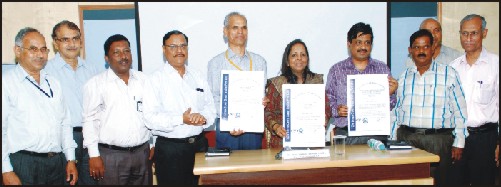
Based on the team’s report, ATI, ANSSIRD and SIUD, Mysore have received the ISO 9001:2008 Certification in Design of Training, Preparation of Reading Material, Impart of Training and Provide Work related Input to Government Officers deputed for training for 3 years. The certificate was formally received by Dr. Amita Prasad, Director-General, ATI, yesterday from the representative of TUV InterCert Saar India Pvt. Ltd (Group of TUV Saarland Regulation).
source: http://www.starofmysore.com/ Star of Mysore / Home> General News / July 01st, 2014
Chief Editor B A Viveka Rai, flanked by associate editors Muddu Moodbelle (right) and Vaman Nandavar at the Mangalore Darshana project office in Mangalore | RAJESH SHETTY BALLALBAGH
Mangalore :
A team of erudite scholars, at the behest of Deputy Commissioner A B Ibrahim, began work on a gigantic project chronicling 2,000 years of Mangalore’s history.
The 1,000-page ‘Mangalore Darshana,’ to be published in two volumes, will highlight plurality of Mangalore, Chief Editor of Mangalore Darshana, Prof B A Viveka Rai said.
The book begins from Christian era where Roman geographer Claudius Ptolemy mentions the Netravathy river. Govinda Pai in one of his works also quotes Ptolemy, said Rai.
From Alupa dynasty, the first kings who ruled Mangalore from sixth century to 14th century, the narration will cover arrival of Portuguese in 1526, rise of Hyder Ali and beginning of British rule in Mangalore from 1799 onwards.
Information available in travelogues of Abdul Razak (a Persian ambassador who visited Mangalore in 1132 AD), Scottish doctor Francis Buccaneer (who visited Mangalore in 1801), is being utilised to liven up the account.
Rai said a sea trader Abraham Ben Yaju’s account of his stay in Mangalore, including being married to a local woman Ashur, his metal industry, lifestyle from 1132 to 1149 which was in old Arabic was translated to English two years ago.
People from different parts of world, including Jews, came and settled in Mangalore. Before Islam became an institution country wide, many in Mangalore were converted to Islam, he said.
Archives on Mangalore
Besides history, geography, geology, epigraphy, socio-cultural development in the region, the unique influence of natha cult, transport, media, industries, administration, heritage buildings, sports, visit of Gandhiji, Tagore, hotels and more will be included in Darshana, associate editors Vaman Nandavar and Muddu Moodbelle said.
On their approach, Rai said discussions were still in formative stages. “The framework, strategies keep changing, but we have a vision and know what needs to be done,” he said.
Chronicling history is nothing new to Prof Rai. While serving as the Vice-Chancellor of Kannada University, he chronicled 50 years of the state’s history.
As the V-C of Karnataka State Open University (KSOU), he initiated work on chronicling history of Mysore and his successor published Mysore Darshana in four volumes.
It was his work in Mysore Darshana that was noticed by Ibrahim.
“The DC asked us to complete Mangalore Darshana within a year and most importantly spared us a headache of maintaining accounts,” he said.
Unlike anything before they had done, Mangalore Darshana project is challenging, admits Rai.
Unlike Mysore Palace, Mangalore has had no culture of maintaining archives.
A previous compilation of Mangalore’s history, ‘Sturrock Manual,’ borrowed for a doctoral thesis was never returned. “We will have to tap information outside Mangalore and India. For instance we will be at Asiatic Society of India in Kolkata to know about plants,” Rai said.
“I am lucky for the fact that I have good network of scholars who will not turn down my request,” he said.
The work will begin with interview of elderly residents to shed light on life in bygone era. Next experts will contribute 100 articles of 10 pages each about Mangalore.
“We hope that an archive of Mangalore will be a byproduct of this initiative,” Rai said.
It is Payback Time
Mangalore: Prof Viveka Rai, who returned from Germany in October 2013, where he serves as guest professor, Chair of Indology, University of Wurzburg, is presently translating Basava’s vachanas to Tulu. He is bringing out a volume (300 pages) on classical Kannada in English translations with Prof C N Ramachandra. He is also working on another book, translating English grammar to Kannada which will be completed within a week. Despite being pre-occupied with close-academic work, he was still drawn to Mangalore Darshana because he loved the subject. “I have lived in Mangalore since 1968 and the city has given me everything,” he said.
source: http://www.newindianexpress.com / The New Indian Express / Home> States> Karnataka / by Harsha / June 30th, 2014