Brindavan Hospital opens its services to public

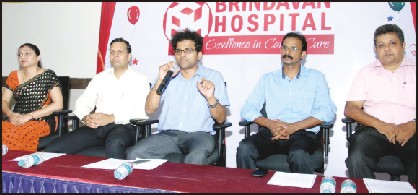
Dr. B.H. Manjunath, Director of the hospital, is seen addressing the press conference as Dr. A. Sonia Mandappa, Dr. K. Ravindranath, Dr. Harish Kejriwal and Dr. B.M. Mahesh Rao look on.

Mysore :

Brindavan Hospital, a Unit of Vidyaranya Multi-Specialty Hospital Pvt. Ltd., today opened its Multispecialty Hospital and a dedicated health care and cure centre services for the people of city at Jayalakshmipuram in city.

Earlier, addressing a press conference in city, Dr. B.H. Manjunath said that the unit has been created to serve the people of Mysore which has been registering a high number of patients related to various diseases in the recent times than earlier and added that Brindavan Hospital strives to provide accessible and affordable healthcare to the masses and the project is another step in achieving the objective of extending a helping hand to the people to make their health good.

Speaking about the medical treatment facilities available at the hospital, he said that the hospital provides Advanced Ortho care, Advanced OBG care such as painless labour, laproscopic Surgeries, Infertility Clinic, High Risk Pregnancy, Advanced Neonatal Care, Advanced Nephro and Urology care, Advanced ENT Care and Advanced Reconstructive Surgery besides providing 24×7 facility in Accident and Trauma Care, Casualty and Intensive Care, Pharmacy, Ambulance service and Laboratory and radiology services.

He further said that with the commencement of the multi speciality hospital, people living in and around Mysore district will have an access to the quality and affordable screening and treatment facilities in city.

Directors of Brindavan Hospital Dr. K. Ravindranth, Dr. Harish Kejriwal, Dr. B.M. Mahesh Rao and Dr. A. Sonia Mandappa were present at the press meet.

source: http://www.starofmysore.com / Star of Mysore / Home> General News / April 27th, 2014

DECEMBER-1, A must see film

KannadaFilmBF02may2014

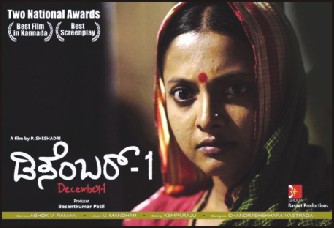
Yesterday when the call came from Vaishali of DRC Cinemas inviting me to see ‘December-1’, I was left wondering what has December 1st got to do with April 25. On being told it was the title of a Kannada film which had just won two National Awards — Best Film in Kannada and Best Screenplay — my ears riveted and there I was at the theatre for a special screening. The exclusive show for the press would be this evening a 5 O’ clock.

Should anyone ask me what was the achievement of our former JD(S) Chief Minister H.D. Kumaraswamy and for what he would be best remembered, I would instantly say ‘Village home stay’, grama vasthavya, though some may remember him as a renegade who nearly ruined B.S. Yeddyurappa’s political career in BJP. Let it be.

I only mentioned this because the film ‘December-1’ is all about a Chief Minister’s village home stay. If at all a Kannada film was produced based on a contemporary political theme which is much discussed among the people and so very topical, this one is the film.

The original intention of this idea, as told by H.D. Kumaraswamy himself, was to experience first-hand the daily trials and tribulations, the daily grind of a farmer in the village. To what extent Kumaraswamy’s experience benefited the villagers in whose houses he stayed, or the village which he stayed or the farmers across the State, everybody knows. Neither his host nor the village nor the farmer found any improvement in their lives as a result of this much-publicised and appreciated village stay.

In this film, December-1 the story revolves around a similar village stay by the Chief Minister but not to experience first- hand the poverty and denials of a village farmer as was the idea in Kumaraswamy’s experiment. Here the intention was to send an important message to the people of the State, why, the world ! Well, we find the Chief Minister being appreciated in Delhi by Dr. Manmohan Singh and even in Washington DC by Barack Obama !! I will not reveal the message here for the beauty of the film and the genius of the producer lies here. This message is indeed the fulcrum upon which this most creatively produced, most enjoyable film is well balanced. I recommend this film, a short one at 94 minutes, to anyone who is a cinema lover.

The film no doubt is a political satire and is produced too realistically to be true. It takes the viewers to a typical village, Basapura in North Karnataka. Hence, the spoken language is highly guttural, sometimes musical and idiomatic for southerners to understand every word of it. For example, the refrain while greeting another ‘Saranare Saara.’ Yet this itself adds to the enjoyment of the film all through. Madevappa, played by Santosh Uppina and Devakka by Niveditha in lead roles as husband and wife have given sterling performance, though Devakka seemed a bit sensual for a village belle of Basapura as seen in the film. Never mind. Well, after all, there must be some reason for Devakkana rotti to become famous in the village town! The couple leads a normal village life with a son, an infant daughter and Madevappa’s aged mother. He was a lorry driver but following an accident lost a leg thus on crutches. He works in a flour mill while his wife Devakka sells rottis, the famous Devakkana rotti mentioned above. Not quite a happy family but certainly a contented family.

Then, like a bolt from the blue, arrives at their doorsteps an official and a Policeman. Madevappa was forcibly taken away from his mill to the DC’s office. The manner in which he was made to wait for hours on end at the office is typical of what we all experience when we go to Government office. The ways of the officials and the DC in informing him of the choice of his humble, ramshackle house for the impending Chief Minister’s overnight stay and the official manner in which his consent is taken are too realistic — the persuasion, promises and mild threat. I am reminded of the Russian classic “Dead Souls” by Nikolai Gogol. The Chief Minister finally comes to the village on December 1st. Hence the title of the film.

The Director and the script writer of the film P. Seshadri must be admired for his sense of time in making the film belong to the present — here and now. Otherwise who would ever bring in the scene where a customer questions Madevappa the justification for charging Rs. 3 for grinding one kg of grain when the grain itself costs Re. 1 a kg to buy. I remembered our present Chief Minister Siddharamaiah and his Re. 1 a kg rice to the BPL card holders. It is such existential situations that lifts the film as a whole to a higher level from among other cliched art films of the same old format.

The Chief Minister finally comes to Madevappa’s house, eats, stays overnight and leaves. Then the denouement. The dreams the family had dreamt of bettering their life was shattered. Worse, even their earlier normal work-a-day life of contentment was destroyed. They suddenly become untouchables all because the Chief Minister wanted to convey a message to the world. A film everyone in Karnataka must see and enjoy both as an entertainment and a reminder of our unscrupulous politicians and their crooked ways oblivious of the common man’s needs and sentiments.

It was gratifying to know that a lady from our city, former journalist Preethi Nagaraj too has played a cameo role as a school teacher apart from assisting in script writing. Full marks for a good, must-watch Kannada Art Film in many years. A rose of a film in December !

e-mail: kbg@starofmysore.com

source: http://www.starofmysore.com / Star of Mysore / Home> Abracadabra… Abracadabra / by K. B. Ganapathy /  April 26th, 2014
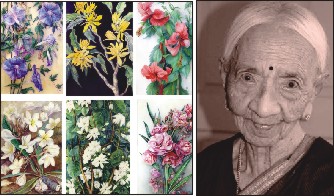
Kuncha Bhramari : Talk on Floral World of Mukta Venkatesh at Ramsons tomorrow

MuktaVenkateshBF02may2014

Mysore :

‘Kuncha Bhramari,’ a talk on the floral world of artist Mukta Venkatesh will be held at Pratima Gallery, Nazarbad Main road, tomorrow (April 27) at 5 pm under the auspices of Ramsons Kala Pratishtana. This is the fifth edition in the talk series, hosted every fortnight since March 2 as part of Kalaa Dhaaraa – the mega exhibition of contemporary art. This last talk will be in the form of a conversation between Girija Madhavan (artist), daughter of Mukta Venkatesh and R.G. Singh, Secretary, Ramsons Kala Pratishtana, following a multimedia presentation.

K.B. Ganapathy, Editor-in-Chief, Star of Mysore, will be the chief guest. Smitha Ningraj, art teacher and research scholar will make a power-point presentation on the floral world of Mukta Venkatesh.

Mukta Venkatesh, a painter-poet, lived to be a 101 years old, painting to the last. She was born in 1902 in Tamil Nadu, one of the daughters of a Victorian liberal and a scholar with a taste of English literature and decidedly unorthodox views. Mukta married Venkatesh, son of Madhava Shastri of the Oriental Research Library, spent a long sojourn in London where she studied under Plein Aire master Xavier Willis. She came back to Mysore in 1922 and never left the sprawling gardens of her house in Mysore. Mukta’s paintings of flowers acquire a soft dreamscape of their own — the exquisite colours, every shade, every curl of the petals, the age, the bruise and smudge on the petals, the vividness of colours etc.

source: http://www.starofmysore.com / Star of Mysore / Home> General News / April 26th, 2014

Mahila Vedike fetes women achievers

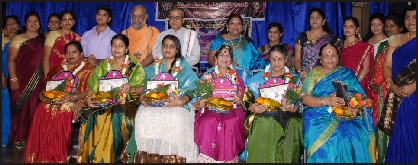
Women achievers (from left) Mani Shekar (art work), Suma Rajkumar (ventriloquist), Uma Jadhav (beautician), Yadugiri Gopalan (fine arts), social worker Sashikala Jayakumar and cine actor late Narasimharaju’s wife Sharadamma, who were felicitated by Mysore Mahila Vedike, at Veene Seshanna Bhavan in Kuvempunagar on Thursday, are seen with the guests and organisers.

Mysore :

The Mysore Mahila Vedike was inaugurated at a function held at Veene Seshanna Bhavan in Kuvempunagar here on Thursday.

Social  worker K. Raghuram, who spoke after inaugurating the Vedike, said that it is the responsibility of mothers to bring up their children in the right direction as a child learns its first lessons at home. As such, the mother, who is often called the first ‘guru’ of a child, plays a key role in moulding children as better citizens in the future.

Asserting that past customs and traditions are becoming increasingly difficult to maintain in urban areas, Raghuram rued that drawing rangoli and singing bhajans / keerthanas in homes have become a thing of the past. He advised the Vedike to organise camps for all-round growth of girl children.

Vedike President Sumana Raghunandan, in her address, said that the Vedike was formed by women in order to work for the welfare of women.

Outlining the objectives of the Vedike, she called upon the women to utilise the Vedike for unearthing the talent in them.

The Vedike has plans to distribute prizes to meritorious SSLC and PUC students.

Cine actress Sudha Narasimharaju, who was the chief guest on the occasion, called upon the Vedike to come to the rescue of aggrieved women. She wished the Vedike all success in the future.

On the occasion, five women achievers — Mani Shekar (art work), Suma Rajkumar (ventriloquist), Uma Jadhav (beautician), Yadugiri Gopalan (fine arts) and social worker Sashikala Jayakumar were felicitated.

Dr. Bhashyam Swamiji, Theatrist Saroja Ramesh, TV actor Vikram and others were present.

source: http://www.starofmysore.com / Star of Mysore / Home> General News / April 26th, 2014

Tejaswi comes alive at Photo Expo

TejaswiBF02may2014

Mysore :

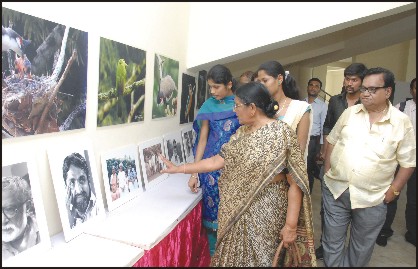
A 2-day photo exhibition on late writer Poornachandra Tejaswi, organised by the engineers theatre group — Abhiyantararu — was inaugurated at Senate Bhavan, Mansagangotri in city, this morning.

Prof. B.N. Sriram, Publisher, Pustaka Prakashana, who spoke after inaugurating the photo expo, said Tejaswi was such a creative writer who found the roles in his stories from among nature, environment and ecology. The photographs clicked by Tejaswi on nature and its environs are wonderful, he said adding Tejaswi’s collection assumes great significance as he took pictures at a time when there was not much advancement in photography. Abhiyantararu theatre group will enact Poornachandra Tejaswi’s play ‘Mayaloka’ at Senate Bhavan at 6 pm today and tomorrow.

source: http://www.starofmysore.com / Star of Mysore / Home> General News / April 26th, 2014

Pankaj Advani Gets ‘Best Sportsperson’ at CSJC Awards

Ace Indian cueist Pankaj Advani was today chosen as the Best Sportsperson of the Country, while football Olympians PK Banerjee and Chuni Goswami were picked for Lifetime Achievement awards by the Calcutta Sports Journalists’ Club for 2013-14.

Former India captain IM Vijayan will also be felicitated for oustanding contribution to football as a host of sportpersons from the state and country will be feted at the ONGC-CSJC Annual Awards Function to be held at the Rotary Sadan on Friday.

Following is the list of the awardees:

Lifetime Achievement: Pradip Kumar Banerjee and Subimal (Chuni) Goswami; Outstanding contribution to football: IM Vijayan; Best Sportsperson of the Country: Pankaj Advani (Cuesport); Best Junior Sportsperson of the Country: Rituparna Das (Badminton); Excellence in Cue Sport: Sourav Kothari.

State awards (Best Player): Archery: Somnath Mondal, Athletics (male): Chandan Bauri, Athletics (female): Swapna Burman, Basketball: Sukurmoni Oraon, Chess: Diptayan Ghosh, Cricket: Mohammed Shami, Football: Arnab Mondal, Football (best foreign player): Celestine Anyichie Echezona, Gymnastics: Pranati Das, Hockey: Chandan Singh, Kabaddi: Sumati Adigiri, Shooting: Arjun Das, Swimming: Sayani Ghosh, Table Tennis: Sutirtha Mukherjee, Tennis: Nitin Kumar Sinha, Volleyball: Anushree Ghosh.

source: http://www.news.outlookindia.com / Outlook / Home> Sports / Kolkata – April 23rd, 2014

Fizz, flight and loop

Prasanna was forever trying to improve as a bowler, even in his last match © PA Photos

The last time I saw him in action was during the V Sivaramakrishnan benefit match between two teams of veteran cricketers at Chepauk in April 1993. The match got off to an electrifying start with Sunil Gavaskar, by then in his mid-40s, playing some pluperfect drives off the medium-pacers. When spin was introduced and EAS Prasanna  came on, the “Little Master” greeted him with more of the same.

The two maestros had turned the clock back and those fortunate to be there that morning were witness to a vintage duel between tantalising flight and dancing feet. Then came the delivery of the day, with Gavaskar forward, aiming a push to the on side, and the ball clipping the off bail. Prasanna was nearly 53 years old.

He had never been an athletic figure on a cricket field, but I believe he was as fit for his job as any top-rung cricketer of his time. In his senior years, nothing much had changed in his bounding run-up and classical side-on finish, and the ball continued to fizz after it left his hand and travelled towards the batsman in an enticing arc, even though he was tubbier than he had been in his playing days.

This was almost 15 years after I had last met him on a cricket field as an opponent – when I was playing for Hyderabad and he for Karnataka. It was one of his last Ranji Trophy matches, if not the very last one, if memory serves me right. In the course of a seven-wicket haul, he bowled splendidly, even applauding my pull to the boundary off him, and having me caught at bat-pad next ball while I was aiming an extra-cover drive.

What caught the attention of some of us during the match even more than Prasanna’s brilliant spell was his bowling in the nets. With little change in his regular offspin action, he repeatedly made the ball go the other way off the pitch, visibly enjoying the addition of a new weapon to his arsenal. This was a veritable legbreak, not the floater with which he had fooled many a batsman, including Gavaskar in the Ranji Trophy semi-final in March 1974 – a dismissal almost identical to the one I watched in the veterans match two decades later.

When one of us ventured to ask him if he had tried the variation in a match yet, he said, “No. I am not ready. I haven’t mastered it.”

In hindsight, Prasanna had stumbled upon the doosra long before Saqlain Mushtaq – and I can swear he delivered it with a perfectly straight arm – and retired without trying it in a match situation. The fact that he was still trying to grow as a bowler in his last match and yet held back a new trick (like a classical musician of the old school, averse to presenting a song on stage before practising it hundreds of times) only underlined his greatness.

Young cricketers and cricket enthusiasts often wonder if spinners of Prasanna’s vintage could survive the assault of contemporary batsmen and bats, especially as they were said to flight the ball way more than today’s bowlers. The answer would of course be that those flighted deliveries were no gentle lobs but sharply spun balls that tended to dip in front of the batsman and spit; at any rate great spinners of any era adapt to the conditions of the day, and flight is not some one-arc-for-all standard fare.

True, a Prasanna today would perhaps go for more sixes – including mishit ones – than he did in his day, but he would still fool batsmen with his deceptive loop. He never represented India in an ODI, but was very effective in the few matches he played in the Deodhar Trophy, the zonal one-day championship.

Would Prasanna have been an effective bowler in T20 cricket? I like to believe, especially after watching the successful exploits of Sunil Narine, R Ashwin and Praveen Tambe, that he would. Prasanna was perhaps the shrewdest of the quartet of spinners India produced in the 1960s, and I believe he would have adapted beautifully to the shortest form of the game. He would have offered his captain an attacking bowling option, especially against left-hand batsmen. At any rate, a more confident bowler would be hard to find.

V Ramnarayan is an author, translator and teacher. He bowled offspin for Hyderabad and South Zone in the 1970s

source: http://www.espncricinfo.com / ESPN Sports Media Ltd / Home> The Cordon / by V. Ramnarayan / April 23rd, 2014

CFTRI’s Researcher receives Gandhian Young Technological Innovations Award

Rajiv Ranjan, Junior Researcher at CSIR-CFTRI, is seen receiving the national award from eminent scientist Dr. R. A. Mashelkar at a function in Ahmedabad recently as others look on.

Mysore :

Rajiv Ranjan, a Junior Research Fellow at the Mysore-based CSIR-Central Food Technological Research Institute (CFTRI), Mysore, has bagged the 2014 Gandhian Young Technological Innovations Award.

He won the award for designing bioluminescence based “simple tool for detection of hazardous materials and sanitary condition at rural level.”

The award is instituted by SRISTI (The Society for Research and Initiatives for Sustainable Technologies and Institutions).

Ranjan received the award from eminent scientist Padma Bhushan Dr. R. A. Mashelkar at a function held in Ahmedabad recently.

Using Rajiv Ranjan’s invention, presence of very low levels of pollutants like mercury, cadmium, arsenic and 2-4 dichlorophenoxyacetic acid (a remnant of pesticides) can be detected. Within half-an-hour the device can show the presence of up to 2 ppm of mercury, 4 ppm of arsenic, 16 ppm of cadmium and 100 ppm of 2-4 dichlorophenoxyacetic acid. Besides, it can also detect presence of 100 cfu (colony forming units) per ml of bacteria in samples of food, milk and fruit juice.

The device has been designed using a marine luminescent bacterium and luciferin extracted from a new kind of firefly. For details, contact A. S. K. V. S. Sharma on Ph: 0821-2515910.

source: http://www.starofmysore.com / Star of Mysore / Home> General News / April 24th, 2014

Rotary Midtown presents Silicon Award to Scribes

Dr. H.M. Rajashekara, renowned Political Science expert, is seen presenting the award to K.H. Chandru (left), Senior photo-journalist and B.S. Prabhurajan, Special Correspondent, UNI, at Rotary Centre on JLB Road here yesterday as Rotary Midtown President Rtn. S. Bhanuchandran, donors of the award Rtn. S. Raghavendra and Rtn. M.S. Naveena Chandra and Secretary Rtn. Dr. K.A. Prahlad look on.

Mysore :

“Journalism is a powerful medium to expose scams like corruption,” opined Dr. H.M. Rajashekara, renowned Political Science expert.

He was speaking at a programme organised by Rotary Mysore Midtown at Rotary Centre on JLB Road here yesterday to present the Rotary Mysore Midtown Silicon award for excellence in journalism.

Dr. Rajashekara said that there were thousands of newspapers and periodicals in the country today throwing light on happenings in society. However, he opined that internet helped to get information in a jiffy.

He opined that the articles published in newspapers should be helpful to the society and the writers should be careful while writing about religion or caste.

Rotary Mysore Midtown Silicon award was presented to B.S. Prabhurajan, Special Correspondent, UNI, Mysore and K.H. Chandru, Senior photo- journalist, Vijayavani, Mysore.

The award has been instituted by Rtn. S. Raghavendra and Rtn. M.S. Naveena Chandra of Silicon Controls India Pvt. Ltd.

source: http://www.starofmysore.com / Star of Mysore / Home> General News / April 24th, 2014

This village is the stork’s domain

Kokkarebellur, a small village in Maddur taluk of Mandya district of Karnataka is named after the painted storks.

The word ‘kokkare’ means crane in kannada. Apart from Painted Storks, the spot-billed pelicans are also found here and it is rather disheartening to know that these birds have been classified as the “near threatened category” in IUCN Red List of 2009. Incidentally, this village is one of the 21 breeding sites existing in India and unlike any other bird sanctuary you may have visited.

A bird’s haven

For starters, Kokkarebellur is not a reserved forest sanctuary but a small village where the storks and pelicans coexist freely among the villagers and mostly in tamarind trees in the middle of the village.

The villagers are used to regular visits by tourists and photographers and can help you find the trees where the birds nest. The painted storks and pelicans are found in big herds during the migratory season. And make no mistake, these birds are huge. The painted storks have snow-white plumage with patterned bright pink and black stripes and have a yellow tapering bill. The pelicans have grey and white plumage, short stout legs, large webbed feet, flat and an enormous bill with an elastic bag of purple skin hanging below the throat that helps them collect fish from water.
The uniqueness in Kokkarebellur is the long established bonding between the birds and the villagers who have adopted this bird as their heritage, since they consider the birds as harbingers of good luck and prosperity to the village.
The happy co-existence of the villagers and the birds is because the villagers actually look after the birds, train them till they fly back to their nests. The spot-billed pelicans are protected by the law in India. In Kokkarebellur, a community-based project has been instituted to carry on the historical links of the pelicans with the villagers.
With increased nestling activity in recent years, efforts to conserve these birds have been fruitful and are also being hailed as a “role model” for replication at other places. Birds are seen nesting in clusters of 15 to 20 pairs per tree and the strange part is that they use the same set of trees every year.

The birds typically arrive after monsoons in September. They then make their nests, lay eggs from October to November and fledge around for three months till March, after which they tirelessly feed their hatchlings through the summer season.

As summer peaks in May, they re-migrate. Apart from the painted stork, you can also find little cormorants, black Ibis, grey herons, black-crowned night herons, ring necked parakeets and Indian pond heron.

Kokkarebellur is a must visit simply because this is probably the only place, where you can spot these winged beauties at such close quarters.

source: http://www.deccanherald.com / Deccan Herald / Home> Supplements> Spectrum / by Bindu Gopal Rao / April 15th, 2014