Cricketer Rahul Dravid presenting the Wildlife Service Award 2018 to Forest Guard J. Yogaraja of Lakavalli range in Bhadra Tiger Reserve. In the middle is Forest Officer Manoj. | Photo Credit: G_P_Sampath Kumar
J. Yogaraja was presented the Wildlife Service Award, which carries a purse of Rs. 1 lakh, by the Cricketers For Tiger Conservation (CFTC) on Friday. He was responsible for the arrest for seven poachers in Lakavalli range in Bhadra Tiger Reserve.
The forest official was felicitated by former Indian cricket team captain and national junior cricket team coach Rahul Dravid at Karnataka State Billiards Association.
“My father was a forest watcher for 30 years. I have grown up listening to stories about his job. When I got the opportunity to be a forest guard, I was more than delighted. Crime against wildlife is a serious offence and convicting poachers is very difficult. I was very happy when we were able to get 3-year jail terms for seven poachers,” he said.
Cricket and wildlife conservation his passion
Mr. Dravid said, “Cricket and wildlife conservation are two things I am very passionate about. Some of my best memories have been associated with the forests of Karnataka. What the Forest Department is doing to protect them is phenomenal. These men (forest guards) make a lot of sacrifices, staying away from their families. We owe them a huge debt of gratitude. Infusing cricket with this cause is commendable, as this sensitises children towards the need to conserve wildlife early on in their life.”
Dravid also gave away awards to the winners and best performers of the ‘Tiger Cup’ tournament.
CFTC was conceived by Sandeep Patil, Harbhajan Singh and Yusuf Pathan in 2012. This year saw the 7th Tiger Cup tournament.
source: http://www.thehindu.com / The Hindu / Home> News> Cities> Bengaluru / by Staff Reporter / May 18th, 2018
The film documents the memories of about 25 families living in these areas. | Photo Credit: K Gopinathan
INTACH to screen ‘Towns of Our City – People, Stories and Life in the old cantonment towns of Bengaluru’ on Sunday
Gulnaz Khan was born in Fraser Town. Her grandfather served in the British Indian Army. Though she now lives in Richards Town, Ms. Khan has very fond memories of Fraser Town.
“Every morning, when we would head to school, the entire street would resemble a carpet of flowers. We would hop and jump over them,” she says, remembering the tree canopy, something she greatly misses now.
This and many such memories of long-time residents of the old cantonment towns will be part of a one-hour long film to be screened by the Indian National Trust for Art and Cultural Heritage (INTACH) on May 20.
Speaking about the making of the film, Meera Iyer, co-convenor of INTACH, said, “The film is a result of the exhibition ‘Towns of City’ that was conducted last year to showcase the heritage and culture of Fraser Town, Cooke Town, Richards Town, Benson Town and Cox Town through walks, photographs and talks. We had spoken to numerous long timers, who gave anecdotes of the places. We recorded them and felt that sharing them with the public will make them know the neighbourhood better and also feel more connected to it.”
The film documents the memories of about 25 families living in these areas. “Most of them are descendants of original settlers,” she added.
Some narrators will also share their ideas for the future of these towns and how to preserve what remains of their heritage. “It is important for these stories to be told to preserve and promote the cultural and architectural heritage of these towns,” Ms. Iyer said.
source: http://www.thehindu.com / The Hindu / Home> News> Cities> Bengaluru / by Staff Reporter / May 16th, 2018
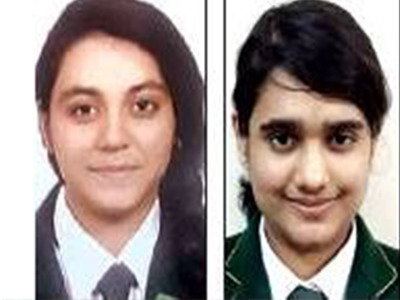
Scoring 99.1% in the ISC exams (class 12), Era Gupta and Sanyukta Giri of Bishop Cotton Girls School have clinched the all-India third rank and topped Karnataka.
Era, who scored centums in physics, chemistry and biotechnology, aspires to be a doctor and land a seat at AIIMS, New Delhi. “Most people who know of my ambition told me to focus on National Eligibility cum Entrance Test (NEET). But I didn’t want to sideline the boards and I’m glad my efforts have paid off,” she said.
Era said most of her time was spent in school and at Allen Career Institute, leaving her with only a couple of hours to study at home. “Swimming and dancing proved to be major stressbusters for me. My teachers were extremely supportive and never let me lose confidence,” she said.
Era, who even benefited from online content, said: “Social media is not a distraction. In fact, it helped me. My friends kept me calm whenever I was worked up,” she said.
Sanyukta scored centums in physics and biotechnology. “I don’t follow a schedule and just go with the flow,” she told TOI. Like her peers, she began preparation after the model examination. She didn’t attend coaching classes as she felt classroom lessons were sufficient. Sanyukta, who’d rather interact with others in person than online, spends her leisure time reading, her favourite author being Fyodor Mikhailovich Dostoevsky.
Her mother Anita Gopalan said, “She has always been interested in reading, and studied more than just her textbooks.” Sanyukta looks up to her brother Vikramaditya, a mathematician at University of Cambridge, for inspiration. She has appeared for NEET and plans to pursue medicine due to her love for biology.
Sanyukta said she was motivated by her parents’ pep talks. “They were very supportive and weren’t interested in marks as such,” she said.
Devaamsh Rajesh, (ICSE) Class 10 from Ekya School in J.P. Nagar, is a student of Western Classical music. | Photo Credit: Handout E Mail
They gave extracurricular activities as much importance as academics
Several toppers, who did their schools and families proud, share a common secret to success: they gave extracurricular activities as much importance as academics.
Leah Anne Johnson from Mallya Aditi International School, who secured 98.5% in the ISC board exams, has been volunteering at Kidwai Memorial Institute of Oncology for two years. She is an active member of Bounce Back, a group that aims to raise funds for cancer patients in association with the Sameeksha Trust. “My school has been instrumental in supporting social work. When it comes to studies, I always resorted to last-minute preparations. In contrast, I feel working for society will be an ongoing affair in my life.”
Another high scorer, Parth Behani, also from Mallya Aditi International School, has represented the school in national-level robotics and debate competitions, and enjoys basketball and swimming. He has scored a centum in maths and computer science, 99 in history, civics, geography, and science, 96 in English and 95 in German in his ICSE 10th board examinations. “I used to pay attention in class. I never attended tuitions,” he said.
For Class 10 student, Devaamsh Rajesh from Ekya School in J.P. Nagar, it was all about hitting the right notes. A student of Western Classical music, he has performed in Shillong, attended a workshop with a Russian music conductor in Hyderabad, and performs in old-age homes to raise funds. He secured an aggregate of 97.4% in his ICSE board exams and topped his school. “I was very attentive in class and would clear my doubts then and there, which helped me in better understanding concepts,” he said.
source: http://www.thehindu.com / The Hindu / Home> News> Cities> Bengaluru / by Sanath Prasad & Karthik Vittal G.S. / May 14th, 2018
Within the Mysore court in the late 1800s, the Royal Carnatic Orchestra served as an important cultural cross-breeding ground between Indian and Western classical music. Today, it faces an uncertain future
A file photo of the Royal Carnatic Orchestra band marching past the Mysore Palace. Photo: Courtesy Mysuru Police Band
In 2015, neuroscientist and classical musician Deepti Navaratna was exploring intercultural encounters while studying at the New England Conservatory, Boston. As she engaged with chamber ensembles and jazz trios, she realized that there was a deep history of such musical hybridity in Mysuru, right next to her hometown of Bengaluru—the Royal Carnatic Orchestra of the Mysore court had served as a site for one of the first encounters between Western classical music and the Carnatic repertoire more than 100 years ago.
“This was one of the first East-meets-West experiments in the country, the legacy of which is being carried forward even today by the Mysuru Police Band, under the official banner of the Mysuru Government Orchestra,” Navaratna says.
When Navaratna shifted to Bengaluru, nearly a year and a half ago, to take up the post of regional director of the Indira Gandhi National Centre for the Arts, she decided to seek out present and erstwhile musicians of the police band. In the past couple of months, she has conducted extensive interviews, poring over records and documents related to the band and hearing private recordings, as well as those in the palace archives and the Karnataka state archives, to trace the history of this orchestra.
“At one point of time, Carnatic composers were writing and orchestrating exclusively for the orchestra. They had a unique repertoire, which could be grouped under Carnatic chamber style of music, with exotic instruments such as the trombone and xylophone being played,” says Navaratna. “I wanted to know more about why, from being a trendsetter, the orchestra is now excluded from mainstream Carnatic music practice and discourse.” Her quest for information has now taken the shape of a project—one which seeks to rekindle a conversation about the Mysuru Police Band and its legacy. In the course of time, Navaratna hopes to publish a book and release a DVD containing old recordings and vintage performances of the erstwhile Royal Carnatic Orchestra.
The Royal Carnatic Orchestra at the Mounted Police Ground, Mysuru. Photo: Anurag Basavaraj/Mint
“The endeavour is also to explore newer performance contexts for the band, so that this unique repertoire is not lost,” she says.
Navaratna’s research sheds light on the multicultural nature of the Mysore court. For instance, during the reign of Nalwadi Krishna Raja Wadiyar IV, from 1894-1940, the court had several Western musicians in residence who spent their entire lives there, composing, teaching and participating in various activities of the orchestra. There were pianists from London and a stream of instrumentalists from Eastern Europe. The Carnatic musicians, who came from diverse class and caste backgrounds, learnt the piano, while the pianists learnt the ragas. “They all thrived in this cross-pollinating environment. And the interesting part is that these musical encounters were very sustained, unlike the symptomatic ones today, when musicians meet to make a series of concerts together and that’s it,” she says.
Unlike the modern idea of experimentation, where Indian classical meets jazz in a mainstream imagination of fusion, this was a meeting of the most sophisticated forms of classical music—where Western art music engaged with its Indian art counterpart, or the court music of southern India. One example is the cultural syncretism in the Mysore state anthem, KayauSri Gowri, composed by the court poet Basavappa Shastry (1843-91). The song, an ode to the tutelary deity of the royal family of Mysore, was written in chaste Kannada but was set to a duplex meter waltz and composed to a simple harmony on the Ionian scale. It was tuned and orchestrated with a Western flavour for a Carnatic ensemble of strings, brass and percussion.
The Royal Carnatic Orchestra band performing at the palace. Photo: Courtesy Mysuru Police Band
The cultural amnesia around the orchestra is also a reflection on the sociopolitical transformation in southern India. “It shows how the cultural histories of Carnatic music, post-independence, have strategically forgotten to document the presence of these European composers and local musicians. More importantly, this reflects on what value was, and still is, placed on purity versus hybridity as a culture,” says Navaratna. Today, the orchestra, which boasted of 150 members in its heyday, has been relegated to the status of a state band with 30 members. Conversation with the musicians is never centred on the present—it is either about the uncertain future looming ahead or the splendid past, when their grandfathers and great-grandfathers performed for royalty. For instance, the grandfather of the current band leader, H. Tandavamurthy, played for Nalwadi Krishna Raja Wadiyar IV. Today, they reclaim some of that legacy when they don their finery for the Republic Day parade or during the Mysuru Dasara.
They wonder why, at a time when Carnatic music is being celebrated with such enthusiasm, they have been forgotten. “Our music is not considered classical enough. We have many exotic instruments from the Middle and the Far East, but there are no players. Many posts in the band are thus lying vacant,” says a multi-percussionist from the band who didn’t want to be named. Incidentally, he is one of the few remaining xylophone players in the country.
Many, like Tandavamurthy, an accomplished violinist, get opportunities as soloists or accompanists for Carnatic classical performances. “But there are very few platforms for us to perform together as a band. We are only called for state and official formalities, where the music we play is not adored as an ‘art’,” he says.
Meanwhile, Navaratna hopes that her efforts will create a new dialogue around these musicians, with people wanting to hear more of this repertoire. Who knows, the Royal Carnatic Orchestra just might play again, in all its splendour.
source: http://www.livemint.com / Livemint / Home> Leisure / by Avantika Bhuyan / May 11th, 2018
Noted critic, poet, and teacher Giraddi Govindraj died of a massive heart attack at his residence in Dharwad on Friday. He was 79.
Prof. Govindraj is survived by wife Saroja, two sons, and two daughters. Prof. Govindraj was alone at home when he reportedly suffered a heart attack. When his wife who had gone to market in the evening returned, she found Prof. Govindraj was not responding. Immediately he was taken to a private nursing home and doctors declared him brought dead.
Recipient of several awards, including the Karnataka State Rajyotsava Award (2002), Lifetime Award of the Karnataka Sahitya Academy (1992), Prof. Govindraj was born in an agricultural family in 1939 at Abbigeri in Ron taluk of Gadag district. He also served as Chairman of the Karnataka Sahitya Academy and played an active role in organising Dharwad Sahitya Sambhrama in the recent years. Prof. Govindraj began writing poems from his college days, and wrote poems, critical essays, and short stories and edited several volumes in both Kannada and English. Considered a serious man, he was also known for expressing his views boldly, some of which also courted controversy.
Family members said his mortal remains would be kept at his residence at Nirmal Nagar, near Karnatak University, till 11 a.m. on Saturday and then taken to Abbigeri village for the final rites.
source: http://www.thehindu.com / The Hindu / Home> News> States / by Special Correspondent / Hubballi – May 12th, 2018
The city has got a unique store which endorses some of the Geographical Indication (GI) products such as Channapatna toys and Devanahalli pomelo among others. This is also said to be the first GI-based products store in the country.
Located in HSR Layout, the store has been started by a group of GI product enthusiasts and will display unique items from artists and agriculturalists. The GI tag that is given to products that possess special features corresponding to a particular geographical location. This tag can be used for agricultural, natural and manufactured goods, emphasizing the heritage of each location.
Around the world, 10,000 products have GI tag, out of which 350 are from India with Karnataka leading it with 36. The products include Mysore silk, Mysore agarbatti, Bidriware, Channapatna toys and dolls, Nanjangud bananas, Byadagi chilli, Devanahalli pomelo among others.
“It feels nice to set up a store for all GI products because this showcases the culture of the country,” said S J Tejas, owner of the store, which was started under the banner of Geographical Indications Tagged World Premium Products Limited (GITWPL).
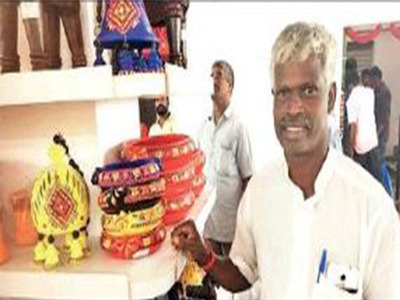
The famous Villianur Terracotta works with huge statues of horses and elephants caught the eyes of many visitors at the shop on the first day. “We’ve been practising this artwork for many years now but after the GI tag was given to us, it gave more confidence and pride,” said artist V K Munuswamy. Because of the GI tag, he could take his art to Geneva, he added.
Ravi Kumar, an industrialist, said: “This is a unique store with products ranging from fruits to ornaments.”
source: http://www.timesofindia.indiatimes.com / The Times of India / Home> News> City News> Bangalore News / TNN / May 11th, 2018
Kiran Mazumdar-Shaw’s tweet comes on a day Walmart group acquired a controlling stake in Flipkart for about $16 billion.
India’s largest e-commerce company, second largest IT services exporter and a biotechnology major share one thing in common: Koramangala, Bengaluru.
A suburb in the south-eastern part of Bengaluru where Flipkart, Infosys and Biocon were born. That’s not about it. All these offices were rented, says Biocon chairperson Kiran Mazumdar-Shaw on microblogging site Twitter.
And Ms Mazumdar-Shaw’s tweet comes on a day Walmart group acquired a controlling stake in Flipkart for about $16 billion – the biggest acquisition by the US retailer.
Terming Koramangala as a “lucky suburb”, the Biocon chief said: “Infosys & Biocon also started in rented offices in Koramangala…” Ms Mazumdar-Shaw, founder of Biotech, also serves as independent member of the board of Infosys.
The first storey of a two-storey Bungalow in Koramangala became the first office from where Sachin and Binny Bansal founded the e-commerce start-up Flipkart in 2007 that later turned into India’s first unicorn.
Located in 447-C, 12th main, Koramangala, the bungalow is located in a leafy lane of a residential suburb that is now inundated with scores of restaurants, restro-bars and fitness centres, according to Flipkart Stories, the official website that publishes latest news updates about the e-commerce company.
Flipkart sold 77 per cent of its stake to Walmart group in a deal that values the 11-year-old company at $20.8 billion.
And it’s not just Ms Mazumdar-Shaw who thinks Koramangala is lucky. SM Fathaulla, a retired government employee, who owns the 447-C, 12th main, Koramangala property also thinks so. “…447-C – the office that had been blessed by Lady Luck,” an article on Flipkart Stories cites Mr Fathaulla as saying. “For many years, the genial landlord recalls warmly, Sachin called on him in person to pay the rent,” it reads.
Besides the three industry leaders – Flipkart, Infosys and Biocon, other major companies headquartered in Bengaluru include Wipro, Britannia Industries, GMR Group, Tata Coffee, Strides Shasun and Shapoorji Pallonji Group.
source: http://www.ndtv.com / NDTV Profit / Home> Corporates / by Sandeep Singh / May 10th, 2018
Sharanabasappa Patil has invented several low-cost equipment and methods that are helping farmers reap benefits
Sharanabasappa Patil of Hal Sultanpur village in front of his Solar hydroponics
Kalaburagi :
THIS farmer from Kalaburagi does not hold any degree in agriculture science, but that did not deter him from turning his field into a laboratory for innovations. In his 5-acre-farmland, both ideas and creativity take shape, and his innovations leave everyone in awe. Sharanabasappa Patil of Hal Sultanpur village has invented several low-cost equipment that are helping farmers of not only Karnataka, but also the neighbouring states.
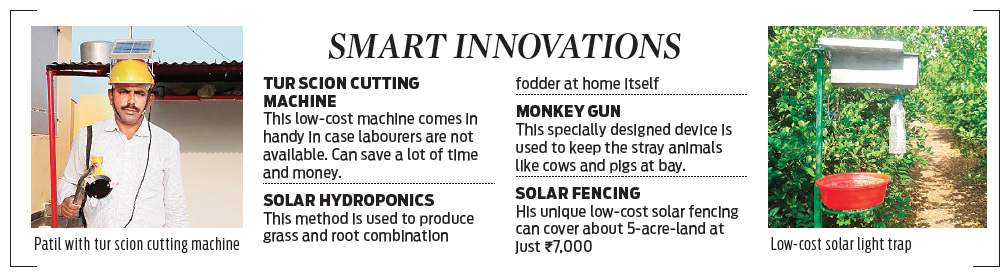
Till date, he has eight inventions to his credit, and people from as far as Visakhapatnam visit his farmland to get an insight into ways to do farming with affordable equipment.Low-cost solar sirens, solar light trap and tur scion cutting machines are some of the innovations that have earned Patil accolades at the state level. He has won many prizes till date, including Krishi Pandit Award and Raita Vignani Award given by agriculture department and University of Agriculture Sciences, Raichur, respectively. He had also bagged the first prize at the state-level innovative farmers’ conference held in 2017.
“When I visited his farmland in Hal Sultanpur, I was completely bowled over by his innovations. I requested Patil to visit Visakhapatnam, and with his help I got my field covered with low-cost solar fencing. Now, I am adopting most of his innovations by using the machines and methods employed at his farmland,” says Ravindra from Visakhapatnam.
Ningappa Molakera of Chimmeidalayee village says, “Many farmers of my village have put low-cost solar fencing around their fields. On their advice, I recently visited Hal Sultanpur to get myself acquainted with the new method of keeping animals and birds away from the field. I also procured the unique tur scion cutting machine from Patil.”
Tur scion cutting machine has helped thousands of farmers of the region who could not afford labourers. “Since workers are not easily available these days, this low-cost machine comes in handy and saves lot of time and money,” says Ningappa.
Patil’s another innovation is Solar hydroponics which can produce fodder without using land. He has also invented a monkey gun device to keep the stray animals like cows and pigs at bay.From where does he get the ideas to innovate? To this, the progressive farmer replies: “Necessity is the mother of invention. Drought, shortage of water for crops and attack on crops by pigs and pests are the trigger behind my inventions. Whenever any problem arises, I try to solve it rather than just complaining about it.”
And in his endeavours, he is also supported by the Agriculture Research Centre of Kalaburagi. “He has created wonders on his farmland. We provide him expert opinions and suggestions which help him fine tune his innovations and equipment,” says Centre head and senior agriculture scientist RajuTeggalli.
source: http://www.newindianexpress.com / The New Indian Express / Home> States> Karnataka / April 29th, 2018
Sathyashree with parents at Ankadakatte on Monday. | Photo Credit: handout_mail
A student of II PU from Kundapur in Udupi district has topped the Science stream in the district.
She studies at the same institution where her father works as a school van driver.
Sathyashree Rao, daughter of Ramesh and Lalitha Rao, and student of Sri Venkataramana PU College has got 593 out of 600 marks. Her combination of subjects is Physics, Commerce, Mathematics and Computer Science.
Her father has been serving as the driver in the same institution.
Ms. Sathyashree told The Hindu that she was expecting above 590 marks.
“While my father was happy with my marks, he was not surprised as he too was expecting it. He is satisfied by my performance in the exams,” she said.
Ms. Sathyashree, who lives in Ankadakatte, said that she would take up engineering and she would like to take up either Computer Science or Electronics and Communications.
“Routinely I used to study about two to three hours. During the exam holidays I used to study the from 9 a.m. to 4 p.m. But I did not pressure myself,” she said.
Ms. Sathyashree’s hobbies are classical and film dancing.
source: http://www.thehindu.com / The Hindu / Home> News> Cities> Mangaluru / by Special Correspondent / May 01st, 2018