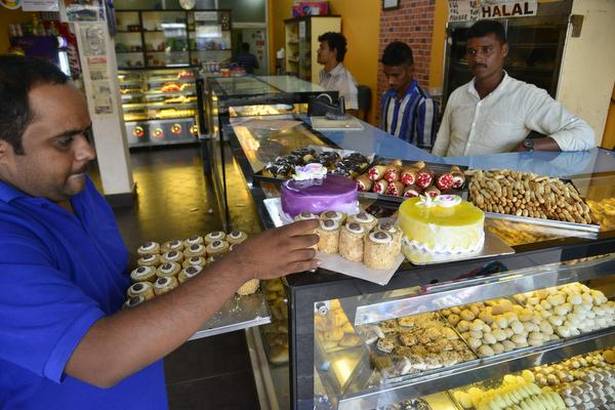
For more than 80 years, people have been queuing up at Bengaluru’s Excelsior Bakery for cakes, milk bread and biscuits
In the 1940s, young Army recruits volunteered to knead the dough at this bakery because they wanted to build upper body strength. They were paid for their services with a loaf of bread.
The Excelsior Bakery in Bengaluru’s bustling Shivajinagar Market is not difficult to find: I just let the smell of freshly-baked bread lead me.
The family-run bakery began as an Indo-British partnership between Sahadevan, a local baker, and a British Lady Emery, in 1930. The establishment is currently run by Saipreeth, Sahadevan’s great-grandson and his father, Muralidharan.
For residents of the cantonment, Excelsior is the go-to place for milk bread, cakes and goodies such as ribbon cakes, cummtee cakes, kal kals, milk cakes, rose cookies, fresh cream cakes, masala biscuits, pastries, puffs and rolls.
“My great-grandfather was a confectioner, who began working at Honour Bakery, that was run by an Englishman in the 1920s. When that shut down, he set up Excelsior along with Lady Emery,” says Saipreeth.
Early birds
“Our bread and cakes were in huge demand. When the store opened at six in the morning, there would be a crowd waiting for a fresh loaf. We had to hand out tokens and only the first 100 customers got the bread! It was not uncommon for people to travel from the other side of town for our cake and a fresh loaf of bread. Even today, we have a huge demand for our plum cakes during Christmas. Our coconut barfi is also a huge hit, and there is also a demand for our day-old bread, since that works better for making sandwiches. I know a lot of people whose staple breakfast fare is our milk bread,” says Muralidharan.
Of course, Excelsior no longer has Army volunteers and now their kitchen is upgraded and less labour-intensive. There have been a few tweaks here and there, but the recipes have essentially remained the same for more than 80 years. Some of its staff have been with them for two generations. They say this has helped in maintaining quality.
The mornings are the busiest for them. The head baker arrives at six and the baking begins in right earnest, says Saipreeth.
“We deliver our products to many colleges and schools. Since we do not use any preservatives, most of our products do not have a very long shelf life, so we strictly follow a routine every day.”
In this weekly column, we take a peek at some of the country’s most iconic restaurants
source: http://www.thehindu.com / The Hindu / Home> Life & Style> Food / by Nikhil Varma / May 03rd, 2018
Bengaluru’s girls basketball team, who will represent India at the Jr. NBA World Championship in Orlando, Florida in August
Bengaluru :
Several weeks of preparation and hard-fought wins over some of the country’s best teams has finally paid off for a bunch of talented young women basketball players from Bengaluru, who will now represent India at the Jr. NBA World Championship to be held near Orlando, Florida, in August.
After a gruelling three-day league phase, the city girls overcame favourites Kerala 47-41 in the semifinals and then sealed a 41-38 comeback win over Chennai in the Reliance Foundation Jr. NBA National Finals at the NBA Academy in Greater Noida on Wednesday. Among the boys, Delhi defeated Kolkata 81-71.
Both Bengaluru and Delhi teams, along with international teams from Africa and West Asia, Europe, Mexico, Canada, Asia Pacific, China and South America will take part in the first-of-a-kind global youth tournament for U-14 cagers which will be held at the ESPN Wide World of Sports Complex near Orlando from August 7-12.
The National Finals featured the country’s top eight boys and girls’ teams from Bengaluru, Chennai, Hyderabad, Delhi, Kolkata, Kerala, Mumbai and Punjab, based on their performance during the Reliance Foundation Jr. NBA Programme held in January. The programme consisted of several individual skills contests and 5v5 competitions and following the city finals in March, each city picked its 10-member All-Star teams (boys & girls) for the National Final.
“The competition was tough, we were facing some of the best in the country. But the girls were confident. We had a good preparatory camp in the run-up to the tournament,” coach Prasanna Venkatesh told TOI on Wednesday. “In the league phase, we finished second behind Chennai and therefore faced Kerala in the semifinals. Kerala, with their tall players, were tough but we still beat them in the end by six points.”
In the final, however, facing old nemesis Chennai was not going to be easy. “There were some nerves because we had lost to them earlier in the league phase and at the 2017 Sub-Junior Nationals,” Sunishka Kartik, one of the team’s top performers, said.
Trailing 2-17 after the first quarter, the Bengaluru girls never lost hope and pushed hard to surge ahead at the break and then defend the lead for the win. “Seven of us have played together before for Karnataka so we rallied together as a team, fought hard and defended well. It was a victory to cherish forever,” said the Baldwin Girls’ High School student.
Asked if they had received any cash award for their achievement, Sunishka quipped, “It doesn’t matter. There is no award bigger than representing India.”
From suave bags fashioned from tetra paks, denim and other textile wastes to fancy tea coasters made using motherboards and vinyl records, Rimagined’s range of upcycled products is indeed a revelation.
India produces 1,00,000 metric tonnes of solid waste on a daily basis, and this amount is higher than the combined solid waste generated by many other countries.
While one can argue that the demographic and area-population ratio perspectives are skewed and debatable while comparing such statistics, it is high time that we admit that the country has failed to manage the insurmountable waste generated by an increasingly burgeoning population, and is in the throes of a crisis.
Therefore, instead of routing the waste to overflowing landfills and putting together half-baked and clumsy measures that are hazardous to the environment, we have to start looking for solutions that are sustainable and can reduce our waste burden.
India’s waste burden. Source: Flickr.
Come to think of it, before materials like plastic and styrofoam entered the country, what exactly were our grandparents or great-grandparents using in place of every synthetically generated item that we have become habituated to?
It wasn’t as though they weren’t practising waste management. On the contrary, their traditional way of life incorporated upcycling even before coinage of the term, and our forefathers truly believed in and practised zero wastage to perfection.
Upcycling is once again becoming popular in India but is currently an option for a limited few. This could be attributed to our age-old aversion towards garbage, and the offensive idea of using products that are made out of somebody else’s waste.
However, some ventures are making a mark with their range of upcycled products in recent times, and we bet that most people wouldn’t be able to distinguish from regular products if not enlightened beforehand.
Rimagined is one such entrepreneurial venture founded by Bengaluru resident Shailaja Rangarajan in 2016, which not only provides supercool and interesting upcycled products in diverse categories such as furniture, jewellery, clothes, and home décor but also employs women from underprivileged sections of the society to offer them a dignified source of livelihood.
With 15 years of experience as a business consultant in the IT sector, Shailaja’s tryst with waste management began when the local residents association began actively practising waste segregation and in-house composting.
The brains behind the venture, Shailaja Rangarajan.
This paved the way for her to begin volunteering with two NGOs—Whitefield Rising and subsequently, Solid Waste Management (SWM)—for about three-and-a-half years.
“This period was a great eye-opener for me, given the massive mounds of waste generated in Bengaluru on a daily basis. Looking at my little daughter, I often wondered what kind of world were we leaving for our children that was overflowing with garbage and extremely depleted of resources. During this volunteering period, I noticed that a large percentage of waste could be put to better use instead of being cast away to landfills. Recycling was an available alternative, but I felt that alone wasn’t enough,” says Shailaja to The Better India.
At that point, she knew many people who were already practising upcycling but in a restricted manner. For them, their customer base was confined to their friends’ circle, and their ventures weren’t about making money or profit.
Understanding that the waste crisis was man’s own creation, she decided to step down into the field herself and spent the next seven to eight months conducting extensive research on upcycling and meeting people associated with waste management in every possible scope.
This would eventually lead her to conceptualise and give wings to Rimagined.
She quit her job and in April 2016, she placed Rimagined on an online marketplace with 10 vendors and 60 products. To gain a greater reach and better visibility, she also put up stalls with these products at local events hosted in Bengaluru.
“The whole purpose of taking this forward was to drive upcycling as a movement rather than just selling products. Also, this was an opportunity to push for conscious consumption in an otherwise consumerism-driven population. Because our products were skilfully crafted with a trendy finish, it took our customers by complete surprise when they came to know these were upcycled products. The wow factor and word-of-mouth together helped in gradually taking Rimagined to greater heights,” Shailaja remembers.
Seven months later, she launched Rimagined as a label.
This happened thanks to an intervention from Devika Krishnan, a well-known designer in Bengaluru, which led to a collaboration, with Rimagined becoming the retail face for Joy@Work.
Devika Krishnan (behind, left) along with the womenfolk of Bengaluru unit. Courtesy: Rimagined.
With a production unit comprising a group of women artisans from a low-income background, Rimagined now envisioned to provide them sustainable livelihoods through upcycling.
“This also proved to be a great learning curve as now I got to witness every stage first-hand in a social entrepreneurial venture—right from waste procurement to the end sales. With a growing customer base and greater demand of products, Rimagined finally had its retail outlet set up in Whitefield in July last year, which is more on the lines of a prototype store,” she says.
In November, Shailaja visited her friend, Debopriya Biswas in Kolkata, who was a teacher at a special needs school for children hailing from underprivileged sections of the society.
“What I had noticed here was that many mothers spent close to 4-5 hours waiting for their children in the school premises. These were impoverished women whose financial state was in shambles due to the lack of opportunities, and we decided to change that,” she mentions.
Shailaja decided to expand the scope of Rimagined’s workforce. Following a discussion with the women who readily showcased interest, she chalked down a training period of three months.
“They surpassed my expectations, and within a month, production-ready pieces with quality finish were laid before my eyes. Now, we have a production unit in Kolkata with around 45 women, and another batch of 35 women are waiting to be trained. There is another team of 15 women in Odisha which will shortly materialise to reality as another production unit,” she proudly adds.
While the implementation of upcycling to this extent in itself is a noteworthy factor, what makes Rimagined’s undertaking even more significant is how the venture is helping women from financially strapped households to take control of their lives with dignity and pride.
“These talented women have proved that if they are given right opportunities, they too can shine. Through this venture, we want the women to rise over their financial circumstances and feel empowered through their capabilities and skills,” Shailaja clarifies.
From suave bags fashioned from tetra paks, denim and other textile wastes to fancy tea coasters made using motherboards and vinyl records, Rimagined’s range of upcycled products is indeed a revelation for even the most cynics.
The best part is that these are not too expensive when compared to other upcycled products in the market, thus giving an opportunity to people from all walks of life to consider purchasing upcycled products and become conscious and responsible consumers.
Also, each product that you see on Rimagined’s website has an assigned score based on the decomposition rate of its content materials and its contribution to overall waste.
Optimal utilisation of Tetra packs, broken glass pieces and fabric wastes to make new products. Courtesy: Rimagined.Stools made of fabric waste and bed sheets fashioned out of denims. Courtesy: Rimagined.
“This will give one an insight over the quantity of waste materials that he or she just pulled away from a landfill by purchasing any one of our products,” she explains.
Having upcycled approximately 60-70 tonnes of varying categories of waste until now, Shailaja hopes to take the concept of upcycling across the country as a movement and bring back the traditional way of living practised by our ancestors, besides helping the country manage its waste in a creative and sustainable manner.
Folks in Bengaluru can reach out to Rimagined if they wish to contribute old denim, fabric waste, e-waste and any segregated solid waste that they think can power their vision.
Rimagined will shortly flag off operations in Indiranagar, one of Bengaluru’s busiest zones, from a new retail unit and we wish the team a great and successful journey ahead.
To check Rimagined’s awesome range of upcycled products, click here. You can reach out to the team at contactus@rimagined.com.
(Edited by Gayatri Mishra)
source: http://www.thebetterindia.com / The Better India / Home> Bengaluru / by Lekshmi Priya S / May 04th, 2018
In an era when girl children were forced to stay home while their male siblings went to school, three Catholic nuns from France started an institution — now St Ann’s High School — in Mangaluru. The nuns, of the order of Sisters of the Apostolic Carmel, spread their mission of educating the girl child to other parts of the country. Now, 150 years on, over 15 lakh students have passed out from 70 institutions of the Carmelite sisters in Karnataka alone.
DOWN MEMORY LANE: Sr Lydia Fernandes, general councillor, Apostolic Carmel with Sr Mary Susheela, superior general of the order
As the order prepares to kick off its sesquicentennial celebrations (150 years) with an event in Bengaluru on May 5, those now in charge look back with pride on the long and difficult road they have travelled. Sr Lydia Fernandes, general councillor, Apostolic Carmel, revealed the literacy rate on the west coast was abysmally low when they first started out.
“The work of the Carmelite sisters in starting institutions for girl children years ago has helped increase the literacy rate in coastal Karnataka,” says Sr Fernandes. “St Ann’s school was the first to be established in Mangaluru in 1870.”
The order was founded in the latter half of the 19th century by Mother Veronica of the Passion (born Sophie Leeves), daughter of an Anglican minister at the British embassy in Constantinople. “She recognized the need to have quality schools for illiterate girls in India,” said Sr Mary Susheela, superior general of the Apostolic Carmel.
“She founded the active Carmelite order, in Bayonne, France and trained sisters who were sent to India,” added Sr Susheela. “They didn’t know the local language, but children picked up the teacher’s language quickly. We have taught children from all communities.”
St Ann’s counts Kamaladevi Chattopadhyay, freedom fighter and social reformer, Octavia Albuquerque, former MLC, Philomena Peres, former chairperson of the Women’s Commission, and Margaret Alva, former Rajasthan governor and senior Congress politician.
“We were taught everything from needlework and gardening to debating and acting,” said Alva. “They were very good educators, taught us discipline and imparted a strong sense of nationalism. At that time, the students were very diverse and from different communities. But we never had a problem getting along.”
source: http://www.timesofindia.indiatimes.com / The Times of India / News> City News> Bangalore News / by Sunitha Rao R / TNN / May 04th, 2018
April 28 will remain a memorable day for Anil Shet, Admin, Mangalore CyclingClub’s WhatsApp group. It was the day he clocked 50,000 km cycling in four years and two months.
Mr. Shet began riding on February 15, 2014, to fight issues like obesity and high BP. There was no looking back for him as he rode an average 33 km daily, starting at 5.30 a.m. His regular rides made him familiar with Mangaluru taluk’s topography.
Mr. Shet said he had done 7,800 km in 2014, 10,200 km in 2015, 12,000 km in 2016, 14,000 km in 2017 and 6,000 km so far in 2018, recorded on fitness app Strava.
A jeweller-turned-builder, the 37-year-old loves cycling for its immense health benefits. An engineering graduate from MIT, Manipal, Mr. Shet weighed 100 kg when he decided to take up cycling.
With fellow MACCers, he instituted Brevet — long distance rides of distance in multiples of 100 km that have to be completed within a specified time-frame. The group’s members have increased owing to the encouragement and guidance he provides other cyclists.
source: http://www.thehindu.com / The Hindu / Home> News> Cities> Mangaluru / by Anil Kumar Sastry / Mangaluru – May 02nd, 2018
She’s demure, coy and has a very welcoming personality onscreen, which appeals to most viewers of the small screen. Hence, it was natural that Shwetha R Prasad, better known as Radha from Radha Ramana, has won the top slot in Bangalore Times’ 15 Most Desirable Women 2017.
She caught up with us, talking about work, marriage and more. Excerpts… You’re Kannada TV’s most desirable woman. Delighted?
Yes. This means that I’m doing good on TV. The project is doing good, people are watching it and liking it — isn’t that desirable! For me, desirability is not only about the appearance, but it is the way you are inside out. That is when you are most desirable — people shouldn’t think you’re fake. When you act, you should really feel like you’re the character. Add to this the attitude you carry both on and off the screen, because everyone is so reachable and accessible through social media. So, people are watching you always.
Radha Ramana has made you one of the most popular actresses on the small screen. What does this serial mean to you?
It feels great to be recognised as Radha. I’m an architect. I never thought I would have a career in acting. I debuted with the serial Srirasthu Shubamasthu. The serial clocked 600 episodes. I didn’t know what to do next. I then decided that I needed to be associated with a channel and show that was doing better than that. I landed Radha Ramana, a serial that was slated to air on prime time and I was sure it would do really good. It has given me a good push and recognition and I owe everyone who made this happen a lot.
Is Shwetha similar to Radha? I’m like Radha in many ways. Probably, the only thing that would be a little different is the fact that I am more intelligent than Radha in real life (laughs). Also, I don’t meddle in others’ business like Radha does.
People, especially elderly women, do not know Shwetha — they only know Radha. When I go out, these people might be strangers to me, but they know me and meet Radha every single day. I receive so much warmth and familiarity from them. They hug me and speak as if they’ve known me for long and this can be awkward, but I understand that they love my character. When people talk about fame and popularity, I’d say popularity is the love that you get from the people.
Talking about marital status, your acting career began after marriage…
People say that opportunities stop after marriage. But, I’m glad that there are people who don’t mind giving opportunities to married women. They don’t stop saying that you’re married. Ultimately, it is the talent that matters. Whether you’re married or unmarried, it boils down to whether you have what the character requires. I’ve been working with sensible people and that’s what matters
eventually.
Are films on your agenda too?
I’m doing a film now. It is an offbeat film. It might release around July. Again, people have seen me as Radha, a married woman onscreen, so I understand I won’t be offered too many roles in terms of versatility. Or, probably, I haven’t shown them that I can be seen differently. So, the offers have been limited and I’ve been choosy in that. Eventually, when I prove myself on the big screen, like I did on the small screen, I am sure more doors will open for me in recognition of my talent.
Tell us more about your debut film…
In my first film, I didn’t want to do the two-songs-and-one-dance routine. This film, titled Kalbettada Darodekararu, is based on a novel and my character, despite not being onscreen for a long time, has something substantial to offer to the script. I play Kalbettada Kamali, a de-glam role in the film. I’m already doing a de-glam role on TV, but this is much more toned down. So, it made for an interesting choice.
source: http://www.timesofindia.indiatimes.com / The Times of India / Home> News> Entertainment> Kannada> Movies> News / by Sunayana Suresh / TNN / April 28th, 2018
Mohan S.L. with his mother, Puttalakshmi, and father, Lakshme Gowda, in Hassan on Monday. | Photo Credit: Prakash Hassan
Mohan S.L., son of a farmer, secured the second highest marks (595 out of 600) in in Science, in the State.
His family lives in Shantigrama village in Hassan taluk but he remained with his grandparents in Hassan town so that he could concentrate on attend classes at Masters PU College in Hassan town and focus on his studies.
He scored 100 each in Physics, Chemistry, Mathematics and Biology.
“My teachers helped me a lot. I used to study till midnight and get up early at 4.30 a.m.,” he said.
His parents were farming their tomato crop when they learned that their son was ranked second in Karnataka.
“I have studied only up to class 4. My dream is that my only son studies well,” said his father, Lakshme Gowda, who owns 33 guntas of land in Shantigrama, and grows tomatoes and potatoes for a living. Mr. Mohan wants to study MBBS and later prepare for the IAS.
“My son studies hard and supports the family in agriculture activities. He looks after our cattle, and gets hardly four hours of sleep in a day,” added Mr. Lakshme Gowda.
Adil Kalyanpur and Abhimanyu Vannemreddy, both Bengaluru boys, made their presence felt in international tennis through Rendez-vous à Roland-Garros, a programme that brings together top junior tennis players in the boys and girls categories at the national level.
This year marks the first edition of the Roland-Garros Amateur Series, which kicks off in Bengaluru today (it is on till May 6).
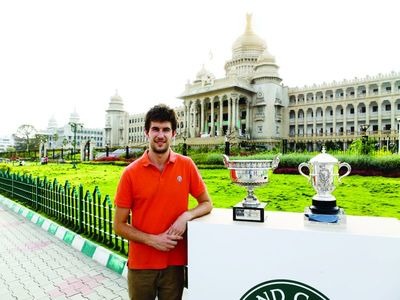
To mark this, the actual French Open trophies — lifted by many tennis greats made their maiden visit to namma Bengaluru. The trophies glistened exclusively for Bangalore Times, on a bright Saturday afternoon, as they took their place in front of the Vidhana Soudha.
Adrien Groscolas, associate international development of French Federation of Tennis, who is also the caretaker of the cups whilst in India, is the only one allowed to touch them — which he can only do after wearing gloves. Only the winners of the trophies can touch them with bare hands.
As Bengalureans gathered to catch a glimpse of the gleaming cups, Adrien filled us in on the protocol that must be followed while handling them, the significance of bringing the trophies to Bengaluru and why French Open officials are looking East. What is the significance of choosing Bengaluru to host this tournament?
Bengaluru is an important city for us because it has a long history of racket sports and a lot of sports personalities are from here. Rohan Bopanna, last year’s Roland Garros doubles winner, is from Bengaluru, so it made perfect sense for us to come to such a sports loving city. What is the protocol when it comes to handling the cups?
Only Roland Garros officials can touch the cups, for which we have to wear gloves. Only the actual winners of French Open can touch the trophies with bare hands. Apart from this, people cannot get too close to the cups, to ensure that they don’t get damaged in any way. Also, when we are travelling, the cups fly with me. We buy additional tickets and the cups are seated next to me on the flight, so that I always have my eyes on them. They cannot be carried as a regular luggage.
What reactions do you get from people when they see the cups? The first reaction is like what we saw during the shoot in Bengaluru — ‘What is this? I know I’ve seen it somewhere, but why would the trophies be here in Bengaluru?’ Once we explain it to people, they realise, ‘Whoa, it’s a big deal to have the actual trophies here, this close to us’. People then think that this is the cup that Rafa has lifted, and that’s something.
How important is it to bring the trophies to Bengaluru now? It’s an encouragement, first for the young players of the tournament, because the winners will get to fly to Paris and watch the game at Roland Garros. I think it will be an inspiration for them to see the trophies all week long while they battle it out in the tournament. Perhaps, this will be the start of the next Indian actually lifting this trophy. That’s a bit long-term and optimistic, but I am hopeful of India’s chances in the singles matches.
How conducive is Bengaluru to tennis? In terms of facilities and infrastructure, Bengaluru is certainly one of the better cities. I will definitely speak of Bengaluru as a tennis city, especially since some of the best Indian tennis players are from here. Bengaluru has a tradition of clay courts and our choice to come here is because there are beautiful clay courts here, just like Roland Garros. It is a city that’s very important for tennis.
How important is India as a country for Roland Garros?
We are very interested in India. First, because there are definitely going to be more good players from India in the future. The country already has good players, like Sania Mirza, Mahesh Bhupathi, Rohan Bopanna and Leander Paes, who have all lifted the cup in the doubles category in the French Open. We are optimistic that an Indian will do so in the singles as well. Yuki Bhambri just broke into the top 100 and is going to be playing in Roland Garros for the first time this year. We are very optimistic about India’s chances, which is why we have taken an interest in organising so many events here, to encourage young kids to pick up rackets.
What can these young players expect to gain from this tournament?
The whole point of the tournament is to give young players the experience of playing a Roland Garros event close to their home. Kids who set foot on these courts may think that if they play well here, they have a shot at getting into a Grand Slam event. That’s pretty inspirational, I think. And that’s what gets those kids to come out on the court and give their best. The courts here are beautifully maintained and there is branding as well, just like in Roland Garros. That’s what sets it apart from other tournaments played through the year.
source: http://www.timesofindia.indiatimes.com / The Times of India / News> City News> Bangalore News / by Dhwani Desai / TNN / April 30th, 2018
City will join Dutch programme to promote use of bicycles among urban commuters
Come May, Bengaluru will have its first ‘Bicycle Mayor,’ or BM, with as many as 19 cycling enthusiasts in the city vying for the post.
The winner will get an opportunity to bring together the city’s cycling community and take up advocacy with the government to bring more bicycles onto the roads.
Honorary two-year position
The Bicycle Mayor, an honorary two-year position, is a global programme envisioned by the Amsterdam-based NGO ByCS. The group is targeting a world with 50% of all city trips covered by bicycles by 2030. Bengaluru will be the third city in the country to have a BM, after Baroda and Guwahati.
ByCS has joined hands with the Evangelical Social Action Forum (ESAF), an NGO, to introduce the programme in India. ESAF is one of the organisers of BCOS (the Bengaluru Coalition for Open Streets), which initiated the Cycle Day concept in October 2013.
The applicants for BM include cycling enthusiasts, activists and those who have been actively involved in making Bengaluru bicycle-friendly, said Manju George, Senior Programme Manager, ESAF, Bengaluru.
“The applications were open for ten days and closed on April 23. After May 12, we will make the announcement,” she said.
Cycling enthusiast and activist Murali H.R., involved with several bicycle projects in the city in coordination with the Directorate of Urban Land Transport (DULT), says there is a lot to be done to implement the existing regulations. “We have had DULT and BBMP for over 10 years now. We are partially successful. This [BM] will be a confidence booster for the work that we have been doing thus far.”
Nikita Lalwani, Bicycle Mayor of Vadodara. | Photo Credit: Email Handout
Nikita Lalwani, who was selected BM of Vadodara (Baroda) last year, is working to encourage corporate professionals and students to make use of bicycles regularly. Having represented India at the Bicycle Mayor summit in Amsterdam in 2017, Ms. Lalwani said, “We need to begin by changing the image that cycles have in our society.”
BM of Guwahati Arshel Akhter, who took charge recently, aims to start by working with educational institutions and corporate establishments to set up parking slots for bicycles, and encouraging more people to use bicycles regularly.
source: http://www.thehindu.com / The Hindu / Home> News> Cities> Bengaluru / by Shruthi H M / Bengaluru – April 30th, 2018
Paresh apartments was build in 1974 by contractors H N Anantharaman (top right) and H N Dwarkanath
Bengaluru :
While Bengaluru today is dotted with apartment complexes and housing societies, many may not know that one of first steps in this direction was taken by H N Anantharaman, now aged 91, and his 89-year-old brother H N Dwarkanath way back in the 1970s.
Having been hired as contractors by the Paresh Apartments Cooperative Society , the duo built the city’s first apartment complex in 1974, which stands tall in Malleswaram even today.
“In the early 1970s, 24 of us got together and bought this plot of land. Anantharaman and Dwarkanath were the contractors, and we all respect them for building such a solid structure,” said Sooryakanthi Madiman, who moved into her flat in 1974 at the age of 27, following her marriage to Madiman, who was a DRDO scientist.
Sooryakanthi says that while newer and fancier buildings are plagued with problems like seepage and leakage, theirs has a strong foundation. “When workers carry out repairs in our houses, they find it very hard to even drill a nail into the wall,” she added.
The complex comprises a cluster of three-storey buildings, and a majority of the original 24 families continue to live here even though the surroundings have rapidly transformed, with individual houses giving way to large apartment complexes.
Born in Hiremagalur, a hamlet in Chikkamagaluru, the brothers were brought to Bengaluru — where they studied engineering — by their older brother who was working here. After a few years, during which they worked in Tamil Nadu, the brothers decided to get into business and started building water tanks, water treatment plants and civil structures.
“They were ahead of their time. They realised that with the rising growth rate, people would start running out of land to build houses on. So, they started constructing multi-dwelling units and venturing into joint-development projects, which was rare at that time,” said Narayan Babu, Dwarkanath’s son.
“They wanted to build homes for people who had saved their hard-earned money for the purpose, unlike today when people are entering the industry purely for business gains,” said Gopinath, Anantharaman’s son.
The duo worked in tandem — while Anantharaman handled financial matters by meeting people and raising funds, Dwarkanath designed the structure and monitored the work.
The brothers, however, are unhappy with the current state of affairs under which members of lower-income groups are unable to find affordable homes within city limits and so have to live on the outskirts.
Honour for pioneer
Anantharaman was recently honoured by Rotary Bangalore Downtown, and conferred the Rotary Pioneer award in recognition of his “pioneering contributions to the field of group housing and construction by developing the first apartment block in Bengaluru, and establishing the industry association KOAPA (Karnataka Ownership Apartment Promoters’ Association), the precursor to the present CREDAI.”
source: http://www.timesofindia.indiatimes.com / The Times of India / News> City News> Bangalore News / by Niharika Alva / TNN / April 28th, 2018