Giving details: Vice-Chancellor of KSOU M.G. Krishnan addressing presspersons in Mysore on Monday. Registrar S.N. Vikram Raje Urs and Registrar (Evaluation) K.J. Suresh are seen / Photo: M.A. Sriram / The Hindu
As many as 27,164 candidates will receive their degrees at the 13th annual convocation of the Karnataka State Open University (KSOU) here on Tuesday, Vice-Chancellor M.G. Krishnan told presspersons here on Monday. He said that 25 students would receive Ph.D degree, 59 M.Phil. degree, 38 people gold medals and 24 would receive cash prizes. As many as 15,649 women are set to receive their degrees as against 11,515 men.
Governor H.R. Bhardwaj would preside over the function. Vice-Chancellor of North Bengal University, West Bengal, Samir Kumar Das, will deliver the convocation address. Minister for Higher Education R.V. Deshpande is also expected to attend the event, Prof. Krishnan said.
In response to a question on the KSOU’s decision not to accord honorary doctorate this year, Prof. Krishnan said the first reason was that he did not get sufficient time to identify candidates and the second was that many universities had accorded the recognition to a number of candidates, which ha drawn flak.
Not conferring honorary doctorate would not amount to breaking any set tradition, he said, in reply to a question, and added that it would definitely be considered next year.
He denied that the Governor had suggested a few names for the honorary doctorate.
ACTION TAKEN
Prof. Krishnan had initiated disciplinary action against two collaborative institutions in Bangalore and Belgaum where cases of examination malpractice had been detected. He had, for the first time, deputed KSOU invigilators to all regional centres across the State to check examination malpractice, Prof. Krishna said. The onus was on the collaborative institutions as the KSOU was not directly responsible.
On the infrastructure front, he said that the auditorium and the administrative block buildings, which would be unique to the city, would come up in six months.
Registrar S.N. Vikram Raje Urs, Registrar (Evaluation) K.J. Suresh and Chief Financial Officer L. Rajashekaraiah were present.
source: http://www.thehindu.com / The Hindu / Home> News> National> Karnataka / by Special Correspondent / Mysore – July 23rd, 2013
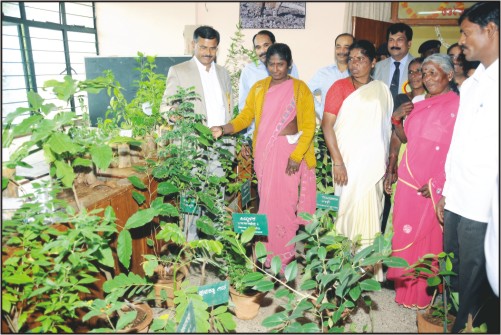
“The government proposes to establish ‘Hasiru Grama’ in every forest division in the State to promote cultivation of exclusive medicinal plants,” said B. Shivanagowda, Additional Principal Chief Conservator of Forests (APCCF).
He was speaking after inaugurating a workshop on medicinal plants organised by the Village Forest Committee (VFC) at Aranya Bhavan in Ashokapuram here today.
Over 100 growers of medicinal plants, native doctors and VFC members are participating in the programme which features lectures on sustainable storage, value addition, transportation and marketing of medicinal herbs which are on the verge of extinction.
Shivanagowda said that the three VFCs were monitoring the cultivation of medicinal plants grown in 16 villages abutting the forests. He assured that the department would provide all needed support for developing the sector with value addition in every stage.
He proposed to hold a medicinal herbs buyers’ meet to explore direct sale of the herbs to manufacturing units. He said that Shathavari, Makaliberu and Gowri hoovu plants had tremendous potential in the medicine sector.
Speaking on the occasion, APCCF Dr. G.N. Srikantaiah said that the buy back system would be immensely beneficial to the growers.
Chief Conservator of Forests (Bamboo mission) A.C. Keshavamurthy opined that Health Tourism would give a fillip to the growers as herbal medicines have become very popular now.
Chief Conservator of Forests K.B. Markandaiah welcomed. FRLHT senior Programmer Jagannath Rao spoke. DCF D.S. Gaonkar was present.
source: http://www.starofmysore.com / Star of Mysore / Home> General News / August 08th, 2013
Wary of her students falling ill because of the high fluoride content in the village water, the headmistress of a government primary school in Doni Thanda, a hamlet in Gadag district has been carrying 18 litres of purified water over 22 km to cook the mid-day meal for them. She has also been bearing the expenses from her pocket.
Doni Thanda and adjacent villages have no access to pure drinking water. “Around 30 students in our school suffer from stunted growth of their arms because of the consumption of water with high fluoride,” said headmistress Anusuya Thuppad of the Doni Thanda school.
She won’t let her 30 students suffer
The headmistress of a government primary school in the hamlet of Doni Thanda in Gadag district has been carrying 18 litres of purified water over 22 kms to cook the mid-day meal and provide students with drinking water, bearing the entire cost from her own pocket as the high fluoride content in the village water makes it unfit for consumption.
The problem is not confined to Doni Thanda, however, as several schools in the adjacent villages of Dindur, Attikatti, Singatarayankere too have no access to pure drinking water, making their students vulnerable to all kinds of ailments.
“Around 30 students in our school are suffering from significant loss of growth in their arms as a result of their dependance on high fluoride containing water. And two months ago the classrooms had to be turned into a hospital for hundreds of villagers suffering from dengue, and malaria.
The education department is paying Rs 220 a month to provide drinking water to 166 students of the school, but this is hardly adequate as we need more than 100 litres of purified water every day for cooking the mid-day meal. We have not received any response to our appeal for a water filter kit either,” said headmistress Anusuya Thuppad of the Doni Thanda school.
Blaming the stunted growth of arms seen among some of the children on malnutrition , district health officer, B V Chennashetti , explains that fluoride content in water can affect people’s bones and teeth. But ask Gadag Zilla Panchayat CEO, V G Turamuri and he claims arrangements have been made to supply purified water to all schools.
source: http://www.deccanchronicle.com / Deccan Chronicle / Home> News> Current Affairs / by Vittal Shastri, DC / August 03rd, 2013
1) Ustad Abdul Rashid Khan presenting Hindustani music at Vivekananda Hall, Mahajana College, Jayalakshmipuram. He is accompanied by Hafeez Ahmed Khan on harmonium, Sarwar Hussain on Sarangi, Bilas Khan on tabla, Ahmed Ali and Asad Ali on vocal & tanpura. 2) Ustad Abdul Rashid Khan presenting his second programme at SJCE auditorium.
By S.R. Krishna Murthy
Most of us do not live a century. Even those who live a hundred years will have so many age-related physical problems and will be dependent on others for every activity of daily chores. Audio and video faculties will be weak. The voice will be failing to convey distinctly, what our minds want to convey to others. Mobility will be restricted. Not that everyone who lives that long paint such a dire picture. Some live happily without any such impediments.
Coming to the Grand Old Man of Gwalior Gharana, Ustad Abdul Rashid Khan. He is 105 years old (born 19th August, 1908). He is a descendent of Miya Tansen (1506-2589) and is twenty-sixth in the lineage. Of course, he too suffers from age related problems.
He is confined to a wheel chair as has lost the ability to walk. His hands have become gnarled with age. He has to be physically lifted on to the platform. When he talks, one has to listen carefully as some of the words will be incomprehensible. Someone has to repeat in his ears what others say to him.
With all this, when he takes his place on the platform and hits his first note, perfectly aligned to the Adhara Shadja, it is difficult to connect his voice with the image he had presented when he was being carried on to the stage.
The range he can reach and the volume of his voice are amazing. It is just unbelievable that this fragile person can produce such wonderful music and manages to regale and mesmerise the audience with such powerful singing.
Khan Saab, recognised as one of the greatest exponents of the Gwalior Gayaki, was born in a family of musicians tracing back to Behram Khan, who was a singer of Gwalior Gharana Gayaki. His father’s elder brother Bade Yusuf Khan and his father Chote Yusuf Khan initiated him to music. Other elders in the family like Chand Khan, Barkhurdar Khan, Mahtab Khan gave him extensive guidance in Gwalior style of singing. He developed this technique suiting his own artistic ability. He is equally versatile with Dhrupad, Dhamar, Dadra, Thumri, Bhajans and Sufiyana music.
Khan Saab has composed more than 2,000 compositions and is also a prolific writer (consider his age and eye sight !). His poems carry the pen name ‘Rasan Piya.’ He has trained innumerable students as a Guru at the ITC Sangeeth Research Academy, Kolkata. He is a part of Spicmacay (Society for the Promotion of Indian Classical Music And Culture Amongst Youth) in its campaign ‘Virasat’ and travels all over the country, singing for young students. He has received many awards including the Sangeet Natak Academy Award, the ITC award and the Kashi Swar Ganga Award. He has been bestowed with titles like ‘Ras Sagar,’ ‘Sangeet Maharishi,’ ‘Sangeet Sartaz’ and ‘Bandish Samrat.’
It was an honour that he was in Mysore and Spicmacay gave Mysore audience a lifetime chance to listen to such a great personality. In fact, it was once again an amazing fact that he gave two concerts on a single day at Mysore, July 11, apart from attending a lengthy press meet before the first concert, where he was honoured by the scribes at Patrakartara Bhavana, along with Pt. Rajiv Taranath, the Sarod maestro and a proud citizen of Mysore.
The first concert of Khan Saab was at Vivekananda Hall of SBRR Mahajana College at Jayalakshmipuram. The programme was organised by Spicmacay and co-sponsored by Mahajana College. It was a noon programme. The singer was accompanied by Hafeez Ahmed Khan (younger brother of the singer) on harmonium, Sarwar Hussain of Bhopal on Sarangi, Bilas Khan (great-grandson of the singer) on tabla. Two disciples of the singer, Ahmed Ali and Asad Ali, gave vocal and tanpura support.
Khan Saab began his concert with a Bada Khyal in a rare Raag Megh. After a short Alap, he took up a Vilambit Khyal in Ek Taal with the Bandish ‘Garajat Aayi Baadalwa,’ in which there was a beautiful description of monsoon. The slow moving air, developing into a forceful gale, the formation of clouds and the thunder and lightning they produce, raindrops slowly trickling and gradually developing into a deluge, were all expressed both in the lyrics and in the singing of Khan Saab. He developed the Raag slowly but steadily, just like the monsoon.
Reaching the higher octaves, he gave a surprise element. He just leapt from the very low octave (Anumandra) to higher octave (Tara Sthayi), just like an unexpected thunderbolt, landing exactly on a required note. Such was his spirit of singing. The unwavering voice at this age, alignment to Shruthi at all levels and clear diction were the highlights.
The second Raag was Khamaj (Hari Kamboji), in which he took up a Meera Bhajan, ‘Maayiri Maine Neeno Govinda Bolo.’ The repetition of the line Govinda Bolo was excellent, earning the encomium of the overflowing gathering, which consisted of musicians, music lovers, litterateurs, elite of Mysore and students.
At SJCE: The second programme had been organised by Spicmacay, in collaboration with Sri Jayachamarajendra College of Engineering (SJCE), at its auditorium in Manasagangothri. This was an evening concert. The accompaniments consisted of the same team. Once again, the auditorium was brimming with listeners.
The performance of Khan Saab was as good as that of the morning session. Only change was that the Raag was different, which was full of grace and pure classical nuances, as if he were a vocalist in his 40s. Starting a Bada Khyal in a more familiar Raag Puria Kalyan, he took up a short Alap and continued with Vilambit in Ek Taal.
The lyrics of the composition ‘Janam ki Emabhayo Leela’ was sung in two speeds. The second speed contained a bit of Taan. He just quipped that the Sargam is not usually sung in his Gharana. But these days, people have started singing Sargam. He had no option but to go along the tide. Therefore, he too would sing some Sargam. Saying so, he took up some extraordinary Sanchara in Sargam. He showed a fine balance of Swaras and Sahitya. The Gamaka in Vilambit and Laykari in the subsequent Dhruth set to Teen Taal, with Bandish — ‘Aaj Rekhiraava Maayo’ — were superb. His Tarana at the end in Jap Taal was definitely not a simple one. He could leap from one octave to another at will, picking up a note from deep below the depth of an unknown territory, right to the heights over the clouds. He could hold his breath on a note steadily for well over a minute and come back to where he started. His energy level was so great, although he looks physically very fragile. Who could say he is past hundred years, when his voice was as young as a man, one third his age?
The second composition he sung was a Raga Malike type. He began with Bhupali (Teen Taal). ‘Jhanana Jhanana Baaje Muraliya’ was the Dhruth in Jai Jaivanti and Mia Ki Malhar, continuing it with another Tarana. Apart from Khyal, he is equally adept at singing Thumri. His third number was a Thumri, which was his own composition, in Mishra Keeravani.
The last one was a Kabeera Sub Karo Ram Bhajan, which he continued with a lengthy Sufiyana ‘Bolo Ram Ram Ram.’ He involved himself so much with lyrics that the mystic element and bhakti engulfed everyone present there. When he repeated the first line after every stanza, the audience too joined him. The atmosphere was so charged, I could see tears in some of the listeners. One must thank Spicmacay for giving the music fraternity of Mysore such a rare opportunity to listen to this Grand Old Man of Gwalier Gharana.
source: http://www.starofmysore.com / Star of Mysore / Home> Feature Articles / August 07th, 2013
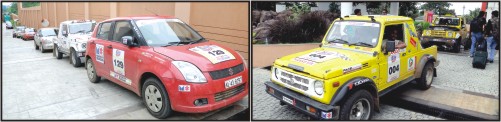
The country’s top long-distance rally driver Suresh Rana along with co-driver Parminder Thakur, driving a Grand Vitara, and Pramod Joshua on a TVS Apache, topped the provisional overall classifications among four and two-wheelers, respectively on conclusion of Leg 1 in the Extreme category of the 5th Maruti Suzuki Dakshin Dare Rally which commenced from Bangalore yesterday after Sunday’s ceremonial flag-off with some 96 vehicles participating in different categories.
The rally started from Bangalore amidst light showers in the early hours of the morning yesterday for six short super stages, traversing a total of 403 kms during the day to reach Mysore.
Rana displaying his mastery in no uncertain manner to top the overall time charts clocking one hour, four minutes and 12 seconds on a day, negotiated the two tricky Competitive Stages that were run thrice near Tiptur.
Amanpreet Ahluwalia and co-driver Venu Ramesh in a Gypsy with a time of (01:05:18) was behind the eight times Raid de Himalaya Champion Rana while Bangalorean Sanjay Agarwal (E Shivaprakash), also in a Gypsy was lying third with 01:07:51.
Joshua of TVS Racing, who crashed out last year, braving spells of rain, rode briliantly to clock 01:06:54, ahead of team-mate and 2012 champion Nataraj Rajanna (01:07:27) also on an Apache while Mohit Verma astride a KTM Duke was third in 01:07:56.
Of the 12 four-wheelers, nine managed to complete Leg 1 while 11 of the 15 bikes and three of the six scooters that were flagged off from Bangalore made it to the night halt in Mysore.
The competitors left for Ooty via Kodagu early this morning on the second Leg and will move about 80 kms towards Coffee and Pepper plantations of Coorg where three stages totaling 78 kms will take place. The rally will then traverse almost 230 kms through very wet Malnad region via Nagarhole National Park, through the southernmost tip of Deccan Plateau in Kearala at Wayanad and climb up tangled jungles and deep valleys towards Nilgiris and reach Ooty by end of the day.
source: http://www.starofmysore.com / Star of Mysore / Home> General News / August 06th, 2013
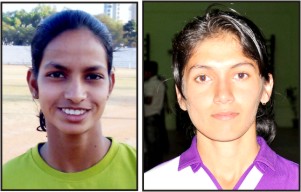
Reena George of DYSS, Mysore, bagged the top honours by clinching the ‘Best Athlete’ title in the girls Under-20 section on the concluding day of the 25th Karnataka State Junior Athletic Championships at Nehru Stadium in Shimoga yesterday.
Reena won the U-20 Girls 200m and 400m event with a timing of 24.9s and 56.5s respectively and hogged the limelight in the Girls U-20 section.
Mysore’s talented athlete Shraddha Rani Desai of DYSS, Mysore, won gold in the U-20 Girls 1,500m and 3,000m. Shraddha won the U-20 Girls 3,000m event with a timing of 11:21.3s.
DYSS Mysore’s Afsana Banu won 400m Hurdles gold in the Girls U-20 section.
Mysore District Athletic Association’s M. Veena won gold in the Girls U-14 600m event with a timing of 1:47.7s.
Alva’s dominated proceedings as expected, taking the team championship in five of eight categories, at the 25th State Junior Athletics Meet.
Only the Girls’ U-14 (IGSC) and 16 (DK) and the Boys’ U-14 (DK) titles eluded the athletics powerhouse from Moodabidri.
The only record of the final day was established by Prathiksha, in the Girls’ U-18 5,000m walk event. The SAI Bangalore athlete clocked 28:45.2s to erase her own mark of 30:05.5 from last year.
Ovin Loyston D’Souza (Boys’ U-14) of Dakshina Kannada and Reena George (Girls’ U-20) of DYSS Mysore also had success, grabbing two gold medals each.
S.G. Priyanka of DYSS Mysore won the 100m event in the U-18 Girls section with a timing of 14.6s. J.S. Manjunath of Mysore District Athletic Association won bronze in 5,000m walking event in the Boys U-16 year’s section.
Boys’ Results
U-20: 200m: N. Vaishak (Alva’s) 22.3s; 400m: Jagadish Chandra (Fusion) 50.6; 400m hurdles: Jagadish Chandra (Fusion) 55.3; 1,500m: N. Vinay (Yuva) 4:10.8; 3,000m steeplechase: Sikandar Pathan (Chalukya SC) 10:59.9; 10,000m: Parasappa Halijol (SAI Dharwad) 34:12.6; High jump: S. Harshith (BSC) 2.08m; Pole vault: Nagaraj Kamble (Alva’s) 2.80; Shot-put: Sairaj (Alva’s) 15.77m; Best Athlete: S. Harshith.
City’s upcoming athletes K.S. Megha and Saqlain Ahmed representing Mysore District Athletic Association (MDAA), taking part in the Karnataka State Junior Athletic Meet at Shimoga on Sunday, won gold in the girls 3,000m event (U-16) and boys shot-put (U-14 ) sections.
City’s Poornima of DYSS, Mysore, won gold in the girls (U-18), 3,000m event. The Mysore District captain K.R. Meghana won her second medal in the championships when she clinched the bronze medal in the girls U-20 400m event. Manjula of MDAA won silver in the girls U-16 3,000m event. S. Ambika won silver in the U-16 girls shot-put. Amruth Mari Gowda of MDAA won bronze in boys U-16 shot-put.
S. Lokesh of Indian Athletic Academy rewrote the boys’ U-14 long jump record on the second day of the 25th State Junior Athletics Championships in Shimoga. Lokesh leapt a distance of 5.90m, erasing Rodricks’ mark of 5.87 from 2011.
Two more records were established on Sunday — R. Keshavan (Alva’s) in the boys’ U-16 hammer throw and Rahat Sayed (UK) in the girls’ U-14 shot-put.
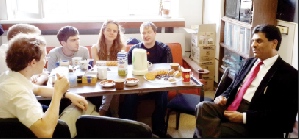
Prof. K.S. Rangappa seen chatting with a group of researchers in Moscow.
by K.M. Chengappa
Cancer is no more considered a deadly disease. It is curable if traced in its early stages, says Prof. K.S. Rangappa, Vice-Chancellor, University of Mysore.
In a tete-a-tete with Star of Mysore, Prof. Rangappa, who had been to Russia as a visiting professor, said that he, along with Prof. Alexey of the N.D. Zelenski Institute of Organic Chemistry, Russian Academy of Sciences, Moscow, are jointly conducting a research in cancer biology in which they have created new molecules that can fight the disease.
Prof. Rangappa, who had been in Moscow from July 7 to 15, said that the research is being conducted in joint collaboration of the Indian National Science Academy and Russian Academy of Sciences.
Discussions with experts in the field were held for three days following which lectures were held in which several research scholars participated, said Prof. Rangappa, adding that he had also given a lecture at the Moscow State University following an invitation.
Prof. Rangappa said that they have applied for funding for the research project from India and Russia governments collaterally.
Prof. Alexey will soon be visiting Mysore as part of the project, he said.
source: http://www.starofmysore.com / Star of Mysore / Home> Feature Articles / August 05th, 2013
Bangalore Metro Rail Corporation (BMRC) might still be stuck with the pre-feasibility study on extending the Metro till Bengaluru International Airport (BIA). But the BIA has already chalked out an elaborate plan to welcome the Metro right at its front door.
The BIA will accommodate the upcoming ‘High Speed Metro Connectivity’ near the terminal, as part of its Phase II expansion plan. The BIA authority, in its Environment Impact Assessment (EIA) for Phase II submitted to the state government recently, said the Metro line would enter the airport from the west and run in the vicinity of the main access roadway.
The EIA will be followed with a public hearing, after which it will get final approval.
The current plan for the Metro station assumes that underground walkways will connect the station to Terminal 1, and one underground station will be located within the terminal area and serve both the existing and upcoming terminals, the report said.
A senior BIA official said Metro connectivity till the heart of the terminal means passengers from the city can just hop off the Metro and board their flight after going through the security checks. “A state-of-the-art baggage tunnel (from Metro station to terminal) will assist passengers in easy boarding,” he added.
Roads to the airport
A copy of the EIA report, available with TOI, says there are plans to improve road connectivity to BIA.
* Currently, NH-7 (Bellary Road) is the single major arterial road providing access to BIA-bound traffic
* Envisages two more access roads – a six-lane divided road from the Southwest and another from SH-104 on the East
* The new roads will cater to eastern section of BIA, comprising cargo, MRO and proposed commercial development
Not just an airport
Phase II expansion comes with a number of non-aeronautical development activities spread over 1,011 acres. It will include amenities like hospitality, entertainment, healthcare, business park, institutional, recreation and commercial facilities, convention centre etc. The proposed non-aeronautical development will support and complement aviation operations.
New-look terminal 1 by October
In 2010, BIAL started augmentation of the existing infrastructure to enhance passenger handling capacity from the existing 11.4 Million Passengers Per Annum (MPPA) to 17.2 MPPA.
A BIAL spokesperson said Terminal 1 (T1) would be open to passengers in a phased manner from October. The highlight of the expansion would be Airport Operational Control Centre, which acts as a nerve centre in monitoring airport activities on a real-time wall monitor. T1 expansion comes with additional check-in counters for passengers, seating capacity and other amenities on a floor area almost double the existing one.
Bigger, better BIA
* After expansion, BIA will cater to 55 million passengers per annum and about 1 million tonne of cargo by 2029-2030
* A new south parallel runway — 4,000m long and 60m wide — will support Code F aircraft and be CAT IIIB compliant to operate in low-visibility conditions
* Terminal 2 to accommodate domestic and international network airlines with a space of 3,65,500 sqm dedicated to passenger facilities.
source: http://www.articles.timesofindia.indiatimes.com / The Times of India / Home> City> Bangalore> Metro Station / by Rohith B R , TNN / July 31st, 2013
IT major Wipro has proposed to set up telecom equipment and product security test and certification centre, making it operational by October 1.
It has proposed to the Department of Telecom that it will set up the centre in phase manner, segregating the products to be tested in two clusters.
(IT major Wipro has proposed…)
The IT company has classified telecom products in three categories — High, medium and low asset value, based on the security implication that they can have on network.
“Wipro has recommended phased approach for security testing and certification of Information and Communications Technology products. In phase 1, starting October 1, 2013, Wipro has recommended testing 12 of 25 asset classes that have critical value,” a DoT official said.
The company has identified mobile devices, sim cards, network management systems, back-end infrastructure like MPLS, Internet telephony system and billing system among those products that have high risk on the network.
“Wipro would like to be cluster leader for cluster 1, which includes testing and certification of product that can high security risk on network. Wipro is confident that we will be able to get the lab operational for phase 1 by October 1, 2013,” the official said.
Wipro did not make available any comments on the issue.
source: http://www.articles.timesofindia.indiatimes.com / The Times of India / Home> Tech> Enterprise IT / by PTI / July 31st, 2013