Dance, life interwoven for troupe

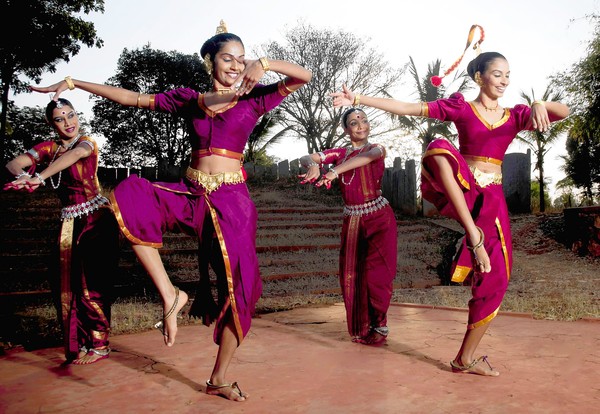
The Indian dance company Nrityagram Dance Ensemble performs Sunday at the University of Notre Dame’s DeBartolo Center for the Performing Arts. (Photo provided / January 3, 2008)

Literally translated, “Nrityagram” means “dance village.”

And what audiences will see from the Nrityagram Dance Ensemble Sunday at the University of Notre Dame’s DeBartolo Center for the Performing Arts is the unified performance of a group of dancers that lives, eats and dances together every day in a live-in dance community in India.
Founded by dancer Protima Gauri in 1990 near Bangalore, India, Nrityagram fosters dancing through community, according to the school’s website. Gauri died in 1998, but her dream lives on through the school.
“I dream of building a community of dancers in a forsaken place amidst nature,” Nrityagram’s website quotes Gauri as saying before the school’s founding. “A place where nothing exists, except dance. A place where you can eat, sleep, dream, talk, imagine — dance.”
Surupa Sen, the current artistic director for the ensemble, has been dancing with Nrityagram for 22 years.
The program for Sunday’s performance is a blend of dances found in India and Sri Lanka, Sen says. Dancers in richly colored and ornate costumes will grace the stage to dance in styles that are inspired by yoga, martial arts and meditation.
A speaker will give a post-performance talk after the show Sunday. The discussion begins immediately after the performance ends.
“My favorite part of the performance is the way the rhythmic beats of the two styles combine to create a new, exciting sound,” she says via e-mail.
Sen was the first soloist of Nrityagram, according to the ensemble’s website. She studied under Guru Kelucharan Mohapatra, as well as Gauri. Sen has performed all over the world with the Nrityagram company.
Nrityagram is in the “Gurukul” tradition, meaning the students take care of the guru, or instructor, as well as the school itself, according to the website. At Nrityagram, students are taught by several gurus and have daily requirements in exercise, prayer and, if they live on campus, chores to take care of the school.
The philosophy of Nrityagram is all-encompassing, impacting every aspect of a dancer’s life, according to the school’s website.
“At Nrityagram, dance is a way of life, a matter of faith and belief, nurtured and enriched by the souls of its own people,” the ensemble’s philosophical statement says on the website. “We believe that being a good dancer is second only to being a good human being.”
Sen says she spent eight months developing the choreography for the upcoming show.
“(Audiences can expect) a joyful collaborative effort and a common resonance between two completely different styles of dance born out of two countries and their respective cultures,” she says. “They will see spectacular costumes and live music played by musicians from India and Sri Lanka.”
The show will be traveling all over America, with 12 scheduled stops, Sen says. The ensemble will have a weeklong run at the Joyce Theater in New York.
“(The best part of performing is) dancing to a new audience and seeing their reactions,” Sen says. “(I enjoy) traveling and learning about the country and its people.”
Onstage
The Nrityagram Dance Ensemble performs at 2 p.m. Sunday at the University of Notre Dame’s DeBartolo Center for the Performing Arts. Tickets are $35-$8. For more information, call 574-631-2800 or visit the website performingarts.nd.edu.
source: http://www.southbendtribune.com / Home> Entertainment> Entertainment, Events from inthebend.com / By AMANDA GRAY ,South Bend Tribune / March 1, 2012
Honda Motorcycle to invest Rs 800 cr in 4th unit in Karnataka

Ancillary units around the Honda plant will invest a total of Rs 1,200 crore to manufacture parts for the main unit.

Bangalore, FEB. 28:

Honda Motorcycle and Scooter India (HMSI) will set up its fourth plant in Karnataka at an investment of Rs 800 crore. This will see the total capacity of the company go up to nearly 6 million units.

An official with the Karnataka Government said that Honda has received necessary approvals to set up the fourth plant at Narsapur, near Bangalore. The third plant is also located at the same site and has a capacity to produce 1.8 million units. The investment for the third plant is around Rs 1,200 crore in the Government-allocated 96-acre site.

The first plant, with a capacity of 1.6 million units, is located in Manesar in Haryana and the second plant — with a capacity of 1.2 million units — is located in Tapukara in Rajasthan.

ANCILLARY UNITS

The official said the ancillary units around the Honda plant will invest a total of Rs 1,200 crore to manufacture parts for the main unit. The Honda plant will generate jobs for around 5,000 people.

The company had earlier told Business Line that India will be its biggest global market for two wheelers by 2015. It will account for about 30 per cent of its overall market share, which is now at about 13 per cent.

Honda was earlier looking at setting up the fourth plant in Gujarat but it eventually decided to set up the fourth plant in Karnataka itself. The State Government recently offered tax concessions to Honda for the plant, which includes 40 per cent value added tax payable by the company to the Government as interest-free loan for up to 10 years. The cabinet has also cleared 95 per cent reimbursement of CST for a period of five years and waiver of 100 per cent of land registration cost as well.

HMSI officials had earlier said that the product line-up for the Karnataka plant include, three models of automatic scooters and six motorcycles in 100 cc to 250 cc range.

kgiriprakash@thehindu.co.in

source: http://www.TheHinduBusinessLine.com / Companies / by K. GiriPrakash / Bangalore, February 28th, 2012


Rare fragrant flowers to reappear in Bangalore

Bangalore:

An urbanised Bangalore has claimed many victims, including several species of flora and fauna. A poignant reminder of the loss is the conspicuous absence of Jalari mara also known as Thalli mara. The Horticulture Department is planning to revive this species by planting Jalari mara in prominent lung spaces of the city, including Cubbon Park.
The botanical name of this species, whose mild but intoxicating fragrance spreads over two kms, is Shorea talura. This deciduous tree was once seen or rather smelt across the city. Now, the tree is almost but extinct here. It is on the red list issued by the International Union for Conservation of Nature (IUCN).
Speaking to City Express, Deputy Director of Horticulture, Dr M Jagadish said, “The city does not have even a single tree of this species anymore. Even the major lung spaces in the city, Lalbagh and Cubbon Park, cannot boast of this tree.”
Environmentalist Yellappa Reddy has been working on conserving this species and has identified the existence of this tree in some pockets of human-settlements within Bannerghatta forest range. The Department has sought his help to revive and conserve this species. “We are procuring around 40 saplings of Shorea talura. We have identified suitable places to plant the saplings by this week. The tree produces pure white flowers in bunches for around six to seven months a year. The flower’s fragrance should provide a great ambience in the park for the visitors,” hoped Jagadish.
Other than Shorea talura, the department has also imported Phillipine Jade Vine Creeper through an agency from Phillipines. “The speciality of this very rare creeper is its scarlet red colour. We have started work on installing a stone arch, near the nursery of the park, for the creeper. It will be planted this week and the beauty of this creeper will be stupendous to the eyes of the visitors. But, it will bloom only after some years,” he said.
The department is also planning to introduce other species such as Tabebuia donnell-smithii in the city’s parks. This tree is currently found only on Raj Bhavan premises and near C V Raman Crematorium, IISC.
As a part of their plans to add colour to the green cover of the city, species such as Plumeria, which bears 190 colours of flowers, Fox Tail Palm, Mesuva Ferra, Pachira Insigne, and Rinchosperma Jasmine Noides will be planted.

source: http://www.ibnlive.in.com / The New Indian Express / by Aknisree Karthik / Bangalore, February 29th, 2012

Indian-Born Kamal Bawa Wins Award for Sustainability Work

Washington, Feb 18 (IANS):

Kamal Bawa, an Indian-born professor of biology at the University of Massachusetts Boston, is the 2012 winner of the Gunnerus Sustainability Award, the world’s first major international award for work on sustainability.

Bawa will receive the Gunnerus Gold Medal and the award of 1 million Norwegian Kronor (about $190,000) at a ceremony in Trondheim, Norway, the university said citing a Royal Norwegian Society of Sciences and Letters (DKNVS) announcement.

Bawa, also a faculty fellow at the Centre for Governance and Sustainability, home of the Global Environmental Governance Project, is known for his research on population biology in rainforest areas. His span of work includes biological discoveries made in Central America, the Western Ghats, and the Himalayas in India.

He is also noted for founding, and serving as president, of the Ashoka Trust for Research in Ecology and the Environment (ATREE), a non-profit conservation and development research think tank in Bangalore.

“I am very pleased over the recognition that our work has received,” Bawa was quoted as saying in an interview with a Norwegian newspaper.

“In January, 2011, a University of Pennsylvania study ranked ATREE #19 among the environmental think tanks in the world, and implicitly #1 in Asia, and now the Gunnerus Award–I am naturallyvery happy.”

Until recently, Bawa held the Ruffolo Giorgio Fellowship in Sustainability Science and Bullard Fellowship at Harvard University.

The Gunnerus award is the first major international prize for outstanding scientific work that promotes sustainable development globally, and will be awarded every two years.

The award is named after DKNVS’ founder, Bishop Johan Ernst Gunnerus (1718-1773), and is the result of collaboration between DKNVS, Sparebank1, SMN, and the society Technoport.

source: http://www.daijiworld.com /  United States / Washington,, IANS / Saturday, February 18th, 2012


Mangalore: Unique Gurpur Panchayat Festival Fosters Unity

Mangalore, Feb 27:

“For the first time in the state of Karnataka, ‘Panchayat Habba’ a festival of the panchayat including the people of various communities was organized at the panchayat level. The credit goes to the committee of Gurupur Gram Panchayat for coming up with such a unique exposure,” said Ramanath Rai, MLA here at the valedictory programme of the festival on Saturday February 25.

The two-day ‘Grama Habba’ was held at the premises of Vaidyanatheshwar Temple on the theme of ‘Grama Swaraja’ (local governance).

The festival included various competitions for the villagers such as tug-of-war, kabbadi and many more. Cultural programmes by the villagers, depicting village life in the coastal region was part of the festival.

Deputy speaker of state legislative assembly and MLA Yogish Bhat who later spoke, lauded the committee for organizing such a programme. He also appreciated their efforts for bringing up such a festival without government funding and bearing the entire cost with the help of the village’s donors.

Former minister Krishna J Palemar, Rajashekarnand Swamiji and many other dignitaries attended the function.

A rally was held from Gurupur bus stand to Falguni village, where the concourse took place.

U P Ibrahim was the organizing committee chief. Some achievers were felicitated on the occasion.

source: http://www.DaijiWorld.com / Daijiworld Media Network, Mangalore (MN) / Monday, February 27th, 2012


Slovenia cosies up to IT City

Bangalore:
The Silicon Valley tag has now brought boutique-country Slovenia closer home. The city’s information technology and cost-effective healthcare has drawn one more country closer – Slovenia. As a first step, a consulate was set up on Monday.

“Slovenia is a getaway to the European market and former Yugoslavia, with a lot of a free access particularly to the latter, so companies specially IT companies travelling to our country should ideally be on an advantage,” Ambassador Janez Premoze told The Times of India.

INVESTMENT HUB?
“It can prove to be ideal investment destination for companies,” added V Ravichandar, Honorary Consul, Republic of Slovenia.

Encouraging IT investments apart, the quality and cost-effective healthcare offered by private players in Bangalore is a key area which Slovenia wants to replicate in their own country. “There is a dearth of specialized medical treatments in the private sector and with the ageing population count going up both government and private players have to co-ordinate to provide quality healthcare cover in Slovenia,” said Premoze.

AYURVEDA, A RAGE
Premoze said India’s Ayurveda is also becoming popular in a big way. There are two ayurveda centres set up in the country. “We want to facilitate an exchange of scientists both at the basic and applied research level from Bangalore,” said Premoze, adding that efforts are on to sustain bilateral exchange of trade between India and Slovenia.

TOURISM FACTOR

“It is a great skiing destination, so the idea is also to project Slovenia as a potential tourist destination,” said Ravichandar. It is learnt that only 5,000-10,000 Indians on an annual basis visit Slovenia while 1,00,000 people from Japan tour the place.

“It is one of the lesser-explored European destinations. With conditions sure to lure the Indian tourist, many more people from Slovenia is likely to touch base here,” Janez pointed out. A high 14% of the country’s GDP is from tourism, but that is largely restricted to a high tourist flow from the European countries.

source:  http://www.timesofindia.indiatimes.com / Home> City> Bangalore / TNN / February 28th, 2012

They’ve got the drive to win

Practising daredevil wrestling moves on a trampoline, Arjun and Kush Maini know they can afford to cut loose for just a bit. After a hectic 2011 in which they competed in 20 gokarting events over 20 weekends, 14 outside India, the two Bangalorebased racers, 14 and 11, know that fun will take a backseat this year as they pursue a passion that has made them potential aces.

In their plush home on Rest House Road, dad Gautam Maini reflects on how his kids got drawn into racing. “I got Arjun his first electric cart when he was a year old, so he practically started walking and driving at the same time,” Gautam said. Arjun soon got his own electric all-terrain vehicle and when Kush was born, he too would sit behind him. “I was a racer back then and the kids would travel with me to Sriperumbudur and watch me in action. I started very late. The atmospherre created the base, although we didn’t know whether the talent was there,” said Gautam.

Gautam went on: “My first race was a Formula Maruti event in 1992 at Sriperumbudur, with another debutant in Narain Karthikeyan. I raced up to 2006 in the Formula Rolon. I gave up racing that year because I wanted to spend time with my kids. Arjun, who was eight, was about to start racing so the bigger focus for me was to play a part in training him. Karting is a different ball game but my racing background helped. We worked closely with Akbar Ebrahim in training sessions and relied on outside information to help the boys become more professional. We also worked with Red Rooster Racing and Leelakrishnan for two years to help develop Arjun’s skills,” he said.

“I remember my dad taught me a lot of basic things,” said Arjun. Kush was just following in his brother’s footsteps and went through the same routine. He said, “Watching my father and brother, I felt racing was fun and I wanted to do it. My first race was at seven and my father had to take special permission from the authorities for me to participate as I was too young.”

In 2008, the family had a big realization that they cannot progress by racing only in India. “I had taken Arjun to race in Malaysia and he won two races that year, the first by an Indian in the Micro Max category,” said Gautam. “That really got us excited because the competition in the Asian region is higher. The tracks are much more challenging and there is more variety. That exposure started working well for both Arjun and Kush. Their race craft and race skills had improved.”

Arjun’s most famous achievement came in October last year when he was chosen as the winner of the Sahara Force India One from a Billion Hunt, a regional search for the best karters that ended at Silverstone. “You should never think you are the best. If you do, then you can never make it,” said Arjun.

On the road for several weekends in a year is tough. “It’s hard because you miss school, have low attendance and the pressure to catch up. Apart from this, you have to go race, work out and get fit too,” said Gautam. “This is all part of becoming a Formula driver so I need to work hard and be dedicated,” he said. Kush added: “My teachers and friends are very supportive . Sometimes, when I return to school I have missed out on a lot of work so they teach me things again.”

He is the male-equivalent of a soccer mom, a motor sports-dad so to speak, and Gautam said he enjoys their every victory. “There’s never a dull moment. Going forward I may not be able to do this as things get more professional. It’s always worth it and it will be in future,” he said.

source: http://www.timesofindia.indiatimes.com / Home> City> Bangalore / TNN / February 27th, 2012

Reality strikes with playback

A playback show by Yours Truly Theatre.

Lights, camera, action! Usually, these are cues given by a director. But what if the audience calls the shots? Here’s a chance to take over the director’s mantle and suggest some ideas to a troupe to enact for you, unrehearsed!

Known as playback theatre, this genre is finding many takers in the city, and audiences love it!

What is playback theatre?

Also known as improvisational theatre, this is actor-audience interaction at its best. Barely around for 40 years, it is a rage across the world now. USA is known to have the maximum number of playback troupes in the world and now, other countries are following suit. Walk into any renowned theatre company in Bengaluru and you will find a course offered in this genre.

If you’re a big fan of Whose Line Is It Anyway?, then playback theatre might just be your thing. It is based on impromptu comedy and several stand-up acts and plays are being centred around this style. In Bengaluru, almost every theatre company teaches this form, and even bring down experts from other countries to conduct workshops.

Renowned colleges like NLS, IIM, Christ University, RVCE, NGOs like Spastics Society of Karnataka, National Academy for Blind have regular programmes and workshops with playback actors. Several corporates like Nokia and Puma too have had workshops for team building exercises and interactions. The scope is mostly personal and what makes this form stand out is that it doesn’t lend a tag of exclusivity.

Theatre artiste Namrta Dhar says, “This is one genre I dare not try in front of an audience if I’m not 100 percent sure of what I’m doing. It requires presence of mind, oodles of confidence and sensitivity. It’s certainly a challenging theatrical pursuit.”

The activists

* Nandini Rao: Hailing from the Prabhath family (an old family of fine arts) acting runs in her blood — and she has more than a decade of experience. Having co-established Yours Truly Theatre, she has 300 impromptu shows to her credit, “One must distance oneself from emotions conveyed by an audience. Playback has healed people worldover.”

* Sumit Acharya: “Spontaneity is my middle name,” claims this software engineer who has juggled work and theatre for seven years. Sumit has done over 200 shows (IIT Mumbai, IIT Delhi, SIMC Pune, NLS, National Academy for Blind, etc). “During a festival, someone spoke about how an actor disappeared before the finale. We enacted the same and it was so funny!”

* Ranji David: “In playback theatre, there is no such thing as preparation. You must have immense confidence.” That’s Ranji David, with over 200 shows, with 13 years of experience. He still gets a wave of excitement before a show. His latest project is based on elements like light, costume, etc. “The only answer to perfecting the art is practice, exposure and experience.”

* Ameet Bhuvan: When he walked into an auditorium to watch a play, little did this 28-year-old manager realise his outlook was about to change forever. “My story was enacted on stage and I was awestruck by how the actors effortlessly reproduced myriad emotions so close to my own experience.” He is a common face at many local playback shows in colleges, schools and NGOs.

* Vishal Bhandary: Media consultant Vishal loves storytelling and playback was the answer to his childhood passion. Interactive theatre is used for therapy and community service, and this struck a chord with Vishal. “This is a modern storytelling format which instantly strikes a connection with the people. The best part is we act without a script so each show is varied.”

Beyond borders

The following programmes have been held across the city to promote playback theatre:

Bangaloraholic

A tribute to the essence of a city which has a quaint charm to it. This programme had old Bengalureans, youngsters, expats and immigrants — who narrated various experiences about the city and they were enacted by the actors.

Relive 1947

To mark the 55th Independence Day, theatre artistes invited freedom fighters, participants of the freedom struggle, youngsters and asked each person to give them examples of modern India.

Wake Up India

In association with the Jaago Re campaign, this was an attempt to make the people reflect on how the country has changed in various aspects. Politicians, artists, defence personnel and college students were made to narrate experiences

source: http://www.DeccanChronicle.com / Home> Tabloid> Bengaluru / by Sindhuja Balaji / DC / Bengaluru, February 27th, 2012


3000 million years old Lalbagh rock facing human threat?

Morning walkers fear that it may be damaged by the use of heavy drilling machinery by personnel hired to rejuvenate the lake in the garden

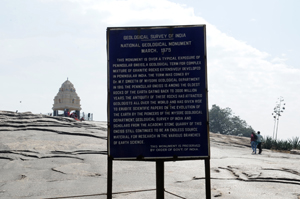
The rock, termed Peninsular Gneiss, is a mixture of granitic rocks

The use of heavy drilling machinery by construction personnel hired to rejuvenate the lake in the renowned Lalbagh botanical gardens has several morning walkers and joggers worried. They fear that work would endanger the 3,000 million years old Peninsular Gneiss, the rock in the centre of the park. The personnel are cutting huge boulders using earth movers, near the Siddapura Gate. Dr Krishna, a morning visitor to the park, told Bangalore Mirror, “I saw these machines near the rock a few days ago. Vigilance officers informed them that they were drilling the earth to cut rocks. None of us had any clue where those rocks were transported.”

But horticulture officials clarified that the rock won’t be damaged. H M Krishnappa, deputy director of Lalbagh, said, “We are not drilling into the rock. 

Special white stone boulders have been brought from Pavagada to construct a bund along the recently rejuvenated Lalbagh lake. They are not only huge but irregular in shape as well. Hence, they have are being cut to fit our requirements. As there was no vast space available within the park to take up the drilling and chiseling work, we chose the empty space near Siddapur Gate, which was sometimes used as a parking lot.”  But when asked whether the drilling work with high level vibrations would damage the texture of the geologically significant rock, Krishnappa clarified, “They have just cleared the soil to keep the boulders intact while drilling and chiseling using heavy machines. We have been vigilant at every step.”

N Chandranna, a retired senior geologist from the mines and geology department, said, “The drilling would not harm the rock as the vibrations would be of negligible level. But using explosives would have a huge impact on the composition of the rock.”
history of the rock
The term Peninsular Gneiss means mixture of granitic rocks, which are largely spread around the southern plateu of India. The term was coined by Dr W F Smeeth of the Mysore Geological Department. It is considered to be one of the oldest rocks of earth. It was declared a national geological monument in 1916.
The antiquity of this rock has attracted geologists from all over the world and has given rise to erudite scientific papers on the evolution of earth by the pioneers of the Mysore Geological Depart-ment, Geological Survey of India and scholars. Stone quarry of this gneiss continues to be source material for research in the various branches of earth science.
source: http://www.BangaloreMirror.com / Bangalore> City / by Niranjan Kaggere / Friday, December 23rd, 2011

A tongue-in-cheek narrative of the Cantonment

Paul Fernandes’s drawings are a light-hearted portrayal of his memories of Bangalore of the 1970s. Photo: Special Arrangement

Whether you have lived in the particularly endearing cantonment area for some time, or paid a visit to its charming environs, you will surely appreciate what you see at aPaulogy, ‘a gallery of curious illustration’ created by Paul Fernandes.

The 50 drawings on display near the entrance of Richard’s Park in east Bangalore will surely draw a few laughs.

“Around five years ago, I started a light-hearted portrayal of my reminiscences of Bangalore, especially of the 1970s. Most of the sketches are based on my experiences as well as those of my friends and family,” Fernandes shared.

The artist has made a careful yet satirical note of what he has been observing over the decades. Some pictures are of famous landmarks of the Cantonment such as Thoms Cafe and Bakery on Wheeler Road, Everest cinema on Madhavaraya Mudaliar Road (both in Fraser Town), and Ulsoor lake. His drawings depict how several communities despite their cultural, religious and linguistic diversity live in harmony.

There is a picture of a cycle rickshaw puller struggling with his heavily built customer on the now flattened St. John’s Hill. There are also small models of this vehicle at the exhibition. “This was the best mode of transport to negotiate the ups and downs of the terrain,” he said.

Some of his sketches are a humorous take on orchestra conductors, and he describes them as those whose “pride comes before their fall”. While most of the illustrations are watercolour prints, a few are in black and white.

Fernandes’s drawings also highlight the integrity and sincerity of yesteryear policemen. “They were tough with men who were caught in an inebriated condition and would ensure that people who rode bicycles at night had their lamps on,” he said.

A multi-faceted artist, the unassuming Fernandes’s work has been compared to that of the legendary Mario Miranda. Having completed his degree in commercial art from the renowned, M.S. University in Vadodara, he earlier worked in advertising. He has contributed illustrations to books such asMultiple City – Writings on Bangalore by Aditi De, Peter Colaco’s On a High NoteHung by my Family Tree by Ajit Saldanha and a leading Indian travel magazine.

source: http://www.TheHindu.com / News> Cities> Bangalore / December 28th, 2011