The monk who makes cheese

Meet Father K L Michael, administrator of a KR Puram-based monastery. This priest from Kerala, now supplies cheese from Bangalore to various parts of the country

A  variety of Italian cheese. Pic: Theresa Varghese.

He’s the monk who makes the cheese and sells it too! Father K L Michael. Administrator of Gualbert Bhavan, a monastery in KR Puram, is a priest with an alter ego as a cheese maker.

How did a priest from Kerala end up supplying cheese from Bangalore to the best of Italian restaurants and star hotels in the country? As Father Michael himself puts it, with a characteristic little smile tugging at his mouth, “It was a long journey.”

A boy of 15, he was among 11 youngsters in the first batch to join the order when a Vallombrosan Benedictine Congregation was set up in Kottayam (in Kerala) in 1988. Five years later, he was sent to Rome where he learnt Italian and theology and prepared for a Masters in liturgy. As he studied and lived within the order, he began to develop a fondness for Italian food.

“We took turns cooking. At first I just threw ingredients together but soon I was able to make fairly good pasta,” he says with a laugh. He was also able to observe at close quarters the various communities that the order nurtured. The Benedictine order follows the motto of prayer and work. When not meditating, the monks and priests engage in income generating activities that will fund the welfare work they do and also help in sustaining each house. Some of these activities traditionally revolve around food and drink. So while there is a community that manages the sale of religious articles, there are also communities involved in the preparation of wine and liqueur. For those who do not know, Benedictine – the sweet liqueur that goes well with brandy – was created out of herbs and spices by a monk in 1510.

Watching these skilled communities, Father Michael pondered over what kind of work he could undertake when he came back to India. Given his partiality towards spaghetti and its ilk, it was not surprising that his mind veered towards cheese. Father Michael was fortunate on two counts – he belonged to the Benedictine order, and spoke fluent Italian. This translated into easy entry into spaces that would otherwise have been closed. With the encouragement of his superiors, he travelled to cheese-making units and learnt the trade. To Aversa, located in the south of Italy, famous for its Mozzarella cheese made of buffalo milk, and to Naples – the place where pizza is said to have originated.

By the time he got back to India and was ordained as a priest in 1998, Father Michael was a liturgical scholar who also knew how to make varieties of Italian cheese. Two years later, when he was sent to Bangalore to establish a house for young monks, he set up Gualbert Bhavan and began work as a novice master, looking after the needs of the approximately ten to 15 students who arrive here annually. But cheese was not far from his mind. Having obtained used machinery from donors in Italy, he began to look around for good quality buffalo milk. After much research, he decided on milk from a village in Hoskote.
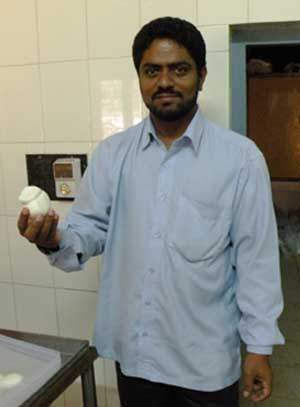
Father K L Michael. Pic: Theresa Varghese.

As he recounts his initial selling experience, Fr Michael is candid about his lack of confidence in his abilities as a cheese maker. “In 2004, I made the first two kilos. Then I looked up the Yellow Pages for Continental restaurants and picked Herbs and Spices in Indiranagar as it was not too far away. I introduced myself to the owner, requested him to try out the cheese and, when he agreed, asked him to let me know what he thought. A week later, he called and told me to get some more.”

It was the beginning of a trajectory. Manjit Singh ofHerbs and Spices, who knew people in the hospitality industry, put out the word. And Father Michael had no reason to look up the Yellow Pages anymore. Within no time he, and his assistant Father Joby, were supplying fresh cheese to five star hotels and Italian restaurants in the city. From there it snowballed to hotels in other cities and from there to Singapore where, according to Father Michael, “For two years we supplied approximately 100 kilos each month to the Pasta Fresca da Salvatore chain of restaurants.”

Vallombrosa cheeses are available at Namdhari’s, Spar, MK Retail, More, Food Zone, Big Market and Tom’s Bakery.

For more information clickhere

Gualbert Bhavan now churns out 45 kilos of cheese each day. Despite the quantity produced, it remains a two-man show, with Father Jinse having replaced Father Joby. The Vallombrosa range, as the brand is known, includes smooth and creamy Mozzarella, small balls of milky Bocconcini, sweet flavoured grainy Ricotta, buttery Burrata, hard and salty Pecorino, tomato paste and olive oil infused Caciotta, rich creamy Mascarpone and, of course, soft stretchy pizza cheese. Except for Mascarpone that utilises fresh cream, all the cheeses are made from buffalo milk, which is creamier and richer than cow’s.

Father Michael recalls how, after his initial success with milk, he found that the supplier was watering down the product. So he cut out the supplier and bought 20 buffaloes, with the aim of ensuring that the source would remain pure. But maintaining the cattle became difficult and when he realised that they were spending more time managing the buffaloes than producing cheese, Father Michael sold off the animals. He then obtained the milk from various buffalo owners in Ramnagaram, an hour’s drive from the city. However, after an initial honeymoon period he found the sceptre of adulteration raising its head again. So it was back to legwork and surveys once again till he finally settled on a farm in Hosur. This is where he currently gets his 170 to 200 litres of milk every day.

Father Michael has recently produced Feta cheese (usually made out of goat milk) from buffalo milk. Though it has been well received, he intends to make Feta the traditional way; the idea being to start a cheese-making unit at the main house in Kottayam where they can also rear goats. The project will be launched by the end of this month.

Did he imagine a mammoth scenario like this when he started out? “Not at all,” replies Father Michael, going on to remark in his mild-mannered way, “It just grew.”

16 Feb 2010

Independent writer and ardent baker who loves all things to do with food.

source: http://www.bangalore.citizenmatters.com / Food> Consumer / by Theresa Varghese / February 16th, 2010
 

The monk who makes cheese

Father K L Michael laughs when you ask him if he is a foodie. It’s a rich, deep-throated laugh, it answers the question. The 38-year-old from Kottayam, the first Indian to get selected to the religious order of Vallombrosan Benedictine Confederation, has acquired another title, he’s the monk who makes cheese. Father Michael’s brand, Vallombrosa, popular with five-star hotels and fine-dining restaurants across Bangalore, also travels to cities like Mumbai, Chennai and Cochin.

The Benedictine order, which follows the motto of `prayer and work’, not only earns its keep, but also contributes to charitable causes with income generating activities. Father Michael, who lived within the order in Italy (Rome and Florence) for eight years, learning the local language before preparing for a masters degree in liturgy, spent a fair amount of time, racking his brains on what work he would do when he eventually returned to India. During the course of his travels, specifically during a holiday in the southern Italian city of  Naples, the idea of making cheese for a living dawned on him.

After he came back to India in the summer of 2000, the monk experimented with small quantities of cheese. “Even though I spent a lot of time studying the methods when I was in Italy, I hadn’t really experimented with the process. So, when I returned, I started working on it immediately. There are variables like temperature and milk and I tinkered with the process before arriving at a formula that worked for us.”

Father Michael leads a team of six people, who work six to eight hours a day, starting as early as 8 am and winding up past mid-night, with breaks for prayer and rest. They churn out a total 90 kilos of cheese a day. The rates for the Vallombrosa brand that includes Mozzarella, Bocconcini, Burrata, Ricotta, Mascarpone, Caciotta, Pecorino and Feta varies from Rs 500 to 1500 per kilo.

Gualbert Bhavan in Thambuchetty Palya (near K R Puram), where father Michael set up home for young monks, guiding ten to fifteen students who join the fold each year, have cheesy dinners twice a week. Every Tuesdays and Thursdays the house is treated to homemade cheese of their choice, which they have with parotas for dinner.

source: http://www.articles.timesofindia.indiatimes.com / City> Bangalore / Home> Collections> Italy / by Prajwal Hegde / December 24th, 2011


KASSIA pleas for tax concession for SMEs

A delegation met chief minister DV Sadananda Gowda to request him to incorporate their demands in the upcoming state budget so as to boost the growth of small scale industries in the state
In a memorandum to chief minister DV Sadananda Gowda on Wednesday, the Karnataka State Small Scale Industries Association (KASSIA) has requested for liberal tax concessions and investment subsidies in the upcoming state budget, in order to boost the growth of small industries in the state.
source: http://www.ciol.com / Thursday, February 23rd, 2012

New garden for Mysore Palace

Rs. 43 lakh for four acres landscaping

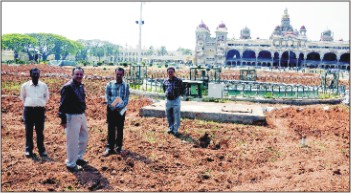
Caption: Palace Board Deputy Director T.S. Subrahmanya and others taking a look at the work going on for the gardens at Palace premises.

Mysore, Feb. 18

The beauty of the world-famous Amba Vilas Palace is to be further enhanced with a garden on four acres of land, work on which has already commenced.

The total cost of the garden is Rs. 43 lakh. Tenders were called for laying the garden an year ago when Harsha Gupta was the DC. However, the work was stalled in view of Dasara.

The tender has been awarded to Uthaiah Mangalaraman Company and it has been asked to complete the work in the next three months, said Palace Board Deputy Director T.S. Subrahmanya.

As part of the project, the two fountains on either side of the Palace front region, that are more than six decades old, will be repaired and made to function on a daily basis.

Retaining walls of stones will be constructed along the borders of the garden to prevent flowing away of soil during rains.

The garden measuring 16,400 square metres will have lawns of a variety of grass, more than 50,000 varieties of plants, shrubs and vines of tropical regions.

The soil will be mixed with 25 per cent of chemical fertilisers, 50 per cent farmyard manure and horse dung. The entire garden will be barricaded with granite slabs and small pools of 10ftx10ft will be created as part of the landscaping, with a walkway.

During the tenure of former DC Harsha Gupta, the authorities talked about a garden on the lines of the Moghul Garden in Delhi. But now the plan has been changed and the garden will be laid out in Mysore style as was prevalent during the reign of Mummadi Krishnaraja Wadiyar.

Rain water harvesting

Plans are on the anvil to set up a rain harvesting unit with a storage capacity of one crore litres, said Subrahamnya and added that in the first phase, a rain water harvesting unit with a capacity of six lakh litres has already been established at the Palace premises.

source: http://www.StarofMysore.com / General News / February 18th, 2012


JSS Doctor bags Oration Award

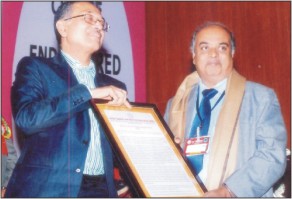
Caption: Dr. Nataraja receiving Dr. R.K. Oza Oration award from the Vice-Chancellor of Hyderabad University.

Mysore, Feb. 16:

Dr. N.P. Nataraja, Director, JSS Institute of Speech and Hearing in city, has been awarded Dr. R.K. Oza Oration National award, at the 44th annual conference of Indian Speech and Hearing Association, held recently at Hyderabad. The award was instituted to honour successful entrepreneur in the field of speech and hearing from India and consists of a citation and trophy.

Dr. Nataraja is a scientist, trainer and a pioneer in voice among the Indian Speech Language Pathologists. He has contributed tremendously in escalating the field of Voice Disorders, Speech Sciences and Forensic Speech Analyses. He was conferred with Bharat and Dr. Ratna Oration awards in 1999 at the 31st Indian Speech & Hearing Assn. Conference, Chandigarh. He was also awarded LVA Oration award at the 1st Annual Conference of Laryngology and Voice Association named as Laryngology Update 2012 in Mumbai on Feb. 4 and 5. The award has been instituted to felicitate leading Phono-surgeons and Speech Language Pathologists who have contributed in the field of Laryngeal Disorders, Voice Restoration.

source: http://www.StarofMysore.com / General News / February 16th, 2012

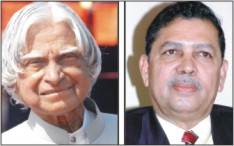
Rs.1 crore Jindal prize for Dr.Kalam, Santosh Hegde

Caption: Dr. Kalam, Justice Hegde

New Delhi, Feb.16:

Former President A.P.J. Abdul Kalam and former Lokayukta of Karnataka Justice N. Santosh Hegde have been selected by the Sitaram Jindal Foundation for S.R. Jindal Prize for their outstanding contributions in their respective fields.

The prize amount carries a cash of Rs. 1 crore. Sitaram Jindal Foundation will felicitate 25 other achievers also at the award ceremony to be held on Feb. 23.

S.R. Jindal Prizes will also be awarded for crusade against corruption, rural development and gallantry.

Patron of the Foundation Sitaram Jindal said, Dr. Abdul Kalam has been selected for the award for his contributions in science and technology while Justice Santosh Hegde will be honoured for his extraordinary service in social development.

source: http://www.StarofMysore.com / General News / February 16th, 2012

Home is where the house is

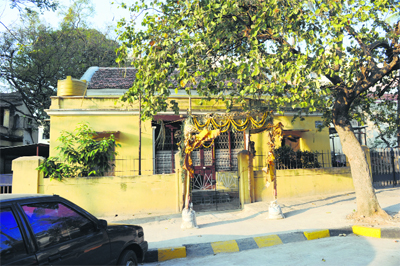
One of the oldest houses in Bangalore stands witness to the rich lives of six generations — both inside and outside its walls

If a person lives for 100 years or more he/she is called a centenarian. What do you call a house that’s 115 years old? Simply…House No.253.

The beige coloured house on IIIrd main, Chamarajpet, sits on the quiet lane like a great-grandpa on  an easy-chair, watching the world go by with a I-have-seen-it-all gaze. The house has been around much before the people, who walk past it now, became a ‘creation’ in God’s workshop. It has seen horses cantering on the roads; macho Sunbeams and Moris Minors driving past its gate, followed years later, by modest Fiats, Marutis and now the boxy Swifts, like the one parked in front of the house. It has witnessed servitude and freedom; it has seen births, deaths, marriages and separations. For 115 years House No.253 has seen life in its varied hues –both inside and outside its walls.
This 19th century house is one of the oldest properties in Bangalore, owned by the original allotee’s family. Measuring 60 ft by 108 ft it was allotted to Kasturi Rangachar in 1896 by the government for Rs 200. The original house number was 171, which later changed to No. 234, 250 and now No. 253. The oldest document of this property dates back to July 9, 1930 — a tax-paid receipt for Rs 12 and 8 annas, issued by Bangalore municipality, signed by a Shanbhog.
It’s a classic
The solitary stone bench at the entrance is typical of houses of a bygone era; windows on either side of the five-door entrance, high roof, signature rose wood doors, black kadapa kallu flooring, spacious rooms sandwiched between thick walls, long verandahs, the attic-cum first floor with a mini-wooden ladder attached to it and the sweet-water well in the backyard amid coconut and mango trees… it is reminiscent of a simpler time when home was the axis of one’s life.
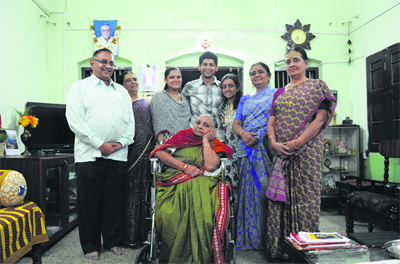
The house is now occupied by Rangachar’s sixth generation family: matriarch 84 year old P Kamalamma lives here with her sons and daughters-in-law. She has six grand children and eight great grand children, some live with her. The spacious four-bedroom house has hosted around 30 family weddings.
The III main road where the house is located was initially 80-feet wide and called Iyengar Street as majority of the residents were from the Iyengar community. “It’s probably the oldest property on this street that is still retained by the original allottees’ family,” says D Vijaykumar, 61, the youngest son of Kamalamma. “Over the years, the family grew, but not once did we think of dividing the property.” Barring a few minor repairs and painting, the house has not been altered at all. The sheen on the  kadapa kallu flooring shimmers —even after 115 years!
Only after the death of Kamalamma’s husband, a few years back, a hunt for the property papers began since the sons wanted to change the title ownership to their mother’s name. Kamalamma’s two daughters-in-law, Ramamani and Sumathi, were entrusted with the job. They laid their hands on the 1930 tax-receipt and traced the property entry in the records in the revenue office. Subsequently, the urban land survey office issued them a certificate of ownership.
In 1992, as the family grew the existing space shrunk. The brothers decided to build three-apartment units in the large backyard. “We didn’t want to make any alterations to the old house,” says Vijaykumar. “But, we also wanted to be in the same compound. Our parents allowed us to construct the flats without dividing the property.” While two brothers shifted to the newly built apartment, Vijayakumar and his wife continued living in the old house with his mother.
Barring some old age related ailments and a recent hip bone fracture, the octogenarian Kamalamma is agile. She crossed the threshold of the house as a new bride in 1944. Pointing to an old black and white picture of the older generations, Kamalamma says, “Many died of epidemic diseases that were common those days.’’
The 6,480 sq ft space purchased for Rs 200 in 1896, is worth around Rs 10 crore now. Several TV serial directors approached the family to let the house on rent for shooting. But the family refused.
A few days ago, House No.253 welcomed the sixth-generation’s youngest grand daughter-in-law, Sahana. Now, the 115-year-old house is getting ready to welcome the ninth great-grand child of the family; gurgles and giggles will once again fill the ancient rooms and the kadapa kallu will gleam under tiny baby feet. Yet another chapter of life will begin under the roof of House No.253.
source: http://www.BangaloreMirror.com / Bangalore / Home> Sunday Read> Special / Sunday, February 16th, 2012

ASI celebrates 150th Anniversary

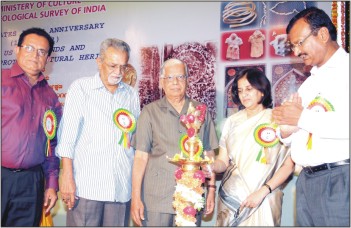
Caption: Juthika Patankar, Additional DG, ASI, lighting the lamp to inaugurate the 150th anniversary celebrations of ASI in city this morning as (from left) Dr. T.S. Ravishankar, Director-Epigraphy of ASI, Dr. K.V. Ramesh, Prof. A.V. Narasimha Murthy and Dr. S.V. Venkateshaiah, ASI Regional Director, look on.

Mysore, Feb. 13

The Archaeological Survey of India (ASI), a pioneering subordinate office under the Ministry of Tourism & Culture, celebrated its 150th anniversary at Panchavati, Gymkhana Auditorium of AIISH on Bogadi road here this morning.

The programme was inaugurated by Juthika Patankar, Additional Director General of ASI, New Delhi.

Speaking on the occasion, she said that the Department had conserved 3,677 monuments all over the country and more such works were on. In view of the challenges faced by the ASI owing to the importance given to heritage and culture, the entire Department will be restructured and the staff will be trained in management skills, she said and added that steps will be taken to fully equip the ASI. Suggestions of scholars will be considered before taking any major decisions, she assured.

Prof. A.V. Narasimha Murthy, former Head, Department of Ancient History and Archaeology, Mysore University, speaking as the chief guest, said that the ASI was like Varaha avatar (incarnation of boar) of Lord Vishnu who dug out planet earth out of the ocean between his tusks and restored it to its proper place in the universe. Similarly, ASI digs out information from ancient times to educate the people. ASI has been rendering yeomen service in preserving the cultural heritage of the land for posterity, he added.

Dr. S.V. Venkateshaiah, Regional Director (South) of ASI, speaking as a chief guest, said that the department has been extensively working for conserving ancient monuments.

An exhibition comprising photographs of the monuments restored by ASI, showing how the monuments were and how they look after restoration, has been organised at Panchavati, which can be viewed by the public.

ASI Director Dr. T.S. Ravishankar (in-charge, Epigraphy Department) said that the Directorate of Epigraphy, Mysore, with its two zonal offices located in Chennai and Lucknow, is engaged in copying, deciphering, editing and publishing the texts.

The office has collected more than 74,000 inscriptions of different scripts and languages from around the country.

source: http://www.StarofMysore.com / General News / February 19th, 2012

Lifetime Achievement Award for Dr.(Brig) R.S. Rajan

Mysore, Feb. 13

Dr. (Brig) R.S. Rajan, Director of Administration, Vivekananda Institute of Leadership Development in city was honoured with the Lifetime Achievement Award-2012 for his contribution to the specialty, the association and the community at the recently concluded Cardio-Thoracic Surgeons meet in Kolkata.


Dr.R. Sundara Rajan graduated from Banagalore Medical College in 1964 and joined the Army Medical Corps in the wake of the 1962 Chinese aggression. He served the Army and the country with distinction for 36 years and reached the rank of Brigadier before taking voluntary retirement in 1999.

During his Army Service, he served in Ladakh and Sikkim at different times while also making steady progress in the Academic field, specialising in Surgery and Cardiothoracic Surgery. He went on study leave to New Zealand to hone his skills under the legendary Sir Brian Barratt-Boyes and returned in 1981.

He soon took over as the Head of the Department of Cardiothoracic surgery at Military Hospital (Cardio-Thoracic Centre), Pune which is affiliated to the Armed Forces Medical College. As its Head over the next 14 years, he trained all the cardiothoracic surgeons of the Army, Navy and Air Force.

Dr Rajan was known for his passion for teaching both undergraduate and postgraduate doctors as also nurses and paramedics. For his distinguished services, he was awarded the Visihta Seva Medal (VSM) in 1999.

Dr. Rajan took interest in other centres of cardiac surgery as a teacher and made valuable contribution to the Indian Association of Cardiovascular & Thoracic Surgeons as an Executive Committee Member and later its President in 1995.

Since his retirement, after a stint with Tata Tea as its Chief Medical Officer at Munnar, he remains active in the field of Community Health and Development Issues in various NGOs. Currently, he is the Director of Administration at the Vivekananda Institute for Leadership Development, a part of Swami Vivekananda Youth Movement, an organisation with which he has been associated for the last three years.

source: http://www.StarofMysore.com / General News / February 13th, 2012

Christ College Wins Natl.Moot Court Contest

Mysore: Feb. 13

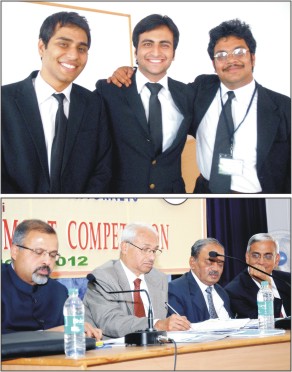
Christ Law College from Bangalore won the two-day National-level moot court competition on ‘Corporate Taxation’ conducted by Surana and Surana International Attorneys and JSS Law College at JSS Law College’s Silver Jubilee auditorium here yesterday.

National Law School of India University is runner up

Caption: 1) Winning Smile:Ajay Kumar, Chahat Chawla and team researcher Roshil Nichani of Christ College, Bangalore, who won first prize in the national moot court competition held at JSS Law College in city. 2) High Court Judges D.V. Shailendra and Praveen Chandra and others seen during the valedictory function of National moot court contest yesterday.

The National Law School of India University (NLSUI) from Bangalore, who keenly contested for the title, had to settle with the runner up trophy. In all, teams from 44 law colleges from all over the country participated in the national level competition, the second in the series. Apart from the trophies, the winner got Rs. 25,000 as cash prize while the runner got Rs. 14,000.

The final rounds were judged by High Court Judges Justice Shailendra Kumar and Justice N. Anand, Padamchand Kincha and Director of Income Tax (International Taxation) Praveen Kishore Prasad of Bangalore.

Ajay Kumar of Christ College, later speaking on behalf of his team, said that such competitions help in honing the skills of students and improve knowledge in the subject. “Such things cannot be learnt in classrooms,” he said. Other members of Christ College team are Chahat Chawla and researcher Roshil Nichani. The National Law School of India University team consisted of Deekshitha, Shreya and Siddarth.

source: http://www.StarofMysore.com / General News / February 13th, 2012