In the last five years, nearly 50 songs in more than a dozen films have relied on the mouth organ
In the right hands, the strident twangs of the mouth organ can be tamed into a riveting melody. In the 1980s, the harmonica, as it is also called, started losing ground to guitars and keyboards in popular culture. But the instrument is once again being patronised by the Kannada film industry. In the last five years, nearly 50 songs in more than a dozen films have relied on the mouth organ for its distinctive sound.
The latest to join the ranks will be Jessie — expected to be released later this month — where music director Anoop Seelin has generously relied on the harmonica for the song ‘Male Bantu’. Some music directors like Sameer Kulkarni have used the harmonica not just in individual compositions, but also in the background score to convey a range of emotions. Kireeta (2015) is one such film. In Munjaane(2012), director S. Narayan used the harmonica for some inventive compositions.
“The harmonica, just as the santoor, sarangi and the shehnai lost ground to the keyboard and guitar,” says Mr. Seelin whose passion for the mouth organ can be traced to his childhood. “I grew up appreciating the ingenuity of the renowned Naushad, Hamsalekha, Rajan Nagendra and Upendra Kumar, and the way they creatively merged the harmonica in their compositions. I believe in live orchestras with different time-honoured instruments, not in keyboard simulations,” says Mr. Seelin who has 16 films to his credit.
One of the reasons for this resurgence is that an increasing number of youth in Bengaluru is rediscovering the twangy depths of the mouth organ. The city is home to nearly 500 amateur and professionals who experiment with the mouth organ in different genres as rock, blues, jazz, gospel and Carnatic.
Riding on this wave of popularity, Carnatic musician Saitejas Chandrashekar and professional organist Avinash Kulkarni recently published a book ‘The Joy of Harmonica Playing’ to guide young musicians. “The intention was to see people getting lessons in Indian swaras so that the harmonica gets a push,” said Saitejas.
But the shift from a hobby to recording for films involves a huge leap. It is tricky to be a recording artiste as the reflexes to follow the music director with notations have to be instantaneous, points out multi-instrument concert and record artiste S.J. Prasanna. “Only trained musical ears can bring them all.”
He’s one of a handful of professional harmonica recording artistes in Bengaluru and has played the harmonica for Anoop Seelin’s song Ellello Oduva Manase in the 2012 drama Sidlingu and Male Haniyein the film Madarangi, among other recent hits.
For now, the harmonica’s reassertion in Sandalwood is a pleasant change from the usual offerings, but only time will tell if its a comeback or a passing fad.
source: http://www.thehindu.com / The Hindu / Home> News> Cities> Bengaluru / by Ranjani Govind /Bengaluru – March 13th, 2016
Opportunities to find deeper powers within ourselves come when life seems most challenging. Its one such challenge that pushed K.V. Sowmya to harness her innate powers into an opportunity to help the specially-abled. It’s with these inmates of her school Karunamayi Foundation in city that Sowmya finds solace and braces herself to face her tomorrows which still look challenging!
Life for Sowmya, a Journalism Post-graduate, was all pink and rosy, till her husband Rajesh, a journalist with a popular national daily, succumbed to depression, leaving her to fend two young kids and a family that made her go through the travails of widowhood! Driven to the brink of despair by the taboos of the society she was surrounded by, Sowmya could not pursue her studies in Mental Disorders, which she was very passionate about. On one of her visits to a school for special kids, which her nephew attended, her interest in dealing with people with special needs was rekindled when her nephew was treated successfully and joined the mainstream which further pushed her interest. It was then she decided to move from Mandya to Mysuru and started the Karunamayi Foundation, a day school for the specially-abled in a rented building in TK Layout. Despite offering free services, Sowmya had to run the school for a more than a year with just one kid!
Undeterred by the poor response, Sowmya with a meagre income to manage her life with a two-year-old daughter and an eight-year-old son, decided not to close down the school, as her passion was to work with people with mental disabilities.
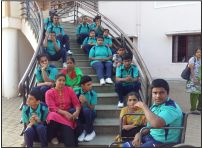
When the neighbours of the only student of Sowmya’s school noticed a visible improvement in the way the child learnt to manage herself, curious parents of children with similar disorders visited the school and apprehensively sent their wards there. Today, the school has 35 inmates between the age group of 4 and 43 years, all with different levels of disabilities. No fee was collected all these years but now to bring in a little responsibility amongst the parents, the school charges a very nominal fee of Rs. 100 every month.
Depending on the level of disability, the inmates are given vocational training and three children have managed to pass their SSLC last year.
Those in vocational training are taught to make paper bags and woollen garlands. This year the school was given an opportunity to open a stall at My Build Expo where it managed to earn Rs. 12,500 by selling products.
Sowmya fondly recalls the help extended by Deputy Commissioner C. Shikha, who gave the special kids an opportunity to take part in the march past during last year’s Independence Day celebrations.
Managing an institution with meagre resources is a big challenge which Sowmya still faces. There are some good Samaritans who do come to help. One Mr. Balaji Srinivas, residing in Oman, has donated a Omni van and pays the salary of one teacher and also the monthly rent of the building. He is even prepared to construct a building for the school, if a site is allotted.
The journey of these seven years hasn’t been easy for Sowmya. “It isn’t about finances alone. It’s the taboos and the conflicts within and outside that arise when a woman loses her husband at a young age. In spite of all the progress that we speak of, our society still has ample doses of regressive thinking which can push women to the brink of total despair. It’s your determination and grit to go ahead and do what you passionately believe that gives you a purpose to live,” says Sowmya, who wants her daughter who is now in Class 5 and her son in Class 10 to pursue their education in the field of special education. The school organises a big cultural event every year with more than 300 children participating in dance competitions. Apart from giving a gift to each child, the first three winners are given cash prizes too. This year the school plans to hold a summer camp for specially disabled kids from April 15- 30, the venue of which is yet to be decided.
Though slow, the progress shown by those who enrol into her school is a big motivation for Sowmya and her staff. Sowmya proudly introduces Nethra a 17-year-old girl, who came in four years ago and needed help for everything, but not she not only manages herself well but manages others too! Sowmya also sadly speaks of Priyanka who had to suffer because of the carelessness of her father, who while trying to hit his wife hit the four-year-old on the neck resulting in a severe damage to a nerve rendering her speechless and mentally deranged! The father abandoned the mother and child! The mother who was finding it very difficult to manage her life, found a saviour in Sowmya! She admitted Priyanka ( who is now 17) to the school and earns a living by stitching clothes during her free time.
Sowmya has plans to expand the school which is presently located in TK Layout. The school runs from 10 am to 4 pm. If you do drop in, take with you your stocked old newspapers and magazines, as it will help them make paper bags and bins, which bring in some revenue to the school.
source: http://www.starofmysore.com / Star of Mysore / Home> Feature Articles / March 12th, 2016
Her confidence and fearlessness deserves to be commended. Her work in dense forest in close proximity of wild animals needs a special mention of her courage.
The woman in question is Netra Gowda, who is serving as a Guard in Forest Department posted at Bandipur Forest Range. A native of Honnavar in Uttara Kannada district, she is the daughter of Timmappa Gowda and Mahadevi. She is learnt to have landed as a Forest Guard not by choice but by chance and has been serving for the last six years.
About six years ago, Netra was an Arts student at SDM College in Honnavar. A friend of hers was learnt to have given her an application form for the post of Forest Guard. She then filled the form rather casually and submitted to the Forest Department. To her surprise, she got through the written test and was selected for the post of Forest Guard and was posted to Bandipur Forest Range.
On the first day of her posting she was taken by the Forest Department staff in a jeep into the forest for getting her familiar to the wild environment. By sheer coincidence, the jeep was attacked by a wild elephant and Netra was terribly upset and shaken to the core. She even confessed to her parents about her inability to get used to the harsh facts of working in the forest. However, Netra was encouraged by her sister Jaya and parents not to give up and was instilled courage to face the odds in her career.
Netra took up her job with confidence, girt and courage and there was no looking back since then.
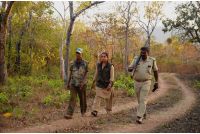
Now, Netra is a member of a team of four forest guards entrusted with patrolling an area of 12.75 sq.km of Kadamattur Katte belt near Maralahalla Camp in Bandipur Forest Range.
She has encountered ‘Prince’, the popular tiger, a couple of times during her patrolling duty. She has also recently seen Prince’s offspring Madesh with its mate and three cubs in the deep forest, not to mention leopards and wild elephants.
Speaking to Star of Mysore, Netra said “I was very afraid in the beginning to venture into the forest alone, but I received a lot of encouragement from my colleagues and parents. Now I am very confident and proud to be a forest guard. The initial reluctance is no more and now I am effectively managing the responsibility I am entrusted with by the Department and feel at home in the forest amid wildlife.”
Project Tiger Director Mallesh speaking to Star of Mysore said that all the staff serving in the Bandipur Forest Range were provided with all facilities
source: http://www.starofmysore.com / Star of Mysore / Home> Feature Articles / March 12th, 2016
M. Arun Shenoy (52), Chairman of Bantwal Sulochana Madhava Shenoy (BSMS) Trust, which runs Kamakshi Hospital in Kuvempunagar and Director of DMS Technologies, Mysuru, passed away in the wee hours of today at M.S. Ramaiah Hospital in Bengaluru after a brief illness.
Arun Shenoy, son of late M. Ananda Rao, partner of Mangalore Ganesh Beedies, was a resident of Jayalakshmipuram.
He leaves behind his wife Shamma, two sons — Arjun and Arinjay — mother Nagarathna, elder brother M. Ashok Shenoy, sisters — Anjana, Anupama and Archana — and a host of relatives and friends.
Last rites were performed at the foot of Chamundi Hill today at 4 pm.
Condoled: The Management and staff of Kamakshi Hospital held a meeting in the hospital premises this morning to condole the untimely demise of Arun Shenoy.
source: http://www.starofmysore.com / Star of Mysore / Home> General News / March 12th, 2016
The collection of stamps and coins is a good hobby which a few pursue. One such philatelist-cum-numismatic is S. Amrutesh, who has kept a low profile after settling down in Mysuru. Very keen to know what efforts the University of Mysore (UoM) was doing to bring out the commemorative stamp and coin during its Centenary celebrations, this shy, reticent, passionate collector opened up to Senior Journalist N. Niranjan Nikam to share his rare collection and the journey thus far.—Ed
S. Amrutesh with his wife Jayanthi.
by N. Niranjan Nikam
If the physically challenged young man had not cajoled me to start the stamp collection, I would never have started this wonderful hobby at all and my life would have been poorer today,” said the tall, erect, shy 83-year-old, even as he started looking at the many stamps and coins, he had spread on the table, through the magnifying glass.
This passionate collector who retired as Manager, Circulation, Times of India, Mumbai, after 36 years of service, settled down in Mysuru almost 24 years ago, was very excited when he heard about the Centenary celebrations of the University of Mysore. He took the stamps of the three Universities of Kolkata, Mumbai and Chennai released in 1957, during their Centenary celebrations and rushed to a Professor in the University asking him whether he could do something to bring a commemorative coin and stamp of our University also.
The philatelist-cum-numismatic was very pleased to hear that the University was making all efforts to bring out both the coin and the stamp this year when it completes its Centenary.
Recalling the days when he first landed in the then Bombay to start his work as an apprentice at the Times of India in 1956, the very calm, composed and reticent S. Amrutesh said, “I used to walk on D.N. Road every evening after work and there were all these stamp dealers who were showcasing their wares in shops and makeshift stands. This boy who was differently-abled and was dealing in stamps of all hues and sizes would change the display every three or four days. One day he called me and asked me whether I collected stamps. I replied in the negative.”
The young man would not leave the passerby alone. He told him, “You just start collecting.” But the problem for Amrutesh was he did not have money to buy the stamps. The dealer asked him how much he could afford and he told him not much. He gave Rs. 60 worth of stamps and asked him to clear it in instalments. “I could afford only Rs. 5 a month for which the young man agreed!” he chuckled.
Asked whether he had any other influence on him, Amrutesh said that his uncle who was a Hindi Professor in the University of Mysore was a collector of stamps. But he always used to show a few collections and immediately hide them. When one is young it is common to show interest in collecting matches, marbles, stamps, coins, peacock feathers, dry leaves and flowers keeping them in-between sheets of books, pencils, pens, erasers, sharpeners and the list can go on.
A majority, however, give it up as one grows and the interests change. The passion for such hobbies is something that one needs to cultivate. “Once when the Gandhi Centenary stamp was released, I stood the whole day in the queue as it snaked its way from the GPO to the VT Station. I finally managed to buy the stamps worth Rs. 50 in the evening at 5.”
There are more than 5,000 stamps in his collection. When one looks at them each one is eye-popping. I was privy to a couple of hundreds only as Amrutesh has stacked them in all available spaces in his home — on the lofts, in the almirahs, in the old aluminium trunks and nooks and corners!
The collection of stamps includes First Day Covers. The Royal Mail First Day Cover issued when it completed 500 years is really eye-catching. The Magna Carta, 1215 — Foundation of Liberty reads, “No Free Man Shall Be Seized or Imprisoned…Except by the Lawful Judgment of his Equals or By The Law of the Land. Magna Carta, 1215.”
There is history, romance, knowledge, ideas and excitement when one embarks on such journeys that last a life time. “One day when my husband was out at work, I got a mail from England from my brother-in-law. In the eagerness to read the letter, I just tore the cover open only to realise that it was a First Day Cover featuring Prince Charles and Lady Diana’s Royal Wedding,” said Jayanthi Amrutesh and added, “I was terrified and grief-stricken to face my husband when he returned. All he did was had tears in his eyes. I promised myself that I would never again repeat the mistake.” But she was happy that her brother-in-law sent a new set which she proudly displayed to me.
Amongst the collections, one which caught my eyes again was the new UN Stamp Supporting Gay Rights, a hot topic these days on LGBT (Lesbian, Gay, Bisexual and Transgender) which the world body has taken note of. “I had asked my son Karthik who lives in the US to send it to me, once he receives it himself at his home, as I was afraid that if I asked for it directly, it would be stolen, something that I had experienced before,” said Amrutesh.
There is also a special commemorative stamp on Mahatma Gandhi printed on Khadi in 2011, as also on First Man on the Moon-1969. The list of stamps include cinema, sports, defence, musicians, composers, freedom fighters, christmas, soccer, birds, wildlife, politicians, tribes of India, sadhus and seers, actors of the likes of Madhubala, playback singers like Lata Mangeshkar, countries that include Pakistan, Canada, New Zealand, Australia and Indonesia.
The brochures that are brought out along with the release of stamps are very informative. For instance, when you read about Nabakalebara, a stamp released in 2015, it gives so much of information that I was inspired to write on it in a Kannada magazine, said Jayanthi.
Coin Collection: Asked when the coin collection began, Amrutesh said that he started collecting them after his retirement. Taking out a collection of coins of England, America and our own country’s old coins which take us back to the ‘good old days,’ when we still used to see the annas, paise (mooru kasu) and the rupee had cent per cent value, Amrutesh said that he has more than 500 coins and still counting.
The Rs. 1000 commemorative coin of Brihadeeshwarar Temple when it completed its 1000 years is a rare collection.
In the present day when hardly anyone writes in post cards, inland letters or airmails, how does one maintain interest in stamps? This question does bother Amrutesh. The attitude of the Postal Department is also something which leaves a lot to be desired.
“The fear of stamps being stolen is always there. Once, I complained to the Royal Mail, England, that I had not received the stamps and the First Day Cover they had sent me. I had written to them after a lot of hesitation thinking that they would ignore my complaint. But I promptly received a fresh set with no questions asked,” he said.
Sadly the same is not true in our country. “I have not received any fresh set of stamps in the last six months. The Post Office in Saraswathipuram is very non-committal,” he added.
He sometimes thinks of quitting but the moment he sees on the internet the stamp on Geological Survey of India released a couple of months ago, “my heart flutters and I feel that I should continue,” said the octogenarian with agony in his voice, even as he answers a phone call from a young stamp collector wanting to know when he is going to get the new set of stamps.
If one is interested in stamp collection, his advise to the collectors is to open a “Philately Deposit Account,” by paying a minimum of Rs. 200 in the Post Office and they would get all the details about the stamps.
However, whether it is philatelist-cum-numismatist Amrutesh, the coin collector R.M. Chetty of the Senior Citizens Forum, Rajarajeshwarinagar or Sanjay Kansal, the coin expert from Delhi — their common interest is to see that the University of Mysore comes out with the Centenary Commemorative Coin and Stamp.
We only hope the Ministries concerned are listening to the call of the collectors.
source: http://www.starofmysore.com / Star of Mysore / Home> Feature Articles / March 11th, 2016
Uber, the technology company that seamlessly connects riders with drivers at the push of a button, has today inaugurated Asia’s first Engineering Center in Bangalore.
Today, Uber celebrated its engineers and together with Thuan Pham, Uber’s chief technology officer, officially opened the doors of Asia’s first Engineering Center in Bengaluru.
After hosting his first chai pe charcha with members of the press as part of the inauguration, Thuan Phamsaid, “The talent we see in India and the sheer passion and eagerness of these Engineers to build world class products and services to improve the lives of people and cities around the world is remarkable,”
The Engineering Center in Bangalore will hire the best-in-class software engineers who will focus on developing customized solutions to better serve our rider and driver partners in India, in collaboration with on-the-ground operations teams as well as global Engineering and Product teams.
Thuan Phama added, “Launching Asia’s first Engineering Center in Bengaluru is a testament to our commitment to investing in India, and I can’t wait to see the innovations that will come from this team as they work to support the phenomenal growth of our business in cities across the country.”
source: http://www.timesofindia.indiatimes.com / The Times of India / News Home> City> Banglore / by Hemali Chhapia / TNN / March 10th, 2016
Cine actor and Theatre Director Mandya Ramesh has been selected for Rotary Kadamba Theatre Award – 2016, given jointly by Rotary Mysore North and Kadamba Rangavedike.
A native of Mandya, Ramesh, who was interested in theatre since his childhood, was trained at Ninasam. Later, he joined Rangayana under the guidance of B.V. Karanth and worked under directors like C. Basavalingaiah and Prasanna.
He made his debut on silver screen through Shiva Rajkumar starer ‘Janumada Jodi’ and went to act in many movies. Mandya Ramesh won the State Award for Best Supporting Role for the movie ‘Nagamandala.’ He has also built a theatre of his own in Mysuru — ‘Natana Rangamandira’ which has been catering to the needs of many theatre buffs in the city.
The Rotary Kadamba Theatre Award-2016 will be presented by Film Director Nagabharana at a function to be held on Mar. 18 at 6.30 pm, according to a press release from Rajashekara Kadama, President, Kadamba Ranga Vedike.
source: http://www.starofmysore.com / Star of Mysore / Home> General News / March 08th, 2016
Front view of Chaturmukha Basadi; (right) Gerusoppa is very close to Jog Falls
Bengaluru :
Stories of kings and queens always attract the young and the old alike. Indian history is abundant with interesting tales of brave queens. In India, where women strive to emulate Sita, and are often docile and meekly submit without resisting , there were valiant women taking up arms against enemies and often succeeded in their attempts. One such brave ruler was Rani Chennabhairadevi, the queen of Gerusoppa, who ruled for 54 years — the longest reign by any Indian woman ruler.
Gerusoppa, situated on the banks of the river Sharavathi in Uttara Kannada, was under the control of the Vijayanagara kings. In the decentralised Vijayanagara empire, various regions were ruled by royal families known as Mahamandaleshwaras. By the early 1550s, Chennabhairadevi, who belonged to the Saluva dynasty, became the queen. As per the inscriptions, her kingdom extended from south of Goa to Uttara Kannada, Dakshina Kannada and Malabar. This region is known not only for harbours like Bhatkala, Honnavar, Mirjan, Ankola and Baindur but also for pepper.
A brass idol of Chennabhairadevi
Honnavar and Bhatkala served as internal and international, flourishing trading centres. Arabian horses and weapons were imported from the West. Pepper, betel nut and nutmeg were exported to European and Arab countries. Chennabhairadevi found herself at confrontation with the neighbouring rival kingdoms as well as the Portuguese. The attempts of the Keladi kings and Bilgi chieftains to pull the queen down proved futile.
The queen had to resist the Portuguese who tried to grab the ports and take over the trade. She was at war with the Portuguese in 1559 and again in 1570. She crushed the Portuguese army with her intelligent battle strategy. One of the Portuguese chronicles states that during the war of 1570, the Portuguese attacked Honnavar and burnt it to the ground. After the decline of Vijayanagar, Chennabhairadevi dealt with the Portuguese diplomatically, who nicknamed her ‘Raina de Pimenta’ — the Pepper Queen.
A letter sheds more light on the importance of pepper trade with the Portuguese. Affonso Mexia, the Portuguese Captain of Cochin, writes to the King of Portugal: “Between Baticala and Goa there are certain places called Onor, Mergen and Ancola, from which I hear 5,000 crusados worth of pepper are annually shipped… These places are under the dominion of Queen of Guarcopa… This pepper is larger than that in Cochin, but is lighter and not so hot. It appears to me that we ought to secure…”
Queen Chennabhairadvi was a Jain. The Chaturmukha Basadi of Gerusoppa is attributed to her. She gave grants to Shaiva and Vaishnava temples too. Saraswath Brahmin businessmen and skilled Konkani craftsmen took shelter in her kingdom to escape Portuguese persecution. Jain scholars Akalanka and Bhattakalaka were under the Queen’s patronage. She is credited with building the Mirjan Fort and is believed to have lived there for several years.
The Keladi and Bilgi chiefs adopted ‘Unity is Strength’ formula. Matrimonial alliances brought these two families together. The combined forces of Keladi and Bilgi attacked Gerusoppa, finally defeating the Queen. Gerusoppa came under the control of Keladi. The ageing queen was taken prisoner to Keladi and she breathed her last in prison. If the strategy of unity was adopted against the foreign intruders, India’s history could have been different.
Queen Chennabhairadevi projects herself as a powerful woman, when other women stayed indoors under submission. She was the contemporary of the Queen Elizabeth I of England and succeeded in ruling for the longest period against all odds.
(Lakshmi Murthy is the principal of J V Vidyapeetha, Bengaluru. Ravi Hegde is a researcher in the field of biological sciences from NIMHANS. They are working as a team in conserving archaeological, cultural and natural heritage of Uttara Kannada district.)
source: http://www.newindianexpress.com / The New Indian Express / Home> Cities> Bengaluru / by Lakshmi Murthy & Ravi Hegde / March 07th, 2016
World Association of Kick-boxing Organisation Indian Unit, WAKO India, had organised Junior National Kick-boxing Championship and Federation Cup (Cadet & Senior) at Takatora Indoor Stadium, New Delhi, from Feb.17 to 21.
More than 900 participants (550 male and 350 female) from Maharashtra, MP, UP, Jharkhand, Haryana, Delhi, Kerala, Tamil Nadu, AP, Telengana, Punjab, Assam, Manipur, Gujarath, Orissa, Karnataka, J&K took part in this event which was divided into 7 categories (Musical Form, Point Fight, Kick Light, Low Kick, Light Contact, Full Contact & K-1).
Kickboxers from Karnataka Kick-boxing Association who took part in this championship won 4 Gold and 1 Silver medals. While Bengaluru’s R. Girish and Ajith Kumar Rai won Gold in -91 kg & -81 kg K-1 senior category respectively, city’s Inchara Bhavith won Gold in – 81 kg Light Contact senior category. Mysuru city’s Karate Kid Deia S. Urs won Gold in the Junior Girls (15 -18 Years, below 48 kg) K-1 Category, becoming the first girl from Karnataka to win Gold Medal in K-1 Category (Full Contact Ring Sport including Knee Strikes). The Karnataka Team was led by Karnataka Kick-boxing Association General Secretary C. Ravi.
Deia S Urs proudly displaying the Gold Medal along with her MMA Coach Kru. Chethan M. Ashwathama at Kimura Fight Club.
The 15-year-old Deia, who is studying in 9th standard at Vidyavardhaka B.M. Sri Education Institutions, Mysuru, is trained by Kimura Fight Club Chief Coach Kru. Chethan Mysuru Ashwathama in Mixed Martial Arts including Kick-boxing, Muay Thai, Muay Boran and Brazilian Jiu Jitsu.
source: http://www.starofmysore.com / Star of Mysore / Home> Sports News / Sunday – March 06th, 2016
Prof. C. Naganna is seen addressing as sculptor L.Shivalingappa, Prof. AVN and others look on.
Mysuru:
“Even as we admire the sculptures at historical places and exhibitions we tend to fail to identify the sculptors,” said Prof. A.V. Narasimha Murthy, Chairman, Bharatiya Vidya Bhavan (BVB), Mysuru.
He was speaking after releasing the books ‘Badami Chalukya Temples Foundation Designs’ by Dr. Virupaksha B. Badigera and ‘Shilpi A. Kiran Subbaiah’ by N.B. Kaverappa at a function held as a part of ‘Shilpakala Sambhrama’ at Maneyangala in Kalamandira in city on Saturday.
Stating that sculptors were professionals who continue their work without expecting any fruits, Prof. Murthy added that it was the duty of the society to identify such persons.
“Tourists do not come to our city to visit IT&BT industries but to study our culture and heritage in which art plays a vital role as it is nothing but the reflection of our society,” he added.
Former Director of Mysore University Prasaranga Prof. C. Naganna spoke about the books. Karnataka Shilpakala Academy Chairman Mahadevappa Shambulingappa, authors Dr. Badigera and Kaverappa were present on the occasion.
source: http://www.starofmysore.com / Star of Mysore / Home> General News / March 06th, 2016