Some of the scientists who work on the Saras programme. | Photo Credit: Sudhakara Jain / The Hindu
Nearly 10 years after a crash seemed to have ended the Saras dream, the turbo-prop plane soared over the crowds at Aero India. The sorties of the 14-seater twin-engine propeller aircraft were perhaps overshadowed by the roar of jet fighters. But for the women of National Aerospace Laboratory (NAL), the anticipation was thick, and their pride soared higher with each sortie.
“Saras is like our second child,” says Manju Nanda, Principal Senior Scientist, Aerospace Software and Information Systems Division (ASISD), NAL.
Following the crash, when funding for the project stopped in 2013, the scientists felt a sense of betrayal.
“We have seen each and every component being developed, every hurdle being crossed. After the crash, we were angry. We did not avail the passes for the aero show… but our passion remained, and now it has risen from the ashes,” says Akshatha H.T., a senior scientist at NAL’s Centre for Civil Aircraft Design and Development who was part of the team that designed the structure of the plane.
The small group of women — as per their estimates, women form just 17% of NAL’s staff — has been critical to the Saras programme. Among them are J. Jayanthi, Chief Scientist, ASISD, and Dr. Nanda who led the team that developed India’s first Stall Warning System software that has been approved for use in aircraft. Lakshmi Devi, Senior Scientist, C-CADD, plays an important role in the team that looks after the electrical systems and their indigenisation while Sivasakthi M., who has worked her way up from a trainee intern to a scientist, is a part of the flight test instrumentation team that keeps an eye on telemetry.
Ms. Jayanthi was among five girls in the B.Tech course in Madras Institute of Technology. By 1989, she was at NAL when there were less than 10 women scientists in the two divisions she was associated with. “More women have joined since then. NAL and other defense PSUs give equal opportunity for women, but the society’s mindset is such that women do not apply in the numbers we desire,” she said.
Over the years, though more women have completed engineering, it is still the private sector that beckons. The prevalent mindset is that aviation is a place suited for men. But, the women at NAL are determined to change that, whether it is an electrical technician who hauls 200kg batteries, or Sivashakti M. who has to climb 20 feet to check tracking antenna as part of her job.
Women in defence
By rough estimates, women now constitute 24% of the armed forces and defence PSUs. However, this is not evenly spread out, with women having lower representation as pilots or technicians.
The International Women’s Pilots Association, which has over 1,000 members across the country, had opened a Bengaluru chapter last week. The chapter is headed by Tessy Thomas, Director General of Aeronautical Systems at Defence Research and Development Organisation, and the first woman to head a missile programme in India.
“In the coming weeks and months, there will be more collaboration with women professionals from DRDO. We want to highlight opportunities not just as pilots, but as mechanical engineers, flight safety officers and the technical side of aviation,” Harpreet A. De. Singh, President of IWPA had told The Hinduduring Aero India 2019.
source: http://www.thehindu.com / The Hindu / Home> News> Cities> Bengaluru / by Staff Reporter / March 07th, 2019
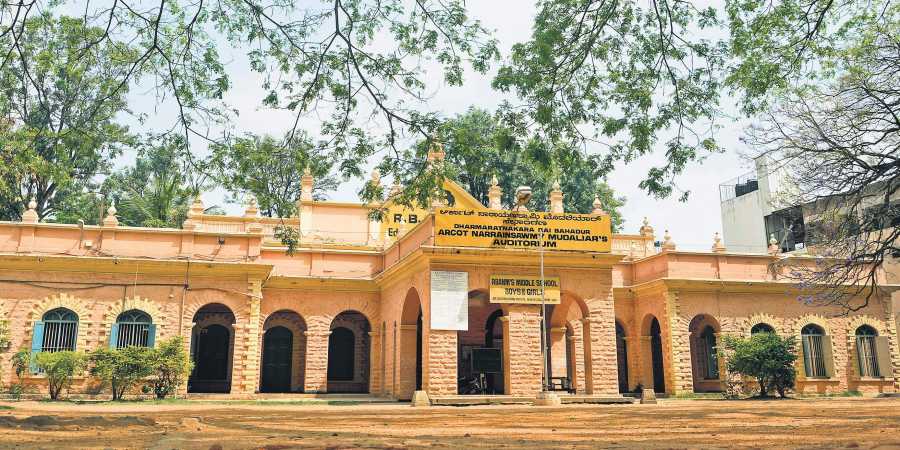
RBANM’s Educational Charities is located in a quiet place in Gangadhar Chetty Road and has been running successful educational institutions since it was founded in 1873.
Bengaluru :
RBANM’s Educational Charities is located in a quiet place in Gangadhar Chetty Road and has been running successful educational institutions since it was founded in 1873. The 146-year-old institution, which was founded by Dharmarathnakara Rai Bahadur Arcot Narrainsawmy Mudaliar, runs and manages five schools, two PU colleges and two degree colleges today.
AA Sanjeev Narrain, secretary, RBANM’s Educational Charities, tells CE that the institution provides education from pre-primary to masters level. It was founded by Mudaliar, an entrepreneur who made fortunes by running various businesses. The founder used to supply furniture to the Maharaja of Mysore and set aside one-third of his wealth for the charitable trust when he got a contract for the High Court. “The primary school was set up to cater an English education to the local population. Indians did not have access to an English education. The schools in the Cantonment area catered only to British and Anglo-Indian kids,” Narrain says.
Laying the foundation
According to a collection of records from Dharmarathnakara Rai Bahadur Arcot Narrainsawmy Mudaliar Family History (1827-1998), Origin and Development of Chattram and Other Charities (1872 – 1998) and Educational Charities (1873 – 1998) by Chitra and T V Annaswamy, Mudaliar founded a free English primary school in the cantonment area with an initial endowment of `15,000. Later, it was raised to `40,000 in a rented building on Commercial Street in his deed of settlement dated April 24, 1873, which was approved by JD Gordon, the then Chief Commissioner of Mysore. Since the initial building was not suitable, Mudaliar constructed a stone building in the spacious high grounds of Dickenson Road at a cost of `50,000. During the period, this school was the only one in the Bangalore Cantonment area that was founded by a Hindu citizen that taught students English up to matriculation.
Narrain adds that Bipin Chandra Pal had served as a headmaster at the school for two years. Pal, who was one of the builders of modern India, had come to Bengaluru in August 1881 to take up the post. He had received the offer through Shivanath Shastri, a Sanskrit scholar. However, two years later, a strained relationship with the proprietor led to Pal leaving the institution to return to Kolkata.
Mudaliar was deeply anguished by the wretched conditions of Panchamas, Pariahs, Valangapurathars and Thirukulathars. They lived in separate localities in the cantonment areas and their children were denied admissions in educational institutions that were meant only for people belonging to a higher caste. Mudaliar tried to persuade the government to provide free education to the downtrodden children but all was in vain. He then took matters in his own hands and established Thrukulathar School in 1883 in Bazaar Street, exclusively for students from lower caste communities.At a time when most women were denied a public life, Mudaliar went on to establish the Govindammal Girls School, which is named after his departed wife, in 1886 at Apparao Lane, Ulsoor.
Second technical institute in city
Earlier, technical education was hereditary, where children of craftsmen learned from their fathers and so on. Providing technical education commenced in the state in the late 19th century, thanks to the first technical educational institute, School of Engineering, in Bengaluru in 1860. The second technical institution, Rao Bahadur Arcot Narrainsawmy Mudaliar’s Technical School, was established in 1887 by Mudaliar. Civil engineering was a part of the syllabus and the annual results of the school formed a part of the Annual Administration Report of the Civil and Military Station of Bangalore. The government back then aided the school by absorbing successful students in the State Public Works Department. The institute also attracted students from other places such as Kodagu and Kerala.
In 1888, he then laid the foundation stone for Narrainsawmy Mudaliar’s High School. The establishment was built in an area of 1.5 acres of land at a cost of `60,000. The school has produced several students now in prominent roles. Owing to the want of sufficient space within the compound for physical exercise, a large open ground has been secured on lease from the military and municipal authorities for the use of the school in 1912. MLA Roshan Baig and former CEO and current vice-chairman of Cognizant Technology Solutions Lakshmi Narayanan are also a part of Narrainsawmy Mudaliar’s High School’s alumni.
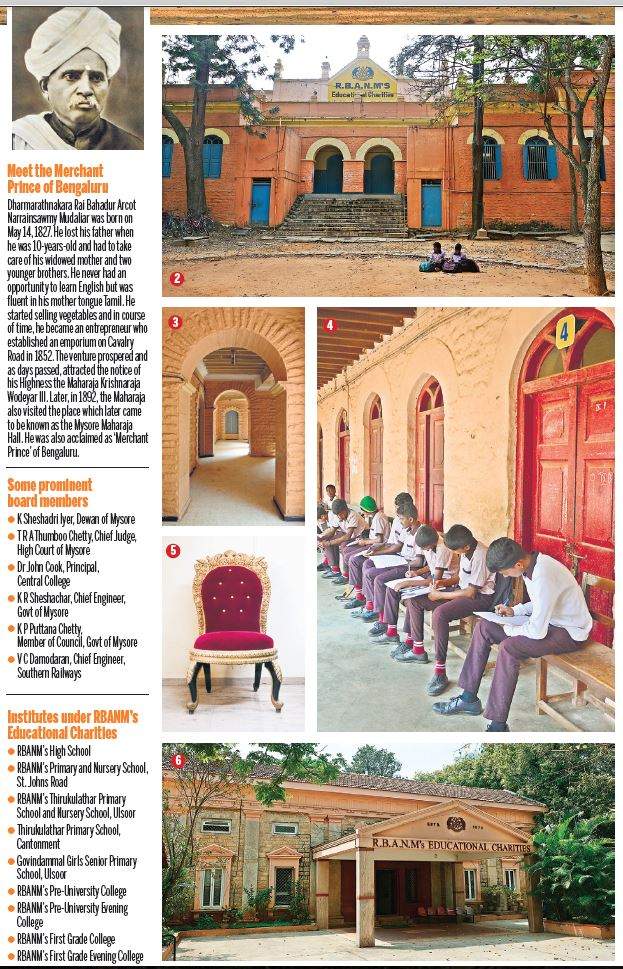
1) RBANM’s Educational Charities located on Gangadhar Chetty Road
2) The trust has nine educational establishments under its umbrella
3) The stone building is of the gneiss type
4) The high school has about 600 students
5) The Wellington Chair presented by the British to the ancestors of Narrainsawmy Mudaliar’s family in recognition of services rendered
6) The carriage portico in the South
7) The paved flooring of the school’s corridor
8) Bipin Chandra Pal had served as a headmaster at the school for two years
9) The old structure has been maintained well by the institute
When Bengaluru was hit by the Great Famine in 1876, Mudaliar invested in the Mysore Railway Debentures to gain security for the amount he had already set aside for schools established by him. On October 13, 1981, the debentures were nearing their maturity and Mudaliar requested the government to permit him to deposit an amount of `75,000 with the government at the same interest paid by the debentures. This was done to ensure safety for the endowment and assured annual income for the schools.
Architecture
The stone building is of the gneiss type, which is generally found in and near Bengaluru. While the floor is all paved, the roof has flat terracing throughout and is supported on steel girders and wooden joists in the hall and on wooden beams and joists in other parts. The building has a main entrance with a carriage portico in the South.
source: http://www.newindianexpress.com / The New Indian Express / Home> Cities> Bengaluru / by Akhila Damodaran / Express News Service / March 07th, 2019
He was an ace linguist, grammarian, lexicographer, editor of numerous volumes, epigraphist and literary critic. He roughly churned out 80 research articles in 40 years in both Kannada and English. Always seen in a close collared coat and dhoti, he was humility personified. The Government of Mysore conferred on him the Kannada Rajyotsava Award. And in recognition of his Lifetime contribution to the world of Kannada Studies, the University of Mysore bestowed on him an Honorary D. Litt in 1969. He is D. L. Narasimhachar, the epitome of scholarship.
By Dr. S. N. Bhagirath
Doddabele Lakshmi Narasimhachar was born on 27th October 1906 in Chikkanayakanahalli, Tumkur district. His father Shamayya Iyengar was a clerk in the Sub-Registrar’s Office. His mother Lakshmamma was daughter of Annaswamy Iyengar, known for his rendition of Mahabharata (Bharathavachana). D.L. Narasimhachar (DLN) spent most of his childhood at Annaswamy Iyengar’s house and he had mastered “Jaimini Bharatha” by the age of 12 ! His family had migrated from Salem during the Vijayanagar Empire’s reign.
Narasimhachar had his schooling at Pavagada, then at Madhugiri and Sira. He learnt Sanskrit through private tuition. While in school, he was an avid contributor to the school magazine “School Folk” which was started by Principal Krishnaswamy Iyer. His earliest articles were an English article titled “The Story of a Cotton Seed” and a Kannada article titled “Dodda Manushyaru Yaaru?” In his school years, he had read works of Raghuvamsa and Champunarayana. During these school years, B.M. Srikantaiah once paid a visit to DLN’s school and took a class on “Stories from Aeneid.” This class captured DLN’s attention and fostered an ardent devotion to B.M. Srikantaiah under whose aegis he would later complete his Master’s qualification.
Narasimhachar joined Central College, Bangalore, in 1927 for his Bachelor’s Degree. His chosen subjects here were Chemistry and Physics. As he scored high marks in Kannada, he joined MA Course (in Kannada) at Maharaja’s College, Mysore. Here, his classmates included K.V. Puttappa, K.V. Raghavachar, Anantarangachar and K. Venkataramappa. While at Maharaja’s College, he came under the tutelage of B.M. Srikantaiah, Rallapalli Anatha Krishna Sharma, C.R. Narasimha Sastry, T. S. Venkanayya and A.R. Krishna Shastry. During his free time, he would frequent Oriental Research Library to peruse old Kannada manuscripts. Narasimhachar completed his MA in 1929 and was awarded the H. V. Nanjundaiah Gold Medal.
DLN was among the first to secure a research grant set aside for the Kannada Department. The Research topic was on the period during which Veerashaiva Literature developed in Karnataka. His first job was as a resident lecturer at Oriental Research Library. Concurrently, he was taken in as a part-time lecturer at Maharaja’s College Kannada Department.
DLN married Muthamma, last daughter of Tiruvallur Sreenivasa Raghavachar, who was himself a great Kannada Scholar. Raghavachar’s residence was a treasure house of rare Kannada books. Narasimhachar utilised this veritable library and penned “Pampa Ramayana Sangraha.” The couple’s first issue was a daughter by name Rajalakshmi. Their second child, a boy, died early in his childhood and this was a great loss to the parents. They would have four more children — Prabha, Padmini, Jayashree and Madhavi.
DLN is famously believed to have dissuaded his first daughter from pursuing Kannada Studies for BA degree. He felt that if she happened to secure a first rank in BA degree, then the gossiping tongues would blame him for favouritism and nepotism !
DLN had a penchant for ‘snuff’, something he picked up from his close friend Kuvempu. Interestingly, Kuvempu is believed to have later given up the habit, whereas his friend continued it till his later years.
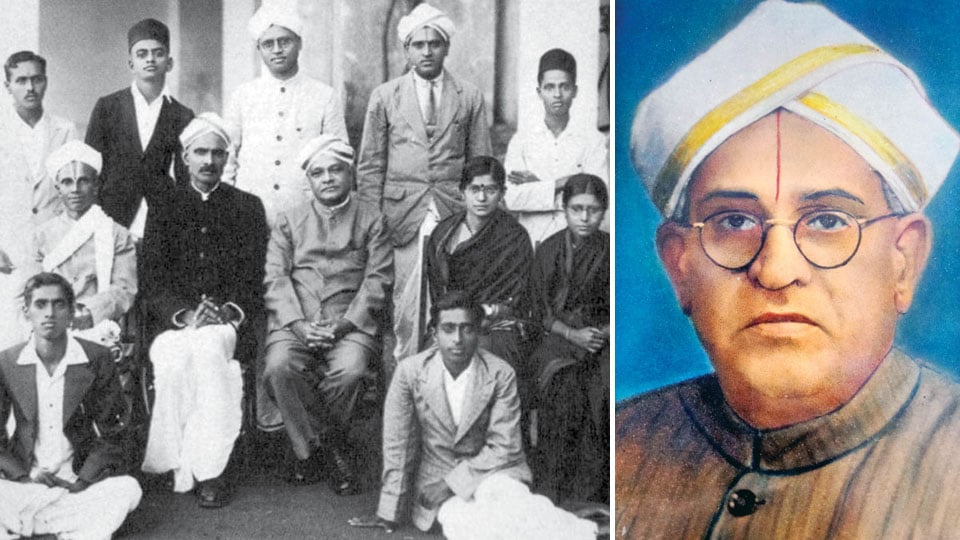
D.L. Narasimhachar (standing second from right); T.S. Venkanayya (sitting second from left), B.M. Srikantaiah (sitting third from left) and G. Venkatasubbaiah (squatting on floor – extreme right). Others’ name not known. (File photo)
Narasimhachar was appointed full-time lecturer in Kannada in 1932 at Maharaja’s College. He remained here for the next seven years and was deputed to the Intermediate College in Mysore (present day Yuvaraja College) from 1939 to 1941. His promotion to the post of Assistant Professor saw him being transferred to Bangalore Central College in 1945. By 1948, he was promoted and consequently transferred back to Maharaja’s College, Mysore.
In 1954, he was appointed Chief Editor of the ‘Kannada-Kannada’ Dictionary Project — a role which required him to again relocate back to Bangalore! Two years hence, by 1956, he was promoted to the post of Professor and came back to Maharaja’s College where he would teach for the next six years before retiring in 1962. His teaching tenure spanning thirty years from 1932 – 1962 was divided almost equally between Mysore and Bangalore.
Following his retirement in 1962, he was appointed UGC Research Fellow for the next six years at the University of Mysore — Department of Kannada Studies. On the demise of T.N. Srikantaiah, he took over the position of Chair of ‘Kannada-Kannada’ Dictionary Project. He eventually presided over the official release of the first edition of the Dictionary. During these years, he published his magnum opus on the art of ‘editorship’ titled “Kannada Grantha Sampadane.” This hectic schedule sadly resulted in him suffering his first heart attack in 1965. Between 1959 and 1963, he edited the prestigious academic journal “Prabuddha Karnataka” on behalf of Prasaranga of Mysore University.
Narasimhachar delivered many lectures on Mysore Akashvani (later AIR). His radio address in 1943 on contemporary Kannada poetry dealt with many elements, which critics later considered to be an early foretelling of ‘Navodaya Literature.’ He penned a memorable preface to K.S. Narasimha Swamy’s famous work “Shilalathe.” His love for ‘Halegannada’ saw him evince keen interest in Epigraphical studies — resulting in a close involvement in the publication of successive volumes of ‘Epigraphia Carnatica.’
His closest acquaintances included T.N. Srikantaiah, N. Shivarama Shastry, K.V. Raghavachar, T.P. Krishnachar, K. Venkataramappa. S. Srikanta Sastri and Kuvempu. Among his list of friends were the likes of V. Raghavan, N. Anantarangachar, Pu.Ti. Narasimhachar, Gorur Ramaswamy Iyengar, D. K. Bhimasena Rao, Manjappa Bhatta, M. R. Sreenivasa Murthy and A. N. Murthy Rao. Among his illustrious students were Parameshwara Bhatta, D. Javare Gowda, H.M. Shankar Narayan Rao, M. Chidanandamurthy and T.V. Venkatachala Sastry.
DLN authored four major works in Kannada, edited about nine comprehensive volumes, penned about eleven prefaces, close to eighty-odd articles across three decades, seven monographs in English and four masterly introductions to various books. His introduction to ‘Vaddaradhane’, ‘Pampa Ramayana Sangraha’ and ‘Sukumara Charitam’ are the best of their kind in Kannada.
Narasimhachar’s scholarship was vast. In fact, it is believed that T.N. Srikantaiah once remarked that “DLN’s name was synonymous with scholarship!”
Maharaja’s College Group Photo (undated) shows (sitting from left) Prof. Chandrashekhar Pattankar Bhat, M.R. Varadachar, Lakshminarasimaiah, M.H. Krishna, A.R. Krishna Sastri, Name unknown, Name unknown, Dr. S. Srikanta Sastri and Ralapalli Anantha Krishna Sharma; (standing bottom row from left) Name unknown, Name unknown, Name unknown, V. Sitaramaiah, K. Venkataramappa, Prof. Nam Sivarama Sastri, Dr. D.L. Narasimhachar and Chengalvarayan. Others’ name not known.
He was an ace linguist, grammarian, lexicographer, editor of numerous volumes, epigraphist and literary critic. He roughly churned out eighty research articles in forty years in both Kannada and English. Always seen in a close collared coat and dhoti, he was humility personified.
He was honoured on multiple occasions by the Kannada Sahitya Akademi. He presided over the 41st Kannada Sahitya Sammelana at Bidar in 1960. He received two Felicitation Volumes — “Jnanopasaka” (1960) and “Upayana” (1967) with rare articles penned by subject experts and close friends. The Government of Mysore awarded the Kannada Rajyotsava Award. In recognition of his Lifetime contribution to the world of Kannada Studies, the University of Mysore bestowed on him an Honorary D. Litt in 1969.
The relentless pace of work sadly resulted in a second fatal heart attack on the night of 7th May 1971. He was 65-years- old at the time of his death. He is cherished by generations of Kannada scholars (many of them his students) who remember his affable, affectionate bearing which often concealed a mountain of intellect.
The Mysuru City Corporation (MCC) has named the Fifth Cross Road in Saraswathipuram after this great soul.
(bugs2beatles@gmail.com)
source: http://www.starofmysore.com / Star of Mysore / Home> Feature Articles / by Dr. S.N. Bhagirath
Each individual has at least 225 crore of wealth; city has seen 36% growth in these individuals in 5 years.
Bengaluru is home to 98 Ultra-High Net-Worth Individuals (UHNWIs), a growth of 36% over the last five years. Each of these individuals has a wealth of Rs 225 crore ($30 million) or more.
In 2013, the technology hub had 72 UHNWIs, according to The Wealth Report 2019 released by global property consultant Knight Frank on Wednesday.
Globally, Bengaluru is expected to see the highest growth rate of 40% over the next five years among 100 cities. By 2023, it is expected that Bengaluru will have 137 UHNWIs. Bengaluru is followed by Hangzhou in China, which is expected to see a growth of 34% in the next five years.
The Wealth Report 2019 provides global perspectives on prime property and wealth. The annual publication includes the Knight Frank City Wealth Index; price movements across 100 luxury residential property markets; the results of Knight Frank’s Luxury Investment Index; and the Attitudes Survey.
The Wealth Report revealed that Mumbai has jumped to the 12th rank from 18th highlighting significant wealth creation in the city. Bengaluru was placed 60th in terms of investments and superceded Mumbai and Delhi.
Overall, India leads with 39% growth, followed by the Philippines (38%) and China (35%). There are 1,947 UHNWIs in India, which is followed by the Philippines. UHNWIs in India grew by 7% in 2017 to 2018, which is well above the global average of 4% and the Asia average of 3%, the report said.
About 61% of Indian UHNWIs expect their wealth to increase in 2019, which shows confidence in the economic growth of the country.
Bengaluru is home to many companies including Infosys, Wipro, Flipkart, and over 400 multinationals like Microsoft, Hitachi and Samsung. This is supported by the fact that the city has been grossing the country’s highest office absorption volume consecutively for the last 10 years and is expected to lead the office growth trend in terms of investments as well as absorption.
“Despite softening momentum in the region’s economies, growth prospects in Asia remain favourable in the medium term,” said Nicholas Holt, Head of Research, Knight Frank Asia Pacific. “While China’s economy is expected to slow, emerging markets such as India and the Philippines will deliver some of the strongest growth over the coming years.”
Bengaluru has made a commitment to creating a knowledge economy by investing in education centres, including the Indian Institute of Management Bengaluru, the Indian Institute of Science and the National Aerospace Laboratories.
“Bengaluru is the first amongst five eye-catching ‘cities of the future’ based on future economic potential. This growth, backed by its intrinsic potential from strong economic fundamentals, will attract investments from domestic as well as institutional sources,” said Shishir Baijal, Chairman and Managing Director, Knight Frank.
source: http://www.deccanherald.com / Deccan Herald / Home> Business> Business News / by Mahesh Kulkarni / DH News Service, Bengaluru / March 06th, 2019
He sets aside a portion of his profits for nurturing the Eshwara Vana that was established on World Environment Day, June 5, 2016.
Nagesh in his forest in Abbalagere village of Shivamogga taluk | express
Shivamogga :
At a time when there is a hue and cry over deforestation in Malnad region, a small-time businessman has managed to turn his one-acre into a forest with more than 35 varieties of trees. Interestingly, it is open to visitors. Nagesh, a caterer, bought the land in Abbalagere village, about 6km from Shivamogga on the way to Shikaripur and planned to develop the land into a forest which he has named ‘Eshwara Vana’. Talking to TNSE, he said, “My idea was to develop a forest and I planted about 350 saplings of trees found in our Malnad forest region.”
He sets aside a portion of his profits for nurturing the Eshwara Vana that was established on World Environment Day, June 5, 2016. “As rains have receded over the last few decades, Malnad region is turning into ‘bayalu seeme’ (plains). The depletion of forest has turned the region into a barren land. Hence, it is our responsibility to improve the green cover. This is a tiny effort towards development of forests,” said Nagesh.
Nagesh visits Eshwara Vana thrice a week to water the plants. The forest has a small house, toilets and water facility. While solar power is used for fencing, electricity is used for drip irrigation of the plants.
Eshwara Vana open to all Nagesh invites everyone to visit the forest and spend time there. Visitors can have food and also offer puja to the Shiva Linga installed there. “Visitors can contact the guard and spend time there.
If they wish to water the plants or offer puja, they can. My only request is ensure cleanliness and not to throw plastic or waste,” said Nagesh. A board has been put up by the side of the road. Travellers going towards Shikaripur can take a short break at the Eshwara Vana. “Nagesh has become a model to others. He is the first person to join us when we go for watering the plants in the city,” said his friend Janardhan Pai. Those interested can contact Nagesh on 98442-82504.
source: http://www.newindianexpress.com / The New Indian Express / Home> States> Karnataka / by Ramachandra V. Gunani / Express News Service / March 03rd, 2019
Some are students, some have jobs, while some are still finding a way to live their life. A few are from affluent families, whereas some come from humble backgrounds.
BUFC scored an average of 3.8 goals every match of the league •Pandarinath B
Bengaluru :
Some are students, some have jobs, while some are still finding a way to live their life. A few are from affluent families, whereas some come from humble backgrounds. Others even had to fight with their families to play a boys’ sport. But all those women from different walks of life had walked side by side for over a month in successfully conducting the inaugural edition of the Karnataka State Football Association (KSFA) Women’s League – Super Division.
With the All India Football Federation (AIFF) making it mandatory for clubs to play in the state league to enter the Indian Women’s League (IWL), KSFA conducted the league and passed with flying colours. On Wednesday, the six-team league came to a conclusion with Bangalore United FC clinching the title.
“People may think getting women’s teams together to play a league is a huge task, but we actually had no trouble finding them. There were huge interests among the clubs to field a team in the women’s league. In the upcoming days, we will have a lower division similar to the men’s league,” said Shaona Sen, League Secretary.
The champions, who maintained an all-win record, also booked a place in the IWL’s next edition. The KSFA is also in talks with the AIFF for the entry of an additional team. BUFC head coach Chitra Gangadharan, the only woman in the state to have an Asian Football Confederation (AFC) ‘A’ coaching licence, was delighted at the progress. The former India skipper had fought a lone battle in providing recognition to women’s football in the state. “With a recognised league, girls can share the same stadium every week. It gives them a regular platform and a chance to pursue the sport professionally.
We also had players from neighbouring states. So, that’s good for the competition within a team,” said Gangadharan.
However, as BUFC sort of disseminated other teams in their way to the title, scoring 3.8 goals every match on average while conceding just one, it questions the competition in the league and readiness of Gangadharan’s team. “We didn’t have great competition in the league. Now, the real challenge will begin, as IWL has mostly international players. We will begin preparations shortly,” she said.
source: http://www.newindianexpress.com / The New Indian Express / Home> Cities> Bengaluru / by Krishnendu Banerjee / Express News Service / March 02nd, 2019
Anuradha Vikranth believes that dance enhances the personality and helps to connect with oneself and will be attending the TEDxMSRIT event as a speaker.
Ramaiah Institute of Technology (Photo | RIT Website)
The talks at the conference, called TED Talks, are then made available on TED.com. Ramaiah Institute of Technology, Bengaluru is organising an independent TEDx event on March 2, 9am to 5pm. Renowned speakers will be joining the event. Anuradha Vikranth is a danseuse who has incorporated dance into every aspect of her life. She believes that dance enhances the personality and helps to connect with oneself and will be attending the TEDxMSRIT event as a speaker.
Other speakers include Archana Timmaraju, who has a hearing impairment, and Daniel Sundaram.
Through sheer grit and hardwork, Timmaraju embarked on a journey called ‘Silent Expedition’ with her partner Sundaram to empower the community across India. Dr Prabha Chandra will also be present at the talk. He is the Head of Psychiatry at NIMHANS and has spent the larger part of her career exploring and unravelling the intricacies of the mind and will enlighten the audience with a talk on the complexities of the mind. Cohan Sujay Carlos is a researcher and the CEO of Aiaioo labs. The speaker’s brainchild, Mechanical Chef, is a robot that can cook more than 100 Indian dishes.
Kim Sain Jidung will also be joining the panel and is actively involved in the drive against prevention of sex trafficking and empowering survivors to lead a transformed life. Girish Badragond is the son of a farmer and is currently a partner at Santepp Systems, a fast-growing technocrat proprietary firm in the field of agricultural technology manufacture. N M Prathap will also speak at the event and is well-known for being the epitome of a small-town boy from Mandya making it big in the world. He won a gold and silver medal and $1,0000 in International Robotics Exhibition held in Tokyo in 2017.
The event will be held at Ramaiah Institute of Technology, Bangalore, on March 2, 9 am – 5pm. Tickets are priced at `800 and available on http://bit.ly/TEDx_Tickets.
source: http://www.newindianexpress.com / The New Indian Express / Home> Cities> Bengaluru / by Express News Service / March 02nd, 2019
The Department of Social Welfare is set to establish two unique museums — Interactive Constitution Museum and the Maharishi Valmiki and Ramayana Museum — in the city.
These museums will be set up in Nagadasanahalli near Yelahanka at a cost of ₹120 crore and ₹60 crore, respectively. The museums will be of international standards and will be constructed on eight acres, Deputy Chief Minister G Parameswara stated in a press release.
“The State government hopes to encourage dialogue between Constitution guarantees and rights that govern the Indian republic, and the spirituality and philosophy that has created one of the richest cultures in the world,” said the release.
The project was spearheaded by Minister for Social Welfare Priyank Kharge, and he said, “The two museums will be the most befitting monuments to the father of the Indian Constitution Dr Babasaheb Ambedkar, and Maharshi Valmiki, who immortalised the epic Ramayana and inspired people with great values.”
source: http://www.thehindu.com / The Hindu / Home> News> Cities> Bengaluru / by Special Correspondent / February 28th, 2019
The hound’s aggressive nature, aptitude for hunting, ability to chase, good stamina and obedience to the owner makes them popular on estates.
A file picture of a Mudhol hound | Express
Vijayapura :
After their introduction in the Indian armed forces, paramilitary Central Reserve Police Force and police squads, the hounds of Mudhol are now in demand among estate owners of Kerala, Karnataka and Tamil Nadu.Coffee and tea planters are showing a keen interest in keeping these faithful hunters on their properties to chase away crop raiding wild animals, and also for vigilance on estates.
The hound’s aggressive nature, aptitude for hunting, ability to chase, good stamina and obedience to the owner makes them popular on estates. Another reason is their low maintenance cost of less than `3,000 per month. The Canine Research and Information Centre (CRIC) in Thimmapur, near Mudhol of Bagalkot, is the official breeding centre of the dog. CRIC functions under the Karnataka Veterinary, Animal and Fisheries Sciences University of Bidar. The demand for Mudhol hounds has increased in the past five years, say authorities at CRIC, which provides a good platform for marketing the hounds.
CRIC has at least 38 Mudhol hounds which are used for breeding. Every year, more than 130 to 140 puppies are sold at this centre and around 60% of the customers are estate owners from Tamil Nadu and Kerala. The Mudhol puppies are sold at a price of `19,000 a pair. The male puppy costs `10,000 and female `9,000.
CRIC is struggling to meet the demands of estate owners, a few of whom have returned empty-handed. Dr Mahesh S Dodamani, head of CRIC, receives at least 10 phone calls from people from other states, asking about the availability of Mudhol hounds. Some families in the region which have taken up breeding of the hound, which also meets the demand to a large extent.
Dr Doddamani told TNIE, “Mudhol hounds are mainly in demand from coffee and tea estates of Tamil Nadu and Kerala. The owners believe that the Mudhol is more faithful than the other breeds and use these faithful hunters mainly to chase away wild animals and also to guard their properties. But we don’t have the same demand from estate owners of Karnataka.”
He concedes that CRIC is unable to meet the huge requirement for the dog. “Mudhol puppies are sold only in two seasons in a year. We sell the puppies on ‘first come first serve’ basis. After the Indian armed forces inducted the Mudhol hound, demand has doubled,” he added.
source: http://www.newindianexpress.com / The New Indian Express / Home> States> Karnataka / by Mahesh M. Gowdar / Express News Service / February 26th, 2019
Vedkiran was devastated when he wasn’t able to hire the right chef who shared his vision for healthy, tasty and sophisticated desserts in his establishment.
Bangalore-based ‘Whitecaps International School of Pastry’ was not just a startup but also what Vedkiran needed to equip his own business along with the entire food industry.
Kochi :
Vedkiran was devastated when he wasn’t able to hire the right chef who shared his vision for healthy, tasty and sophisticated desserts in his establishment. Now, as a businessman himself, he couldn’t afford to go away for a three-year course to learn all the nuances taught in pastry school. “I needed a place that could give practical training in this regard. Theoretical training through conventional courses was not enough,” says Vedkiran. A small look into the state of pastry chefs in the country showed him a bigger picture.
Bangalore-based ‘Whitecaps International School of Pastry’ was not just a startup but also what Vedkiran needed to equip his own business along with the entire food industry. “After failing to find a pastry chef who matches my vision, I did some research into finding professionals and realised that there wasn’t any professional institution to teach confectionery or baking. I always wanted to start up in the food industry and through this research, I also realised the gap that the education sector had with the confectionery industry,” says Vedkiran.
Although some may argue that baking is too niche a category to have an institute for, Vedkiran begs to differ. “We as Indians have a conventional way of seeing things. Anything that isn’t usual, we consider niche. But if you look deeper, most of the urban populace is familiar with international gourmet food. And confectioneries, dessert bars are on a rise lately. You can find sophisticated outlets that exclusively serve desserts running successfully. Today’s urban citizen is not happy with the usual. And, as the industry grows so does the need for professional pastry chefs. That’s where Whitecaps International comes in,” he explains. Whitecaps International School of Pastry offers three-month specialisation courses in various skills required to be a pastry chef with 1 week of industry experience. “Our alumni are already placed in star hotels across the country,” says Vedkiran.
As Vedkiran learns along with students, he also has the help of Aravind Prasad, a celebrity chef who represented India globally. Ved shares, “He helped me structure the courses and his experience and expertise got our students the hands-on learning that they needed to go ahead and pursue their dreams.” Their alumni are placed in prestigious positions in establishments like Shangi La, Ritz Carlton and Hyatt Regency.
Started with a self-funding of `1 crore, Vedkiran after just one year of establishing the institute valuated the company for `11 crores and acquired investment for a 6 per cent share in the company. Besides expanding the infrastructure of the Bengaluru institute, Vedkiran plans on franchising the institute to Hyderabad, Mumbai, Delhi, Kolkata and Chennai.
In a Nutshell
Vedkiran, a Bengaluru-based MBA grad started Whitecaps International School of Pastry in 2016
Self-funded with E1 Cr, the company use their valuation at E11 Cr in a year and got investment for 6 per cent of share
The alumni of the institute work at establishments like Shangri La, Ritz Carlton and Hyatt Regency, while most set up their own confectioneries.
Vedkiran plans on franchising the institute to Hyderabad, Mumbai, Delhi, Kolkata and Chennai
source: http://www.newindianexpress.com / The New Indian Express / Home> Cities> Kochi / by Srividya Palaparthi / Express News Service / February 28th, 2019