M N Krishna Rao park pavillion now a library, move irks family

The MN Krishna Rao park in Basavanagudi, one of the oldest parks in the city has an interesting history.

Bengaluru :

The MN Krishna Rao park in Basavanagudi, one of the oldest parks in the city has an interesting history. Possibly the first park in the country meant only for women and children, the 25-acre park was named after Sir M N Krishna Rao, who was the acting Dewan of the Mysore princely state in 1941. This, as he had contributed generously for the  construction of the park pavilion dedicated to women and children.

However, a recent move to change this pavilion into a public library has attracted the ire of Sir Rao’s family, who are worried that it defeats the purpose of the park. In the early 1940’s, his family contributed a huge sum of `20,000 from his personal funds to build the park and he laid the foundation stone. An additional amount of `15,000 was spent on the two-storeyed Krishna Rao pavilion located at the centre of the park. It was especially planned keeping in mind that women and children in the area had  few places for recreational activities.

“The park was built for cultural events and music for the women and children to enjoy. Now, even men enter the premises. I understand it is not possible to stop anyone but the idea behind this park has changed. A library has been built without even informing us,” said Vikram Simha, the grandson of Krishna Rao.
Simha claimed that neither he nor PR Ramesh, Member of Legislative Council (MLC) were invited to the library opening as well. On asking Ramesh, he replied  that he was not aware of the situation and has requested the library department to make the library available only for women and children.

Interestingly, even the Department of Libraries was unaware of the situation. N Saraswathi, Deputy Director South, said, “I will talk to my senior officials and the Director along with Mayor Gangambike and see if I can allow only women and children to use the library.” Mayor Gangambike said, “The pavilion was in a bad state when we spotted it.Turning that into a library is not a bad idea at all. How can I restrict any one from entering the library? The place is to gain knowledge and everyone should be able to access the library in the park.”

source: http://www.newindianexpress.com / The New Indian Express / Home> Cities> Bengaluru / by Aarthi M / Express News Service / February 27th, 2019

Rare rock art found in Udupi district

Nineteen rocks with petroglyph arts were found at a site, Avalakki Pare, 15 km from Kollur, on February 17.

A petroglyph found near Kollur

Udupi  :

Nineteen rocks with petroglyph arts were found at a site, Avalakki Pare, 15 km from Kollur, on February 17. These were discovered by Prof T Murugeshi of the Department of Ancient History and Archaeology, MSRS College, Shirva, and his team.Prof Murugeshi said these 19 rock etchings were found in 15-20 acres of grazing land in the wildlife reserve forest. These petroglyphs, as per initial understanding, are 12,000 years old, dating back to 10,000 BC.

Of the 19 engravings, 10 are human figures, including one of a baby. Most figures reflect hunting activities. Among the numerous figures at the site, a female figure stands apart. “It was engraved with special care and on the right side of the belly a cup-mark is seen. On the left side over the head, a rectangular cup-mark was created. This forces us to believe that the figure could have had some religious significance,” the professor said.

“These hunting scenes and associated assemblages clearly indicate that the site must have had some connection to the hunter and gatherer culture from the Mesolithic Period. It’s difficult to date the rock art. However, Dr A Sundara, a retired archaeology professor from Shivamogga has suggested they are from the Mesolithic age, from 10,000-3,000 BC,’’ Prof Murugeshi said.

source: http://www.newindianexpress.com / The New Indian Express / Home> States> Karnataka / by Express News Service / February 26th, 2019

Creators of robotic arm and Braille printer win first Aarohan awards

The winners of Aarohan Social Innovation Award in Bengaluru on Tuesday. | Photo Credit: Special Arrangement

A 26-year-old engineering school dropout who designed a robotic arm for those without limbs and a team of fresh-of-out-college students who developed from scratch cheap Braille printers took the top honours at the first-ever Aarohan Social Innovation Awards, instituted by Infosys Foundation, on Tuesday.

As many as 906 innovators in the social sector had applied for the awards. The field was narrowed down to 12 finalists, who were awarded ₹1.7 crore in cash prizes cumulatively.

When Prashant Gade, a resident of Khandwa in Madhya Pradesh, encountered a person without limbs, he knew he had to use his passion for robotics to come up with a solution to help out. He dropped out of college, and by 2015 had started the Inali Foundation to develop a robotic prosthetic arm.

Three years of research and eight iterations later, his myoelectric arm costs barely ₹50,000. “It can lift up to 10 kg and can clasp and unclasp at a thought. It senses the pulses in the nerves and activates the fingers,” said Mr. Gade, who was one of the two winners of the platinum Aarohan award of ₹30 lakh.

Khushwant Rai, 23, was in college when he saw the difficulties of a visually-challenged teacher. Braille printers were expensive, costing up to ₹1.5 lakh, and so even question papers were manually written in Braille for students. While he worked on creating a Braille printer, his batchmate from Punjab Engineering College Anjali Khurana, 22, coded a software to convert multiple languages into Braille for printing. “We built the printer from scratch to reduce the number of expensive solenoids. This way, we reduced the printer cost to ₹30,000. [We] have already tried it in four schools,” said Mr. Rai.

The awards were handed in four other categories, recognising people who have worked to find solutions to various social problems.

Sudha Murty, chairperson of Infosys Foundation, said: “There are also those who left offers of cushy jobs abroad to come to work for solutions here. They fit the criteria of being able to scale up and have tremendous impact,” she said, adding that the awards would now become an annual feature.

source:http://www.thehindu.com / The Hindu / Home> News> Cities> Karnataka / by Staff Reporter / Bengaluru – February 26th, 2019

Medal winners from remote villages hog the limelight at convocation

Some of the medal winners at the convocation of Kuvempu University on Friday. | Photo Credit: VAIDYA

Her parents work for daily wage to meet the educational expenses of their children and other needs of the family. But keeping aside all the problems in her household, Nethravathi K.A. emerged as the topper in M.A. in Kannada, for which she was awarded seven gold medals at the 29th convocation of Kuvempu University on Friday.

Her father, Annappa, works as a porter at coffee curing units in Chikkamagaluru, while her mother, Thangyamma, works as an agricultural labourer in her native village of Kuruvangi. Speaking to The Hindu, Annappa and Thangyamma expressed pride in their daughter’s achievement.

Mr. Nethravathi pursued M.A. at the IDSG College in Chikkamagaluru. “I was attentive in class. In-depth study of reference books helped me develop a comprehensive view of Kannada literature. It is possible to secure good marks with persistent hard work,” she said.

Other medal winners

Vimala R. from Bhadravathi, who secured three gold medals in mathematics, is working as a Grameen Dak Sevak with the Department of Posts in Channagiri taluk. She plans to take the civil service examinations.

Anusha H.V., also from Bhadravathi, bagged four gold medals in M.Sc in Biotechnology. She is planning to pursue Ph.D on herbal cure for cancer. Vimochana from Chitradurga, who got four gold medals in M.A. in Sociology, said she would establish a non-governmental organisation to bring semi-nomadic communities into the mainstream.

Ali Ahmed N., who hails from Seegebagi, a remote village near Bhadravathi, secured five gold medals in M.Sc in Chemistry. He is serving with a biotechnology firm in Bengaluru at present as a research associate and plans to pursue doctorate.

Priyanka T., who hails from Rangenahalli, another remote village, secured four gold medals in MBA. She is serving as manager in the HR department of a private firm in Bengaluru. “Along with academic performance, management students should attain proficiency in soft skills to land a good job,” she said.

source: http://www.thehindu.com / The Hindu / Home> News> States> Karnataka / by Staff Reporter / Shivamogga – February 16th, 2019

‘Kalaburagi is fast developing into a healthcare hub’

Vikram Siddareddy, general surgeon and director of United Hospital, counselling a patient during a free health check-up camp at United Hospital in Kalaburagi on Tuesday. | Photo Credit: ARUN KULKARNI

Referring to expanding healthcare facilities in Kalaburagi, Superintendent of Police N. Shashikumar on Tuesday said the city will become a healthcare hub in the Hyderabad Karnataka region. He was speaking on United Hospital premises after inaugurating a free health check-up camp organised to mark the seventh anniversary of the hospital here on Tuesday.

“With five medical colleges and a dozen private facilities, Kalaburagi is fast developing as a healthcare hub of Hyderabad Karnataka region, just as Manipal in coastal Karnataka and Davangere in central Karnataka regions. Several private players, such as United Hospital, are augmenting healthcare facilities in the region by offering quality services,” he said.

Commending the hospital for maintaining high standards of service and hospitality, the officer said he had not come across any instance of medical malpractice and resultant mass outburst against the hospital and its doctors. He called upon people to adopt a stress-free and healthy lifestyle to avoid visiting hospitals.

Managing director of the hospital Vikram Siddareddy spoke about how he started the venture from scratch seven years ago and developed it as one of the most sought after super-speciality centres for accident trauma and critical care in the region. “We have successfully performed 9,000 surgeries in the last seven years. The commitment and expertise of our team of doctors have earned us a special place in the field of accident trauma and emergency care,”he said.

Around a thousand people were screened and medicines were distributed to the needy for free during the camp.

State Bank of India’s divisional general manager A. Hussein, regional manager Prakash, United Hospital director Veena V. Siddareddy, doctors Mohammed Abdul Baseer, Raju Kulkarni, and Prashant R. Kulkarni, and manager Dawood Ali were among those present.

source: http://www.thehindu.com / The Hindu / Home> News> State> Karnataka / by Staff Reporter / Kalaburagi – February 20th, 2019

Folk art forms come alive at women’s college in Mandya

Students of the Government College for Women participating in ‘Janapada Jatre’ in Mandya on Tuesday.

‘Janapada Jatre’ held to create awareness among students

The rich culture, heritage and values of Karnataka’s folklore came alive during Janapada Jatre, a folk festival organised on the premises of the Government College for Women here on Tuesday.

The day-long event was organised to create awareness among students about fading or disappearing folk art forms. Folk expert Kyathanahalli Ramanna inaugurated the programme and addressed the students, colourfully dressed in saris and other traditional attires. The teaching and non-teaching staff also wore traditional clothes on the occasion.

Mr. Ramanna urged students to strive hard to protect folk art forms and cultures in the State.

A colourful procession, including a bullock cart and various folk troupes, was taken out on the Bengaluru-Mysuru highway.

Veeragarse Kunitha, Dollu Kunitha, Pata Kunitha, Puja Kunitha, Huli Kunitha (traditional tiger dance), Sobane Pada, Garatiya Hadugalu, Kanaja Puja, Dhanya Puja, and Hasemane Padya were performed during the event to enthusiastic applause from the audience that included students, lecturers and parents. There was also a rangoli drawing programme.

A “desi-style” mock wedding of two girls was also organised as part of the programme. Many girls opened stalls and sold home-made delicacies at the college.

source: http://www.thehindu.com / The Hindu / Home> News> States> Karnataka / by Special Correspondent / Mandya – February 20th, 2019

HAL-L&T consortium to start making PSLVs for ISRO soon

Shekhar Srivastava said discussions were under way to assess the exact cost of each PSLV.

Army chief Gen Bipin Rawat gets into the cockpit of the Light Combat Aircraft Tejas during the Aero India show on Thursday | Nagaraja Gadekal

Bengaluru :

Soon, Hindustan Aeronautics Limited (HAL) will start manufacturing the Polar Satellite Launch Vehicle for the Indian Space Research Organisation (ISRO). Recently, the public sector unit formed a consortium with Larsen and Tourbo for this purpose.

Speaking to Express, Shekhar Srivatsava, Chief Executive Officer of HAL’s Bengaluru Complex, said they were in the process of finalising an agreement with ISRO to start manufacturing the launch vehicles. “It is one of the prestigious projects we are associated with,” he said. To a question, he said that they were expecting to start production of the launch vehicles soon.

One of the primary objectives of outsourcing the manufacture of PSLVs to companies like HAL was to decrease their manufacturing costs. “ISRO still has to give us requirements on the number of launch vehicles they might require,” he said.

Considering the number of launches ISRO has every year, HAL is expecting an order of 12 PSLVs every year,he said.

Shekhar Srivastava said discussions were under way to assess the exact cost of each PSLV. HAL sources added that discussions were on and was expected to be finalised soon.

Earlier this year, ISRO chairman K Sivan had revealed that a consortium of HAL and L&T had approached ISRO after the space agency sought assistance from the public sector to manufacture PSLVs, in a bid to concentrate ISRO’s efforts towards research.

While Sivan had said that consortiums consisting of other companies too had approached the agency, HAL sources said they had all the required equipment and partners to produce the launch vehicles as per ISRO’s schedule and requirements.

The history of PSLV launchers in the country has been ISRO’s success story with the rocket emerging as the workhorse of India’s space programme. Chandrayaan-1 too was launched on a modified PSLV launcher in October 2008. Many low-earth orbit remote sensing and earth observing satellites have been launched on board the PSLV, which made its maiden launch in 1993.

source: http://www.newindianexpress.com / The New Indian Express / Home> States> Karnataka / by Akram Mohammed / Express News Service / February 22nd, 2019

IIM-B students’ bio-degradable innovation wins them national contest

The team won a cash prize of `4.5 lakh and have reached out to various scientists to develop it further.

Jinit Dharia, Mit Parekh and Yash Parekh also won a cash prize of `4.5L

Bengaluru  :

In a mission to combat the issue of waste disposal faced by India, three Master of Business Administration (MBA) students from Indian Institute of Management – Bangalore (IIM-B) have developed a bio-degradable packaging material. This is to substitute single-use plastic.Jinit Dharia, Mit Parekh and Yash Parekh won the national finals of ‘The Ultimate Pitch 4.0’, a competition organised by Reliance Industries Limited.

“Our product is a packaging material made from agricultural waste and Mycelium, which is the vegetative part of mushroom. It will act as a glue and bind the substrate together. It is fully bio-degradable as compared to thermocol packaging, which take years to decompose,” said Yash.

The team won a cash prize of `4.5 lakh and have reached out to various scientists to develop it further. “We will take the help of two national incubation centres and scientists to create a commercially viable product. The incubators will help us source raw material to create it. Developing a product prototype will take another three months,” he said.  Once they scale it up, the students plan to promote the product among microentrepreneurs in rural areas surrounding industrial belts in the country.

source: http://www.newindianexpress.com / The New Indian Express / Home> Cities> Bengaluru / by Express News Service / February 19th, 2019

City-based service bridges gap between paediatric oncologists and patients

The current situation in the field of paediatric cancer care looks quite grim.

Bengaluru  :

The current situation in the field of paediatric cancer care looks quite grim. The number of cancer experts who specialise in paediatric cancer is limited. Furthermore, paediatric cancer experts are located only in tertiary referral centres in metropolitan cities and thus, have limited time and availability to treat children with cancer. All hope, however, is not lost. Paediatric cancer specialists anywhere in the world can now share their experience in guiding the treatment plan of children with cancer through Navya Care, a Bengaluru-based clinical informatics system and online expert opinion service.

GitikaBF26feb2019

“Most childhood cancers are curable and enabling infrastructure to deliver care to the children of our country, is of prime importance. Therefore, parents and social support systems should expedite to receive expert treatment plans and evidence-based care at the earliest instead of introducing any procedural delays,” said Gitika Srivastava, founder, Navya. She added that since time is essential, the service enables online reviews by cancer experts in 24 hours.

There are three million cancer patients in India and only 1,500 oncologists, and the number of experts specialising in a specific type of cancer is likely few tens or hundreds, she said. Over 28,000 patients have reached out to Navya, and 75 per cent of these patients are from India.

“There are 300 oncologists on board. Faculty oncologists at Tata Memorial Centre routinely use the Navya system for patients worldwide. Additionally, they are one of the flagship programmes of the National Cancer Grid, which comprise all of the leading tertiary care cancer expert centers from AIIMS in North India to Adyar Cancer Institute in South India,” stated Srivastava.

At their recent presentation at the San Antonio Breast Cancer Symposium and the National Comprehensive Cancer Network Conference, Srivastava spoke about how 97 per cent patients in an international sample confirmed that even a day’s delay in knowing the treatment plan mattered to them. “They experienced significant anxiety relief because of the 24-hour turnaround of Navya.”

Challenges in paediatric cancer
Access to care:
Out of 100 oncologists, probably less than 10 treat paediatric cancers
Access to informed evidence-based expertise:
Treating paediatric cancer patients based on published medical evidence that pertains specifically to pediatric patients, is complex
Access to centres that can provide such care:
There are only a few tertiary care centres with dedicated paediatric disease management groups
Resource constraints:
In India, lack of resources prevents exploration of treatments available to cure children.

source: http://www.newindianexpress.com / The New Indian Express / Home> Cities> Bengaluru / by Akhila Damodaran / Express News Service / February 21st, 2019

An UAV that not only flies, but also remains under water

UAVbf26feb2019

It has been developed by students of Bengaluru’s Sir M. Visvesvaraya Institute of Technology

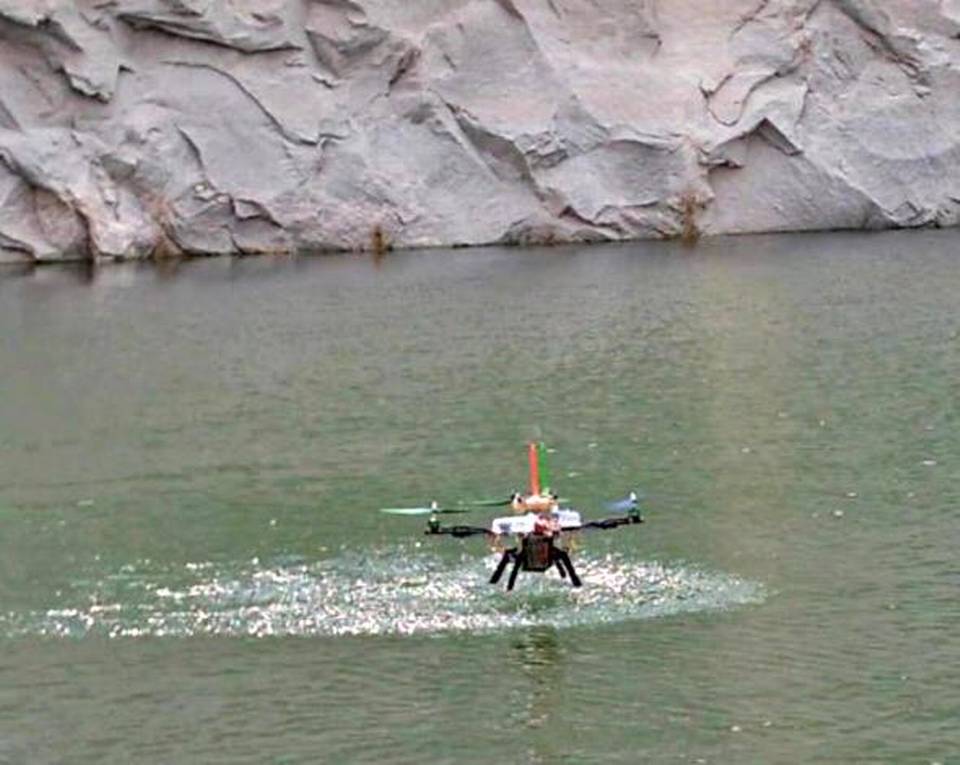
Gannet, a sea bird, is known to pursue its prey under water and is capable of hunting fish by diving into the sea. This Gannet, however, is an unmanned aerial vehicle that is capable of remaining under water like a submarine.

Developed by students of Bengaluru’s Sir M. Visvesvaraya Institute of Technology, the UAV called Gannet on Sunday won the best college project award at Aero India 2019 and students walked away with a cash prize of ₹2 lakh. The UAV can not just fly, but also remains under water and does not require much power.

“It has a separate propeller to move under water and also has navigational wings for the autonomous mode,” said Shiv Varun Singh Rajput, a third year mechanical engineering student of MVIT. He along with D. Revanth, an electronics and communication student, and Aman Singh, student of electrical and electronics, have jointly developed Gannet. The vehicle, which weighs 2.6 kg, can go to a depth of up to 20 metres and can remain under water for months. When required, it can be triggered to move. It can fly for 14 to 20 minutes while can be operated under water for four to five hours.

Currently, Gannet is being incubated at the Indian Institute of Technology-Bombay to scale it up for commercialisation. “We are the first in the country to do an underwater vehicle. We do not want to keep this as a project but want to commercialise the product. It may take about four months to make it market ready,” he added.

Among others, the camera equipped Gannet has civilian application in fisheries industries and pollution monitoring of rivers. “You don’t require divers in many aspects. Instead, the UAV can be operated.”

source: http://www.thehindu.com / The Hindu / Home> News> States> Karnataka / by Special Correspondent / Bengaluru – February 24th, 2019