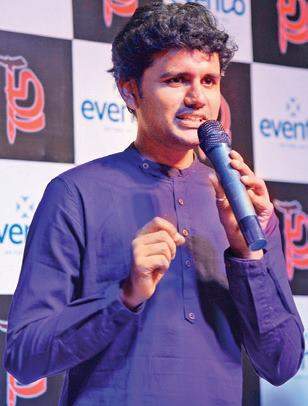
Bengaluru mixologist in high spirits after big win

A 25-year-old bartender from Bengaluru, Rohan Matmary won the Brown-Forman American Whiskey Legacy Cocktail Challenge 2019 held in New Delhi on February 6.

Rohan Matmary
Rohan Matmary

Bengaluru :

A 25-year-old bartender from Bengaluru, Rohan Matmary won the Brown-Forman American Whiskey Legacy Cocktail Challenge 2019 held in New Delhi on February 6. The third edition of the challenge saw participation of 300 mixologists from Delhi, Chandigarh, Gurgaon, Pune, Mumbai, Goa, Chennai and Bengaluru and 17 of them were shortlisted for the finale.

The competition was judged by industry experts, including Yangdup Lama, one of India’s finest and well-known mixologist; Vikram Achanta, CEO and co-founder of the popular portal Tulleeho and Vinay Joshi, Brand Manager, Jack Daniel’s for Indian subcontinent and Maldives, Brown-Forman Worldwide LLC. The annual championship expects mixologists to create some signature cocktail recipes with some of the most well-known American whiskies. Matmary, a mixologist at the Byg Brewsky, Sarjapur Road, prepared Lillianaire and Aztec Mule at the finale. Lillianaire is a combination of whiskey, hibiscus plant and egg white and Aztec Mule is a mix of whiskey, pineapple, jaggery and jalapeño.

He says, “I created these cocktails over three months with several trials and errors and received feedback from my customers. Some said it’s spicy and others found them too sweet. So I worked on creating a balance between sweet and sour so that it suits the Indian palate. Indians prefer their drinks slightly sweeter, while Americans prefer it sour.” He adds that as these combinations for cocktails are rare, people were initially hesitant to try. Coming up with these recipes weren’t easy for Matmary. “These ingredients are a rare combination. Some, for example, would associate hibiscus with whiskey. So, I did a lot of trials before making these creations,” he says, adding that these cocktails will be included in the menu and patrons can try them with some meat options. “Lillianaire is quite velvety while Aztec Mule is very tiki-like, fun-loving and a good drink during a brunch,” he says. But, his personal favourite is
Aztec Mule.

This was the second time Matmary participated in this challenge. Last time, he secured the second position. “This time, luckily, I came first,” says Matmary, who has always been interested in bartending and loves trying out different combinations with whiskey and gin.

Now, the 25-year-old bar chef will go on a guided tour to the Jack Daniel Distillery in Lynchburg, Tennessee, and the Woodford Reserve Distillery in Versailles, Kentucky, USA. Besides the distilleries, he will also attend the Bar Convent Brooklyn, a leading international bar and beverage trade show, as part of a global bartending contingent and rub shoulders with some of the best bartenders globally.

source: http://www.newindianexpress.com / The New Indian Express / Home> Cities> Bengaluru / by Akhila Damodaran / Express News Service / February 18th, 2019

New haven for art

Art meets heritageAt Kadri Rocks / Special Arrangement

An old house is converted into an art gallery called Kadri Rocks

Whenever we think of an art gallery, our minds is flooded with the images of Venkatappa Art Gallery (Bengaluru) or Prince of Wales Art Gallery (Colaba, Mumbai). These galleries are housed in heritage buildings that have their own aura. Now even Mangaluru boasts of one such gallery, Kadri Rocks, which has an old world charm and also offers a glorious artistic space.

The D’Souza family has lived here for nearly a century. “The space has many memories associated with it, which is why I wanted to convert this house into something that everybody, art lover or otherwise, could enjoy, says Harsha D’Souza, proprietor of Kadri Rocks. “Hence, it was turned into an art gallery.”

At a time, when many have sold off their homes to make way for multi-storey buildings, Harsha wanted to use his home to promote art as he once dreamt of being an artist himself. “But life had different things in store for me.” Harsha chose to dedicate a large chunk of his land and the family home, in the uptown Mangaluru to art.

The brick red walls, red oxide floors, tiled roof, long corridors, spacious halls and verandas and wooden grilled windows give a perfect setting for an art gallery. But it is not the art on canvas alone that Kadri Rocks is looking at, Harsha is even open to letting out the space to basket weavers, potters, mural makers and so on.

“I learnt that basket weavers in coastal districts are a dying tribe. During a visit to Naravi, Hebri and Moodbidri, I discovered that basket weavers were disappearing by the day. Their children had gone to the city in search of jobs. We have a treasure trove of art, which is handed down for generations and it can be turned into an entrepreneurial venture.”

In another of his expeditions, Harsha came across a community of potters in Nilambur in Tamil Nadu who specialised in making clay murals. “Kadri Rocks will showcase their work,” Harsha says.

source: http://www.thehindu.com / The Hindu / Home> Features> MetroPlus / by M. Raghuram / February 25th, 2019

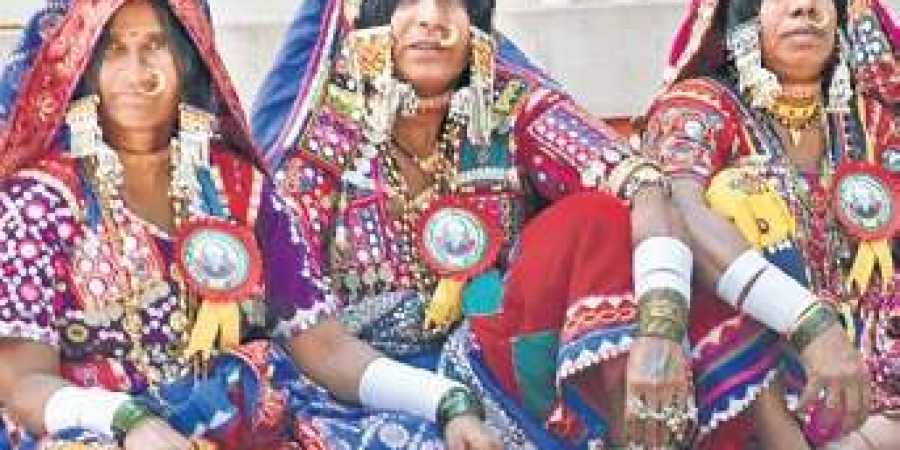
Lambani art soon in fashion spotlight

The distinctive fabrics created by members of the Lambani community may soon get a global push, with the state government providing them assistance to work with the latest trends.

LambaniBF25feb2019

Bengaluru :

The distinctive fabrics created by members of the Lambani community may soon get a global push, with the state government providing them assistance to work with the latest trends. The Lambani women make colourful pieces of cloth, embellished with mirrors and embroidery.

The Department of Skill Development and Entrepreneurship and Livelihood has identified several traditional art forms, including Lambani embroidery, Bidri arts from Bidar, and wooden toys of Channapattana, which would receive encouragement from the state government.

It has decided to open ‘Traditional Art Skill Schools’ to revive these arts forms and promote artisans at Gadag, Hoovinahadagali in Harapanahalli taluk, Suryagondanahalli in Nymathi taluk and Kanakapura taluk. A government order to set up these training schools was issued recently.

Skill Development Minister Parameshwar Naik said many traditional art forms, which are part of our rich heritage, are vanishing. Artisans with no market for their products are moving to cities for work. “In a bid to stop them from migrating to the city, and renew the age-old crafts, we have started the training school where the government will upgrade their skills to cater to the present market,” he said.

Karnataka has the second largest population of Lambanis in India. Naik said they possess skills that are passed through generations. “To give their creations a modern look, we will sign up fashion designers who will train the Lambani women, giving them ideas about the colours and designs that are in trend now. A three-month residential programme will be conducted at our skill training schools,’’ he said.

 
After their training, the women will head back to their villages armed with raw material and financial assistance in form of loans. “These women can then make the cloth, which we will buy. These products will also be sent outside Karnataka and even the country, giving them a brand identity,’’ Naik said. The government will also provide them space at various art exhibitions to give them a market platform.

source: http://www.newindianexpress.com / The New Indian Express / Home> Cities> Bengaluru / by Ashwini M Sripad / Express News Service / February 25th, 2019

Bengaluru firm develops fire-fighting drone

Drones delivering goods ordered online and being used to photograph exotic locations which are inaccessible to humans are already well known.

A heavy-lift hybrid drone developed by Poeir Jets

Bengaluru :

Drones delivering goods ordered online and being used to photograph exotic locations which are inaccessible to humans are already well known. How about a drone-based fire extinguisher that can reach any spot without the hassles faced by fire tenders or firemen?A Bengaluru-based aerospace firm — Poeir Jets — is developing heavy-lift hybrid drones for the purpose, which has already attracted the attention of a Spanish firm, Drone Hopper, for mass production.

Speaking to TNIE, Devathathan Mookiaha, director of Poeir Jets, said that the ‘Urban Firefighting Hopper’ is designed to restrain fires, especially in high-rise buildings. “The drone uses six micro-jet engines — developed by Poeir — to carry either extinguishing foam or water to douse flames,” he said.
The hopper is among the four heavy-lift drones being developed by the firm. “For the ‘Firefighting Hopper’, one-third of the research grant is being provided by the Department of Science and Technology,” he said.

Mookiaha and the firm’s co-founder Sridhar Balaram have been developing heavy-lift drones for the past three years and were the first company in the country to develop micro-jets. These micro-jets are being used for drones developed by the company.

Poeir Jets has also launched three heavy-lift drones during the ongoing 12th Aero India. While its Turbo Shaft MTS 30 will be able to carry weights of up to 200 kg when fully developed, Hybrid Drone DJE 30 has a capacity to carry weights of up to 75 kg for more than two hours.

source: http://www.newindianexpress.com / The New Indian Express / Home> Cities> Bengaluru / by Akram Mohammed / Express News Service / February 23rd, 2019

Mysuru cocoon market opens

inister for Sericulture S.R. Mahesh, Minister for Higher Education G.T. Deve Gowda, and Mayor Pushpalatha Jagannath at the cocoon market in Mysuru on Sunday.

A publicity campaign was held in Manyda, Mysuru, and Chamarajanagar earlier

A cocoon market began functioning on the Agricultural Produce Marketing Committee (APMC) Yard in Bandipalya on the outskirts of Mysuru on Sunday with more than 3,000 kg of cocoons auctioned on the first day.

The cocoon market in Mysuru will have to vie with established markets in Ramanagaram, Malavalli, T. Narsipura, Kollegal and Santhemarahalli, among other places in the region.

Nataraj, Joint Director of Sericulture, Mysuru, said the cocoon market received a good response. More than 3,000 kg of cocoon was sold. The maximum price was ₹413 per kg and the lowest was ₹280 per kg.

Officials of the Department of Sericulture had carried out a publicity campaign in sericulture-intensive areas of Manyda, Mysuru and Chamarajanagar ahead of the start of the cocoon market here.

A cocoon market in Mysuru will be of convenience to farmers in the region as they can avoid the expenditure otherwise incurred on transporting produce to other far away markets. “For farmers who grow other produce, a cocoon market in Mysuru will help them bring the cocoons to the APMC yard and sell other produce too,” Mr. Nataraj said.

Earlier, Minister for Sericulture S.R. Mahesh, who inaugurated the market, recalled Mysuru’s more than two centuries old agricultural tradition of sericulture introduced during rule of Tipu Sultan. Presently, more than 12 lakh families are dependent on sericulture in Karnataka with Mysuru earning a name for itself in the silk industry.

In the absence of a cocoon market in Mysuru, efforts were made to establish a market to cater to districts of Chamarajanagar and Mandya along with Mysuru, which together had a total of 36,000 growers and 735 reelers.

55 cocoon markets

Karnataka, which is the leading silk producer in the country, has a total of 55 cocoon markets including 20 seed cocoon markets and 35 commercial silk cocoon markets.

Mr. Nataraj said the cocoon market was presently functioning from a premises rented from the APMC yard. The buyers and sellers have to pay 1% of the transaction amount as market fees.

Though the department was facing a shortage of staff in Mysuru to handle the affairs of the market, about five persons including a demonstrator, a first division assistant, and an inspector have been drawn from different places to assist them in the functioning of the cocoon market.

5,000 acres of land

According to Javare Gowda, Deputy Director of Sericulture, Mysuru, Mysuru district alone has mulberry cultivation spread across more than 5,000 acres of land in 600 villages with more than 3,300 farmers and their families engaged in sericulture activities. “A total of 70,000 to 75,000 kg of cocoons are reared in Mysuru every month,” he said.

source: http://www.thehindu.com / The Hindu / Home> News> States> Karnataka / by Special Correspondent / Mysuru – February 24th, 2019

Inspiring village near Karwar shows the way forward

If you want to know what a model Green Village looks like, then you have to visit Satageri near Karwar.

Solar light and battery at a house in Satageri

Karwar  :

If you want to know what a model Green Village looks like, then you have to visit Satageri near Karwar. Until three years ago, women had to blow and invariably inhale the smoke while cooking on firewood. Not any more. Now they boast of an LPG connection. This is not the only clean and green change in this village.

Satageri, located about 25 km from Karwar and surrounded by forests of the Western Ghats, proudly displays solar power, LPG connection and toilet in every house. Solar lamps light up the houses. People do not throw any waste on the streets, and even make vermicompost for use in their garden and fields. The village, with 70 houses and a population of about 270, sets an example of how people can live with forest and nature without harming it.

“We are happy to live here and nobody is interested in leaving the village any more,” says Gajer Vaikuntha Marathe, a farmer from Satageri.The villagers cannot thank the forest department enough for the change that it ushered into their hamlet over three years ago. The forest department took Satageri under its wing in 2016, as part of the Green Village and Smokeless Village schemes of the state government.

LPG cylinder and gas stove;

It distributed free LPG connections and two solar light systems to each house. A total of 12 solar street lights were also set up.According to a senior forest officer, since 34 houses already had LPG connections, they distributed free connections to the remaining 36 houses. All the people were also given fruit and flower saplings, and encouraged to grow trees near their houses. The place has now been converted into a Green Village.

The situation was far different here earlier. The village was like many others in the country. People collected firewood from the forest, electricity was a nightmare during the monsoon months and the surroundings, though enveloped by a verdant green cover, were not clean.Women had to go to the forest every day to collect firewood, otherwise they faced shortage to meet the daily household needs, says Malita Mohan Marathe, talking about how the practice has been stopped over the last three years since food in every house is now cooked using LPG.

Gajer Vaikuntha too points out that all the villagers have happily adopted the new way of life. Each house got a toilet constructed under the Gram Panchayat scheme.Vinod Marathe, who runs an autorickshaw, says he earlier used to pay `100 towards the electricity bill every month, but the charges have come down by half after solar light system was installed at his house. His family uses electricity only to watch TV, and to run the refrigerator and mixer-grinder while the house is lit using solar power.

Satageri has a primary school, and after completing Class 5, children travel 3 km to Ulga village for pursuing higher education, including graduation and some professional courses. People here are engaged in various occupations, including farming, daily wage labour, and small businesses. Some of them work in Karwar and other nearby towns while four persons hold government jobs. Women mostly look after the house and work in their fields.

They are also involved in making vermicompost, and are part of the Village Forest Committee (VFC), that strives to conserve the forest and wildlife, and protect it from poachers. They plant saplings and take up other work with the forest department, for which the latter shares its profit with the VFC.Satageri, which comes under Gopishitta range forest, was selected to be developed as a model village in 2015-16, says K Ganapathi, Deputy Conservator of Forests, Karwar Division. He lauds the women of the village for their commitment towards protecting the forest. “We wish such VFCs come up in other villages too,” Ganapathi says.

What is a Green Village?
State forest department’s Green Village scheme aims to make the whole village smokeless by making people stop using firewood and opting for LPG stoves. Satageri village of Karwar taluk was selected under the scheme on a pilot basis.

Tackling Poverty
More than 65 families of the village have Below Poverty Line (BPL) cards, and all of them have enrolled in Mahatma Gandhi National Rural Employment Guarantee Act (MGNREGA). They have been earning money by taking up activities such as developing  the school ground, desilting the pond, and other  works.

Natural Treasures
The village is surrounded by the thick and evergreen forest of Western Ghats. Along with precious wood, it is home to wildlife such as leopard and black panther. The Kali river flows just a few kilometres away from the village.

source: http://www.newindianexpress.com / The New Indian Express / Home> States> Karnataka / by Arunkumar Huralimath / Express News Service / February 24th, 2019

Veteran Kannada writer Ko Channabasappa passes away

Ko Channabasappa | Photo Credit: Special Arrangement

He died at a private hospital on Saturday morning.

Ko Channabasappa, former judge, writer and a well-known liberal voice in Karnataka passed away on Saturday. He was 97.

He presided over the Kannada Sahitya Sammelana at Vijayapura in 2015. In his Sammelana address, he had defended an individual’s right to expression. He was the recipient of several awards including the Rajyotsava award.

Channabasappa died at a private hospital on Saturday morning. He is survived by two sons and two daughters.

source: http://www.thehindu.com / The Hindu / Home> News> States> Karnataka / by Special Correspondent / Bengaluru – February 23rd, 2019

Seeing 70mm: Mysuru youth’s novel makes its way to the big screen

A Kannada film, Kalbettada Darodekoraru, based on a novel written by Mysuru youth Anush A Shetty is all set to hit theatres this Friday.

Anush Shetty
Anush Shetty

Bengaluru  :

A Kannada film, Kalbettada Darodekoraru, based on a novel written by Mysuru youth Anush A Shetty is all set to hit theatres this Friday. Shetty, a writer and a musician ventured into novel writing while pursuing his Masters. A multi-faceted personality, he not only writes books but is also an exponent in Tabala, Mridangam and other percussions. Kalbettada Darodekoraru isn’t Shetty’s first novel and he has penned four books in total. Ahuthi was his first work, then followed Kalbettada Darodekoraru, Jodpala was third and then Neenu Ninnolage Khaidi was his fourth.

His fiction novel Kalbettada Darodekoraru turned out to be a milestone in his career as a writer as the novel inspired filmmaker Deepak Madhuvanahalli to bring the story to the big screen. It all began when Madhuvanahalli read an article about Shetty and his book. Having liked the novel penned, the filmmaker decided to transform the story into visual art and contacted Shetty for the rights.

“In the past, many people got in touch with me to make a film or short film on the novel, but most of them did not turn up later. Similarly, when Deepak got in touch with me, I did not take it seriously but was surprised when he came with a producer and asked for the rights,” says Shetty.

He added that since he had watched Madhuvanahalli’s previous film Bhagyaraj, which he found “sensible”, he decided to give the rights to the filmmaker. Shetty played an active role in the scripting process and was in constant touch with the team. “They retained the structure of the novel and have made a few necessary changes to fit the story into the film’s format,” he said.

An ardent follower of columnist Abdul Rasheed, Shetty is planning to publish a book soon, on a collection of stories of Rasheed under Anugraha Prakashana. “I am also penning a few short stories that will be made into a book collection of short stories in the near future,” said Shetty, who has also been associated with two music bands ‘Naavu’ and ‘Rhythm Adda’ as well. Kalbettada Darodekoraru is made under the banner of Bridge Cinemas, starring Nataraj, Shwetha R Prasad and Hemanth Sushil in major roles and has music by composer and singer J Anoop Seelin.

source: http://www.newindianexpress.com / The New Indian Express / Home> Cities> Bengaluru / by Karthik K K / Express News Service / February 19th, 2019


U-17 football World Cup star chasing his dream to play in Europe

Sanjeev Stalin assisted Jeakson Singh for India’s only goal in a FIFA World Cup (U-17) against Colombia in New Delhi in October 2017.

Sanjeev Stalin (left)

Bengaluru :

Not everyone fulfils their dream of playing professional football. Stalin too had to be satisfied with amateur football with the Aeronautical Development Establishment. But he and his wife Parameshwari, who were running a small roadside garment shop in Bengaluru, were determined to make their son Sanjeev a professional footballer.

They gambled everything on their 10-year-old son, sending him to Chandigarh Football Academy. Little did they know that their son would script history for India seven years later. Sanjeev Stalin assisted Jeakson Singh for India’s only goal in a FIFA World Cup (U-17) against Colombia in New Delhi in October 2017.

The 18-year-old has come a long way since then. He is an integral part of Indian Arrows squad (All India Football Federation’s developmental team) which helped him support his family. While he is fulfilling his father’s dream, the boy refuses to let success get to his head.

“Playing for India was a dream come true. All the sacrifices my parents made, paid off. It is an experience which will always stay with me. I’m thankful to my parents who made the tough choice of sending me away. It helped change the situation in my family. I could help my parents with money,” he added. In his second season with the Arrows, the left-back is making a transition to a winger. Despite the limited opportunities he is getting, he is pushing his limits to play better.

“People say U-17 WC was the best achievement. But it isn’t everything. I’ve just begun. It was initially difficult to play against experienced players in the I-League. They were older and better than us. I had to adapt to that. It’s been a great learning opportunity. Thanks to all the coaches, especially Nicolai Adam (former India U-17 coach), who gave me the confidence,” said one of the only three footballers from Karnataka playing in the top divisions (I-League and Indian Super League) of India currently.

His coach at the Arrows, Floyd Pinto, is also impressed with his commitments. “Sanjeev has been brilliant so far this season. He is the one who has the capability of dribbling and opening up defences. He can assist and score goals. That’s the role we want to see him in,” Pinto said. But Sanjeev is not swayed by glitzy lifestyle. He wants to grow as a footballer and play in Europe. “I have so many dreams, so many targets. But for now, I want to keep my family happy, play best to my abilities and leave the rest to God,” he said.

source: http://www.newindianexpress.com / The New Indian Express / Home> Cities> Bengaluru / by Krishnendu Banerjee / Express News Service / February 20th, 2019

New imaging technology to the aid of manuscripts

Professor P.R. Mukund and MegaVision president Ken Boydston with the multispectral imaging.

It is currently being used on rare texts in Udupi’s Ashta Mutts

Thousands of manuscripts scattered across India — many lying in neglect or threatened by the exposure to vagaries of nature — are facing threats of destruction. To preserve them, a Bengaluru-based not-for-profit organisation has procured a highly advanced multispectral imaging technology to capture their images. The technology is currently being used on rare texts in the Ashta Mutts of Udupi.

What is special about multispectral imaging is that it can capture texts in manuscripts that are affected by pests, fungus, over written, scribbled, blackened or scraped and cannot be seen with bare eyes. It uses infrared rays and ultraviolet rays to retrieve texts.

Its importance

“Mapping of knowledge is important in the current context. People are not bothered about these manuscripts because they do not see a direct relation with them and understand the importance of the stuff in it,” says P.R. Mukund, professor, Electrical Engineering, at Rochester Institute of Technology and founder of Bengaluru-based Tara Prakashana. “We have brought the technology for the first time in the country and the services would be offered for free. Our aim is to preserve the important written scripts in the country for posterity,” he said.

Tara Prakashana has acquired the imaging system from the U.S.-based MegaVision, a leading digital imaging company, that has worked in similar projects across the world and MegaVision president Ken Boydston has been training people in handling the multispectral imager over the last week.

Prof. Mukund’s interest in developing technology that would help conserve the knowledge for posterity started more than a decade ago when his guru Bannanje Govindacharya sought his help in conserving the 800-year-old Sarvamoola Grantha, authored by Saint Madhvacharya. The text is in the possession of Palimar Mutt and was found to be in bad shape in 2006.

“At that time, I did not have any idea about processing of manuscripts. Help came from a fellow professor from the imaging department at Rochester,” said Prof. Mukund. Since then, more than 3,000 rare manuscript bundles have been digitised, a small part of which has now been published into 500 archival books and nearly 1,000 more archival books will be ready shortly. Currently, ancient texts belonging the lineage of Saint Madhvacharya that are in the possession of the Ashta Mutts in Udupi are being digitised using the technology.

For Mr. Boydston, his association with the project comes from his love to protect ancient works, though he says cultural imaging is still not profitable. “I get to meet people who really know stuff. Even if no money is being paid, there is a lot of stuff to do. Objects [antiquities] have great value. Experts know historical contents and to be in the project is a great honour,” he said.

“We want to make the imaging complete and accurate following which several bundles of copies can be generated to preserve the knowledge for future generation,” said Mr. Boydston.

The next stage

The conservation efforts does not stop at capturing the images of manuscripts. While creation of e-library of manuscripts for the scholars to retrieve and research is currently under way, Tara Prakashana has published about 500 books of manuscripts.

“We have used the acid-free cotton archival paper for publishing these manuscripts. These special papers can last another couple of hundreds of years,” said Prof. Mukund.

To enhance the time span of the texts captured in images, a patented technology developed by Prof. Mukund called the wafer fiche, is being used. Using photo lithography technology, the images are imprinted on silicon wafers. “These copies can last for thousands of years,” he said.

source: http://www.thehindu.com / The Hindu / Home> News> Cities> Bengaluru / by Sharath S. Srivatsa / Bengaluru – February 17th, 2019