Meet the men behind Vistara Farms, makers of goat cheese and goat-milk yoghurt

Goat’s milk for health was an old wives’ tale, but 20 friends gave up their jobs to make it a marketable product
What’s common between an IT accountant, a driver, a retail manager and a grocery store-owner? Goats.
The overwhelming smell of goat dung greets us as we walk into Vistara’s farms in Kunthur, Karnataka. The auditory accompaniment is the bleating of hundreds of goats and the hysterical barking of the Mudhol guard dog. Inside the farm, the goats, grouped according to size and sex, stand in their wooden stalls, eyeing us.
The big male goats reach almost to our shoulders. They push around in their pens, their long, silky brown ears flapping around their big, bony faces. As a welcome drink, we are offered a glass of fresh goat milk, still warm and frothy. The taste is not unlike cow milk, but with an added smokiness. Krishna Kumar A.N. and his friends show me around their farm with a sense of proud proprietorship.
With kid gloves
When Krishna starts talking about his goat farm, it’s difficult to get a word in edgeways. On the nearly 160 km drive from Bengaluru to this farm in Kunthur, Krishna has barely paused in the recital of his dream of promoting goat-milk products. His loquacity is apparently quite typical, quip his close friends, who are now his partners at Vistara Farms and are travelling with us.
“I’m just a bridge,” Krishna says, when described as the prime mover behind Vistara, but he is not just any bridge. He has been the link that has brought together 20 people from diverse experiences to turn an ordinary village remedy into a business venture.
Krishna persuaded them to put in their small savings, and he took a personal loan by mortgaging his mother’s jewellery. They bought a farm near Kunthur and began stocking up on goats. Now they have two farms and 200 goats supplying 50 litres of milk per day.
“When we were young, if someone fell ill in our village, they would say, ‘give him goat milk,’” says R. Chetan Kumar, 31, one of Krishna’s friends, who now manages Vistara’s marketing. And as the last days of school drew to an end and the discussions of what to do with their lives got more heated, they remembered the health benefits of goat milk and the fact that it wasn’t easily available. Nor had goat milk caught on in the cities. Krishna and his friends wanted to turn this to their advantage. “We decided to go into business together and start a goat-milk farm,” he says.
The village wisdom is seconded by Sagari Ramdas, veterinary scientist and member of Food Sovereignty Alliance. She says: “In rural areas, the milk of the mother goat is reserved for the goat kids and some of it is used for tea and as a medicine. Traditionally, goat milk has always been used for the sick, the elderly, children and TB patients. It is thought to be good for healing fractures.”
The dream notwithstanding, it wasn’t until 2013 that the friends could buy four acres of land for their farm. Then it was time to buy the goats. After talking to breeders, Krishna zeroed in on the Beetal breed. They purchased the first 15 Beetals from Tavarekere in Begaluru, and the rest from markets in Pune, Punjab and Mysuru. From here on, getting goat milk to the market seemed easy enough.
But it wasn’t. In the first few months after starting the farm, they lost over 150 goats. First, the feed was wrong. Next, the pens were too cold. Next, mosquitoes attacked the goats. Neither villagers nor government officials were able to help. The fledgling farmers drew a blank. So they fell back on their own instincts to set things right. “Our goats are like us. If we are comfortable in their pen, they will be too,” says Ravi Kumar D, one of the partners.
They all had day jobs then, but started to visit the farm more frequently. The pens were covered with polynet to keep out the mosquitoes and the cold. The protein content of the feed was reduced. Finally, the results showed.
By early 2016, the crisis was over and they finally began to supply raw goat milk in 200 ml plastic packets in Bengaluru. Each of them would take turns to deliver the milk. They could make ₹50,000 per month just by selling in their own area.
It’s different
However, the supply of raw milk always comes with the risk of spoilage, which is not only a loss but also lowers the profit level. After many rounds of discussion, the group decided to try their hand at making cheese, which has a longer shelf life and fetches a higher price. They contacted cheese-maker Aditya Raghavan, who spent days at the farm to finetune the product.
Four months into production and Vistara now has three types of soft goat cheese and five varieties of yoghurt under the brandname ‘Basta’, which means goat in Sanskrit. Their factory is a small ground floor unit in Vijaynagar.
We arrive there early in the morning to watch the raw milk, which has been preserved in the fridge all night, being boiled in a double boiler. In the fridge are two sets of soft cheese, made a day apart, wrapped in muslin, and a big block of feta, ready to be packed.
Krishna and company are very proud of their feta as it is 100% goat milk, unlike most of feta available in upmarket stores that is usually 90% cow milk and only 10% goat milk. Priced at ₹320 for a 100gm packet, customers seem to love it, and feta currently accounts for 60% of their sales.
Firm footing
Vistara’s other product is their fruit-flavoured goat-milk yoghurt. They have four uncommon flavours — custard apple, honey-banana, chikoo and tender coconut — and the yoghurt contains real fruit pulp. In 2016, Vistara Farms was established as a private company. The friends are so buoyed up they just bought a second farm in Malavalli, 40 km away. Other friends have opted to join the business. A few months ago, the friends finally quit their jobs and became full-time goat farmers.
Plans are on to increase the number of goats to 3,000 and start exporting the cheese to other cities. One future model they are considering is to give the goats to the villagers for upkeep and take only a steady supply of milk.
It was quite a modest dream; did they think they would come this far? Their only response is a cheesy grin.
The writer is happiest unearthing stories and chasing them down.
source: http://www.thehindu.com / The Hindu / Home> Field Notes> Society / by Priti David / February 10th, 2018
25
IIMB professor honoured
G. Raghuram, director of the Indian Institute of Management-Bangalore, was recently honoured for lifetime achievement at the Mahindra Transport Excellence Awards 2017.
It is supported by the Ministry of Road Transport and Highways. The award is in recognition of Prof. Raghuram’s work in the transport sector.
source: http://www.thehindu.com / The Hindu / Home> National> Karnataka / by Staff Reporter / Bengaluru – March 12th, 2018
23
Nadoja honour for sarod maestro Rajiv Taranath
Kannada University Hampi will be conferring the prestigious ‘Nadoja’ title (equivalent to honorary D. Litt degree) on sarod maestro Rajiv Taranath, in recognition of his contribution in the field of classical music.
Governor Vajubhai Vala, who is Chancellor of the university, will be awarding the degree at the 26th Nudi Habba (convocation) to be held on Saturday on the university campus at 5.30 p.m., according to Mallika Ghanti, Vice-Chancellor.
A total of 299 students, including 91 Ph.D., would be conferred degrees.
Meena Chandavarkar, former Vice-Chancellor of Akkamahadvi Women University, will be delivering the convocation address.
Basavaraj Rayaraddi, Minister for Higher Education and Pro-Chancellor, will be present.
source: http://www.thehindu.com / The Hindu / Home> News> States> Karnataka / by Special Correspondent / Hampi – March 08th, 2018
21
MIT scores hat-trick of wins at IIMB fest

Students of Manipal Institute of Technology (MIT) emerged with flying colours at the just concluded IIM Bangalore cultural fest, Unmaad. A press release issued by the Manipal Academy of Higher Education (MAHE) here on Tuesday said that it was a hat-trick of wins for MIT at the fest, which was held from February 2 to 4.
The students excelled in a number of literary and dramatics events to clinch the overall championship.
The MIT contingent comprised students from first year to the fourth. The performance this year was better than the previous years and what was encouraging was the fact that many first year students prevailed over more seasoned seniors from other colleges.
Aaina Dramatics of MIT managed to clinch the much coveted Curtain Call event, while also bagging the Best Direction and Best Actor awards.
Members of MIT’s Literary, Debate and Quiz Club swept most of the literary events, with Amandeep Singh Kalsi claiming the ‘Best Literary Award’ in addition to his many accolades.
While MIT’s students also shone in the Hindi poetry event, Nishit Singh Chauhan and Vidushee also claimed the elusive titles of Mr. Unmaad and Ms. Unmaad respectively.
source: http://www.thehindu.com / The Hindu / Home> News> Cities> Mangaluru / by Special Correspondent / Manipal – February 07th, 2018
19
A look at how Bengaluru’s Lady Jehangir Kothari Memorial Hall came to be
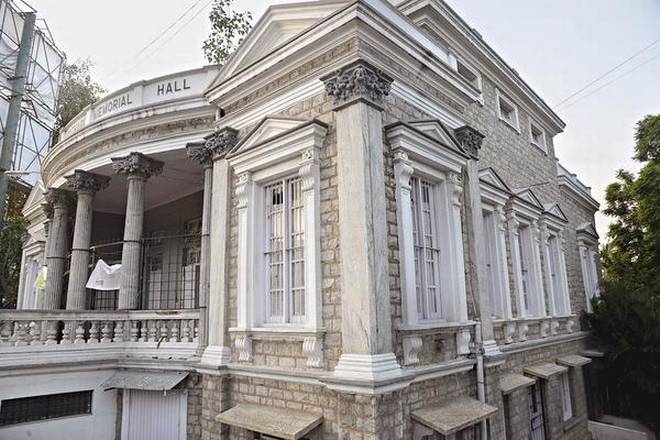
Most of us have crossed the Indian Express Circle umpteen times and hardly notice the surroundings as we are always in a rush. At times, when you are waiting your turn at the chaotic traffic signal, your eyes may catch a glimpse of an old structure with The Lady Jehangir Kothari Memorial Hall written in bold black letters.
The building is usually locked and sometimes is hidden from view with ugly hoardings or banners screaming out various sales that are conducted in the complex, almost robbing the building off its beauty. Be it books or saris, umpteen exhibitions and sales are conducted here. It is only when you venture into the complex, that you notice the beautiful architecture.
It has a small veranda with tall pillars at the entrance. Once inside, in spite of the huge stacks or rows of products put up for sale, you will see the pretty white interiors. It has a high ceiling with large open windows all around. It also has a tiny room inside and little platform in the main wing. The building is predominantly white – right from the walls, windows, doors and even the pillars – all of which have turned a pale grey over the years due to pollution and dust.
The building, initially, was built by Sir Jehangir in memory of his wife, Lady Goolbai Kothari. According to Parsi history, Jehangir was a globetrotter and came to Bengaluru with his wife who is believed to have fallen ill and died here.
Sir Jehangir built the place not just as a memorial for his late wife, but also as a place where Parsis could get together for parties and also celebrate their events and functions.
It is believed to have been built with a donation of ₹25,000 and started functioning in 1932.
Normally, the hall is given out for parties and events for the Parsi community. But, as the place “does not provide the proper facilities for such grandeur, most Parsis prefer conducting their weddings and functions outside,” says a representative.
“It was started as a Parsi club, initially. And, now is also open to outsiders for fairs. Some Parsi families also celebrate Navroz and Pateti here,” he adds.
So, the next time, you walk into The Lady Jehangir Kothari Hall, remember that you are walking into a slice of Parsi history.
Where we discover hidden and not so hidden nooks and crannies of the city.
source: http://www.thehindu.com / The Hindu / Home> News> Cities> Bengaluru / by Shilpa Sebastian / February 06th, 2018