Personal diaries have always been around. Confidential and distinctive, personal diaries capture some memorable moments, in the life of an individual. However, VP Manohar. a passionate hoarder of machines of all ages, has a list of cars written down in his diary!
It all started when he was a kid. Manohar would write down the names of the cars that he liked and the ones he saw on the roads. Not only did he know the names of the best cars that roared on the streets of old Bangalore, but would also write down the information about the owners of these cars. “I always dreamt of owning the best cars,” says Manohar, currently the managing partner of Southam and Company. He says, “I remember that my father owned just one car. I made sure I washed it regularly.” However, it was in 1967 that Manohar was gifted his first car — the Triumph Herald. He later owned a few more beauties, including a Ford and a Contessa, after which his love shifted to vintage and classic machines.His first classic car was a 1966 Mercedes Benz, a royal blue queen, which ruled the automobile markets for eleven years. “These cars are called classic for the obvious reasons. They were strong and weighed over two tons,” he explains. The second entrant into his collection was the very stylish 1984 Jaguar XJ6 Sovereign. A rare car with twin fuel tanks, it has the glass headlight cover, which is not to be seen in the present-day models.“The old models of Jaguar are better built than the newer ones. This car has twin fuel tank with a button that can switch from one tank to the other. The 1984 model is premium when compared to the recent models,” he opines. After the ‘panthera’ beauty came the beastly wagon — 1946 Chevrolet Fleetmaster. A synonym for luxury, it has a fastback styling, comfortable upholstery and white-walled tyres. A roar of the car is enough to know its majesty. “I have the original keys for this car. I have the bill from 1946 with me too,” he quips.
A love for these classic beauties has turned his house into a workshop of sorts. “The Benz was in a pretty good condition. But the other two needed complete restoration. I would never leave my cars at the workshop. Instead, I would get the mechanics home and my house was altered into a workshop,” he informs.
His Mercedes Benz has driven one lakh miles. He says, “The Germans built this machine ahead of technology and hence it has remained intact, without any rust or wear and tear.” While most of the parts of Jaguar were imported from the US, the Chevy’s parts were available in the country. “I even have the original petrol cap for my Chevy,” he says.
A member of Karnataka Vintage and Classic Car Club, he takes out his cars every Sunday and says he likes the attention he gets while driving these old cars. He has been a part of rallies for many years now. Drawing a parallel to the rallies of the old times, he says, “The rallies of the olden times were tougher. Now it is just a 600 to 800 km rally. But I have taken part in 2,000 km rallies and one had to be a strong driver to take part in them.”
It is his passion that has brought him thus far and inspired him to learn a great deal about cars, from assembling to reassembling. He concludes saying, “I want to own a vintage Rolls Royce in future.”
source: http://www.deccanherald.com / Deccan Herald / Home> Supplements> MetroLife / by Pragna GR – DHNS / June 16th, 2015
Musicians will be jamming it out in various venues around the city on June 20 and June 21 to celebrate the International Music Day.
Since its inception in France in the year 1982, The Fête de la Musique has ramified into other countries. The Fête de la Musique was hosted in 700 cities in over 100 countries not including the country of origin in 2014. In India, Bengaluru, Chennai, Delhi, Kolkata, Pune and Puducherry organize the event on a very large scale. In accordance with each country’s cultural specificities, The Fête de la Musique – International Music Day is celebrated on June 21 around the world. Bengaluru’s first Fête de la Musique took place in 1984 in collaboration with the Bangalore School of Music.
The Fête is free to all and open for all to participate across genres. This year, some venues have chosen to represent certain genres. For example: Church Street Social is going all out to celebrate Electronica and Toit Brewpub has Acoustic Rock acts, whereas SAIACS CEO Centre is focusing on Jazz and Bangalore School of Music is more focussed on Western Classical. This is also the year where a lot of professional acts will be sharing the stage with amateurs – Galeej Gurus, Perfect Strangers, Peepal Tree, to name a few.
Another noteworthy performance to lookout for from a group of young girls from The Baale Mane Trust who will be the first ever female troupe to play the Dollu Kunitha, a Kannada percussion always played by men.
In most of Europe, public spaces host the Fête de la Musique. People step out at cross roads, footpaths, city squares for one big jam session. In Bengaluru, such an idea may not work given our unpredictable weather. This year though, BMRCL official U V Vasanth Rao himself opened up the Rangoli Metro Art Centre (Rangasthala and Hoovina Haadi) as well as select Metro stations for the event. Venues include the Bangalore School of Music, The Humming Tree, Octavium, Big Pitcher, Toit, Church Street Social, SAIACS CEO Centre, Goobe’s Book Republic, Guruskool, The Warehouse, Blistering Barnacles and Alliance de Française.
source: http://www.timesofindia.indiatimes.com / The Times of India / Home> Cities> Bengaluru / by Shalini Raman / June 16th, 2015
It’s not just your pet dog that will need a licence. That cow grazing on the footpath or the buffalo which suddenly parks itself in the middle of the road need one too.
Owners of all domestic animals will henceforth have to get a licence if they want to keep them, and also ensure they are not left to stray on roads and other public places. A dedicated hygienic enclosure is part of the rules under the licensing system.
Exasperated with cows, buffaloes and other animals straying on the roads and blocking up traffic, the BBMP has submitted a proposal to the urban development department seeking its approval for extension of norms to all kinds of pets and domestic animals, including pigs, donkeys, horses etc. Currently, the licence ambit covers only pet dogs, and there is no compulsion as such.
Dr KA Nanjappa, deputy director (animal husbandry), BBMP, told TOI they have provision to impose a penalty on owners of cows and other domestic animals who let their animals out on the streets, as finding the owners has become a challenge. “If the licence is made compulsory, we can give unique numbers to these animals so the owners can be identified,” he added. From 2011 to 2015, as many as 4,730 domestic animals were caught straying on the roads by BBMP officials and a total of Rs 3,35,173 was collected in penalty from the owners.
source: http://www.timesofindia.indiatimes.com / The Times of India / Home> City> Bangalore / TNN / June 16th, 2015
Nearly eight months after the launch of its ambitious solar rooftop project, the Bangalore Electricity Supply Company (Bescom) finally reached a milestone by generating 1,000 kW (1 MW ) of solar power.
Getting off to a slow start, the power utility now has 409 applications registered with an overall proposed solar generating capacity of 19 MW.
Among the major contributors to Bescom’s solar generating capacity are: the Karnataka State Cricket Association, which has installed a 400 kW rooftop solar power plant at M. Chinnaswamy Stadium, St. Joseph’s College and National Institute of Advanced Sciences (100 Kwp each).
A Bescom release said that process and technical committees have been formed to encourage solar rooftop power distribution generation.
A solar help desk has also been constituted (080-22340816 andsolarhelpdesk@bescom.co.in) for those interested in installing solar rooftop plants.
source: http://www.thehindu.com / The Hindu / Home> News> Cities> Bengaluru / by Staff Reporter / Bengaluru – June 16th, 2015
A British-era tower clock here will be silenced forever to enable widening of a road.
Looking to widen Kalmath Road to 45 feet under its master plan, the Belagavi City Corporation has instructed authorities of the Pioneer Urban Cooperative Bank to raze the %part of the building where the tower clock stands. The bank authorities have secured a week’s time to do so.
The clock on the bank’s building on Kalmath Road sounds its bell every half an hour. Residents of surrounding areas, like %Kalmath Road, Ganapati Galli and Maruti Galli, have an emotional attachment with it. The clock helps some manage their schedules.
The building was constructed 110 years ago. In 1939, the bank management awarded the contract to manufacture the clock to Mumbai’s Swadeshi Electric Clock Company. A large bell from John Tailor Company was fitted into the clock 75 years ago.
The bank has employed a person to wind the clock once a week, and to maintain the tower.
Speaking to STOI, bank manager D R Jadhav lamented that the antique will soon become part of history.
In 1940, the management spent around Rs 40,000 on constructing the bank building. Now, the bank pays a like amount %as property tax, the manager said.
source: http://www.timesofindia.indiatimes.com / The Times of India / Home> City> Bengaluru / by Ravindra Uppar, TNN / June 14th, 2015
There’s a new kind of shopping fad catching the fancy of Bengaluru’s fashionable set and it doesn’t have to do with sucking up tummies to fit into that impossibly small crop top or pre-ordering the next season’s collection of their favourite brand. If anything, youngsters in the city are air-kissing their approvals to the concept of clothes swapping – a trend that reportedly started in the US in the 90s and has been gaining popularity ever since recession hit the world economy in the noughties and people woke up to the burden of an overflowing wardrobe and its attendant credit card woes.
Clothes swapping, or ‘swishing’ as the movement is referred to as, involves a get-together where guests exchange their unused clothes and or accessories between themselves and the exchange is almost always done for free or for a major discount.Environment-friendly collaborative consumption that is also… no wonder the concept has the world’s shopaholics in thrall.
Last Saturday, Bengaluru’s shopaholics got a taste of this with Clothary, the brainchild of Isabella Escobedo. “Clothary is an attempt at making fashion sustainable and affordable by breaking away from conventional patterns of the retail industry. With one eye on conscious consumption and the other on the latest trends, Clothary wants to be a walk-in wardrobe, a clothes library where sharing is the new possessing and renting the new purchasing,” reads the initiative’s Facebook page. Talking about the event and how it was received by Bengalureans, Escobedo says, “The event was very successful and while around a 100 had accepted our Facebook invite, about 65 people – mostly youngsters – turned up. And by the response, the participants were happy with the exchange.There were people who’d come to access fashion for free, some came to declutter their wardrobes, and some came because they thought it was a sustainable idea that contributed to a better environment.”
The Exchange Room is another city-based initiative that was started by four friends who “always had wardrobes full of clothes but never had anything ‘new’ to wear.” “It was from this dilemma that we hit upon the idea of exchanging clothes amongst ourselves rather than go on shopping sprees,” says Sai Sangeet, one of the co-founders. “But from a project that started between four close friends, the idea gained traction among our wider circle of friends; we’ve got a Facebook page and even conducted two events that were successful. Though we focus mainly on clothes exchange, we also give away clothes for low prices when some people do not have anything to offer in exchange.”
The Street Store Bangalore sets its model on the South Africa-based ‘open-source’ movement, The Street Store. Explains founder Samridhi Agarwal, “The Street Store is a worldwide movement that first started in South Africa. It’s basically a nonprofit drive where we tie up with various NGOs to set up a store in a public place and provide an amazing shopping experience to the needy.” But that’s not all. “Taking a leaf out of the clothes swap idea, we’ve recently started an exchange forum for women called Revamp My Closet where we buy used clothes from people that we personally pick from their homes.Customers can then either accept cash or shop at our store where we sell clothes at highly discounted rates,” Agarwal informs.
Finally, giving a spin to the concept of barter trading is AdalBdal (pronounced A-Dal-B-Dal). Explains founder Bal Krishn Birla, “We started AdalBdal over a year ago to kickstart the trend of moneyless transactions and renewing the system of barter. We function in two ways – one is through our online portal where people can upload pictures of things they want to give away and choose what they want in return. The second are the numerous donation drives we organize in apartments where we give away whatever is collected to the needy. “To impress upon kids the credo of sharing-is-caring, AdalBdal “has also partnered with the Freethinking School for their event Freeswap Summer Camp Barter Weekend Program, to introduce kids to the system of exchange without letting money come into the equation. We bring up the issue of money all the time in front of kids today. This initiative is a way to teach them that there is joy in giving and receiving something with no monetary consideration involved.”
source: http://www.timesofindia.indiatimes.com / The Times of India / Home> City> Bengaluru / by Mahalakshmi P, TNN / June 14th, 2015
The State government on Thursday launched a central remote-sensing centre that brings all remote-sensing data activity under one roof – different from the three centres that were handling the work previously.
Former chairman of Isro, K Kasturirangan, and ST, BT & IT Minister, S R Patil, inaugurated the centre – billed as the first of its kind – on Major Sandeep Unnikrishnan Road in Yelahanka.
Kasturirangan, a former member of the Planning Commission, said the centralised office would help people and institutions approach a single centre instead of three previously. All the remote-sensing data collected from Isro’s satellites would be processed here, making satellite data available at one location.
Karnataka was one among the first states in the country to use GIS-Data and remote-sensing data in planning. The technologies have been used in agriculture, farming, forestry and rural and urban development. The new centre which consolidates all technologies and data under one roof makes planning easier across sectors.
Minister Patil said Bengaluru and Karnataka were still ahead of all the cities and states in information technology. By 2020, Karnataka will have reached four lakh crore worth of IT exports. The government, he said, was ready to take measures to consolidate this lead and continue to be the number one IT destination in the country.
source: http://www.deccanherald.com / Deccan Herald / Home> State / DHNS – Bengaluru, June 12th, 2015
As the early-morning sun soaks the Ulsoor lake, dreamy-eyed youngsters — some sleepy, some chirpy — troop into Trishna Club in a far corner of the lake. Soon, the stillness of the lake is tattooed with the rhythmic paddling of oars. For the next couple of hours, rowers go about their routes, shouting ‘down’ and ‘bravo’.
The sport long dominated by defence personnel has new takers: civilians. A reflection of this trend is in evidence at the ongoing 18th sub-junior rowing national championships at the MEG & Centre here.
Of the 23 members in the Karnataka squad, 15 are from the civilian background.
Karnataka Amateur Rowing Association secretary G Somasekharappa says: “We usually had sportspersons from Army schools. Now, we’ve many kids from elite schools. More heartening is parents’ involvement in their children’s progress as also in improvising the sport.”
Asked about his rowing ambitions, Frank Anthony Public School’s Eeshan Krishnan says: “I’m a keen swimmer and I like watersports. One of my father’s friends suggested I try the sport. Then I started rowing, and I thoroughly enjoyed it. I was a little plump; this helped me lose the flab. My shoulders hurt initially, but then there is no gain without pain.”
Eeshan’s mother Hema, a special educator, says rowing has made her 11-year-old son responsible and passionate about the sport. “He needs no alarm and is up at 5am to go to practice. His days are long, but he doesn’t complain. There was a time when I asked him to concentrate on studies because we weren’t sure about his future in rowing. But he was very clear: he wanted to take up the sport seriously and would balance studies and sport.”
Watching other rowers in action has inspired many, like Palak Agarwal, a student of Vidya Shilp Academy. Ditto with G Annapurna, 17, who took up the sport a year ago and is participating in the Challenger Sprint category. The second-year PU student from Narayana College swapped the athletics track with the water sport after watching her brother Tarun, 14, in action.
“I was an athlete for nine years and participated regularly in high jump. But I wasn’t tall enough to take my passion forward. I often watched my brother at practice and that’s when I thought I should also try. Once in the water, I was hooked to the sport. Since I was an athlete, the strenuous routine wasn’t difficult to embrace.”
From an individual sport to participating in team events like double scull or coxed fours, Annapurna says adjustment and understanding of the teammates is the key.
“Initially, it was difficult for me. But it’s a great way to build team spirit because you learn to sync with teammates both physically and mentally. The race plan tells us the course of our action in water. Since we’ve little time to communicate during the race, we depend on the rapport we share.”
Many parents feel the state association must proactively promote the sport.
source: http://www.timesofindia.indiatimes.com / The Times of India / Home> City> Bengaluru / by Manuja Veerappa, TNN / June 13th, 2015
Hundreds take part in day-long event including seminar, cultural programme and Kavi Goshti
Kusuma J. Shenoy, President, GSB Mahila Mandali-Mysuru, is seen lighting the lamp to inaugurate the Konkani Women’s meet at Jaganmohan Palace auditorium in city this morning as Joyce Lobo (extreme right), Principal, St. Joseph’s Central School, Vijayanagar; Roy Castelino, Chairman, Karnataka Konkani Sahitya Academy; M. Jagannath Shenoy, President, GSB Sabha-Mysuru and others look on.
Mysuru :
Over 500 Konkani women are participating in the first Konkani Mahila Samavesh organised jointly by Gowda Saraswath Brahmin (GSB) Sangha, Mysuru and Karnataka Konkani Sahitya Academy (KKSA) in association with Konkani Christian Association (KCA), Mysuru at Jaganmohan Palace here this morning.
Inaugurating the programme, GSB Mahila Mandali, Mysuru President Kusuma J. Shenoy was overwhelmed by the huge congregation of Konkani women for the first such meet in city and thanked the co-operation of members of all Konkani Associations in organising the event.
Addressing the gathering, KKSA member and Programme Co-ordinator Mamata Manjunath Kamath asked the women to be united and spread the richness of Konkani language.
Earlier to the stage programme, a procession was taken out by Konkani women from Maharani’s PU College through Krishna Vilas Road to the programme venue. The star attraction of the procession was the tableaux depicting the Konkani tradition and culture.
GSB Mahila Mandali Founder-President Mohini D. Pai was the chief guest.
Konkani Bhasha Mandali, Mangalore President Geetha C. Kini; St. Joseph’s Central School, Mysuru Principal Joyce Lobo; Sugama Sangeetha artiste Anuradha Dhareshwar; Balodayana Higher Primary School, Mysuru Head Mistress Meera Nagesh; Government Higher Primary School, Jyotinagar Head Mistress S.H. Pushpaveni; GSB Sabha Mysuru President M. Jagannath Shenoy; KKSA Chairman Roy Castelino and others were present on the occasion.
The day-long event includes cultural programmes, seminar, comedy play ‘Yeya Hasya’ and Kavi Goshti.
Minister for Kannada and Culture Umashree will be the chief guest at the valedictory ceremony this evening. On the occasion, Konkani Sthree Vibhushani awards will be presented to distinguished achievers in various fields.
source: http://www.starofmysore.com / Star of Mysore / Home> General News / Sunday – June 07th, 2015
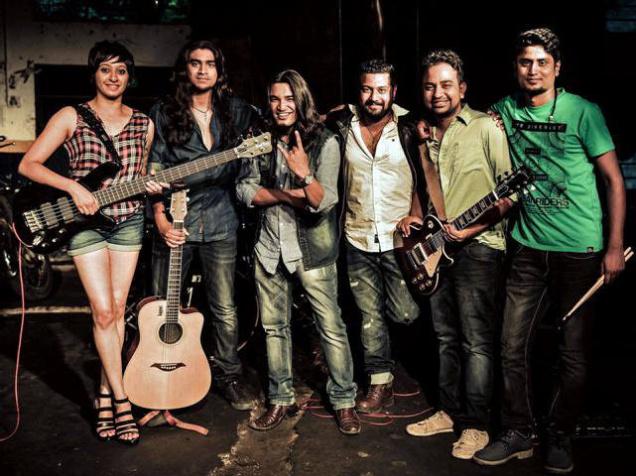
Bengaluru folk rock band Lagori share their thoughts on a one-of-its-kind music venture tying up with international DJ trio Above And Beyond
Music lovers across genres in the city were in for the ride of a lifetime as Bengaluru folk rock band Lagori launched a brand new track in collaboration with Girish Pradhan from hard rock/heavy metal band Girish And The Chronicles on June 12. What makes this collaboration actually epic is that the track and its accompanying music video is a remixed cover of English progressive trance group Above And Beyond’s title track from their latest album We Are All We Need.
Invited by the DJ trio themselves to work on the track, Lagori’s version of ‘We Are All We Need’ is a non-EDM take on it, which, the much impressed Above and Beyond are launching on their YouTube channel, simultaneous to its official release in India.
Comprising vocalist Tejas Shankar, electric/acoustic guitarist Geeth Vaz, acoustic guitarist Edward Rasquinha, bass guitarist Shalini Mohan and percussionist/drummer Vinyl Kumar, Lagori teams up with one of the rising stars in the indie scene – Girish — for the music video that blends a range of Indian elements and rock to its unique soundscape. Tejas says they are excited “in capital letters!” What got Above and Beyond’s attention on Lagori was an earlier cover of their song ‘Sun And Moon’, explains Edward. “We were approached by their label Anjunabeats to do a cover for the title track of We Are All We Need and when we heard it the first time, we knew that it’s going to be an amazing venture.”
Tejas elaborates: “We could relate to this track a lot since it’s about travelling and exploring ourselves. We all love that though we do get bored of touring and each other sometimes,” he jokes. “The song is all about hitting the road and the journey. We thought we could write a nice Hindi version of it and rope in a kick-ass western singer for the English bit.”
Shalini adds: “We retained the original feel of the song so Above & Beyond fans connect while we’ve added a bit of Lagori to it. It’s a nice mashup of Hindi and English where Girish comes in.”
They admit that Girish was the best thing that happened for the track. Tejas emphasises: “We couldn’t have found a better singer. He was our first choice. He came in and nailed it in one take.” Vinyl adds that though it is a non-EDM track going to Above and Beyond fans, it is different and appealing. “When we did ‘Sun And Moon’, we shot the video in City Market among cows and vegetable vendors. It was a massive hit.” Tejas pitches in: “That gave us the confidence that it doesn’t matter if the audience is an EDM listener base or not. At the end of the day if you can relate to the music, it’s good enough.” Shalini sums up: “It’s just our way of saying that if we can relate to EDM by covering their song, the other way round is also possible.”
Shalini points out that they are quite kicked about the video they shot for the track. “We look quite cool in it,” she beams. Tejas explains: “It’s got the whole road feel.”
Edward elaborates: “We shot the video in a garage that services bullets and other bikes. We ride in on our bikes in the biker outfits for the video.” Shalini adds that the first shot is that of a regal-looking sitar player in the midst of all the rugged bikes since the intro of the song has a sitar piece.
Tejas says they have added a whole repertoire of elements in the song – from Indian to dirty garage to even a scene on a railway track. “It’s a neat mishmash of everything.”
“The only challenge in making the video was getting Girish and Edward to ride the bikes,” Shalini laughs. “They have this whole biker appearance but they didn’t know how to ride the bikes.” Edward joins in and says: “We had a lot of cool ideas and some of them turned out to be funny like this one.”
Tejas adds that having co-written the Hindi lyrics for the track with composer Abdul, giving the completely EDM track an Indian feel and taking the challenge up made it a fun process.
What’s the take away for listeners and viewers in ‘We Are What We Need’? Shalini one lines it: “Girish’s vocals and Lagori, of course.” Tejas adds: “And the fact that an Indian band has done something cool like this. This proves that Indian music can blend with a range of other genres.”
The video is available on YouTube and was aired on Pepsi MTV Indies.
source: http://www.thehindu.com / The Hindu / Home> Features> MetroPlus / by Allan Moses Rodricks / June 12th, 2015